

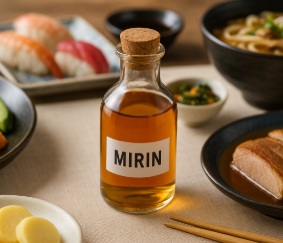
Mirin
Rating : 7
| Evaluation | N. Experts | Evaluation | N. Experts |
|---|---|---|---|
| 1 | 6 | ||
| 2 | 7 | ||
| 3 | 8 | ||
| 4 | 9 | ||
| 5 | 10 |
0 pts from Al222
| Sign up to vote this object, vote his reviews and to contribute to Tiiips.Evaluate | Where is this found? |
| "Descrizione" about Mirin by Al222 (23259 pt) | 2025-Nov-17 12:19 |
| Read the full Tiiip | (Send your comment) |
Mirin
(sweet fermented rice seasoning – Japanese sweet rice wine)
Description
Mirin is a sweet, slightly alcoholic liquid seasoning obtained by fermenting glutinous rice, koji (Aspergillus oryzae) and alcohol (typically shochu or neutral alcohol), traditionally used in Japanese cuisine.
Hon-mirin (traditional mirin) usually contains around 12–14% alcohol and a high content of natural sugars generated by starch saccharification.
There are variants such as mirin-fu chomiryo and “cooking mirin”, with lower alcohol and often added salt, developed for tax reasons or for cooking-only purposes.
It is used as a seasoning and functional ingredient to provide sweetness, gloss (glaze), aromatic depth and rounded umami to sauces, marinades, grilled and braised dishes.

Indicative nutritional values (per 100 g traditional mirin)
(Average indicative values for hon-mirin; “seasoning mirin” with added salt or sugars may differ significantly.)
Energy: ≈ 220–260 kcal
Water: ≈ 55–65 g
Protein: < 1 g
Total fat: ≈ 0 g
first occurrence: SFA/MUFA/PUFA = saturated / monounsaturated / polyunsaturated fatty acids; in mirin the fat content is negligible, so this distribution has no practical nutritional relevance.
Total carbohydrates: ≈ 35–45 g
of which sugars (mainly glucose, maltose): ≈ 30–40 g
Fibre: 0 g
Ethyl alcohol: ≈ 12–14 g
Sodium:
hon-mirin: very low (a few mg/100 g)
mirin-fu / seasonings: may be much higher (up to hundreds of mg/100 g) if salt is added
Minerals and vitamins: traces of minerals (e.g. potassium) and B vitamins from rice/koji; mirin is not a significant source of micronutrients.
Key constituents
Simple sugars
mainly glucose, maltose and other sugars derived from enzymatic saccharification of rice starch by koji;
responsible for sweet taste, viscosity and a certain caramelisation capacity during cooking.
Ethyl alcohol
present at relatively high levels in hon-mirin (≈ 12–14%);
part of the alcohol evaporates during cooking, but is not necessarily completely eliminated, especially in short or low-temperature cooking.
Organic acids and aromatic compounds
acids (e.g. lactic and succinic acid in traces), esters, aldehydes and other fermentation-derived molecules that contribute to the complex aroma profile and rounded umami mouthfeel.
Rice and koji components
residues of starch/partial dextrins, small amounts of free amino acids (including glutamate) and peptides;
traces of B vitamins and minerals originating from the substrate.
Lipids
practically absent; any traces are nutritionally irrelevant.
Production process
(Scheme referring to traditional hon-mirin; industrial variants may use simplified procedures or added ingredients.)
Rice preparation
selection of glutinous rice, washing and soaking;
steaming to gelatinise the starch and make it accessible to enzymes.
Koji preparation
rice (or sometimes another cereal) is inoculated with spores of Aspergillus oryzae;
incubation in a controlled environment (temperature, humidity, aeration) until a rich mycelium with high enzymatic activity (amylases, proteases, etc.) develops.
Mixing and fermentation
cooked rice, koji and alcohol (shochu or neutral alcohol) are mixed;
fermentation/maturation in tanks for months, under controlled conditions, during which koji enzymes break down rice starch into sugars, while yeasts/bacteria transform part of the substrates into alcohol and aroma compounds.
Pressing and clarification
the fermented mash is pressed/filtered to separate the liquid fraction (mirin) from the solids;
further clarification may be performed by additional filtration.
Maturation and possible heat treatment
mirin may undergo additional maturation to harmonise flavours;
it is often pasteurised for microbiological stability and to inactivate residual enzymes.
Packaging
bottling in inert containers (glass, food-grade plastic) protected from light and oxygen, with hermetic closure.
Physical properties
Appearance: clear liquid, pale straw-yellow to light amber in colour, more or less intense depending on raw materials and maturation.
Viscosity: moderate, thicker than water but more fluid than a concentrated sugar syrup.
Density: consistent with a sugary/alcoholic liquid (depends on sugar/alcohol content).
pH: slightly acidic (about 4.5–5.5).
Boiling point: higher than that of water due to sugar and alcohol content.
Sensory and technological properties
Sensory profile
distinctly sweet taste, but more “rounded” and complex than simple sugar;
light alcoholic note and fermentation aromas reminiscent of sweet sake, ripe fruit, cooked rice;
contributes to perceived umami in combination with soy sauce, broths, dashi and other ingredients.
Technological functionalities
sweetener with aromatic component: provides not only sweetness but also a characteristic flavour profile;
texture and gloss improver: sugars help create a glaze on meats and fish (yakitori, teriyaki), aiding the formation of shiny, lightly caramelised surfaces;
odour modulator/masking agent: softens strong fish or meat odours, harmonising the overall aroma profile;
limited preservation contribution: sugars and alcohol have a mild antimicrobial effect, especially when combined with salt and cooking.
Food applications
Home cooking and foodservice
base for teriyaki sauces together with soy sauce and sugar/honey;
ingredient in marinades for meat, fish, tofu and vegetables (tenderises and enhances flavour);
used in soups and nimono (simmered dishes) to give sweetness and roundness;
in glazes and coatings for grilled/oven dishes (yakitori, glazed fish);
in creative Western-style cooking as a partial replacement/addition to cooking wine and sugars in reductions and sauces.
Food industry
component in ready-made sauces, marinades, seasonings for ready meals, dressings and ethnic products;
used in chilled/frozen ready meals inspired by Japanese cuisine (bento, wok dishes, noodles, main courses);
added to snacks, ready dishes and sauces to contribute a characteristic sweet-fermented note.
Nutrition & health
From a nutritional standpoint, mirin is primarily a source of simple sugars and alcohol:
it provides rapidly available energy but contributes very little fibre, protein or micronutrients.
The caloric intake per serving is modest because typical culinary quantities are small (tablespoons), but:
over the whole diet, frequent or abundant use contributes to the overall load of added sugars;
alcohol, even if partially evaporated during cooking, may remain in the finished dish, especially in short reductions and when mirin is used without intense cooking.
For people who need to limit simple sugars (e.g. diabetes, metabolic syndrome) or alcohol intake, mirin should be considered in the daily total.
The almost negligible fat content makes its contribution to SFA/MUFA/PUFA irrelevant; cardiovascular effects depend more on the overall diet context than on mirin itself.
Portion note:
In home cooking: typically 5–15 ml per serving portion (≈ 1–3 tablespoons per recipe), often diluted into sauces and broths.
In industrial products: the mirin content is generally low (a few % of the product), but it still contributes to sugar profile and, in not fully cooked items, to residual alcohol.
Allergens and intolerances
Mirin is normally produced from glutinous rice, koji and alcohol:
in principle it is gluten-free, as long as no gluten-containing cereals are used as raw materials or processing aids;
some industrial products may use alcohol or enzymes derived from wheat or be processed in facilities handling other cereals: possible gluten cross-contamination.
The fungus Aspergillus oryzae is considered safe for food use; any direct allergenicity is rare and mainly associated with occupational exposure (spore inhalation).
The main factor to consider is alcohol:
mirin is not suitable for young children, pregnant/breastfeeding women and people who must avoid alcohol completely (medical, religious, addiction reasons).
People with rice allergy or sensitivities to specific process components (e.g. soy, if used elsewhere in the facility) should check the label or ask the manufacturer for confirmation.
Quality & specification (typical topics)
Chemical–physical parameters
sugar content (°Brix), total sugars;
alcohol content, crucial for taxation and labelling;
pH, titratable acidity;
colour (standard scale) and clarity.
Sensory parameters
flavour profile: harmonious sweet/fermentative notes, absence of oxidised, moldy or solvent-like off-notes;
balance between sweetness, alcoholic note and umami “body”.
Microbiological aspects
products are typically stable due to alcohol, sugar and often pasteurisation;
control for spoilage yeasts and bacteria in non-pasteurised or low-alcohol products.
Contaminants
compliance with limits for heavy metals, pesticides (on rice) and fermentation by-products;
any solvent residues and additives in line with legislation.
Storage & shelf-life
Unopened product
store in a cool, dry place protected from light;
the alcohol level, sugar content and pasteurisation ensure good stability: shelf-life often 12–24 months or more, depending on the producer.
Opened product
close the container tightly;
preferably store in a cool place, sometimes refrigerated if indicated on the label;
over time, aroma intensity may decrease and slight oxidation may occur; ideally use within a few months of opening.
Safety & regulatory
Mirin is regulated as a fermented beverage/seasoning with alcohol content.
There are differences between countries in tax classification (wine, spirit, seasoning):
in Japan, there are specific categories for hon-mirin and mirin-like seasonings created to minimise alcohol tax;
in other jurisdictions there may be specific limits for alcohol in culinary products sold as seasonings.
Facilities must operate under GMP/HACCP (good manufacturing practices / hazard analysis and critical control points), with attention to:
quality of rice and koji (absence of toxigenic molds),
control of fermentation and maturation,
pasteurisation parameters (where used),
prevention of contamination and oxidative defects.
Labelling
Usual product name: “mirin”, with specifications such as “hon-mirin” (traditional mirin) or terms like “mirin-style seasoning” for low-alcohol or salted condiments.
Labels must state:
full ingredient list (e.g. rice, alcohol, koji, water, added salt and sugar if used);
alcohol by volume where required by law;
nutritional information (energy, sugars, etc.);
best-before/expiry date, lot number, storage instructions;
any allergen declarations (e.g. cereals containing gluten from cross-contact or wheat-derived alcohol, soy, etc.).
Troubleshooting
Oxidised or solvent-like odours, overly “cooked” flavour
Cause: oxidation due to exposure to light/oxygen or excessive temperature.
Action: improve packaging, reduce exposure to heat/light, tighten storage time control.
Unusual sediments or turbidity
Cause: colloidal instability, re-fermentation, precipitation of components.
Action: verify filtration, microbiological stability, pasteurisation parameters; assess safety/quality risk.
Sweetness or alcohol content out of specification
Cause: variability in fermentation, incorrect dosing of raw materials or concentration steps.
Action: recalibrate recipe and fermentation conditions, strengthen in-line analytical controls.
Loss of aroma over time
Cause: volatilisation and oxidation of aroma compounds.
Action: optimise closure systems, use low-permeability containers, reduce pre-sale storage time.
Sustainability & supply chain
The environmental impact of mirin is linked to:
rice cultivation (water use, fertilisers, plant-protection products);
energy consumption for steaming, controlled fermentation, pasteurisation;
management of high-organic-load effluents (rice washing waters, fermentation residues).
Plants must properly treat process water, often characterised by high BOD/COD (biochemical oxygen demand / chemical oxygen demand), using appropriate purification systems and, where possible, energy recovery.
Using rice from sustainable or organic supply chains and valorising solid residues (fermented rice solids) as feed, compost or secondary ingredients can improve the overall sustainability profile.
Main INCI functions (cosmetics)
There is no specific traditional cosmetic use of “mirin” as such, but rice fermentation filtrates (e.g. sake-related ingredients) may appear in cosmetics under names such as Rice Ferment Filtrate or similar, inspired by similar fermentation techniques.
In this context they act as:
skin-conditioning and light moisturising agents,
carriers of amino acids, peptides and organic acids with potential effects on skin texture and radiance.
These ingredients are regulated under cosmetic law, with microbiological and safety requirements different from food regulations.
Conclusion
Mirin is a key fermented seasoning in Japanese cuisine, combining sweetness, alcohol and complex fermentation aromas in a versatile liquid. Technologically, it enhances flavour, gloss, body and perceived umami in many dishes and sauces, in both domestic and industrial settings. Nutritionally it is mainly a source of sugars and alcohol, so it should be used in moderation in the context of overall sugar and alcohol intake. When produced under robust GMP/HACCP, with safe raw materials and appropriate storage and supply-chain management, mirin can be used as a distinctive and reliable ingredient in traditional recipes and modern applications, ensuring safety and consistent quality.
Mini-glossary
SFA/MUFA/PUFA – saturated / monounsaturated / polyunsaturated fatty acids; in mirin, fat content is practically zero, so its contribution to dietary fat balance is negligible.
GMP/HACCP – good manufacturing practices / hazard analysis and critical control points: organisational and technical systems that define good production practices and critical control points to ensure safety, hygiene and traceability for mirin and other fermented products.
BOD/COD – biochemical oxygen demand / chemical oxygen demand: indicators of organic and oxidisable load in wastewater from washing, cooking and fermentation; high values require suitable treatment plants to limit environmental impact.
References__________________________________________________________________________
Ono, M., & Mouritsen, O. G. (2025). Japanese Cooking Practices for Umamification. In Traditional Japanese Seasonings and Condiments: Umamification in the Plant-forward Cuisine (pp. 121-129). Cham: Springer Nature Switzerland.
Abstract. Several general and authoritative Japanese cooking books exist in English, most prominently the classic Japanese Cooking: A Simple Art by Shizuo Tsuji (1980), the modern tomes Washohu and Kansha by Elisabeth Andoh (2005, 2010), and Japan: The Cookbook by Nancy Singleton Hachisu (2018). Although the concept of umami tacitly underlies the cooking techniques, recipes, and dishes in these and other books, the verbalisation of the concept and a dedicated use of the scientific underpinnings of umami and umami synergy, not to mention koku sensation, do not transpire these books. The Japanese Culinary Academy (2015, 2016) has published two major books in which umami and dashi assume a key role, and the same is true of the volume Dashi and Umami: The Heart of Japanese Cuisine (Blumenthal et al., 2009). Recently an unusual book has appeared on Japanese food culture which gives an interwoven exposition of culture, language, literature, and mealtime customs, in addition to culinary practices, recipes, and aesthetics (Brown, 2021).
Kaneko S, Kumazawa K. Aroma compounds in Japanese sweet rice wine (Mirin) screened by aroma extract dilution analysis (AEDA). Biosci Biotechnol Biochem. 2015;79(3):484-7. doi: 10.1080/09168451.2014.980218.
Abstract. Thirty-nine key aroma compounds were newly identified or tentatively identified in the aroma concentrate of Japanese sweet rice wine (Mirin) by an aroma extract dilution analysis technique based on the 68 detected peaks. Among them, 3-(methylthio)propanal, 3-hydroxy-4,5-dimethyl-2(5H)-furanone, 3-methylbutanoic acid, 2-methylbutanoic acid, and 2-methoxy-4-vinylphenol were detected with the highest FD factors in this study.
Oyashiki, H., Uchida, M., Obayashi, A., & Oka, S. (1987). Mirin-making using long-life koji with low water content. Journal of Fermentation Technology, 65(6), 643-649.
Abstract. In an attempt to store koji longer than is now possible at room temperature, we investigated ways in which to dry it. Dried koji with a water activity (Aw) of 0.77 containing 0.11 g of water/g of solid was prepared from fresh koji with an Aw of 0.88 containing 0.39 g of water/g of solid. Drying was found to be more efficient above 50°C. The most suitable conditions were at 55°C under 760 mm Hg of pressure for 5–6 h (Method I) when fresh koji was prepared with crushed rice. This dried koji had 84% or more of the original enzyme activity. Other methods, such as drying at 55°C under 20 mm Hg of pressure for 6 h (Method II), and drying by mixing fresh koji with dried steamed rice powder at 23°C for 24 h (Method III) were also examined. For retaining enzyme activity after drying, Method III was theoretically the best. In practice, however, Method I was found to be efficient and inexpensive. For dried koji made using Method I, the α-amylase and neutral protease activities were 80% and over 90%, respectively, of the baseline values after 6 months of storage at 30°C. The number of bacteria in the dried koji was small, but the number of thermotolerant bacteria was almost unchanged. For mirin manufactured using dried koji which was stored for 4 months, the yield, properties and sensory qualities of the mirin were essentially the same as those obtained using fresh koji.
Oyashiki, H., Uchida, M., Obayashi, A., & Oka, S. (1989). Evaluation of koji prepared with various molds for mirin-making. Journal of Fermentation and Bioengineering, 67(3), 163-168.
Abstract. Koji is one of the raw materials used for mirin-making, and it is traditionally prepared with Aspergillus oryzae. To improve productivity and to be available for a variety of mirin, various koji were prepared with A. niger, A. awamori, A. usamii mut. shiro-usamii, and Rhizopus oligosporus and examined for possible to use in mirin-making. The degrees of digestion of the starch and protein in various koji were at its highest with either koji prepared with A. oryzae at pH 7.0 or with A. usamii mut. shiro-usamii at pH 3.0. The degree of digestion of the protein in koji made with A. usamii mut. shiro-usamii was decreased in koji digestion at higher temperature (at over 50°C) compared to that in koji made with A. oryzae. We examined the ratio of koji to steamed glutinous rice to identify the optimum value for mirin production. The optimum ratios for digestion of starch in the mash with koji of A. oryzae and A. usamii mut. shiro-usamii were 0.10 and 0.15, respectively. These values were in agreement with the 0.10–0.25 established by experience. Therefore, of the five strains tested, A. usamii mut. shiro-usamii, among the tested molds was the most suitable strain for preparing koji in mirin-making without decreasing productivity, while lending new qualities to the mirin. The koji prepared with A. oryzae had a good smell but the koji prepared with A. usamii mut. shiro-usamii had a little mold smell. Then if this little mold smell could be improved, this koji can be used in mirin-making. The koji prepared with A. niger contained the most citric acid of all strains but the digestivities of starch and protein in the koji was less than those of koji prepared with A. oryzae and A. usamii mut. shiro-usamii. The digestivities of starch and protein in koji prepared with A. awamori were the lowest values. In 35% alcohol, its productivities in mirin-making seemed to be low. Because of the highest content of lactic acid, the koji prepared with R. oligosporus seemed to be suitable for mirin-making. Then if its productivity could be improved, this koji can be used in mirin-making.
Werasit Kanlayakrit, and Metinee Maweang. 2006. Production of Seasoning ‘Mirin’ from Thai Rice by Fermentation. Agriculture and Natural Resources 40 (6 (Suppl.). Bangkok, Thailand:39-46.
Abstract. The investigation of the use of Aspergillus oryzae strain and Thai non-glutinous rice varieties, which are suitable for enzyme production for koji preparation was carried out. A. oryzae strain no. WM-2 could produce a-amylase enzyme at the highest level while “Leung 11”, a non-glutinous rice variety was the most suitable for koji preparation because of its unaggregation characteristics which are good for enzyme production (31.71 units/ml of α-amylase and 6.66 units/ml of acid protease). The suitable ratio of solid:liquid content for mirin production was also studied and it was found that the ratio of 60:40 was the most appropriate because it gave rather pale color and suitable residual alcohol concentration (13 % v/v). This ratio was subsequently used for the determination of an appropriate ratio of koji to glutinous rice. The result indicated that the ratio of koji to glutinous rice of 1:7 gave good quality mirin when comparing with the commercial mirin. Based on the scaling-up of koji preparation, it was found that the cultivation time of 36 h gave the highest activities of α–amylase and protease, which are suitable for mirin production. Ten kilograms of rice koji with 1.0 inch bed thickness gave suitable conditions for enzyme production (322.0 units/g dry wt. of a–amylase and 150.82 units/g dry wt. of acid protease). The results from the study were used for pilot-scale mirin production (50 kg). Ninety per cent of the untrained panelists accepted the quality of mirin produced at the above-mentioned conditions.
Inoue, Y., Katsumata, T., Watanabe, H., & Hayase, F. (2016). Mechanisms of D-amino acid formation during maturation of sweet rice wine (mirin). Food Science and Technology Research, 22(5), 679-686.
Abstract. Ripened sweet rice wines (mirins) are stored at room temperature for several years to produce a well-balanced sweet flavor. We performed reverse-phase HPLC quantitative analysis of d-amino acids in eight ripened mirins by using derivatization reagents, and investigated the influence of the Maillard reaction on amino acid racemization in mirin during maturation. The relative quantities of d-enantiomers (%d) of Asp, Glu, and Ser in mirins matured for seven years or more were higher than in non-ripened mirins. Based on the calculated correlation coefficient between %D and the amount of Amadori rearrangement products (ARPs) analyzed by LC-MS in ripened mirins for each amino acid, Asp showed a statistically significant strong correlation. Finally, we conducted heating experiments using synthetic ARPs. Our results revealed for the first time that Asp was racemized via ARPs under the influence of pH during mirin maturation.
Hashizume, K., Ito, T., Shimohashi, M., Ishizuka, T., & Okuda, M. (2013). Ferulic acid and ethyl ferulate in sake: comparison of levels between sake and mirin and analysis of their sensory properties. Food Science and Technology Research, 19(4), 705-709.
Abstract. Ferulic acid (FA) and ethyl ferulate (EF) in sake and mirin samples were quantified. Concentrations of FA and EF in the sake and mirin samples showed high correlations (r = 0.91 and 0.89, respectively). The highest level of EF in the sake samples was ca. 14-fold that of the mirin samples. Thresholds of FA and EF in a sake sample were estimated using a pipette method as 0.075 mg/L and 0.39 mg/L, respectively, by eight assessors in their twenties. The FA threshold was far lower than the highest level of FA in the sake samples, which suggested that FA might affect the sensory quality of sake. FA added to the sake sample showed unpleasant bitter, astringent, “egumi”, or irritating taste characteristics. Sensory and instrumental analyses suggested that EF has the ability to mitigate the taste of FA in sake.
| Sign up to vote this object, vote his reviews and to contribute to Tiiips.EvaluateClose | (0 comments) |
Read other Tiiips about this object in __Italiano (1)
Content:   Last update:   2025-11-17 12:02:13 | Kcal/100g:   260 Family:   Threat factors:   |

