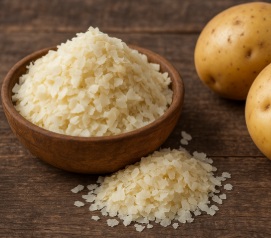
Potato flakes
(from tubers of Solanum tuberosum L.; family Solanaceae — dehydrated, pregelatinized product)*
Description
• Dehydrated ingredients made from cooked mashed potatoes that are drum/tunnel-dried and flaked into irregular sheets. Flakes are pregelatinized, so they rehydrate instantly in hot water/milk.
• Neutral potato flavor, cream–pale yellow color; supplied in various flake sizes (fine/standard/coarse) and as clean-label grades (no additives) or with emulsifiers (e.g., E471) for body and stability.

Indicative nutrition values (per 100 g; plain, unsalted, no milk)
• Energy: 340–370 kcal
• Carbohydrate: 75–85 g (sugars 2–6 g; starch predominant)
• Dietary fiber: 4–8 g
• Protein: 6–10 g
• Fat: 0.3–1.0 g — SFA (saturated fatty acids; best kept low for LDL control) ~0.1–0.3 g; MUFA ~0.1–0.3 g; PUFA ~0.1–0.3 g
• Sodium: naturally low; higher in seasoned “instant” mixes
• Minerals: notable potassium and magnesium (vitamin C largely reduced by dehydration)
Key constituents
• Potato starch (pregelatinized), potato proteins, fiber (cellulose/hemicelluloses), and minerals (K predominant).
• Optional co-formulants: emulsifiers (E471), permitted antioxidants/anticaking agents, milk or salt in flavored instant blends (must be declared).
Production process
• Washing, peeling, sorting → blanch/cook to inactivate enzymes and moderate reducing sugars → mashing to puree.
• Drum/tunnel drying to low moisture → flaking → cooling and sieving to size.
• Quality control (moisture, color, microbiology) and barrier packaging/modified atmosphere per GMP/HACCP.
Physical properties
• Appearance: light, friable flakes, 1–20 mm depending on grade.
• Moisture/aw: moisture ≤8%; aw ≤0.60.
• Water uptake: 4–6 g water/g flakes; rehydrate in 1–3 min at 75–95 °C.
• Bulk density: 0.15–0.35 g/mL (grade-dependent).
• Solubility: not soluble; form cohesive, viscous systems on rehydration.
Sensory and technological properties
• Instant functionality: rapid reconstruction of mashed potato with fluffy/creamy structure.
• Body/binding: effective binder and bulking agent in doughs and fillings; improves water retention and softness after baking/cooking.
• Processability: supports extrusion/lamination for snacks; promotes browning (Maillard) during baking/frying.
• Compatibility: works with dairy, fats, eggs, spices; manage reducing sugars to control color/acrylamide in frying.
Food applications
• Instant mash and rehydrated sides.
• Snacks & reformed chips (extruded/pressed), tortillas, gnocchi, croquettes.
• Bakery: moister, softer breads/focaccia, savory crackers/biscuits.
• Soups/sauces: clean thickener and emulsion stabilizer.
• Gluten-free/plant-based: structure and yield in burgers and gluten-free doughs.
Nutrition & health
Potato flakes deliver mainly starch and potassium with very low fat; saturates (sfa) are negligible. Glycemic load can be high when consumed hot right after rehydration; cooling or hot–cold cycling raises resistant starch, which may temper post-prandial glycemia. Sodium depends on the recipe (plain vs seasoned mixes). Naturally gluten-free (verify <20 ppm for claims); sulfites may be present if used for anti-browning in some processes and must be labeled where applicable.
Portion note: For one side serving, use 25–35 g flakes + 120–180 mL hot water/milk and 5–10 g fat (butter/oil) to yield ~150–200 g of mash.
Quality and specifications (typical topics)
• Moisture ≤8%; aw ≤0.60; ash within spec.
• Color (CIELAB), typical odor/taste, free of oxidized/earthy off-notes.
• Reducing sugars controlled to limit browning/acrylamide in frying.
• Particle size and bulk density to spec; WAI/WAC and reconstitution viscosity.
• Microbiology: pathogens absent/25 g; low APC/yeasts/moulds.
• Residues/contaminants: heavy metals within limits; sulfites and pesticides ≤ MRL.
Storage and shelf-life
• Store cool, dry, and dark in moisture/oxygen-barrier packs; avoid odor pickup.
• Reseal carefully; desiccant recommended after opening.
• Typical shelf-life: 12–24 months unopened.
Safety and regulatory
• Food ingredient status; some formulations include permitted additives (e.g., emulsifiers) that must be declared.
• Sulfites (if present) are a labeled allergen per law. Manufactured under GMP/HACCP with traceability.
Labeling
• Name: “potato flakes”.
• Declare any emulsifiers, milk, salt, flavors; “gluten-free” claim only with verification; raw-material origin where required.
Troubleshooting
• Lumps on reconstitution → liquid too cool or poor agitation → use 75–95 °C liquid, sprinkle flakes gradually, stir briskly.
• Gluey mash → over-shearing or high liquid ratio → reduce shear and correct dosing.
• Excess frying browning → high reducing sugars/too high temperature → select low-reducing lots and optimize time/temperature.
• Loss of snack crispness → high humidity → stronger barrier pack, include desiccant.
• Oxidized notes → poor storage → lower headspace O₂, use suitable packaging.
Sustainability and supply chain
• Valorization of peels/pulp to feed/biogas; recover water/energy; wastewater managed to BOD/COD targets.
• Prefer recyclable packaging and growers/processors with sound agronomy; supplier audits under GMP/HACCP.
INCI functions (cosmetics)
• Solanum Tuberosum (Potato) Starch/Extract: absorbent/opacifying, viscosity-controlling, mild exfoliant in powders/scrubs; usage and claims per cosmetic regulations.
Conclusion
Potato flakes are a versatile, reliable tool for speed, body, and binding across snacks, bakery, soups, and more. Performance depends on flake size & WAC, moisture control, choice of co-formulants, and proper reconstitution in the target recipe.
Mini-glossary
• SFA: Saturated fatty acids — Excess intake can raise LDL-cholesterol; flakes contribute very little.
• MUFA: Monounsaturated fatty acids — Favorable when replacing saturates.
• PUFA: Polyunsaturated fatty acids — Beneficial when balanced and protected from oxidation.
• aw: Water activity — Lower aw improves microbial stability.
• WAI/WAC: Water absorption index/capacity — Indices of water uptake by flakes.
• MRL: Maximum residue limits — Legal limits for pesticide residues.
• GMP/HACCP: Good manufacturing practice / hazard analysis and critical control points — Preventive hygiene and process-control systems.
• BOD/COD: Biochemical/chemical oxygen demand — Wastewater metrics guiding treatment and discharge.
Studies
About 80% of the weight of a fresh potato tuber is water; almost all the remaining dry matter is starch. Most of the starch (70%) is amylopectin, the rest being amylose (1).
Particular warning about the potato skin, which is a concentrate of phenolic compounds with antioxidant activity (2) and dietary fibres.
Potatoes are a source of carbohydrates in the diet all over the world and are generally considered high glycaemic index (3) foods, the parameter that indicates how much glucose is present in the blood.
Another problem with potato consumption is the pesticide residue that can be found in this tuber. Warning should be given as to where it is grown and what fertilisation it is subjected to.
In addition, warning must be given to prolonged frying at high temperatures, which degrades the qualities of the oil and the potato itself, generating acrylamide, a potentially carcinogenic molecule (4)
For more information:
"Potatoes : how to store, how to fry"
Potato studies
References_______________________________________________________________________
(1) Diego Fajardo, Sastry S. Jayanty, Shelley H. Jansky Rapid High Throughput Amylose Determination in Freeze Dried Potato Tuber Samples J Vis Exp. 2013; (80): 50407. Published online 2013 Oct 14. doi: 10.3791/50407
Abstract. This protocol describes a high through put colorimetric method that relies on the formation of a complex between iodine and chains of glucose molecules in starch. Iodine forms complexes with both amylose and long chains within amylopectin. After the addition of iodine to a starch sample, the maximum absorption of amylose and amylopectin occurs at 620 and 550 nm, respectively. The amylose/amylopectin ratio can be estimated from the ratio of the 620 and 550 nm absorbance values and comparing them to a standard curve in which specific known concentrations are plotted against absorption values. This high throughput, inexpensive method is reliable and reproducible, allowing the evaluation of large populations of potato clones.
(2) Akyol H, Riciputi Y, Capanoglu E, Caboni MF, Verardo V. Phenolic Compounds in the Potato and Its Byproducts: An Overview. Int J Mol Sci. 2016 May 27;17(6):835. doi: 10.3390/ijms17060835.
Abstract. The potato (Solanum tuberosum L.) is a tuber that is largely used for food and is a source of different bioactive compounds such as starch, dietary fiber, amino acids, minerals, vitamins, and phenolic compounds. Phenolic compounds are synthetized by the potato plant as a protection response from bacteria, fungi, viruses, and insects. Several works showed that these potato compounds exhibited health-promoting effects in humans. However, the use of the potato in the food industry submits this vegetable to different processes that can alter the phenolic content. Moreover, many of these compounds with high bioactivity are located in the potato's skin, and so are eliminated as waste. In this review the most recent articles dealing with phenolic compounds in the potato and potato byproducts, along with the effects of harvesting, post-harvest, and technological processes, have been reviewed. Briefly, the phenolic composition, main extraction, and determination methods have been described. In addition, the "alternative" food uses and healthy properties of potato phenolic compounds have been addressed.
(3) Lin Ek K, Wang S, Brand-Miller J, Copeland L. Properties of starch from potatoes differing in glycemic index. Food Funct. 2014 Oct;5(10):2509-15. doi: 10.1039/c4fo00354c.
Abstract. Potatoes are a popular source of dietary carbohydrate worldwide and are generally considered to be a high glycemic index (GI) food. Potato starch characteristics play a key role in determining their rate of digestion and resulting glycemic response. Starches isolated from seven potato cultivars with different GI values, including a low GI cultivar (Carisma), were examined for relative crystallinity, granule size distribution, amylopectin chain length, and thermal and pasting properties. Starch from the Carisma cultivar was more thermally stable and more resistant to gelatinization, with significantly higher (p < 0.05) pasting temperature and differential scanning calorimetry (DSC) gelatinization onset, peak and conclusion temperatures, compared to the other cultivars. Differences between the potatoes in the other properties measured did not align with the GI ranking. Thermal analysis and starch pasting properties may be useful indicators for preliminary identification of potato cultivars that are digested slowly and have a lower GI.
(4) Di Francesco A, Mari M, Ugolini L, Parisi B, Genovese J, Lazzeri L, Baraldi E. Reduction of acrylamide formation in fried potato chips by Aureobasidum pullulans L1 strain. Int J Food Microbiol. 2019 Jan 16;289:168-173. doi: 10.1016/j.ijfoodmicro.2018.09.018.



 Potato flakes