

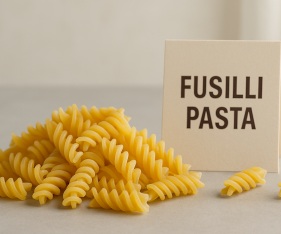
Fusilli pasta
Description
Short-cut, spiral (“corkscrew”) pasta traditionally made from durum wheat semolina and water, extruded through dies (often bronze-die for a rough surface) and low-moisture dried.
Sensory profile: firm, elastic bite when al dente; ridged/spiral geometry gives high sauce pickup and cling.
Variants: whole-wheat, enriched/fortified (jurisdiction-dependent), flavoured/coloured (spinach, tomato, squid ink), and gluten-free versions (e.g., corn, rice, legume blends).

Caloric value (per 100 g)
Dry: ~350–370 kcal; carbohydrates 70–75 g (of which fiber 2–4 g, higher in whole-wheat), protein 11–14 g, fat 1–2 g, sodium negligible.
Cooked in water (no salt/oil): ~140–165 kcal; carbohydrates 28–33 g, protein 5–6 g, fat <1 g (values depend on cook ratio and water uptake).
Key constituents
Starch (amylopectin/amylose) forming a gel matrix on cooking; RS3 — retrograded resistant starch increases after cooling.
Gluten proteins (gliadin/glutenin) from durum wheat create a viscoelastic network that encases starch granules and resists cooking loss.
Minerals (e.g., selenium, magnesium) and B-vitamins (higher in whole-grain/enriched).
Moisture (dry pasta): typically ≤12.5%.
Production process
Milling: clean durum wheat → semolina with controlled granulation, ash, pigment.
Mixing & extrusion: semolina + water (and optional ingredients) → vacuum mixing → extrusion through Teflon or bronze dies; cutting into fusilli.
Drying: controlled time–temperature–humidity curves (often HTD for firmness) to target final moisture; tempering, cooling.
Finishing: optical sorting, metal detection, packaging (barrier films/boxes).
QC checkpoints: moisture, mass per piece, breakage, protein/gluten index, colour (L, b)**, cooking time, cooking loss, turbidity of cooking water, micro (pathogens absent).
Sensory and technological properties
Shape–sauce synergy: spirals and (if present) ridges increase surface area and capillarity → excellent with pesto, ragù, chunky vegetable or cream sauces.
Process behaviour: high-protein durum and proper drying → low stickiness, low cooking loss, and firm texture.
Bronze-die surfaces are rougher (better adhesion, slightly higher cooking loss) vs Teflon (smoother, glossy).
Food applications
Hot dishes: pesto alla genovese, ragù, alla panna, al forno (bakes), pasta salads (shape resists breakage).
Industrial/foodservice: retortable meals, HMR, salads (choose shorter cook time and high-protein fusilli for holding).
Nutrition and health
Energy-dense when dry; per-portion intake depends on cooking yield.
Glycaemic response: al dente cooking, whole-grain, cooling/reheating (↑ RS3) and pairing with protein/fat can reduce effective GI.
Protein quality: complements legumes to improve amino-acid balance.
Sodium is low unless salted during cooking or in sauces.
Fat profile
Very low total fat. Residual lipids are mainly PUFA — polyunsaturated fatty acids (potentially beneficial when balanced; more oxidation-prone) and MUFA — monounsaturated fatty acids (often neutral/beneficial), with minimal SFA — saturated fatty acids (best kept moderate overall). TFA — trans fatty acids negligible; MCT — medium-chain triglycerides not significant.
Quality and specifications (typical topics)
Identity & physicals: uniform length/spiral pitch, low breakage, absence of cracks/black specks; moisture ≤12.5%.
Cooking metrics: al dente time, optimal time window, water uptake, cooking loss (target ≤7–8%), turbidity (low).
Raw-material specs: protein (e.g., ≥12% for high quality), gluten index, falling number (starch damage), ash.
Microbiological: compliant for low-moisture foods; pathogens absent/25 g.
Storage and shelf life
Store cool, dry, and dark, in airtight packaging; avoid humidity (caking, mould risk) and pests.
Shelf life: typically 24–36 months unopened; cooked: ≤4 °C for 3–4 days; freezable after draining and oiling lightly.
Allergens and safety
Contains gluten (wheat). People with celiac disease or wheat allergy must use gluten-free fusilli.
May contain egg in some fresh/artisanal products—check label.
Naturally lactose- and nut-free unless cross-contact occurs; manage under GMP/HACCP.
Troubleshooting
Sticky/clumping: use plenty of boiling water, stir early, adequate salt; avoid overcooking and holding in hot water.
Mushy texture: overcooked or low-protein pasta → reduce time, choose durum/high-protein; for bakes, undercook by 1–2 min before oven.
Sauce slippage: switch to bronze-die fusilli or reduce fat phase; finish in pan with starch-rich pasta water.
Breakage in salads/retort: select shorter cook time, cross-section thicker fusilli; shock-cool to set structure.
Sustainability and supply chain
Durum wheat yield and milling efficiency drive impact; whole-grain improves resource efficiency per nutrient.
Plants should manage water/effluents toward BOD/COD targets, optimise thermal energy in drying, and use recyclable packaging; maintain traceability and supplier GAP.
Labelling
Typical names: “durum wheat semolina pasta (fusilli)”; for gluten-free, declare the base flours (e.g., corn, rice).
Indicate cooking time, any enrichment/fortification, allergen statements (e.g., contains wheat, may contain egg), country of origin/lot.
Conclusion
Fusilli offers a robust, sauce-holding geometry with a firm al dente bite. Selecting high-protein durum, appropriate die type, and controlled drying, paired with process-fit cooking, delivers low cooking loss, excellent adhesion, and consistent texture across home, retail, and industrial applications.
Mini-glossary
RS3 — retrograded resistant starch: Less-digestible starch formed after cooling; can moderate glycaemic response.
GI — glycaemic index: Glycaemic impact of foods; lowered by al dente cooking, whole-grain, cooling, and protein/fat pairing.
Cooking loss: Solids leached into cooking water; lower values indicate better structure.
Bronze-die vs Teflon-die: Bronze → rough, matte surface (better cling); Teflon → smooth, glossy (lower loss).
GMP/HACCP — good manufacturing practice / hazard analysis and critical control points: Preventive systems with validated CCPs for food safety.
BOD/COD — biochemical/chemical oxygen demand: Metrics for wastewater treatment and environmental impact.
PUFA — polyunsaturated fatty acids; MUFA — monounsaturated fatty acids; SFA — saturated fatty acids; TFA — trans fatty acids; MCT — medium-chain triglycerides: Lipid classes; present only in trace amounts in dry pasta.

