

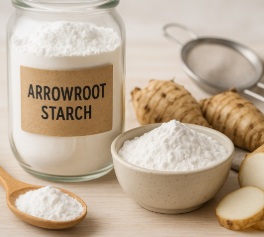
Arrowroot starch
Rating : 7
| Evaluation | N. Experts | Evaluation | N. Experts |
|---|---|---|---|
| 1 | 6 | ||
| 2 | 7 | ||
| 3 | 8 | ||
| 4 | 9 | ||
| 5 | 10 |
0 pts from Al222
| Sign up to vote this object, vote his reviews and to contribute to Tiiips.Evaluate | Where is this found? |
| "Descrizione" about Arrowroot starch by Al222 (23254 pt) | 2025-Nov-29 11:48 |
| Read the full Tiiip | (Send your comment) |
Arrowroot starch (Maranta arundinacea)
Extended description
Arrowroot starch is the common name for the purified starch obtained from the rhizomes of the tropical plant Maranta arundinacea, a perennial species native to Central and South America and now cultivated in many humid tropical regions. The plant is a herb up to about 1–1.5 m tall, with oval leaves and fleshy, cream-white rhizomes that are particularly rich in easily digestible starch. In food use, “arrowroot” usually refers to the refined starch flour: a very fine, white, practically tasteless powder used as a natural thickener, in bakery formulations and as a gluten-free alternative to more common starches such as wheat, corn and potato starch. Historically, arrowroot preparations have also been used in traditional medicine, especially as a soothing food for delicate digestion and as a mild topical application for irritated skin, reflecting its high tolerance and digestibility. In modern food technology, arrowroot starch is considered a “clean label” ingredient because it is a physically extracted, non-chemically modified starch with a simple declaration and a neutral sensory profile that fits well in products aimed at sensitive consumers, infants, the elderly, gluten-free diets and premium clean-label formulations.

Botanical classification
Common name: arrowroot, maranta, arrowroot starch
Scientific name: Maranta arundinacea
Family: Marantaceae
Genus: Maranta
Origin: tropical Central and South America
Growth habit: perennial rhizomatous herb, usually 0.5–1.0 m tall, cultivated for its starchy rhizomes
Cultivation and growing conditions
Climate
A typically tropical–subtropical species, loving warmth and humidity.
Not frost-tolerant: temperatures around 0 °C can seriously damage shoots and rhizomes.
Well suited to areas with regular rainfall or irrigation for most of the year.
Exposure
Prefers bright, diffused light or light partial shade.
In full, intense tropical sun it may suffer if soil moisture is not adequate.
In deep shade growth slows and rhizome production decreases.
Soil
Requires deep, loose, well-drained but moist soils, rich in organic matter.
Grows well in slightly acidic to neutral soils.
Avoid heavy, compact, waterlogged soils, which favour rhizome rot.
Deep soil preparation before planting is important to allow rhizomes to develop and swell.
Irrigation
Likes consistently moist soil, without strong alternation between very dry and very wet conditions.
In intensive cultivation, regular irrigation is common, especially in dry periods.
Prolonged waterlogging should be avoided as it increases the risk of fungal diseases on rhizomes.
Temperature
Optimal growth between about 22 and 30 °C.
Temperatures below 15 °C markedly slow development.
Not suitable for climates with cold winters unless grown under protection.
Fertilization
Needs good levels of organic matter and nutrients, especially to support rhizome formation.
Before planting, apply mature compost or well-rotted manure, possibly combined with a balanced NPK fertilizer.
Nitrogen should be supplied in balance: excess promotes lush foliage at the expense of starch accumulation in rhizomes.
Crop management
Keep the soil free from weeds, especially in early growth stages.
Light hoeing helps aerate the soil and control weeds.
In more intensive systems, organic mulches can reduce evaporation and suppress weeds.
Monitor for soil pests and rhizome rots under high humidity.
Harvest
Rhizomes are usually harvested several months after planting, when leaves start yellowing and the plant approaches maturity (often 9–12 months in tropical climates).
Rhizomes are lifted, cleaned and sorted:
the best are used for starch extraction (arrowroot flour),
some are kept for replanting.
For starch production, rhizomes are washed, grated or ground, and the starch is separated by washing and settling.
Propagation
Propagated almost exclusively by division of rhizomes or clumps.
Healthy pieces with well-formed buds are replanted in prepared holes or furrows.
Seed propagation is rare in practice, as it is slow and yields variable offspring.
Indicative nutritional values per 100 g (arrowroot starch/flour)
(Values are indicative and may vary with origin and processing.)
Energy: ~350–360 kcal
Water: ~10–12 g
Protein: ~0.3 g
Total carbohydrates: ~88 g
Starch: ~84–86 g
Dietary fibre: ~3–4 g
Sugars: negligible
Total fat: ~0.1 g
First occurrence of lipid acronyms: SFA (saturated fatty acids, potentially adverse if chronically high in the diet), MUFA (monounsaturated fatty acids, often considered cardioprotective), PUFA (polyunsaturated fatty acids, important for cardiovascular and inflammatory balance). In arrowroot these fat fractions are present only in trace amounts, without real nutritional impact.
Sodium: ~2–3 mg
Potassium: ~10–15 mg
Calcium: ~30–40 mg
Magnesium: ~3–5 mg
Iron: ~0.3–0.4 mg
Key constituents
Starch (major component)
Amylose (typically medium–high proportion, contributing to gel firmness and film-forming ability)
Amylopectin (branched fraction, contributes to viscosity and clarity)
Resistant starch fractions and dietary fibre
Trace minerals (calcium, potassium, magnesium, iron, phosphorus)
Very small amounts of proteins and amino acids
Minor phytochemicals (e.g., polyphenolic traces reported in some studies)
Negligible lipid fraction (traces of SFA, MUFA and PUFA, nutritionally insignificant in normal serving sizes)
Production process
Cultivation and harvesting
Maranta arundinacea is cultivated in tropical climates; rhizomes are typically harvested 10–12 months after planting, when starch content is highest.
Primary processing
Rhizomes are washed thoroughly to remove soil and plant residues.
Clean rhizomes are peeled or left with thin skin depending on the process, then grated or ground with water to produce a wet mash.
Starch separation
The mash is mixed with water and strained through cloth or sieves to separate fibrous material from the starch-rich slurry.
The slurry is allowed to settle; the starch sediment is collected from the bottom.
Purification and drying
The crude starch is repeatedly washed and resuspended to remove pigments, soluble impurities and residual proteins.
The purified starch is dewatered and dried under controlled conditions (tray dryers, fluidized beds, or sun-drying in traditional settings).
Milling and standardisation
Dried starch cakes are milled into a fine powder and sieved to standardise particle size.
The final product is packed in moisture-barrier bags or multi-layer packaging, sometimes under modified atmosphere, to maintain low moisture and prevent contamination.
Physical properties
Appearance: very fine, white to off-white powder.
Particle size: small, relatively uniform granules (typically finer than many cereal starches).
Solubility: insoluble in cold water; disperses as a suspension and forms a clear to slightly translucent gel when heated in water.
Gelatinisation temperature: relatively low–medium (around 70–80 °C, depending on source and processing).
Viscosity: high peak viscosity; forms smooth, glossy gels.
Swelling power: high; granules swell markedly when heated in excess water.
Moisture content: typically around 10–12 % in commercial flour.
Bulk density: relatively low (light powder).
Sensory and technological properties
Flavour: neutral, slightly sweet or bland; does not mask or distort other flavours.
Aroma: practically odourless.
Mouthfeel: provides smooth, silky, non-grainy texture in sauces, puddings and fillings.
Gel clarity: good clarity and gloss; more transparent than some cereal starch gels.
Thickening behaviour:
Rapid development of viscosity upon heating above gelatinisation temperature.
Produces moderately firm but non-rubbery gels.
Stability:
Relatively good stability in acidic systems compared with some other starches.
Reasonable freeze–thaw stability, with reduced syneresis compared with certain cereal starches, although formulation-dependent.
Interactions:
Performs well in fruit sauces and acidic fillings.
In high-dairy systems, excessive arrowroot may give slightly slimy textures, so dosage must be controlled.
Food applications
Thickening agent
Soups, clear broths, gravies and sauces.
Fruit sauces, coulis and dessert toppings where clarity and gloss are desired.
Bakery and confectionery
Gluten-free biscuits, cookies, crackers and cakes (usually combined with other gluten-free flours for structure).
As a partial replacement for wheat flour to lighten texture and improve crispness.
Desserts and beverages
Puddings, custards, creams and fruit gels.
Traditional beverages or porridges used as light, digestible foods for children and convalescents.
Special nutrition products
Infant foods and weaning porridges.
Diets for elderly or patients requiring easily digestible carbohydrate sources.
Culinary and household uses
As a corn-starch alternative in home cooking for people preferring gluten-free or “natural” thickening agents.
Nutrition and health
Digestibility and glycaemic aspects
Arrowroot starch is highly digestible and rapidly provides energy; depending on processing and particle size, it can have a moderate to high glycaemic index.
The presence of some resistant starch and fibre fractions may partly attenuate glycaemic response and support gut microbiota, but arrowroot flour is still primarily a starch-based energy source.
Gastrointestinal tolerance
Traditionally used as a gentle food for sensitive digestion, infants and convalescents.
Resistant starch fractions may support beneficial gut bacteria and contribute to stool bulk.
Gluten-free profile
Naturally gluten-free, suitable for individuals with coeliac disease or non-coeliac gluten sensitivity, provided cross-contamination is controlled.
Lipid profile contribution
Extremely low fat content with only traces of SFA, MUFA and PUFA, so its contribution to lipid intake and cardiovascular risk is negligible at usual serving sizes.
Micronutrients
As a refined starch, it is not a major source of vitamins; mineral content is modest (small amounts of calcium, potassium, magnesium, iron).
Overall role in the diet
Best considered as an easily digestible carbohydrate source, useful where gentle texture, neutral flavour and high tolerance are desired, but it should be combined with sources of protein, fibre, vitamins and healthy fats to obtain a nutritionally balanced meal.
Portion note
Typical culinary portion as a thickener: about 10–20 g arrowroot starch per serving (e.g., to thicken sauces or desserts).
In baked goods: often 30–50 g per 500 g of total flour mix, usually together with other gluten-free flours and binders.
Allergens and intolerances
Intrinsic allergenicity
Arrowroot (Maranta arundinacea) is not among the major recognised food allergens, and reports of true arrowroot allergy are rare.
Gluten and cross-contamination
Naturally gluten-free, but products may be contaminated if processed in facilities that also handle wheat, barley or rye. For coeliac consumers, certification or “gluten-free” labelling and clean manufacturing practices are important.
Other intolerances
High intakes, especially in sensitive individuals, could theoretically contribute to bloating or discomfort due to fermentation of resistant starch in the colon, but this is uncommon at typical culinary doses.
Storage and shelf-life
Optimal storage conditions
Store in a cool, dry, well-ventilated place, away from direct sunlight and strong odours.
Keep packaging tightly closed to prevent moisture uptake and clumping.
Shelf-life
Under good storage conditions, commercial arrowroot starch typically has a shelf-life of about 24–36 months.
Quality may deteriorate earlier if exposed to high humidity, leading to lumping, off-odours or loss of thickening power.
Indicators of loss of quality
Caking or hard lumps due to moisture.
Musty or off-odours.
Reduced viscosity or poor gel formation during use.
Safety and regulatory
General safety status
Arrowroot starch is widely recognised as safe for food use in major jurisdictions when produced under good manufacturing practices.
Additives and chemical modification
Native arrowroot starch used in “clean label” applications is not chemically modified; if modified arrowroot derivatives are used, they may require specific additive labelling depending on local regulations.
Microbiological aspects
As a low-moisture food, it has relatively low microbiological risk, but good hygiene and proper drying/packaging are essential to prevent contamination.
Special dietary claims
Can support fibre-related or digestive-comfort positioning when used in suitable formulations, but specific health claims must follow local regulatory frameworks.
Labelling
Ingredient name
Common declarations include “arrowroot starch”, “arrowroot flour” or the botanical-based cosmetic INCI form “Maranta Arundinacea Root Powder / Starch” in cosmetic products.
Allergen and gluten information
For foods intended for coeliac consumers, “gluten-free” can be declared only when regulatory thresholds and cross-contamination controls are respected.
Origin and quality
Optional information may include country of origin, organic certification, fair-trade or sustainability logos, and information such as “non-GMO” where relevant and allowed.
Troubleshooting
Problem: Sauce or cream remains too thin.
Possible causes: insufficient dosage, inadequate heating above gelatinisation temperature, or excessive dilution.
Corrective actions: slightly increase arrowroot level, ensure adequate cooking temperature and time, or reduce added liquid.
Problem: Lumpy texture.
Possible causes: arrowroot added directly to hot liquid without pre-dispersion.
Corrective actions: always disperse arrowroot in a small amount of cold liquid before adding to hot preparations, or whisk vigorously during addition.
Problem: Gel becomes weepy (syneresis) after freezing and thawing.
Possible causes: formulation too rich in water, repeated freeze–thaw cycles, or insufficient solids.
Corrective actions: adjust solids, combine with other hydrocolloids, minimise freeze–thaw cycles.
Problem: Slightly slimy mouthfeel in dairy desserts.
Possible causes: high arrowroot dosage interacting with dairy proteins.
Corrective actions: reduce arrowroot level and/or combine with another starch or hydrocolloid, adjust heating profile.
Sustainability and supply chain
Agricultural aspects
Maranta arundinacea can be cultivated in tropical agro-ecosystems, including smallholder and mixed cropping systems, potentially supporting biodiversity and soil protection when well managed.
Resource use
Starch extraction is mainly mechanical and aqueous, typically without harsh chemicals, which can be advantageous compared with more intensive refining processes.
By-products
Fibrous residues from starch extraction can be used as animal feed or as a soil amendment, reducing waste.
Social and economic dimensions
Arrowroot can provide income diversification for small farmers in tropical areas and may contribute to the valorisation of under-utilised tuber crops.
Sustainability challenges
As with other crops, deforestation, inappropriate land use and poor water management can undermine sustainability; responsible sourcing and certification schemes can help mitigate these risks.
Main INCI functions (cosmetics)
(For INCI names such as Maranta Arundinacea Root Powder / Maranta Arundinacea Root Starch.)
Absorbent (helps absorb sebum and moisture in powders and dry shampoos).
Viscosity-increasing agent (contributes to the thickness of emulsions, creams and lotions).
Opacifying agent (reduces transparency and improves visual coverage in cosmetic products).
Anti-caking agent (improves free-flow in loose powders).
Texture enhancer / sensorial modifier (provides a soft, silky skin feel in body powders and natural make-up).
Conclusion
Arrowroot (Maranta arundinacea) starch is a highly digestible, neutral-tasting and versatile ingredient that plays a valuable role in both traditional and modern food systems. Its clean sensory profile, good clarity and gloss, and reliable thickening behaviour make it especially suitable for delicate sauces, desserts and gluten-free bakery applications, as well as for infant and geriatric nutrition where gentle textures are needed. From a nutritional standpoint, arrowroot is primarily an easily digestible carbohydrate source with very low fat and modest mineral content, best combined with other ingredients to achieve a complete nutritional profile. In cosmetics, its INCI forms provide absorbency, texture and a pleasant skin feel in natural formulations. When responsibly sourced and properly processed, arrowroot offers a technically robust, consumer-friendly and potentially sustainable option across food and personal care applications.
Studies
Arrowroot starch offers several health benefits due to its low gluten content and ease of digestion. It is also known for its ability to help manage diarrhea and other digestive issues thanks to its soothing properties.
Glycemic Index Arrowroot starch has a relatively high glycemic index, so its consumption should be monitored by those managing blood sugar levels.
Allergies It is a safe alternative for most people with gluten allergies or sensitivities.
Mini-glossary
SFA – Saturated fatty acids; a class of fats that, when consumed in excess, may adversely affect blood lipid profiles and cardiovascular risk.
MUFA – Monounsaturated fatty acids; fats typically associated with favourable effects on blood lipids and cardiovascular health when they replace saturated fats.
PUFA – Polyunsaturated fatty acids; include omega-3 and omega-6 families, important for cell membranes, inflammatory balance and cardiovascular function.
Bibliografia__________________________________________________________________________
Tarique J, Zainudin ES, Sapuan SM, Ilyas RA, Khalina A. Physical, Mechanical, and Morphological Performances of Arrowroot (Maranta arundinacea) Fiber Reinforced Arrowroot Starch Biopolymer Composites. Polymers (Basel). 2022 Jan 19;14(3):388. doi: 10.3390/polym14030388.
Abstract. This research is driven by stringent environmental legislation requiring the consumption and use of environmentally friendly materials. In this context, this paper is concerned with the development and characterization of thermoplastic arrowroot starch (TPAS) based biocomposite films by incorporating arrowroot fiber (AF) (0-10%) into a glycerol plasticized matrix by using the solution casting method. Developed TPAS/AF composite films were investigated, such as physical, morphological (FESEM), tensile, and tear strength characteristics. The tensile and tear strengths of TPAS/AF composites were increased significantly from 4.77 to 15.22 MPa and 0.87 to 1.28 MPa, respectively, as compared to the control TPAS films, which were 2.42 MPa and 0.83 MPa, respectively, while elongation was significantly decreased from 25.57 to 6.21% compared to control TPAS film, which was 46.62%. The findings revealed that after the fiber was reinforced, the mechanical properties were enhanced, and the optimum filler content was 10%. Regardless of fiber loadings, the results of water absorption testing revealed that the composite films immersed in seawater and rainwater absorbed more water than distilled water. Overall, the results of this research focus on providing information on biopolymer composite film and revealing the great potential it has for the food packaging industry.
Kumalasari ID, Harmayani E, Lestari LA, Raharjo S, Asmara W, Nishi K, Sugahara T. Evaluation of immunostimulatory effect of the arrowroot (Maranta arundinacea. L) in vitro and in vivo. Cytotechnology. 2012 Mar;64(2):131-7. doi: 10.1007/s10616-011-9403-4.
Abstract. Arrowroot (Maranta arundinacea. L) is an underutilized local crop potentially to be developed as carbohydrate source and functional food in Indonesia. The objectives of this research are to evaluate the immunostimulatory effects of arrowroot extracts in vitro by using animal cell culture techniques, and in vivo by using BALB/c mice. The arrowroot tuber extracts were prepared by heat-treatment at 121 °C for 20 min in distilled water. The IgM production stimulatory activity of arrowroot tuber extracts against human hybridoma HB4C5 cells and mouse splenocytes was assessed. The result indicated that the arrowroot tuber extract stimulated IgM production by HB4C5 cells and immunoglobulin (IgG, IgA and IgM) production by splenocytes in vitro. In addition, the arrowroot tuber extracts strongly enhanced interferon γ production by splenocytes. In vivo study indicated that the diet containing arrowroot extracts increased the serum IgG, IgA and IgM levels in mice. These results revealed that the arrowroot tuber extracts have immunostimulatory effects in vivo as well as in vitro.
Cooke C, Carr I, Abrams K, Mayberry J. Arrowroot as a treatment for diarrhoea in irritable bowel syndrome patients: a pilot study. Arq Gastroenterol. 2000 Jan-Mar;37(1):20-4. doi: 10.1590/s0004-28032000000100005.
Abstract. Objectives: Arrowroot is an old-fashioned remedy for diarrhoea, but no clinical studies have been done to evaluate its effectiveness. The aim of this pilot study was to assess its efficacy as a treatment for diarrhoea in 11 patients, all of whom had irritable bowel syndrome with diarrhoea as a feature. Methods: The patients were interviewed and a questionnaire completed on entry into the trial. They then took 10 mL arrowroot powder three times a day for one month and discontinued the treatment for the subsequent month. Questionnaires were completed after one month on treatment and at the end of the trial after one month off treatment. Results: Arrowroot reduced diarrhoea and had a long-term effect on constipation. It also eased abdominal pain. Conclusion: Arrowroot is an effective treatment for diarrhoea. Its action could be explained by several theories which relate to an increase in faecal bulk and thus a more efficient bowel action. The number of patients was small, and further studies are needed to substantiate preliminary results.
Kim S, Fung DY. Antibacterial effect of crude water-soluble arrowroot (Puerariae radix) tea extracts on food-borne pathogens in liquid medium. Lett Appl Microbiol. 2004;39(4):319-25. doi: 10.1111/j.1472-765X.2004.01582.x.
Abstract. Aims: To evaluate the effect of crude water-soluble arrowroot tea extracts on microbial growth of food-borne pathogens in liquid medium and to confirm the damage to bacterial cells using Transmission Electronic Microscopy (TEM). Methods and results: Inhibition of growth of Escherichia coli O157:H7, Salmonella enterica serovar Enteritidis, Listeria monocytogenes and Staphylococcus aureus was investigated using Brain Heart Infusion (BHI) broth containing 0 (control), 0.63, 1.25, 2.5 and 5.0% (w/v) arrowroot tea. Bacterial cell counts were performed on specific selective agar on days 0, 1, 3 and 5. BHI containing 5.0% arrowroot tea extract showed a 6-7 log suppression of growth for all test strains on days 3 and 5, compared with the control. Even 0.63% arrowroot tea effectively inhibited microbial growth of all test strains on day 5. TEM images of the samples treated with 5.0% arrowroot tea revealed the rupture of cell walls and nonhomogeneous disposition of cytoplasmic materials within treated bacteria. Conclusions: Crude water-soluble arrowroot tea extract strongly inhibited microbial growth of all test pathogens in liquid medium. Significance and impact of the study: Water-soluble arrowroot tea extract has the potential to be used directly on foods or as a spray on the surfaces of food handling and processing facilities in order to prevent microbial growth of both Gram-negative and Gram-positive bacteria.
Pérez E, Lares M. Chemical composition, mineral profile, and functional properties of Canna (Canna edulis) and Arrowroot (Maranta spp.) starches. Plant Foods Hum Nutr. 2005 Sep;60(3):113-6. doi: 10.1007/s11130-005-6838-9.
Abstract. The aim of the present study was to evaluate some chemical and mineral characteristics and functional and rheological properties of Canna and Arrowroot starches produced in the Venezuelan Andes. Canna starch showed a higher (P < 0.05) moisture, ash, and crude protein content than arrowroot starch, while crude fiber, crude fat, and amylose content of this starch were higher (P < 0.05). Starches of both rhizomes own phosphorus, sodium, potassium, magnesium, iron, calcium, and zinc in their composition. Phosphorus, sodium, and potassium are the higher in both starches. Water absorption, swelling power, and solubility values revealed weak bonding forces in Canna starch granules; this explained the lower gelatinization temperature and the substantial viscosity development of Canna starch during heating. Arrowroot starch showed a higher gelatinization temperature measure by DSC, than Canna starch and exhibited a lower value of DeltaH. Both starches show negative syneresis. The apparent viscosity of Canna starch was higher (P < 0.05) than the Arrowroot starch values. The size (wide and large) of Canna starch granules was higher than arrowroot starch. From the previous results, it can be concluded that Canna and Arrowroot starches could become interesting alternatives for food developers, depending on their characteristics and functional properties.
Shintu, P. V., Radhakrishnan, V. V., & Mohanan, K. V. (2015). Pharmacognostic standardisation of Maranta arundinacea L.-An important ethnomedicine. Journal of pharmacognosy and phytochemistry, 4(3), 242.
Abstract .Plants are said to be medicinal when they are used to promote health beyond basic nutrition. Various bioactive compounds present in the plant are responsible for the medicinal properties of the plant. The present study aims to establish pharmacognostic standardization such as macro and microscopic standards, physico-chemical analysis, powder analysis and preliminary phytochemical screening of rhizome of Maranta arundinacea L. Phytochemical screening was carried out with petroleum ether, chloroform, methanol and distilled water respectively. The study revealed the presence of bio-active compounds such as alkaloids, carbohydrate, cardiac glycosides, aminoacids, phenolic compounds, terpenoids, saponins, flavones and gum. Histochemical studies showed the presence of innumerable starch grains. Physicochemical parameters like moisture content (6.6%), total ash (2.5%), extractive values of alcohol (1.8%) and water (25.1%) were also evaluated. The above parameters are significant towards establishing the pharmacognostic standards for future identification and authentication of genuine plant material.
Brito, Vitor, et al. "Arrowroot (Maranta arundinacea L.): Botany, horticulture, and uses." Horticultural reviews 48 (2021): 233-274.
Abstract. Arrowroot (Maranta arundinacea L.) is a monocotyledon in the order Zingiberales, family Marantaceae. It is an important medicinal spice, mainly known for the quality of its starch and for its applications since times immemorial. It is associated with diets in Asia and the Americas, where specific gel and starch paste rheologies are required. In addition, it is a highly digestible product. This review has gathered information on the botanical and horticultural aspects as well as uses of arrowroot, including its contributions to the development of higher value-added products and the special properties of its starch. Moreover, it aimed
| Sign up to vote this object, vote his reviews and to contribute to Tiiips.EvaluateClose | (0 comments) |
Read other Tiiips about this object in __Italiano (1)
Content:   Last update:   2025-11-04 21:30:36 | Kcal/100g:   360 |

