

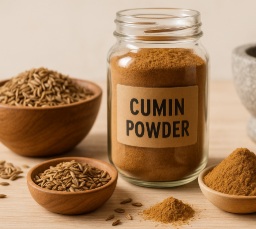
Cumin powder (Cuminum cyminum, family Apiaceae)
Description
Ground spice obtained from the dried seeds of Cuminum cyminum, offered at multiple particle sizes (e.g., fine, 40–60 mesh).
Sensory profile: warm, earthy, lightly nutty, with green/peppery nuances and a gentle bitterness on the finish.
Commercial formats: single-ingredient or blends (e.g., curry, taco mix); may include anticaking agents for better flowability.

Caloric value (per 100 g, dry spice)
~370–400 kcal; carbohydrates 40–50 g (of which fiber 10–12 g), protein 17–19 g, fat 20–23 g, sodium low (unless in salted blends).
Typical use (1 tsp, ~2 g): 7–8 kcal.
Key constituents
Essential oil (~2–5%): dominated by cuminaldehyde (signature aldehyde), with p-cymene, γ-terpinene, β-pinene, traces of phenolics/esters.
Fixed oil (non-volatile lipids): linoleic (n-6), oleic (n-9), and palmitic acids.
Polyphenols/flavonoids (e.g., apigenin, luteolin), saponins, tannins; minerals (iron, manganese, magnesium, potassium).
Production process
Harvest/drying: cut mature umbels, dry under control, thresh.
Cleaning/grading: sieving, air separation, optical sorting to remove impurities/foreign seeds.
Toasting (optional): light roast to boost nutty notes.
Milling: cryogenic or pin milling with temperature control to preserve essential oil; sifting to target particle size.
Decontamination (as needed): steam or validated alternatives; barrier packaging with optional inert gas.
Sensory and technological properties
Relative heat stability: base notes persist; top notes fade in long cooks → add a finishing sprinkle near the end.
Lipid affinity: blooming in oil/ghee extracts volatiles and disperses aroma.
Antioxidant/antimicrobial contribution (dose-dependent) supports stability in spice mixes, snacks, and sausages.
Food applications
Cuisines: Indian (tadka, garam masala), Middle Eastern (baharat), Mexican/Tex-Mex (taco/chili), Mediterranean (legumes, vegetables).
Uses: dry rubs, marinades, curry/sauce bases, savory snacks, spiced breads/flatbreads, plant-based burgers.
Pairings: coriander, paprika/chili, garlic, onion, fennel seed, Nigella, lemon/vinegars.
Nutrition and health
Small culinary doses → minimal calories; contributes fiber, iron, and aromatic phytochemicals.
Traditionally used as a carminative; generally well tolerated at food-use levels.
Sodium is intrinsically low; watch salted blends.
Fat profile
Moderate total fat in the dry spice (but low intake per serving). The lipid fraction is mainly PUFA — polyunsaturated fatty acids (especially linoleic n-6; potentially beneficial when balanced, more oxidation-prone) and MUFA — monounsaturated fatty acids (e.g., oleic n-9; often neutral/beneficial), with a smaller share of SFA — saturated fatty acids (e.g., palmitic; best kept moderate overall). TFA — trans fatty acids are negligible; MCT — medium-chain triglycerides not significant.
Quality and specifications (typical topics)
Moisture ≤ 10–12%, aw ≈ 0.6, essential-oil yield and cuminaldehyde within spec; ash, particle size, foreign-matter free.
Microbiology: pathogens absent/25 g; validate CCPs for sanitation.
Contaminants/adulteration: mycotoxins (e.g., ochratoxin A), heavy metals, pesticides within limits; surveil adulterants (related seeds, non-compliant colorants).
Packaging: barrier to light/oxygen/moisture; optional nitrogen flush/O₂ scavenger.
Storage and shelf life
Store cool, dark, dry, and airtight; avoid heat/light.
Shelf life: typically 12–24 months unopened; after opening, use promptly to preserve aroma.
Allergens and safety
In the EU, cumin is not a major allergen; possible cross-reactivity within Apiaceae (e.g., celery, carrot, fennel).
Essential oil can be sensitising (aldehydes) in aroma/cosmetic use → follow IFRA limits.
Manage cross-contact risks with gluten/sesame/mustard in mixed facilities.
INCI functions in cosmetics
Possible INCI: Cuminum Cyminum Seed Oil, Cuminum Cyminum Seed Extract, Cuminum Cyminum Fruit Oil.
Roles: fragrance, masking, light antioxidant, skin conditioning (use conservatively with claim/safety substantiation).
Troubleshooting
Flat aroma after long cooking: add cumin at finish or use a lightly toasted portion.
Over-green notes: lightly toast whole seeds before milling/using.
Caking: reduce moisture/aw, use approved anticaking agents, and barrier packs.
Aroma loss in storage: upgrade barrier, reduce oxygen (low-OTR films, O₂ scavenger).
Sustainability and supply chain
Annual, moderate-input crop; prefer suppliers with traceability and GAP practices.
In-plant: control dust, improve drying/energy efficiency, manage effluents toward BOD/COD targets; operate under GMP/HACCP; use recyclable packaging.
Labelling
Declare as “ground cumin”/“cumin powder.” For blends, list ingredients and allergens.
Optional claims: “no added salt”, “flavour/colour from natural sources” when compliant.
Conclusion
Cumin powder is a cornerstone spice with a warm, earthy signature that anchors flavour architectures across cuisines. Targeted toasting, fat blooming, fit-for-purpose particle size, and barrier packaging are critical to maximise intensity, persistence, and stability of its aroma.
Mini-glossary
PUFA — polyunsaturated fatty acids: Often beneficial when balanced; more prone to oxidation.
MUFA — monounsaturated fatty acids: Typically neutral/beneficial and relatively stable.
SFA — saturated fatty acids: Best kept moderate overall; minor share here.
TFA — trans fatty acids: Negligible in non-hydrogenated spices.
MCT — medium-chain triglycerides: Not significant in cumin.
IFRA — International Fragrance Association: Sets safety limits for fragrance materials.
GMP/HACCP — good manufacturing practice / hazard analysis and critical control points: Preventive systems with validated CCPs.
BOD/COD — biochemical/chemical oxygen demand: Indicators of wastewater impact and treatment efficiency.
aw — water activity: Key stability parameter for caking and micro control.
References__________________________________________________________________________
Drugs and Lactation Database (LactMed®) [Internet]. Bethesda (MD): National Institute of Child Health and Human Development; 2006–. Cumin. 2025 Jun 15.
Abstract. Cumin (Cuminum cyminum) seed contains a volatile oil that contains cuminaldehyde and other aldehydes; the seeds also contain numerous flavonoids and terpenes. Cumin has been used as a galactogogue in India and Türkiye with some literature support, including as part of an herbal mixture.[1–5] Galactogogues should never replace evaluation and counseling on modifiable factors that affect milk production.[6,7] No data exist on the excretion of any components of cumin into breastmilk or on the safety and efficacy of cumin in nursing mothers or infants. Cumin is “generally recognized as safe” (GRAS) as a spice and flavoring by the U.S. Food and Drug Administration. Cumin is generally well tolerated, but occasional phototoxic skin reactions have been reported after contact with the oil. Those allergic to cumin or related herbs should avoid cumin. Dietary supplements do not require extensive pre-marketing approval from the U.S. Food and Drug Administration. Manufacturers are responsible to ensure the safety, but do not need to prove the safety and effectiveness of dietary supplements before they are marketed. Dietary supplements may contain multiple ingredients, and differences are often found between labeled and actual ingredients or their amounts. A manufacturer may contract with an independent organization to verify the quality of a product or its ingredients, but that does not certify the safety or effectiveness of a product. Because of the above issues, clinical testing results on one product may not be applicable to other products. More detailed information about dietary supplements is available elsewhere on the LactMed Web site.
Yabalak E, Ibrahim F, Erdoğan Eliuz EA. Natural sanitizer potential of Cuminum cyminum and applicable approach for calculation of Kováts retention index of its compounds. Int J Environ Health Res. 2023 Feb;33(2):158-169. doi: 10.1080/09603123.2021.2011159.
Abstract. The demand for natural agents instead of chemicals in terms of food and health safety is increasing day by day. This study aimed to investigate the potential of the methanolic extract of Cuminum cyminum (C. cyminum) in the fight against Escherichia coli (E. coli), Staphylococcus aureus (S. aureus)and Candida (C. albicans). The chemical composition of the methanolic extract of C. cyminum was analyzed using GS-MS. Also, Kováts retention indices were calculated for the detected compounds using an applicable formula. The most basic substance was cuminic aldehyde (27.86%) and p-(Dimethoxymethyl)-isopropylbenze (18.32%). The Minimum Inhibitory Concentration (MIC) of the extract was 0.1 g/mL for S. aureus and C. albicans while it was > 0.1 for E. coli. Although the methanol extract of C. cyminum acts against all three microorganisms, the most lasting effect was on S. aureus, indicating that it can be recommended as a strong antibacterial disinfectant for S. aureus.
Sowbhagya HB. Chemistry, technology, and nutraceutical functions of cumin (Cuminum cyminum L): an overview. Crit Rev Food Sci Nutr. 2013;53(1):1-10. doi: 10.1080/10408398.2010.500223.
Abstract. Cumin is a seed spice belonging to the family umbelliferae. Cumin and value added products from cumin are used in food flavoring and perfumery. Cumin contains volatile oil (3-4%), cuminaldehyde, the major active principle, which is present to an extent of 45-50%. Cumin and value added products from cumin, viz., cumin oil and oleoresin are exported. Cumin powder forms the main component of many spice mixes and curry powders. Cuminaldehyde is an important phytochemical and possesses many health benefits. Alcohol and water extract of cumin are reported to possess many nutraceutical properties like antiallergic, antioxidant, anti-platelet aggregation, and hypoglycemic. Cumin and value added products from cumin can be a good source of nutraceuticals with many biological activities. Incorporation of cumin into food products will have the benefits of a flavorant and nutraceutical at the same time. In the present review, the chemistry, processing, and biological activities of cumin and its components are discussed.
Ishida M, Miyagawa F, Nishi K, Sugahara T. Aqueous Extract from Cuminum cyminum L. Seed Alleviates Ovalbumin-Induced Allergic Rhinitis in Mouse via Balancing of Helper T Cells. Foods. 2022 Oct 15;11(20):3224. doi: 10.3390/foods11203224.
Abstract. Cuminum cyminum L. (cumin) seeds are widely used as a spice. Although we previously reported that the aqueous extract of cumin seeds suppresses the degranulation of rat basophilic RBL-2H3 cells, it has not been clarified whether the extract alleviates actual allergy symptoms in vivo. Therefore, in this study, we investigated the effect of oral administration of cumin seed aqueous extract (CAE) in ovalbumin (OVA)-induced allergic rhinitis. BALB/c mice were randomly divided into the following three groups: control group (five mice), OVA group (five mice), and OVA + CAE group (five mice). Allergic rhinitis was induced by sensitization (intraperitoneal, 25 μg OVA and 1.98 mg aluminum hydroxide gel) followed by challenge (intranasal, 400 μg OVA). The oral administration of CAE (25 mg/kg) reduced the sneezing frequency of OVA-induced allergic rhinitis model mice. In addition to reducing the serum immunoglobulin E and IL-4 levels, the oral administration of CAE reduced the production of T-helper type-2 (Th2) cytokines (IL-4, IL-5, IL-10, and IL-13) in the splenocytes of the model mice. Furthermore, a significant increase in the ratio of Th1 to Th2 cells was observed in the CAE-administered group. Our findings suggest that the ingestion of CAE improves T cell balance, the dominant state of Th2, and alleviates allergic rhinitis symptoms.
Koppula S, Choi DK. Cuminum cyminum extract attenuates scopolamine-induced memory loss and stress-induced urinary biochemical changes in rats: a noninvasive biochemical approach. Pharm Biol. 2011 Jul;49(7):702-8. doi: 10.3109/13880209.2010.541923.
Abstract. Context: Cuminum cyminum Linn. (Apiaceae), cumin, is a popular spice with a long history of medicinal use to treat various symptoms such as diarrhea, flatulence, gynecological, and respiratory diseases. Objective: To date, no scientific investigation was reported regarding memory-enhancing and antistress activity of cumin fruits. The present study deals with the memory-enhancing and antistress activities and further the antioxidant status via lipid peroxidation inhibition. Materials and methods: Antistress activity was evaluated by inducing stress via forced swimming and the urinary vanillylmandelic acid (VMA) and ascorbic acid were estimated as biomarkers. Memory-enhancing activity was studied by conditioned avoidance response using Cook's pole climbing apparatus in normal and scopolamine-induced amnestic rats. Thiobarbituric acid reactive substances (TBARS) assay was used to evaluate the lipid peroxidation. Results: Daily administration of cumin at doses of 100, 200, and 300 mg/kg body weight 1 h prior to induction of stress inhibited the stress-induced urinary biochemical changes in a dose-dependent manner without altering the levels in normal control groups. The cognition, as determined by the acquisition, retention, and recovery in rats, was observed to be dose-dependent. The extract also produced significant lipid peroxidation inhibition in comparison with known antioxidant ascorbic acid in both rat liver and brain. Discussion and conclusion: This study provides scientific support for the antistress, antioxidant, and memory-enhancing activities of cumin extract and substantiates that its traditional use as a culinary spice in foods is beneficial and scientific in combating stress and related disorders.

