

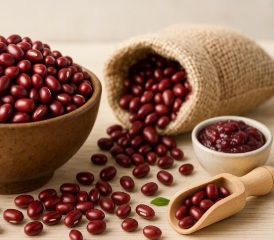
Adzuki beans
Rating : 7
| Evaluation | N. Experts | Evaluation | N. Experts |
|---|---|---|---|
| 1 | 6 | ||
| 2 | 7 | ||
| 3 | 8 | ||
| 4 | 9 | ||
| 5 | 10 |
0 pts from Al222
| Sign up to vote this object, vote his reviews and to contribute to Tiiips.Evaluate | Where is this found? |
| "Descrizione" about Adzuki beans by Al222 (23393 pt) | 2025-Nov-26 12:50 |
| Read the full Tiiip | (Send your comment) |
Adzuki beans
Description
Dried legume seeds (Vigna angularis; historical synonym Phaseolus angularis) with a reddish seed coat (black, white, and green varieties also exist).
Sensory profile: mild, sweet–nutty taste, mealy flesh with thin skin; holds shape when simmered and purées smoothly (ideal for sweet pastes).

Common name: Adzuki bean (pl. Adzuki beans)
Source plant: Vigna angularis (Willd.) Ohwi & Ohashi
Kingdom: Plantae
Clade: Angiosperms
Clade: Eudicots
Order: Fabales
Family: Fabaceae
Genus: Vigna
Species: Vigna angularis (Willd.) Ohwi & Ohashi
Note: Adzuki beans are small legumes, typically red (though white, black and mottled varieties also exist), widely used in East Asian cuisine for sweet pastes, soups and savory dishes.
Cultivation and growing conditions of adzuki beans
Climate:
Prefers warm, temperate climates with moderately warm summers.
More tolerant of cool conditions than many tropical legumes, but does not tolerate frost.
Usually grown as a spring–summer crop in temperate regions.
Exposure:
Requires full sun for good vegetative growth and proper flowering and pod formation.
Soil:
Thrives in medium-textured, well-drained soils with good organic matter.
Prefers slightly acidic to neutral pH.
Sensitive to waterlogging, which promotes root rot and fungal diseases.
Watering:
Needs regular water supply during emergence, flowering and seed filling.
Tolerates short dry periods once well established, but prolonged water stress reduces yield and seed quality.
Avoid strong alternation between drought and excess water.
Temperature:
Optimal germination when soil temperature is around 15–20 °C.
Optimal growth roughly between 18 and 28 °C.
Very low temperatures slow development, while excessive heat combined with drought can impair pod set.
Fertilization:
As a legume, it fixes atmospheric nitrogen via root rhizobia, so heavy mineral nitrogen inputs are usually unnecessary.
Phosphorus, potassium and micronutrients are more important to support flowering and seed filling.
Incorporation of compost or well-rotted manure before sowing is beneficial, especially on poor soils.
Crop management:
Early weed control is important while plants are still small and not very competitive.
Avoid soil compaction, which limits root development and rhizobial activity.
Crop rotation:
Fits well into rotation with cereals and other non-legume crops.
Helps improve soil fertility through nitrogen fixation and crop residues.
Propagation:
By seed, with direct sowing in the field once frost risk has passed and the soil is sufficiently warm and workable.
Caloric value (per 100 g)
Dry (as sold): ~320–350 kcal.
Cooked in water, unsalted: ~110–130 kcal, protein 7–9 g, carbohydrates 20–25 g (of which fiber 6–8 g), fat 0.3–0.7 g.
Canned (drained): similar to cooked; sodium varies (rinsing reduces sodium).
Key constituents
Complex carbohydrates: starch (with a share of resistant starch that can increase after cooling).
Proteins ~20–24% d.b. (sulfur amino acids are limiting → complement with cereals).
Dietary fiber (soluble/insoluble: pectins, hemicelluloses).
Oligosaccharides (raffinose, stachyose; FODMAP).
Phytochemicals: polyphenols (proanthocyanidins/anthocyanins in the seed coat), phytates (mineral chelators), saponins.
Minerals (potassium, magnesium, iron, phosphorus) and B-vitamins (folate, thiamin).
Production process
Selection, cleaning, sizing; controlled drying and barrier packaging for dry beans.
Cooked/ready-to-eat: soaking (or quick hydration), boiling/pressure cooking to tenderness, optional brine, packing and retort sterilization for canned products.
Pastes/flours: milling (sometimes cryogenic), heat treatments to inactivate inhibitors; for sweet bean paste (anko) cook in water and sugar and concentrate.
Sensory and technological properties
High purée-ability (creams/pastes), adds body and viscosity to soups; thin skins help a smooth texture.
Cooking stability: maintains shape in stews; on cooling, RS3 (retrograded resistant starch) increases, giving slight gelation.
Red seed coat can bleed color into cooking water (useful for sweets and pastes).
Food applications
East Asian cuisines: anko (sweet pastes), daifuku/dorayaki, sekihan (rice with adzuki), zenzai/oshiruko (sweet soups).
Soups, stews, warm/cold salads, sides; veg burgers and fillings; sprouts for raw/cooked uses.
Flours in pasta/gnocchi and extruded snacks to boost protein/fiber.
Nutrition and health
Fiber supports satiety and regularity; notable folate and minerals.
Glycemic response is moderate to low; further attenuated by cooling (↑ RS3) and eating with fat/protein.
Antinutrients (phytates, lectins, enzyme inhibitors): soaking + cooking (ideally pressure cooking) and fermentation/sprouting reduce their impact and improve mineral bioavailability.
FODMAP: oligosaccharides may cause bloating; discard soak water and rinse canned beans to lower content.
Fat profile
Very low total fat; residual lipids are mainly PUFA — polyunsaturated fatty acids (e.g., linoleic n-6; potentially helpful when balanced but more oxidation-prone) and MUFA — monounsaturated fatty acids (e.g., oleic n-9; often neutral/beneficial), with minimal SFA — saturated fatty acids (best moderated in the overall diet).
Quality and specifications (typical topics)
Dry beans: moisture ≤ 14–16%, pest-free, uniform size, low breaks/foreign matter.
Canned: drained weight on spec, uniform texture (avoid overcook), declared sodium; optional CaCl₂ for firmness.
Microbiology: category-appropriate (commercial sterility for canned; pathogens absent/25 g).
Residues: pesticides/metals within limits; no foreign bodies.
Storage and shelf life
Dry: store cool/dry/dark; avoid high temperature/humidity (prevents hard-to-cook phenomenon).
Cooked/refrigerated: ≤ 4 °C, 3–4 days; freezeable after cooking and draining.
Allergens and safety
In the EU, legumes are not major allergens, but possible cross-reactivity in those allergic to soy/peanut.
Lectins: ensure vigorous boiling (a low-temp slow cooker alone may not suffice).
Gluten: naturally gluten-free; check cross-contact in shared facilities.
INCI functions in cosmetics
Possible listings: Vigna Angularis Seed Extract / Vigna Angularis Seed Powder.
Roles: skin conditioning, antioxidant, masking in niche products; use is limited and subject to safety/claim evaluation.
Troubleshooting
Excessive cook time/firm texture: aged/HTC beans → soak 8–12 h in lightly salted water, pressure cook; a small amount of baking soda (0.1–0.2%) can help.
Skins detaching: thermal shocks/alkalinity → keep a gentle boil, salt during/after cooking; minimal CaCl₂ if extra firmness is needed.
Bloating/flatulence: discard soak water, rinse well, increase portion gradually; use carminative herbs (bay, fennel).
Flat flavor: insufficient salt/acid → balance with salt, acids (lemon/vinegar), and good fats (olive oil).
Sustainability and supply chain
Nitrogen-fixing legume: reduces synthetic fertilizer needs; GHG footprint lower than animal proteins.
Improve via crop rotations, efficient water/energy use in soaking/cooking, effluent management toward BOD/COD targets; recyclable packaging; full traceability under GMP/HACCP.
Conclusion
Adzuki beans are versatile, nutrient-dense, and pleasantly flavored, suiting both sweet (pastes/fillings) and savory dishes. Proper preparation (soak, adequate cooking) and pairing with cereals optimize bioavailability, digestion, and sensory quality.
Mini-glossary
GI — glycemic index: measure of blood-glucose response; lowered by fiber, fat, and cooling (↑ RS3).
RS3 — retrograded resistant starch: less digestible starch that can blunt glucose spikes.
FODMAP — fermentable oligo-, di-, mono-saccharides and polyols: may cause bloating in sensitive individuals.
SFA — saturated fatty acids: excess linked to higher LDL; low share in adzuki.
MUFA — monounsaturated fatty acids: e.g., oleic; often neutral/beneficial for lipids.
PUFA — polyunsaturated fatty acids: e.g., linoleic; beneficial when balanced, but more oxidation-prone.
GMP/HACCP — good manufacturing practice / hazard analysis and critical control points: preventive hygiene systems with validated CCPs.
BOD/COD — biochemical/chemical oxygen demand: indicators of effluent impact along the supply chain.
References__________________________________________________________________________
Kwan SH, Gonzalez de Mejia E. The Potential of the Adzuki Bean (Vigna angularis) and Its Bioactive Compounds in Managing Type 2 Diabetes and Glucose Metabolism: A Narrative Review. Nutrients. 2024 Jan 22;16(2):329. doi: 10.3390/nu16020329. PMID: 38276567;
Abstract. Type 2 diabetes (T2D) is a common noncommunicable disease. In the United States alone, 37 million Americans had diabetes in 2017. The adzuki bean (Vigna angularis), a legume, has been reported to possess antidiabetic benefits. However, the extent and specific mechanisms through which adzuki bean consumption may contribute to T2D prevention and management remain unclear. Therefore, the aim of this narrative review is to analyze current evidence supporting the utilization of adzuki beans in the diet as a strategy for preventing and managing T2D. Animal studies have demonstrated a positive impact of adzuki beans on managing T2D. However, supporting data from humans are limited. Conversely, the potential of adzuki bean consumption in preventing T2D via modulating two T2D risk factors (obesity and dyslipidemia) also lacks conclusive evidence. Animal studies have suggested an inconsistent and even contradictory relationship between adzuki bean consumption and the management of obesity and dyslipidemia, in which both positive and negative relationships are reported. In sum, based on the existing scientific literature, this review found that the effects of adzuki bean consumption on preventing and managing T2D in humans remain undetermined. Consequently, human randomized controlled trials are needed to elucidate the potential benefits of the adzuki bean and its bioactive components in the prevention and management of T2D.
Guo Q, Luo J, Zhang X, Zhi J, Yin Z, Zhang J, Zhang W, Xu B, Chen L. A Comprehensive Review of the Chemical Constituents and Functional Properties of Adzuki Beans (Vigna angulariz). J Agric Food Chem. 2025 Mar 19;73(11):6361-6384. doi: 10.1021/acs.jafc.4c12023.
Abstract. The adzuki bean (Vigna angulariz), a member of the Vigna genus within the Leguminosae family, is native to China and extensively cultivated across East Asia. Renowned for its rich nutritional profile, the adzuki bean is abundant in carbohydrates, proteins, and bioactive compounds such as polysaccharides, polyphenols, flavonoids, saponins, and peptides. These components confer a wide range of health-promoting properties, including potent antioxidant, anti-inflammatory, antidiabetic, antiobesity, antibacterial, and neuroprotective effects. Notably, adzuki beans exhibit unique functional properties, such as high resistant starch content and the ability to modulate gut microbiota by promoting beneficial bacteria like Akkermansia, which enhance insulin sensitivity and lipid metabolism. These attributes make adzuki beans particularly effective in managing chronic diseases such as diabetes, obesity, and cardiovascular disorders. Additionally, adzuki beans show promise in addressing conditions like muscle atrophy, osteoporosis, and cancer. Processing methods such as fermentation and heat treatment further enhance their bioactive potential, underscoring their suitability for developing functional foods and nutraceuticals. This review highlights the chemical composition, functional activities, and mechanisms of adzuki beans, providing valuable insights for their application in food and pharmaceutical industries to prevent and manage chronic diseases.
Wang Y, Yao X, Shen H, Zhao R, Li Z, Shen X, Wang F, Chen K, Zhou Y, Li B, Zheng X, Lu S. Nutritional Composition, Efficacy, and Processing of Vigna angularis (Adzuki Bean) for the Human Diet: An Overview. Molecules. 2022 Sep 17;27(18):6079. doi: 10.3390/molecules27186079.
Abstract. Adzuki beans are grown in several countries around the world and are widely popular in Asia, where they are often prepared in various food forms. Adzuki beans are rich in starch, and their proteins contain a balanced variety of amino acids with high lysine content, making up for the lack of protein content of cereals in the daily diet. Therefore, the research on adzuki beans and the development of their products have broad prospects for development. The starch, protein, fat, polysaccharide, and polyphenol contents and compositions of adzuki beans vary greatly among different varieties. The processing characteristic components of adzuki beans, such as starch, isolated protein, and heated flavor, are reported with a view to further promote the processing and development of adzuki bean foods. In addition to favorable edibility, the human health benefits of adzuki beans include antioxidant, antibacterial, and anti-inflammatory properties. Furtherly, adzuki beans and extracts have positive effects on the prevention and treatment of diseases, including diabetes, diabetes-induced kidney disease or kidney damage, obesity, and high-fat-induced cognitive decline. This also makes a case for the dual use of adzuki beans for food and medicine and contributes to the promotion of adzuki beans as a healthy, edible legume.
Chen X, Sun Z, Zhang S, Lee GA, Nasu H, Zhang F, Cai H, Liu X, Gao J, Zhu C, Lang J, Zhao Z, Liu X. The discovery of adzuki bean (Vigna angularis) in eastern China during the 9th millennium BP and its domestication in East Asia. Proc Natl Acad Sci U S A. 2025 Sep 30;122(39):e2510835122. doi: 10.1073/pnas.2510835122.
Abstract. Adzuki bean (Vigna angularis) is a key legume widely cultivated in East Asia, prized for both its nutritional value and nitrogen-fixing properties. This paper presents one of the oldest directly dated archaeological finds of adzuki bean, recovered from the Xiaogao site in Shandong, China, and dated to 8985-8645 and 8032-7939 cal. BP-predating previously known Chinese records by at least 4,000 y (approximately 6,000 y considering published directly dated evidence alone). The evidence suggests that adzuki beans formed part of an Early Neolithic multicropping system alongside millet, rice, and soybean in a well-established agricultural tradition in the Lower Yellow River region. Morphometric analysis of adzuki beans from 41 archaeological sites across East Asia reveals a gradual increase in seed size over time when regional data are aggregated, yet highlights distinct regional trajectories. These patterns reflect complex, multiregional domestication processes shaped by both cultural practices and ecological conditions. Notably, the marked differences in bean sizes observed between the Neolithic Yellow River and Jomon-period Japan could be contingent on the distinctions in dietary regimes and associated selective pressures.
Kim M, Kim DK, Cha YS. Black Adzuki Bean (Vigna angularis) Extract Protects Pancreatic β Cells and Improves Glucose Tolerance in C57BL/6J Mice Fed a High-Fat Diet. J Med Food. 2016 May;19(5):442-9. doi: 10.1089/jmf.2015.3598.
Abstract. Adzuki beans have long been cultivated as a food and folk medicine in East Asia. In this study, we investigated the effect of black adzuki bean (BAB) extract on pancreatic cells and determined their mechanism of action in impaired glucose tolerance in an animal model of type 2 diabetes. In addition, we performed functional gene annotation analysis to identify genes related to the regulation of glucose metabolism and insulin response. Treatment of pancreatic β cells with BAB extract (0.2 mg/mL) led to tolerance of the high glucose-induced glucotoxicity, resulting in a similar viability as cells maintained in normal glucose media. In addition, dietary supplementation with BAB extract significantly (P < .05) improved hyperglycemia and homeostasis model assessment of insulin resistance index (HOMA-IR) in high-fat diet-induced glucose-intolerant obese C57BL/6J mice. Our results suggest that BAB extract ameliorates hyperglycemia and glucose intolerance, and lowers HOMA-IR by regulating insulin secretion and response, and by maintaining the integrity of pancreatic β cells exposed to hyperglycemic conditions.
| Sign up to vote this object, vote his reviews and to contribute to Tiiips.EvaluateClose | (0 comments) |
Read other Tiiips about this object in __Italiano (1)
Content:   Last update:   2025-11-03 17:43:26 | Kcal/100g:   350 Family:   Threat factors:   |

