

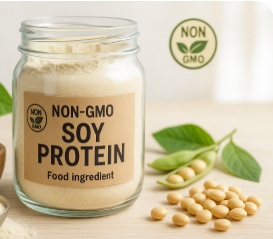
Non-GMO Soy Proteins
Rating : 7
| Evaluation | N. Experts | Evaluation | N. Experts |
|---|---|---|---|
| 1 | 6 | ||
| 2 | 7 | ||
| 3 | 8 | ||
| 4 | 9 | ||
| 5 | 10 |
Cons:
Allergen (1)0 pts from Al222
| Sign up to vote this object, vote his reviews and to contribute to Tiiips.Evaluate | Where is this found? |
| "Descrizione" about Non-GMO Soy Proteins by Al222 (23393 pt) | 2025-Nov-03 12:12 |
| Read the full Tiiip | (Send your comment) |
Non-GMO soy protein
Description
Protein ingredient derived from non-GMO soybeans (Glycine max) with identity-preserved (IP) supply chains and PCR verification to meet legal non-GMO thresholds.
Main commercial forms: soy protein isolate (SPI, ≥88–90% protein), concentrate (SPC, ~65–70%), flour (~50%), and textured/TVP for structure.
Sensory profile: neutral to lightly beany; deodorization and controlled heat treatments reduce green/legume notes.
Caloric value (per 100 g)
Isolate (SPI): ~360–380 kcal; protein ≥88–90 g, fat ~1–3 g, carbohydrates low (some fiber).
Concentrate (SPC): ~330–360 kcal; protein ~65–70 g, fat ~1–3 g, fiber ~15–20 g.
Textured (TVP), dry: similar to SPC; rehydrated TVP (1:2–1:3 water) has much lower energy density per serving.
Key constituents
Proteins with a broadly complete amino-acid profile (limiting methionine + cysteine); PDCAAS ~1.0, DIAAS high for isolates.
Major fractions: glycinin (11S) and β-conglycinin (7S) → gelation, emulsification, foaming.
Phytochemicals: isoflavones (genistein/daidzein; typically reduced in isolates), phytates (mineral chelation), saponins.
Minimal residual lipids (mainly linoleic, oleic, traces of ALA), minerals (iron, potassium), variable B vitamins.
Production process
Dehulling and defatting of soy flakes (food-grade solvents or supercritical CO₂).
SPC: selective removal of solubles (alcohol or acid-wash), drying, milling.
SPI: alkaline extraction, isoelectric precipitation (~pH 4.5), washing, neutralization, spray-drying.
TVP: hot extrusion of SPC/flours → fibrous texture and high water uptake.
Non-GMO/IP: segregated lots, audits, PCR testing and documentation through the chain.
Sensory and technological properties
Solubility depends on pH (minimum at pI ~4.5); excellent at pH 6–8 for beverages and shakes.
Provides O/W emulsification, heat-set gels, water/oil binding, and foam stabilization.
TVP hydration 1:2–1:3; good yield and chew for partial meat replacement.
Food applications
Meat and plant-based: burgers, meatballs, fillings, cooked emulsions; as binder/extender.
Protein beverages, bars, plant yogurts/desserts; bakery (tender crumb, ↑ water retention).
Sauces/dressings (stabilizer), pasta, extruded snacks.
Nutrition and health
High-quality protein with PDCAAS ~1.0; valuable in vegetarian/vegan diets.
Cholesterol-free; phytates may reduce mineral bioavailability (mitigate via fermentation, long proofing, or fortification).
Isoflavones: variable contribution; typically lower in isolates than in flours/SPC.
Allergen: soy is a major allergen—confirm individual tolerance.
Fat profile
Low residual fat overall: mainly PUFA (polyunsaturated fatty acids, e.g., linoleic n-6; potentially beneficial but more oxidation-prone), some MUFA (monounsaturated fatty acids, e.g., oleic n-9; often neutral/beneficial), and minimal SFA (saturated fatty acids, e.g., palmitic/stearic; best moderated in the total diet). TFA negligible; no meaningful MCT.
Quality and specifications (typical topics)
Protein (Kjeldahl/Dumas, N×6.25 or N×5.71), moisture ≤ 6–8%, ash, fat ≤ 1–3% (SPI).
Solubility (NSI/PDI), emulsifying capacity/retention, viscosity, gel strength.
Urease index and trypsin inhibitors low (proper heat inactivation).
Particle size, compliant heavy metals/pesticides, residual solvents within limits; microbiology: low counts, pathogen-free.
Non-GMO/IP: certificates (e.g., Non-GMO, ProTerra, EU schemes) and traceability.
Storage and shelf life
Store dry, dark, and well sealed (barrier pack); avoid humidity (hygroscopic).
Typical shelf life 18–24 months (≤ 25 °C, low RH). After opening, reclose and use within weeks.
Allergens and safety
Soy is listed among major allergens: clear labeling required; avoid cross-contact in shared lines.
Non-GMO status maintained via IP controls; operate under GMP/HACCP; manage dust (ATEX) where relevant.
INCI functions in cosmetics
Possible INCI: Glycine Soja (Soybean) Protein, Hydrolyzed Soy Protein, Soy Amino Acids.
Roles: film-forming/conditioning, light humectant; non-GMO claim possible with IP documentation.
Troubleshooting
Beany/green note: optimize deodorization, use maskers/spices; apply gentle heat.
Weak/brittle gels: raise protein solids, adjust pH/salts, use gradual heating.
Unstable emulsions: check PDI/NSI, increase shear and aqueous phase, add compatible emulsifiers.
Low solubility at pH 4–5: move away from pI or use functionalized isolates.
Rubbery TVP: over-hydration or overcooking; correct water:product ratio.
Sustainability and supply chain
GHG per kg protein generally lower than meat; watch deforestation/land use risks.
Prefer non-GMO IP chains with Responsible Soy standards (e.g., ProTerra/RTRS), deforestation-free sourcing.
Improve energy efficiency, solvent recovery, manage effluents toward BOD/COD targets, and use recyclable packaging.
Labeling
Examples: “soy protein isolate (non-GMO)”, “soy protein concentrate (non-GMO)”, “textured soy protein (non-GMO)”.
For “non-GMO” claims: maintain IP documentation, PCR analyses if required, and follow local thresholds.
Conclusion
Non-GMO soy protein delivers high nutritional quality and versatile functionality (gels, emulsions, structure) with consistent performance in plant-forward and conventional products. The combination of IP supply, well-targeted functional specs, and sound formulation/process ensures performance, safety, and sensory acceptance.
Mini-glossary
PDCAAS — Protein digestibility-corrected amino acid score: protein quality adjusted for digestibility; 1.0 indicates a complete profile.
DIAAS — Digestible indispensable amino acid score: ileal-based protein quality metric; high for soy isolates.
IP — Identity preserved: segregated supply chain to guarantee non-GMO status.
NSI/PDI — Nitrogen solubility index / protein dispersibility index: solubility/dispersibility metrics for beverages and emulsions.
PUFA — Polyunsaturated fatty acids (e.g., linoleic n-6): can support cardiometabolic health; more prone to oxidation.
MUFA — Monounsaturated fatty acids (e.g., oleic n-9): often neutral/beneficial for lipid profile.
SFA — Saturated fatty acids (e.g., palmitic/stearic): advisable to moderate in the overall diet.
TFA — Trans fatty acids: negligible in soy protein ingredients; limit when present from added fats.
MCT — Medium-chain triglycerides: not significant in soy protein ingredients.
BOD/COD — Biochemical/chemical oxygen demand: indicators of effluent impact on wastewater treatment.
GMP/HACCP — Good manufacturing practice / hazard analysis and critical control points: preventive hygiene systems with validated CCPs.
Studies
Soy contains several polyphenol compounds, especially isoflavones, which have positive effects on human health, but their presence in percentage varies depending on the type of soy.
Isoflavones (classified as phytoestrogens) have shown positive potential against cardiovascular disease, diabetes, cancer. osteoporosis and neurogenerative disorders. In the soybean, 12 different types were identified divided into:
In 1999, the FDA recognized soy proteins with some protection against coronary heart disease and authorized the following posology: 25 grams of soy protein per day as part of a low-fat, cholesterol-low diet.
In 2017, the FDA announced its intention to review the authorization for lack of scientific data as only 19 studies confirmed the usefulness of soy in reducing coronary risk, while 27 studies did not support this positive thesis.

It's a rather controversial food.
On the one hand, some studies draw attention to isoflavones present in soy that help defend the cardiovascular system by regulating cellular and enzymatic functions in situations such as inflammation, thrombosis and atherosclerotic progression (2).
On the other hand, it is feared that it may cause damage, especially as a contributing cause for Alzheimer's disease, if ingested in the form of an industrial product. This study analyses the problem (3).
However, a certain amount of post-2017 scientific studies confirm the positive activity of soy bea on human health.
In a 20 km cycling race, a fermented soybean extract improved the performance of athletes both in terms of power and speed (4).
Patients with type 2 diabetes achieved improved blood conditions, increased brachial blood flow, improved endothelial function, increased total serum antioxidants and lipid profile. There was no significant effect on blood pressure and HDL cholesterol (5)
Soy and its isoflavones have a positive influence on mortality risks associated with cancer and cardiovascular disorders (6).
References______________________________________________________________________________________
(1) Orts A, Revilla E, Rodriguez-Morgado B, Castaño A, Tejada M, Parrado J, García-Quintanilla A. Protease technology for obtaining a soy pulp extract enriched in bioactive compounds: isoflavones and peptides. Heliyon. 2019 Jun 22;5(6):e01958. doi: 10.1016/j.heliyon.2019.e01958. PMID: 31294110; PMCID: PMC6595185.
Abstract. This work presents a new bioprocess process for the extraction of bioactive components from soy pulp by-product (okara) using an enzymatic technology that was compared to a conventional water extraction. Okara is rich in fiber, fat, protein, and bioactive compounds such as isoflavones but its low solubility hampers the use in food and fertilizer industry. After the enzymatic attack with endoproteases half of the original insoluble proteins were converted into soluble peptides. Linked to this process occured the solubilization of isoflavones trapped in the insoluble protein matrix. We were able to extract up to 62.5% of the total isoflavones content, specially aglycones, the more bioactive isoflavone forms, whose values rose 9.12 times. This was probably due to the increased solubilization and interconversion from the original isoflavones. In conclusion, our process resulted in the formulation of a new functional product rich in aglycones and bioactive peptides with higher antioxidant potency than the original source. Therefore, we propose that the enzymatic extraction of okara bioactive compounds is an advantageous tool to replace conventional extraction.
(2) González Cañete N, Durán Agüero S. Isoflavonas de soya y evidencias sobre la protección cardiovascular. Nutr Hosp. 2014 Jun 1;29(6):1271-82. Spanish. doi: 10.3305/nh.2014.29.6.7047.
Abstract. Soya isoflavones represent a group of non-nutritive, bioactive compounds, of non-steroidal phenolic nature that are present in soy bean and derived foods. They share with other compounds the capacity of binding to estrogenic receptors from different cells and tissues so that they may act as phytoestrogens. The current interest in these compounds comes from the knowledge that in Asian populations with high levels of their consumption the prevalence of cancer and cardiovascular disease is lower, as compared to the Western countries populations. This cardiovascular benefit would be the result not only of the modulation of plasma lipids, which is a widely studied mechanism. This paper reviews the published evidence about the beneficial effects of soya isoflavones and the different mechanisms of action that would benefit cardiovascular health and that surpass the mechanisms traditionally approached such as the modulation of plasma lipids, and that implicate the regulation of cellular and enzymatic functions in situations such as inflammation, thrombosis, and atherosclerotic progression.
(3) Roccisano D, Henneberg M, Saniotis A. A possible cause of Alzheimer's dementia - industrial soy foods. Med Hypotheses. 2014 Mar;82(3):250-4. doi: 10.1016/j.mehy.2013.11.033.
(4) Seeley AD, Jacobs KA, Signorile JF. Acute Soy Supplementation Improves 20-km Time Trial Performance, Power, and Speed. Med Sci Sports Exerc. 2020 Jan;52(1):170-177. doi: 10.1249/MSS.0000000000002102.
Abstract. Introduction: Isoflavones, a chemical class of phytoestrogens found in soybeans and soy products, may have biological functions similar to estradiol. After binding with ERβ or perhaps independently of estrogen receptors, isoflavones may augment vascular endothelial relaxation, contributing to improved limb blood flow....Conclusions: Ingestion of a fermented soy extract supplement improved sprint-distance performance through improvements in both power and speed. For those with great aerobic fitness, soy supplementation may help to decrease cardiac demand alongside performance improvement.
(5) Sedaghat A, Shahbazian H, Rezazadeh A, Haidari F, Jahanshahi A, Mahmoud Latifi S, Shirbeigi E. The effect of soy nut on serum total antioxidant, endothelial function and cardiovascular risk factors in patients with type 2 diabetes. Diabetes Metab Syndr. 2019 Mar-Apr;13(2):1387-1391. doi: 10.1016/j.dsx.2019.01.057.
(6) Nachvak SM, Moradi S, Anjom-Shoae J, Rahmani J, Nasiri M, Maleki V, Sadeghi O. Soy, Soy Isoflavones, and Protein Intake in Relation to Mortality from All Causes, Cancers, and Cardiovascular Diseases: A Systematic Review and Dose-Response Meta-Analysis of Prospective Cohort Studies. J Acad Nutr Diet. 2019 Sep;119(9):1483-1500.e17. doi: 10.1016/j.jand.2019.04.011.
| Sign up to vote this object, vote his reviews and to contribute to Tiiips.EvaluateClose | (0 comments) |
Read other Tiiips about this object in __Italiano (1)
Content:   Last update:   2025-11-03 11:38:38 | Kcal/100g:   380 Family:   Threat factors:   |

