

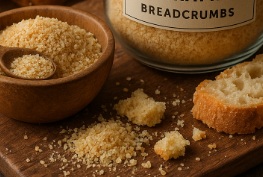
Breadcrumbs (pangrattato)DescriptionProduct made from bread (wheat flour, water, yeast, salt; sometimes oils and sugars) that is dried and milled to various particle sizes (fine/medium/coarse).Variant ...
Breadcrumbs (pangrattato)
Description
Product made from bread (wheat flour, water, yeast, salt; sometimes oils and sugars) that is dried and milled to various particle sizes (fine/medium/coarse).
Variants: classic breadcrumbs, wholemeal, seasoned (herbs, spices, cheese), and panko (light, irregular flakes from crustless bread).
Color ranges from straw to amber (toasted); flavor neutral to lightly toasty.

Caloric value (per 100 g)
Typically ~340–400 kcal/100 g (depends on fat content and moisture).
Indicative averages: carbohydrates ~65–75 g, protein ~10–13 g, fat ~2–8 g (↑ in seasoned types), fiber ~3–8 g (↑ wholemeal), salt variable.
Key constituents
Starch and dextrins (body and crunch), gluten (binding), wheat proteins.
Low lipids unless added (oils/butter/cheese).
Salt and flavorings in ready-to-use blends; possible herbs/spices.
Typical markers: low moisture, low aw, defined granulometry (sieving curve), color (L*a*b*), and peroxides if fats are present.
Production process
Baking (or qualified bread recovery) → slicing → controlled drying/toasting → milling and sieving → optional seasoning → cooling → packaging in dry or MAP conditions.
Managed under GMP/HACCP with CCP on final moisture, toasting temperature, foreign bodies, and seal integrity.
Sensory and technological properties
Provides crispness and browning via Maillard reactions; panko gives a more aerated, friable crust.
Oil uptake in frying increases with porosity and finer cuts.
Useful binder/absorber in panades and fillings; improves water retention in mixes.
Food uses
Breading (2–3 steps: flour → egg → crumbs), gratins, fillings, meatballs/loaves, burgers and croquettes, rustic thickener for sauces.
Panko suits light fries and voluminous crusts; fine cut is ideal for even gratins.
Nutrition and health
Predominantly carbohydrate; moderate-to-high energy depending on dose.
Wholemeal options provide more fiber and minerals.
Sodium varies: choose no-salt-added when needed.
Gluten-free alternatives available (rice, corn, legumes).
Quality and specifications (typical topics)
Moisture ≤8–10%, low aw; particle-size within spec; no burnt residues.
Microbiology: low counts (yeasts/molds within limits); pathogens absent/25 g.
Fat oxidation (for seasoned types): peroxides/TBA within limits.
Labeling: full ingredient list, allergens, and any additives (anti-caking, flavors).
Storage and shelf-life
Keep dry, well closed, away from light/heat.
Typical shelf-life 6–12 months (shorter if higher-fat recipes).
After opening, use within 2–4 months; avoid humidity (risk of caking and mold).
Allergens and safety
Contains gluten (wheat). Possible traces of milk, egg, soy, sesame, tree nuts in mixed facilities.
If bread used contains milk/eggs, these must appear on the label.
Follow GMP/HACCP; CCP on moisture, coding/seal, and foreign-body control.
INCI functions in cosmetics
Troubleshooting
Coating detaches: poor adhesion → use flour → egg → crumbs, rest 10–15 min, ensure a dry surface.
Soggy/greasy crust: oil too cool or crumb too fine → fry at 170–180 °C, use panko/coarser cut, avoid crowding.
Pale gratin: low oven heat/excess moisture → raise temperature/airflow, pre-toast crumbs.
Rancid note: fat oxidation in seasoned blends → check date, improve barrier pack, enforce FIFO rotation.
Dry mixes: too many crumbs → increase wet phase (milk/egg/broth) or reduce dose.
Sustainability and supply chain
Upcycling of unsold/qualified bread reduces food waste.
Energy efficiency in drying/toasting; effluent control to BOD/COD targets.
Recyclable packaging; low-humidity logistics; full traceability under GMP/HACCP.
Conclusion
Breadcrumbs are a versatile ingredient delivering crunch, structure, and binding across many applications. Particle size, moisture, and seasoning drive cook performance and sensory quality.
Mini-glossary
aw — Water activity: “free” water; lower aw improves shelf stability and limits mold.
GMP/HACCP — Good Manufacturing Practice / Hazard Analysis and Critical Control Points: hygiene/preventive systems with defined CCP.
CCP — Critical control point: step where a control prevents/reduces a hazard (e.g., final moisture, sealing).
MAP — Modified atmosphere packaging: N₂/CO₂ atmospheres to protect from oxidation/moisture.
L*a*b* — Color space: L* (lightness), a* (green↔red), b* (blue↔yellow).
FIFO — First in, first out: stock rotation that uses older lots first.
BOD/COD — Biochemical/Chemical oxygen demand: indicators of wastewater impact from processing.