

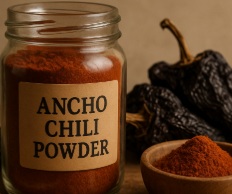
Dried ancho chili peppers (dried ripe poblano; Capsicum annuum L., family Solanaceae)
Description
The ancho is the fully ripe, dried poblano chile: large, heart-shaped, wrinkled pod, deep maroon–mahogany color, mild heat (~1,000–2,000 SHU).
Sensory profile: sweet, raisin/prune, hints of cocoa, coffee, tobacco, light earthiness; minimal bitterness if seeds/placenta are removed.

Caloric value (per 100 g)
Key constituents
Capsaicinoids at low levels (mainly capsaicin/dihydrocapsaicin).
Carotenoids (capsanthin, capsorubin, β-carotene), sugars (glucose/fructose), organic acids (malic/citric), fiber/pectins, minor polyphenols; vitamin C largely reduced by drying.
Analytical markers: SHU, capsaicinoids by HPLC, color (CIE L*a*b*; red products often report ASTA color), moisture/aw, mesh/particle size, defects/foreign matter.
Production process
Raw material: sound, field-ripened red poblanos.
Preparation: washing → destemming, deseeding (as required) → splitting/cutting.
Drying: sun/solar or hot-air dehydration with controlled time–temperature to targets moisture ≤10–12% and aw ≤0.60–0.65.
Sizing/screening, metal detection, and high-barrier packaging (often nitrogen-flushed).
Managed under GMP/HACCP with CCP on drying profile, foreign bodies, and pack integrity.
Sensory and technological properties
Blooming/toasting (brief, low heat) enhances volatiles; over-toasting yields bitterness.
Rehydration: soak in hot water/stock (∼60–80 °C, 15–30 min); blend to paste; strain to remove tough skins if desired.
Acid (vinegar/tomato) brightens fruit notes; fat (oil/nuts/seeds) rounds bitterness and carries aroma.
Food uses
Core chile in moles (e.g., mole poblano), adobos, enchilada/enchilamole sauces, salsas rojas, stews/chili con carne, dry rubs, sausages, marinades.
Typical dosages: powder 0.2–1.0% in blends; paste 1–5% of sauce weight; whole rehydrated 1–3% of finished product. Validate in pilot trials.
Nutrition and health
Low sodium, low fat at culinary portions; provides carotenoids and fiber (vs fresh).
Capsaicin may irritate in sensitive individuals; avoid unauthorized health claims.
Lipid profile
Very low total fat; traces from seeds/placenta only. Pattern is trace PUFA ≥ MUFA > SFA with no material impact at use levels.
Health note: diets favoring MUFA (monounsaturated fatty acids) and PUFA (polyunsaturated fatty acids) over SFA (saturated fatty acids) are generally favorable/neutral for blood lipids; here the effect is minimal. TFA (industrial trans fatty acids) absent; MCT (medium-chain triglycerides) not characteristic.
Quality and specifications (typical topics)
Moisture ≤10–12%, aw ≤0.60–0.65, uniform color (deep red-brown), low defects/foreign matter, absence of infestation.
Microbiology: APC within spec; yeasts/molds low; Salmonella absent/25 g.
Contaminants: pesticides/metals compliant; monitor mycotoxins (e.g., aflatoxins/ochratoxin A) and lead in imported powders.
Capsaicinoids/HPLC, ASTA color, mesh size for powders.
Storage and shelf-life
Store cool/dry/dark in oxygen/light-barrier packs; 12–24 months sealed.
Reseal after opening; after rehydration, treat as perishable (refrigerate; short hold).
Allergens and safety
Capsicum is not a major EU allergen; rare individual sensitivities exist.
Manage cross-contact on seasoning lines (sesame, celery, mustard, gluten/soy carriers). Use PPE when milling/powder handling.
INCI functions in cosmetics
Listings: Capsicum Annuum Fruit Extract/Powder (non-pungent to mildly pungent).
Roles: fragrance, mild warming/rubefacient; assess irritancy and color stability.
Troubleshooting
Bitter/ashy notes: over-toasting → reduce time/temp; remove seeds/placenta; balance with acid/fat.
Tough skins/gritty sauces: extend soak or lightly simmer, then blend and strain.
Dull color: oxidation/light → use amber/high-barrier packs; add chile late in cooking.
Caking in powders: high RH → add desiccant, improve barrier, consider anticaking.
Weak flavor: toast briefly, increase dose, or blend with guajillo/pasilla for complexity.
Sustainability and supply chain
Favor IPM cultivation and efficient irrigation; use solar drying where feasible.
Optimize dryer heat recovery; use recyclable/mono-material packs; treat plant effluents to BOD/COD targets; full traceability under GMP/HACCP.
Conclusion
Dried ancho delivers mild heat, lush dried-fruit sweetness, and signature color that define many Mexican sauces. Controlled drying/toasting/rehydration, good packaging, and spec standardization ensure safe, stable, and sensory-consistent results across applications.
Mini-glossary
SHU — Scoville heat units: pungency scale (ancho ≈ 1,000–2,000).
HPLC — High-performance liquid chromatography: quantifies capsaicinoids and identity markers.
ASTA (color) — American Spice Trade Association color index for red spice products.
aw — Water activity: low aw (≤0.60–0.65) limits microbial growth in dried goods.
SFA — Saturated fatty acids: excessive intakes may raise LDL; trace here.
MUFA — Monounsaturated fatty acids (e.g., oleic): generally favorable/neutral for blood lipids; trace here.
PUFA — Polyunsaturated fatty acids (e.g., linoleic): beneficial when balanced; trace here.
TFA — Trans fatty acids (industrial): avoid; absent in non-hydrogenated spices.
MCT — Medium-chain triglycerides: characteristic of coconut fat; not present in ancho.
GMP/HACCP — Good Manufacturing Practice / Hazard Analysis and Critical Control Points: hygiene/preventive-safety systems with defined CCP.
CCP — Critical control point: step where a control prevents/reduces a hazard.
BOD/COD — Biochemical/Chemical oxygen demand: indicators of effluent impact from processing.
References__________________________________________________________________________
Hernández, L. J., Montejo, N. C., Rangel, A. S., Torres, V. R., Rico, J. S. G. J. A., & Naveda, A. F. (2024). Agronomic and morphological evaluation of six genotypes and two hybrids of Poblano peppers in field conditions. Agro Productividad.
Abstract. Objective: to evaluate agronomic and morphological traits of six Poblano-type pepper genotypes, compared to a commercial hybrid and an experimental hybrid, in order to select genotypes with potential to continue with a plant breeding program. Design/ Methodology/ Approach: treatments and statistical model were arranged in randomized complete blocks, with eight treatments (six F2 genotypes, and two hybrids Carranza (commercial F1) and F402 (experimental F1). Treatments were analyzed with analysis of variance (p ≤ 0.05); then tested with Multiple Mean Comparison (Tukey, p ≤ 0.05) and Pearson Correlation Analysis. Results: no statistical differences were found in yield per plant (RPP), number of fruits per plant (NFP), average weight per fruit (PPF), plant height (AP), stem thickness (GT), leaf length (AL) and leaf width (AH). Regarding width at the base of the fruit (ABF) the hybrids were superior; in average width of the fruit the genotypes G4, G6 and the hybrids were better; in fruit length G2, G5 and G6 stood out; in calyx depth G1, G3 and G4; in length of the peduncle G4 was different from the others; and in thickness of the mesocarp (GM) the genotypes G2, G4, G6 and hybrids were superior. According to Pearson's correlation, the yield depended on NFP (0.66), MG (0.46), ABF (0.38), as it is shown by their coefficients.
Toledo-Aguilar, R., López-Sánchez, H., López, P. A., Guerrero-Rodríguez, J. D. D., Santacruz-Varela, A., & Huerta-de la Peña, A. (2016). Morphological diversity of native population’s poblano pepper. Revista mexicana de ciencias agrícolas, 7(5), 1005-1015.
Abstract. The genetic diversity in different types of pepper in Mexico has been little studied. The poblano pepper (Capsicum annuum L.) has great culinary importance as an ingredient in traditional dishes from Puebla; also constitutes a source of income for rural families in the region of the Sierra Nevada de Puebla; however, there is no study to determine the morphological diversity of native populations of this type of pepper found in this ecological niche. The aim of this study was to analyze the morphological diversity of native population’s poblano peppers de la Sierra Nevada de Puebla. By using descriptors were analyzed 41 populations of pepper poblano, four of ancho pepper, two of “Loco” pepper, one of “Miahuateco” and hybrid pepper ancho pepper “Doroteo” (Ahern Seeds®). An experimental design was used in three randomized complete block assessment in two locations. In the combined analysis of variance statistically significant difference in 60% of the variables found. With the selection of 30 morphological was performed variables principal component analysis, where populations of pepper poblano formed a group, away from the rest of populations evaluated and the hybrid. The cluster analysis was also performed, in which four subgroups were defined. The native populations that shaped each subgroup were not related to the geographical location of seed collection, suggesting the exchange of germplasm among farmers. In the native populations of pepper poblano morphological diversity found mainly in fruit variables, plant habit and earliness.
Santiago López, U., Ramírez Meraz, M., & Méndez Aguilar, R. (2018). HAP14F: hybrid of ancho poblano pepper for the Altiplano de México. Revista mexicana de ciencias agrícolas, 9(2), 481-485.
Abstract. In Mexico, the poblano pepper has great gastronomic, economic and social importance because it is a basic ingredient of traditional dishes. Obtaining low yields in the producing areas, mainly in the Altiplano de México, is due to the high use of creole seeds. To mitigate the aforementioned problem, INIFAP developed the HAP14F wide pepper poblano hybrid, which is an early cycle because it presents flowering and ripening at 39 and 118 days after transplantation (DDT), respectively. It produces fruits of intermediate green color in an immature state that turn a dark red color with a strong brilliance in a mature state. In open-pit evaluations, this hybrid had an average yield of 3.7 t ha-1 of dried or dehydrated chili and in green fruit it reached 23.1 t ha-1. For the aforementioned, HAP14F is considered a good alternative for the Altiplano de México.
Hernández Hernández, B. N., Tornero Campante, M. A., Sandoval Castro, E., Rodríguez Mendoza, M. D. L. N., Taboada Gaytán, O. R., & Peña Olvera, B. V. (2021). Growth, yield and quality of poblano chili pepper grown in hydroponics under greenhouse. Revista mexicana de ciencias agrícolas, 12(6), 1043-1056.
Abstract. The poblano chili pepper crop sown in soil in the Alto Atoyac in Puebla has been affected by the presence of diseases caused by fungi, bacteria and nematodes, generating losses in yield and reduction of the sowing area. The production under greenhouse and hydroponics is an alternative solution to this problem, since it allows the development of crops in a controlled environment using inert substrates, ensuring a greater percentage of production. The objective was to evaluate the growth, yield and fruit quality of two local varieties of poblano chili pepper (Tlacotepec and Tlalancaleca) and a commercial variety (San Luis), supplied nutritionally by three concentrations of the Steiner nutrient solution under greenhouse and hydroponics in order to know their agronomic and productive behavior. A 3x3 factorial treatment design in a completely randomized experimental design was considered. The variables evaluated were: plant height, stem thickness, number of leaves, number of bifurcations, number of flowers, yield and fruit quality. The results showed that the San Luis variety reached the highest yield and fruit quality. As for the three concentrations of nutrient solution, there was no significant effect on the yield and the agronomic behavior of creole varieties in the substrate, greenhouse and hydroponics system may be an option for the production of poblano chili pepper in the Alto Atoyac region