

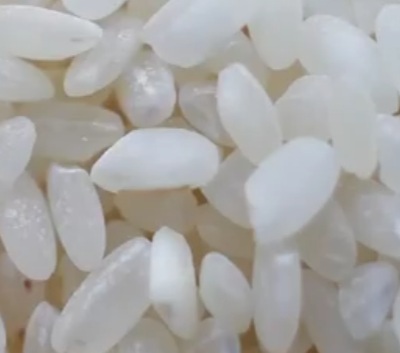
White rice (Oryza sativa L.)
Description
Hulled and milled/whitened cereal (husk, bran, and germ removed), with the kernel composed mostly of starch.
Types: long-grain (indica), medium/long A, and short-grain (japonica); parboiled variants (partial starch gelatinization) and enriched/fortified versions in some markets.
Sensory profile: mild flavor; textures range from fluffy and separate (higher amylose) to sticky (higher amylopectin).

Common name: White rice
Source plant: Oryza sativa L. (family Poaceae)
Kingdom: Plantae
Clade: Angiosperms
Clade: Monocots
Order: Poales
Family: Poaceae
Genus: Oryza
Species: Oryza sativa L.
Note: “White rice” is milled / polished rice, i.e. grains from which the bran layer, outer husk and germ have been removed. This improves shelf life and shortens cooking time but reduces fibre, vitamins, minerals and bioactive compounds compared with whole (brown) rice.
Cultivation and growing conditions of white rice (Oryza sativa)
Climate:
Prefers warm, humid climates.
Needs high temperatures throughout the growing cycle (ideal 20–30 °C).
Very sensitive to cold: temperatures below about 15 °C markedly slow development.
Exposure:
Requires full sun for good tillering, panicle formation and grain filling.
Shaded areas reduce yield.
Soil:
Traditionally grown in flooded fields (paddies), which help suppress weeds and improve nutrient availability.
Can also be grown as “upland” or “dryland” rice in some regions, provided soils are deep, loamy or clayey, and rich in organic matter.
Ideal pH: slightly acidic to neutral (about 5.5–7).
Watering / flooding:
In flooded systems, water depth is usually kept constant over most of the crop cycle (roughly 5–15 cm), with gradual drying towards maturity.
In non-flooded systems, frequent irrigation is needed to support tillering and grain formation while avoiding water stress.
Temperature:
Optimal germination: about 20–35 °C.
Flowering and grain filling require warm, stable temperatures.
Sudden cold spells, especially around flowering, can seriously reduce yield.
Fertilization:
Requires adequate nitrogen to support tillering and grain yield.
Phosphorus is important for root development.
Potassium enhances plant robustness and grain quality.
In many systems, nitrogen is applied in split doses during the crop cycle to optimize uptake and yield.
Crop management:
Weed control is essential, particularly in upland rice fields.
In flooded rice, careful management of water depth helps control weeds, reduce lodging and maintain root health.
Modern varieties are often selected for resistance or tolerance to common diseases such as blast.
Harvest:
Propagation:
Caloric value (per 100 g)
Raw: ~350–365 kcal; carbohydrate ~77–80 g, protein ~6–8 g, fat ~0.5–1.0 g, fiber low.
Cooked (absorption or excess-water methods): ~120–140 kcal (varies with hydration).
Sodium naturally low; added salt comes from cooking/seasoning.
Key constituents
Starch: the amylose/amylopectin ratio governs stickiness/firmness.
Proteins (mainly glutelins; lysine is limiting); fiber is very low due to milling.
B vitamins and minerals are reduced by whitening; fortified products may add B1, B3, iron, etc.
Inorganic arsenic: generally lower than in brown rice but location- and process-dependent.
Production process
Dehulling (husk removal) → milling/polishing (bran/germ removal) → screening and grading (whole vs broken) → optional parboiling (soak–steam–dry) → packaging under GMP/HACCP.
Optional fortification step; routine controls for moisture, varietal purity, metals/pesticides.
Sensory and technological properties
Gelatinization ~68–78 °C; water uptake typically 2–3× dry weight.
Retrogradation on cooling increases resistant starch (RS), affecting texture and glycemic response.
High-amylose rice yields separate grains (pilaf), while low-amylose favors adhesion (sushi).
Parboiled rice: firmer, less sticky, better hot-hold performance.
Food uses
Side dishes, risotti (Italian japonica types), pilaf, paella, sushi, soups, desserts (puddings), plus rice flours and rice noodles.
Typical water ratio: 1 part rice to 1.5–2.2 parts water (variety and method dependent).
Nutrition and health
Source of carbohydrates with GI from medium to high, modulated by cooling (raises RS), parboiling, higher-amylose varieties, and by adding fat/protein to the meal.
Naturally gluten-free (suitable for a gluten-free diet with cross-contact controls).
Arsenic: rinsing and cooking in excess water with draining can reduce part of the content; prefer suppliers/regions with low As.
Sodium low; fat and sugars negligible.
Lipid profile
Very low total fat; only trace amounts of SFA, MUFA, and PUFA with no meaningful nutritional impact.
Health note: a relatively higher share of MUFA/PUFA vs SFA is generally favorable/neutral for blood lipids, but the effect is not material in white rice.
Quality and specifications (typical topics)
Moisture (target 13–14%), broken percentage, kernel length/shape, degree of milling, chalkiness/whiteness, foreign matter.
Apparent amylose, pasting/viscosity profile, cooking yield.
Pesticides/metals (focus on As), mycotoxins (proper storage), foreign bodies.
For ready-to-eat: compliant microbiology and pH/aw.
Storage and shelf-life
Store cool and dry, protected from odors and infestation; keep sealed or under controlled atmosphere.
Typical shelf-life 24–36 months (white rice); apply FIFO.
Cooked rice is perishable: cool rapidly and hold <4 °C to prevent Bacillus cereus growth.
Allergens and safety
Rice is not a major EU allergen; individual sensitivities are rare.
Risk of gluten cross-contact in mixed mills/lines—verify certifications.
Manage CCP for foreign matter, pests, storage moisture, and hygiene.
INCI functions in cosmetics
Related materials: Oryza Sativa (Rice) Starch, Oryza Sativa (Rice) Bran Extract/Oil (from bran, not present in white rice), Hydrolyzed Rice Protein; functions absorbent/emollient/conditioning.
Troubleshooting
Overly sticky grains: rinse until water runs nearly clear; lower water ratio or use higher-amylose varieties.
Mushy/broken grains: excess agitation or overcooking; choose lower broken grade, control time.
Flat taste: light toasting, use stock instead of water, rest 5–10 minutes after cooking.
Hard core: increase water or time; for pilaf ensure proper toasting.
Insects/off-odors: improve barriers and warehouse sanitation; use traps or modified atmospheres.
Sustainability and supply chain
Traditional flooded paddies can produce CH₄ emissions and require water; practices like AWD (alternate wetting and drying) and efficient varieties can reduce impact.
Upcycling: broken rice → rice flour; bran/germ → rice oil.
Manage processing effluents to BOD/COD targets; use recyclable packaging; full traceability under GMP/HACCP.
Conclusion
White rice is a neutral, versatile ingredient with predictable technological behavior. Varietal choice, amylose/amylopectin balance, and controlled cooking deliver textures and yields suited to a wide range of applications while keeping a simple, adjustable nutritional profile.
Mini-glossary
GI — Glycemic index: blood-glucose response; medium–high for white rice, reducible via RS, parboiling, and meal composition.
RS — Resistant starch: undigested starch fraction; increases with cooling/storage of cooked rice.
SFA — Saturated fatty acids: excessive intake may raise LDL; trace in white rice.
MUFA — Monounsaturated fatty acids (e.g., oleic): generally favorable/neutral; trace in white rice.
PUFA — Polyunsaturated fatty acids (n-6/n-3): beneficial when balanced; trace in white rice.
TFA — Trans fatty acids: avoid industrial TFA; not relevant to dry rice.
ALA — Alpha-linolenic acid (n-3): precursor of EPA/DHA; irrelevant in white rice.
EPA/DHA — Long-chain n-3 fatty acids: present in fish, absent in rice.
MCT — Medium-chain triglycerides: not characteristic of rice.
GMP/HACCP — Good Manufacturing Practice / Hazard Analysis and Critical Control Points: hygiene and preventive-safety systems with defined CCP.
BOD/COD — Biochemical/Chemical oxygen demand: indicators of effluent impact.
FIFO — First in, first out: inventory rotation using the oldest lots first.
Studies
In general, rice contains more than 100 bioactive substances mainly in its bran layer including phytic acid, isovitexin, gamma-oryzanol, phytosterols, octacosanol, squalene, gamma-aminobutyric acid, tocopherol and derived from tocotrienol (1), antioxidants.
It does not contain beta carotene (provitamin A) and has a very low iron and zinc content (2).
In rice bran there are bioactive phytochemicals that exert protective actions against cancer that involve the metabolism of the host and the intestinal microbiome. A diet based on rice bran has shown positive effects in reducing the risk of colon cancer (3).
Rice studies
Allergies: Be careful, rice contains a certain amount of lactose.
The most common types of rice used are :
- Arborio : large grains, the most common in Italy
- Ribe : elongated grains.
- Thaibonnet : medium, elongated and fine grains
- Rome : large grains
- Basmati : thin and elongated grains. Grown in Pakistan and India
- Carnaroli : large grains
- Vialone nano : large, round grains
- Original or Balilla : small round grains
- Jasmine : fine grains of Asian origin
- Red : red, small and narrow grains
- Wild : Zizania palustris
- Baldo : large, shiny grains
- Ganges : from India
- Footboard : releases a lot of starch
- Venus : from China and the Po Valley
- Patna : from Thailand. Long and narrow grains
- Sant'Andrea : Thick and long grains. Releases a lot of starch
Rice viruses and pests: Pseudomonas aeruginosa, Rice yellow mottle virus, Magnaporthe oryzae , Rice Tungro Bacilliform Virus , Lissorhoptrus oryzophilus Kuschel, Oebalus pugnax, Xanthomonas oryzae
References____________________________________________________________________
(1) Bidlack W. Phytochemicals as bioacive agents. Lancaster, Basel, Switzerland: Technomic Publishing Co., Inc; 1999. pp. 25–36.
(2) Singh SP, Gruissem W, Bhullar NK. Single genetic locus improvement of iron, zinc and β-carotene content in rice grains. Sci Rep. 2017 Jul 31;7(1):6883. doi: 10.1038/s41598-017-07198-5.
Abstract. Nearly half of the world's population obtains its daily calories from rice grains, which lack or have insufficient levels of essential micronutrients. The deficiency of micronutrients vital for normal growth is a global health problem, and iron, zinc and vitamin A deficiencies are the most prevalent ones. We developed rice lines expressing Arabidopsis NICOTIANAMINE SYNTHASE 1 (AtNAS1), bean FERRITIN (PvFERRITIN), bacterial CAROTENE DESATURASE (CRTI) and maize PHYTOENE SYNTHASE (ZmPSY) in a single genetic locus in order to increase iron, zinc and β-carotene content in the rice endosperm. NAS catalyzes the synthesis of nicotianamine (NA), which is a precursor of deoxymugeneic acid (DMA) iron and zinc chelators, and also chelate iron and zinc for long distance transport. FERRITIN provides efficient storage of up to 4500 iron ions. PSY catalyzes the conversion of GGDP to phytoene, and CRTI performs the function of desaturases required for the synthesis of β-carotene from phytoene. All transgenic rice lines have significantly increased β-carotene, iron, and zinc content in the polished rice grains. Our results establish a proof-of-concept for multi-nutrient enrichment of rice grains from a single genetic locus, thus offering a sustainable and effective approach to address different micronutrient deficiencies at once.
(3) Zarei I, Oppel RC, Borresen EC, Brown RJ, Ryan EP. Modulation of plasma and urine metabolome in colorectal cancer survivors consuming rice bran. Integr Food Nutr Metab. 2019 May;6(3). doi: 10.15761/IFNM.1000252.
Abstract. Rice bran has bioactive phytochemicals with cancer protective actions that involve metabolism by the host and the gut microbiome. Globally, colorectal cancer (CRC) is the third leading cause of cancer-related death and the increased incidence is largely attributed to poor dietary patterns, including low daily fiber intake. A dietary intervention trial was performed to investigate the impact of rice bran consumption on the plasma and urine metabolome of CRC survivors. Nineteen CRC survivors participated in a randomized-controlled trial that included consumption of heat-stabilized rice bran (30 g/day) or a control diet without rice bran for 4 weeks. A fasting plasma and first void of the morning urine sample were analyzed by non-targeted metabolomics using ultrahigh-performance liquid chromatography-tandem mass spectrometry (UHPLC-MS/MS). After 4 weeks of either rice bran or control diets, 12 plasma and 16 urine metabolites were significantly different between the groups (p≤0.05). Rice bran intake increased relative abundance of plasma mannose (1.373-fold) and beta-citrylglutamate (BCG) (1.593-fold), as well as increased urine N-formylphenylalanine (2.191-fold) and dehydroisoandrosterone sulfate (DHEA-S) (4.488-fold). Diet affected metabolites, such as benzoate, mannose, eicosapentaenoate (20:5n3) (EPA), and N-formylphenylalanine have been previously reported for cancer protection and were identified from the rice bran food metabolome. Nutritional metabolome changes following increased consumption of whole grains such as rice bran warrants continued investigation for colon cancer control and prevention attributes as dietary biomarkers for positive effects are needed to reduce high risk for colorectal cancer recurrence.
Brown DG, Borresen EC, Brown RJ, Ryan EP. Heat-stabilised rice bran consumption by colorectal cancer survivors modulates stool metabolite profiles and metabolic networks: a randomised controlled trial. Br J Nutr. 2017 May;117(9):1244-1256. doi: 10.1017/S0007114517001106.
Abstract. Rice bran (RB) consumption has been shown to reduce colorectal cancer (CRC) growth in mice and modify the human stool microbiome. Changes in host and microbial metabolism induced by RB consumption was hypothesised to modulate the stool metabolite profile in favour of promoting gut health and inhibiting CRC growth. The objective was to integrate gut microbial metabolite profiles and identify metabolic pathway networks for CRC chemoprevention using non-targeted metabolomics. In all, nineteen CRC survivors participated in a parallel randomised controlled dietary intervention trial that included daily consumption of study-provided foods with heat-stabilised RB (30 g/d) or no additional ingredient (control). Stool samples were collected at baseline and 4 weeks and analysed using GC-MS and ultra-performance liquid chromatography-MS. Stool metabolomics revealed 93 significantly different metabolites in individuals consuming RB. A 264-fold increase in β-hydroxyisovaleroylcarnitine and 18-fold increase in β-hydroxyisovalerate exemplified changes in leucine, isoleucine and valine metabolism in the RB group. A total of thirty-nine stool metabolites were significantly different between RB and control groups, including increased hesperidin (28-fold) and narirutin (14-fold). Metabolic pathways impacted in the RB group over time included advanced glycation end products, steroids and bile acids. Fatty acid, leucine/valine and vitamin B6 metabolic pathways were increased in RB compared with control. There were 453 metabolites identified in the RB food metabolome, thirty-nine of which were identified in stool from RB consumers. RB consumption favourably modulated the stool metabolome of CRC survivors and these findings suggest the need for continued dietary CRC chemoprevention efforts.
Beyer P, Al-Babili S, Ye X, Lucca P, Schaub P, Welsch R, Potrykus I. Golden Rice: introducing the beta-carotene biosynthesis pathway into rice endosperm by genetic engineering to defeat vitamin A deficiency. J Nutr. 2002 Mar;132(3):506S-510S. doi: 10.1093/jn/132.3.506S.
Abstract. To obtain a functioning provitamin A (beta-carotene) biosynthetic pathway in rice endosperm, we introduced in a single, combined transformation effort the cDNA coding for phytoene synthase (psy) and lycopene beta-cyclase (beta-lcy) both from Narcissus pseudonarcissus and both under the control of the endosperm-specific glutelin promoter together with a bacterial phytoene desaturase (crtI, from Erwinia uredovora under constitutive 35S promoter control). This combination covers the requirements for beta-carotene synthesis and, as hoped, yellow beta-carotene-bearing rice endosperm was obtained in the T(0)-generation. Additional experiments revealed that the presence of beta-lcy was not necessary, because psy and crtI alone were able to drive beta-carotene synthesis as well as the formation of further downstream xanthophylls. Plausible explanations for this finding are that these downstream enzymes are constitutively expressed in rice endosperm or are induced by the transformation, e.g., by enzymatically formed products. Results using N. pseudonarcissus as a model system led to the development of a hypothesis, our present working model, that trans-lycopene or a trans-lycopene derivative acts as an inductor in a kind of feedback mechanism stimulating endogenous carotenogenic genes. Various institutional arrangements for disseminating Golden Rice to research institutes in developing countries also are discussed.