

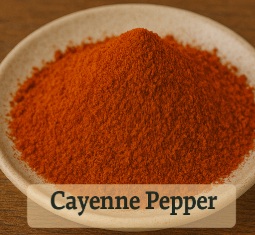
Cayenne pepper
Rating : 6
| Evaluation | N. Experts | Evaluation | N. Experts |
|---|---|---|---|
| 1 | 6 | ||
| 2 | 7 | ||
| 3 | 8 | ||
| 4 | 9 | ||
| 5 | 10 |
Cons:
Avoid excessive amounts (1)0 pts from Al222
| Sign up to vote this object, vote his reviews and to contribute to Tiiips.Evaluate | Where is this found? |
| "Descrizione" about Cayenne pepper by Al222 (23254 pt) | 2025-Nov-26 19:01 |
| Read the full Tiiip | (Send your comment) |
Cayenne pepper (Capsicum annuum L./C. frutescens, family Solanaceae)
Description
• Spice made from dried, ground red pods of medium-to-hot cultivars; typically a pure powder (not to be confused with blended U.S.-style chili powder).
• Sensory profile: hot, pungent, with fruity and slightly smoky notes; bright red color.
• Typical heat: ~30,000–50,000 SHU (varies by cultivar and lot).

Common name: Cayenne pepper
Parent plant: Capsicum annuum L.
Kingdom: Plantae
Clade: Angiosperms
Clade: Eudicots
Order: Solanales
Family: Solanaceae
Genus: Capsicum
Species: Capsicum annuum L.
Climate:
Cayenne pepper requires a warm, stable climate with long, frost-free summers. The plants are sensitive to cold and perform best in temperate–warm environments.
Sun exposure:
It prefers full sun. Direct light promotes flowering, fruit set, and the accumulation of capsaicinoids (the compounds responsible for pungency).
Soil:
It grows well in well-drained, medium-textured soils, rich in organic matter and slightly acidic to neutral (pH 6.0–7.0). Waterlogging can cause root rots.
Irrigation:
It needs moderate, regular moisture. Water supply should be sufficient during early growth and vegetative development, but reduced during fruit ripening to intensify flavor and prevent fruit cracking.
Temperature:
Optimal germination occurs between 20 and 30 °C. Ideal growth is between 22 and 28 °C. Temperatures below 12 °C slow development, while values above 35 °C can reduce fruit set.
Fertilization:
Cayenne pepper requires a good potassium supply, which is crucial for fruiting. Balanced inputs of phosphorus and nitrogen improve vigor and yield. Organic matter enhances overall soil fertility.
Crop care:
Light hoeing helps keep the soil loose and free from weeds. Plants benefit from mulching to retain moisture and limit weed growth. Monitoring and control of aphids, thrips, and mites is often necessary, as these pests commonly affect peppers.
Harvest:
Harvest takes place when fruits turn bright red. At full maturity, the flesh concentrates capsaicin and aroma. Fruits destined for drying are harvested fully ripe to preserve color and pungency.
Propagation:
Cayenne pepper is propagated by seed. Sowing is done in seedbeds at the end of winter, with transplanting in spring when soil temperature is consistently above 15 °C. Crop rotation is recommended to avoid the build-up of typical Solanaceae pests and diseases.
Caloric value (per 100 g)
• ~280–360 kcal/100 g (depends on seed/oil content).
• Indicative: carbohydrate 50–60 g, fiber 25–35 g, protein 10–15 g, fat 10–17 g; sodium naturally low.
Key constituents
• Capsaicinoids: chiefly capsaicin and dihydrocapsaicin (heat drivers; often 0.2–1.0% w/w).
• Carotenoids: capsanthin, capsorubin, zeaxanthin, β-carotene (color and antioxidant activity).
• Volatiles with fruity/herbaceous character (terpenes, aldehydes).
• Fixed oil from seeds (triacylglycerols) dominated by PUFA (linoleic n-6) with some MUFA (oleic).
• Analytical markers: SHU/capsaicinoids (HPLC), ASTA color, moisture and aw.
Production process
• Harvest ripe pods → controlled drying (air/tunnel) to target moisture.
• Cleaning/destemming → optional light toasting → milling to specified particle size.
• Sanitization (steam or equivalent) → sieving → barrier packaging under GMP/HACCP.
Sensory and technological properties
• Fat phases extract capsaicinoids efficiently → fuller heat perception; brief heating can intensify pungency.
• Disperses well in oil/alcohol; in water, consider emulsification.
• Contributes color, aroma, and Maillard cues; strong synergy with cumin, garlic, onion, and acids (vinegar, lime).
Food uses
• Hot sauces, rubs and marinades for meats/fish, stews and legumes, snack seasonings, cured meats, chili oils.
• Typical inclusion: 0.05–0.6%; validate target SHU and color via pilot trials.
Nutrition and health
• Source of fiber and carotenoids; fat and sodium are low at culinary doses.
• Capsaicin may elicit a warming effect and mild thermogenesis, but can irritate GI tract and mucosa in sensitive individuals.
• For those with reflux/ulcers or sensitive skin/mucosa: use lower doses or milder varieties. Avoid unauthorized health claims.
Lipid profile
• Overall fat modest; pattern typically PUFA > MUFA >> SFA (nutritional impact negligible at use levels).
• Health note: a relatively higher MUFA/PUFA share vs SFA is generally favorable/neutral for blood lipids.
Quality and specifications (typical topics)
• Moisture (often ≤10–12%), aw, particle size, ASTA color, capsaicinoids/SHU.
• Microbiology (TVC, yeasts/molds) compliant; absence of pathogens; pesticides/metals within limits; mycotoxins (e.g., aflatoxins, OTA) per spice standards.
• Authenticity/adulteration control: free of unauthorized colorants; seeds/stems within spec.
Storage and shelf-life
• Store cool, dry, and protected from light/oxygen; reclose promptly.
• Prone to caking and color fading: use barrier packs; add desiccant if needed.
• Typical shelf-life 12–24 months if parameters remain within spec (FIFO).
Allergens and safety
• Cayenne is not an EU major allergen, but can cause skin/eye irritation and reactions in sensitive individuals.
• Production: use dust PPE, ensure ventilation; prevent cross-contamination; manage CCP within HACCP.
INCI functions (cosmetics)
• Typical entries: Capsicum Annuum/Capsicum Frutescens Fruit Extract/Oleoresin.
• Roles: mild rubefacient/warming effect, stimulant at low doses, natural red colorant (oleoresins). Manage sensitization and observe use limits.
Troubleshooting
• Dull color/oxidation: light/oxygen exposure → upgrade barrier, low-O₂ filling.
• Dusty/rancid notes: excess seeds or oxidation → better raw selection, low-temperature milling, FIFO rotation.
• Inconsistent heat: cultivar/lot variability → standardize via blending and HPLC/SHU control.
• Caking: high RH → stronger packaging barrier, permitted anti-caking agent, add desiccant.
Sustainability and supply chain
• Upcycle seeds/stems for oil/oleoresin extraction; valorize trimming fines.
• Manage effluents to BOD/COD targets; use recyclable packaging; supplier audits and traceability under GMP/HACCP.
• Protect workers from capsaicin dust (ventilation, PPE).
Conclusion
Cayenne pepper provides clean heat, vivid color, and wide versatility. Varietal selection, tight control of SHU/capsaicinoids, and protection from light/humidity ensure consistent performance and high-quality sensory delivery.
Mini-glossary
• SHU — Scoville heat units: sensory heat scale proportional to capsaicinoid content.
• ASTA — Standardized color value metric for spices.
• aw — Water activity: free water available to microbes; lower aw improves stability.
• SFA — Saturated fatty acids: excess may raise LDL; typically trace here.
• MUFA — Monounsaturated fatty acids (e.g., oleic): generally favorable/neutral; low here.
• PUFA — Polyunsaturated fatty acids (n-6/n-3): beneficial when balanced; overall low here.
• GMP/HACCP — Good Manufacturing Practice / Hazard Analysis and Critical Control Points: hygiene and preventive-safety frameworks.
• BOD/COD — Biochemical/Chemical Oxygen Demand: indicators of wastewater impact.
• CCP — Critical Control Point: step where a control prevents/reduces a hazard.
• FIFO — First in, first out: stock rotation using older lots first.
References__________________________________________________________________________
Sarabon N, Löfler S, Cvecka J, Hübl W, Zampieri S. Acute effect of different concentrations of cayenne pepper cataplasm on sensory-motor functions and serum levels of inflammation-related biomarkers in healthy subjects. Eur J Transl Myol. 2018 Mar 1;28(1):7333. doi: 10.4081/ejtm.2018.7333.
Abstract. Physical medicine therapies are often used in treating widespread musculoskeletal disorders, such as neck and low back pain. Herbal cataplasms containing rubefacient substances, such as Cayenne pepper, or galenic preparations like Munari cataplasm are commonly used as natural medications to treat painful areas. In this paper we show the effects of a 20-min application of Cayenne pepper and kaolin powder cataplasm (CPC) on healthy subjects. Treatment effects were evaluated by cold/hot feeling on visual analogue scale, blood pressure, body temperature, skin light touch sensations, two-point discrimination, and pain threshold to a mechanical stimulus, before and immediately after, 15 min after and 30 min after different concentration of Cayenne pepper in CPC preparation on healthy subjects. Maximal voluntary trunk extension force and trunk extension submaximal force matching error were also measured. In addition, the resulting optimal CPC mixture was tested for its safety by measuring changes in circulating levels of inflammatory-related biomarkers after 20-min application. The results indicate that the 5% concentration of Cayenne pepper in the preparation of CPC is the best choice, since no additional effects can be obtained with the 10% concentration, and the effects are higher than those observed at the 2.5% concentration. Importantly, 5% CPC application did not induce a significant increase of inflammatory-related biomarkers, suggesting that 20-min application has no negative side effects at systemic levels. Further studies are needed to investigate the immediate and long-term effects of repeated CPC applications as well as to understand the intersecting underlying mechanisms activated by Capsaicin and other identified factors, in order to be more extensively used in the field of physical medicine therapies.
Knazicka Z, Galik B, Novotna I, Arvay J, Fatrcova-Sramkova K, Kacaniova M, Mlcek J, Kovacikova E, Mixtajova E, Jurikova T, Ivanisova E, Kolesarova A, Duranova H. Enhancing Commercial Gourmet Oil Quality: The Role of Dried Cayenne Pepper Red (Capsicum annuum L.) as a Natural Additive. Molecules. 2025 Feb 17;30(4):927. doi: 10.3390/molecules30040927.
Abstract. This study assessed the potential of dried Cayenne pepper (CP; Capsicum annuum L.) as a natural additive to rice bran oil (RBO), grape seed oil (GSO), and virgin olive oil (OO). Key analyses included peroxide and acid values, oxidative stability (Rancimat method), the composition of fatty acids (FAs) (GC-FID method), antioxidant activity (AA; DPPH method), and antimicrobial properties (disc diffusion method). Capsaicin and the dihydrocapsaicin contents in CP were quantified (HPLC-DAD method) as 1499.37 ± 3.64 and 1449.04 ± 5.14 mg/kg DW, respectively. Oleic acid (C18:1cis n9) dominated in OO (69.70%), OO-CP (69.73%), and RBO-CP (38.97%), while linoleic acid (C18:2cis n6) prevailed in RBO (41.34%), GSO (57.93%), and GSO-CP (58.03%). The addition of CP influenced the FA profile, particularly linoleic acid in OO and RBO, and all FAs in GSO. Peroxide and acid values increased significantly in RBO and GSO upon CP addition, but induction times remained unaffected. The strongest AA (77.00 ± 0.13%) was observed in OO-CP. Cayenne pepper significantly enhanced the antioxidant profiles of all oils compared to the counterparts. However, the antimicrobial activity was weak (≤5.0 mm inhibition zones) against tested microorganisms. These findings support CP as a functional additive for enhancing the nutritional and functional properties of gourmet oils, while highlighting the need for further optimization to improve stability and bioactivity.
Abstract. Background: Herbal drug delivery is limited by poor solubility and bioavailability which can be overcome with suitable nanomaterials that will enhance their pharmacokinetics and performance. Objective: This study aimed to analyze the synthesis, characterization, and biological activities of silver nanoparticles (AgNPs) from three spices. Materials and methods: AgNPs were prepared using 0.1 M silver nitrate and aqueous extracts of Allium sativum L. (garlic), Zingiber officinale Rosc. (ginger), and Capsicum frutescens L. (cayenne pepper). The AgNPs were characterized using ultraviolet-visible (UV-Vis) spectroscopy, scanning electron microscopy (SEM), transmission electron microscopy (TEM), energy dispersive X-ray, X-ray diffraction (XRD), and Fourier transform infrared (FTIR) spectroscopy. Results: The AgNPs were formed within an hour of the reaction and showed maximum UV-Vis absorption in the 375-480 nm range. SEM and TEM revealed well-dispersed spherical particles with little agglomeration, average sizes of 3-6 nm, 3-22 nm, and 3-18 nm for garlic, ginger, and cayenne pepper, respectively. FTIR showed that amine, protein, phenolic, aromatic, and alkynes groups contributed to AgNP synthesis and XRD confirmed their crystalline and face-centered cubic nature. Antibacterial action of the AgNPs was in the following order: ginger (minimum inhibitory concentration [MIC] <25 μg/mL) > garlic> cayenne pepper (MIC 125 μg/mL). Antioxidant action showed cayenne pepper > ginger > garlic (inhibitory concentration 50% [IC50]: 40, 240, and 250 μg/mL, respectively) against 2,2-Azino-bis (3-ethylbenzthiazoline-6-sulfonic acid) and garlic > cayenne pepper > ginger (IC50: <31.25, 40, and 120 μg/mL, respectively) against 1,1-diphenyl-2-picrylhydrazyl. Conclusion: Optimization of this green synthesis would support the production of AgNPs with great therapeutic potentials.
Yang L, Sun J, Zhao M, Xi B. Chili pepper intake and all-cause and disease-specific mortality. Int J Vitam Nutr Res. 2023 Aug;93(4):378-384. doi: 10.1024/0300-9831/a000746.
Abstract. Background: Chili pepper has been used for the treatment and prevention of multiple diseases. This may be due to its abundance of bioactive components, such as carotenoids, which are well known for their antioxidant properties. To date, several prospective cohort studies have examined the association between chili pepper intake and mortality, but the results have not been consistent. This study aimed to clarify the association between chili pepper intake and all-cause and disease-specific mortality using a meta-analysis. Methods: PubMed, Embase, and ISI Web of Science databases were searched up to December 20, 2020, and reference lists of included studies were manually reviewed. All prospective cohort studies on the association between chili pepper intake and all-cause, cardiovascular disease (CVD)-specific, and cancer-specific mortality were included in this study. Pooled hazard ratios (HRs) and 95% confidence intervals (CIs) were calculated in the meta-analysis. Between-study heterogeneity was assessed using I2 statistic and Q test. Results: A total of 4 cohort studies (N=564,748; all four studies had adjusted for important potential confounders such as demographic variables, dietary intake, and physical activity) were ultimately included in this meta-analysis. Among them, 31,527 died due to all causes, 10,184 died due to CVD, and 9,868 died due to cancer. Compared to none or rare consumption of chili pepper, consumption of chili pepper (ever or more than once a week) could significantly reduce the risk of all-cause mortality (summary adjusted HR: 0.87, 95% CI: 0.85, 0.90), CVD-specific mortality (summary adjusted HR: 0.89, 95% CI: 0.85, 0.93), and cancer-specific mortality (summary adjusted HR: 0.92, 95% CI: 0.88, 0.97). There was no significant between-study heterogeneity in the analyses (all-cause mortality: I2=0.7%, P=0.389; CVD-specific mortality: I2=21.8%, P=0.280; cancer-specific mortality: I2=0.0%, P=0.918). Conclusions: The present meta-analysis confirmed that chili pepper intake could reduce the risk of all-cause, CVD-specific, and cancer-specific mortality, suggesting that chili pepper may be a beneficial ingredient in the diets in prolonging life.
Luo L, Yan J, Wang X, Sun Z. The correlation between chili pepper consumption and gastric cancer risk: A meta-analysis. Asia Pac J Clin Nutr. 2021;30(1):130-139. doi: 10.6133/apjcn.202103_30(1).0016.
Abstract. Background and objectives: The correlation between chili pepper intake and gastric cancer (GC) risk has been controversial. We conducted a meta-analysis of 16 studies to provide updated evidence for this uncertainty. Methods and study design: Medline, and China National Knowledge Infrastructure (CNKI) databases were searched to obtain all qualified literature related to pepper consumption and GC incidence before June 2020. Random effects models were adopted to integrate the relative risk of individual studies. The Newcastle-Ottawa Scale (NOS) was used to assess the quality of the literature of each included study. Dose response meta-analysis was implemented through the one-stage robust error meta-regression (REMR) approach. Results: 16 studies (8337 cases) were included in quantitative meta-analysis. The pooled odds ratio (OR) of GC for the highest versus the lowest category of chili consumption were 1.51 (95% confidence interval [CI]=1.02-2.00) for all countries, 2.05 (95% CI=1.15-2.95) for Mexican, 2.03 (95% CI =0.71-3.34) for Colombian, 1.92 (95% CI=1.21-2.64) for Asian and 0.48 (95% CI=0.24-0.72) for other countries. Dose-response meta-analysis showed that there was a positive linear correlation between the risk of GC and the daily frequency of chili consumption. Conclusions: Significantly increased consumption of chili pepper or capsaicin has the potential to increase the risk of gastric cancer, however, inconsistencies still exist in subgroup analysis between different regions.
Ao Z, Huang Z, Liu H. Spicy Food and Chili Peppers and Multiple Health Outcomes: Umbrella Review. Mol Nutr Food Res. 2022 Dec;66(23):e2200167. doi: 10.1002/mnfr.202200167. Epub 2022 Oct 19. PMID: 36111960; PMCID: PMC10078540.
| Sign up to vote this object, vote his reviews and to contribute to Tiiips.EvaluateClose | (0 comments) |
Read other Tiiips about this object in __Italiano (1)
Content:   Last update:   2025-10-29 10:26:00 | Kcal/100g:   360 Family:   Threat factors:   |

