

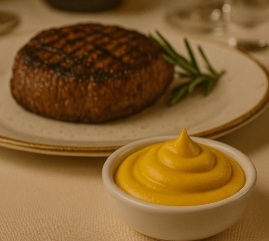
Yellow mustard
Rating : 7
| Evaluation | N. Experts | Evaluation | N. Experts |
|---|---|---|---|
| 1 | 6 | ||
| 2 | 7 | ||
| 3 | 8 | ||
| 4 | 9 | ||
| 5 | 10 |
Cons:
Allergen (1)0 pts from Al222
| Sign up to vote this object, vote his reviews and to contribute to Tiiips.Evaluate | Where is this found? |
| "Descrizione" about Yellow mustard by Al222 (23486 pt) | 2025-Nov-26 19:16 |
| Read the full Tiiip | (Send your comment) |
Yellow mustard (American mustard; from Sinapis alba L., family Brassicaceae)
Description
• Mild, smooth condiment made predominantly from white/yellow mustard seeds (Sinapis alba) that are finely ground and hydrated with water, vinegar (or other acids), salt, often a little sugar, turmeric (for the bright yellow color), and spices.
• Moderate pungency: yellow seeds are rich in sinalbin (a glucosinolate) which, via myrosinase hydrolysis, forms isothiocyanates that are softer/less aggressive and less stable than allyl isothiocyanate from brown/black mustards.
• Bright yellow appearance (curcumin), spreadable-to-pourable texture depending on recipe and stabilizers (e.g., xanthan).

Common name: American mustard (yellow mustard)
Parent plant: Sinapis alba L. — also known as white or yellow mustard
Kingdom: Plantae
Clade: Angiosperms
Clade: Eudicots
Order: Brassicales
Family: Brassicaceae
Genus: Sinapis
Species: Sinapis alba L.
Climate:
American mustard prefers temperate to cool climates. It is a rather hardy species and tolerates low temperatures well during the early growth stages. Moderate temperatures promote uniform germination and good production of flowers and seeds. Prolonged high temperatures can accelerate flowering and reduce yield.
Sun exposure:
It requires full sun to develop properly. Constant direct light improves photosynthesis, inflorescence formation, and seed maturation.
Soil:
It grows well in well-drained, medium-textured soils that are rich in organic matter. The ideal pH ranges from 6.0 to 7.5. Waterlogging should be avoided, as it can cause root rot and weaken the plants.
Irrigation:
Water requirements are moderate. Soil should remain slightly moist during germination and flowering, while irrigation should be reduced in the final stages to prevent diseases and lodging of the plants.
Temperature:
Optimal germination: 10–20 °C
Ideal vegetative growth: 15–25 °C
Temperatures above 30 °C can hasten maturation and reduce seed size.
Fertilization:
The crop benefits from balanced fertilization:
Nitrogen: needed in the early stages to promote leaf growth, but in moderate amounts.
Phosphorus: essential for root development and flowering.
Potassium: important for seed formation and resistance to environmental stress.
A good sulfur supply is beneficial, since this species produces glucosinolates typical of the Brassicaceae family.
Crop care:
Light hoeing to keep the soil aerated and free from weeds.
Possible use of mulching to reduce weed growth and conserve soil moisture.
Control of flea beetles, aphids, and other insects common on crucifer crops.
Prevention and monitoring of fungal diseases such as alternaria and powdery mildew.
Harvest:
Harvest takes place when the plants turn yellow and the seed pods (siliques) begin to dry. It is important not to delay harvest, as mature fruits can open spontaneously, causing seed loss. After harvesting, seeds should be further dried to around 10% moisture.
Propagation:
American mustard is propagated by seed. Sowing is carried out in spring or late summer, depending on the desired cropping cycle. Crop rotation with cereals or legumes is recommended to limit diseases and pests typical of Brassicaceae.
Caloric value (per 100 g)
• Typically ~55–80 kcal/100 g (varies with added sugar/oil).
• Approximate macros: carbohydrate ~5–10 g, protein ~3–6 g, fat ~3–6 g; sodium often high (0.8–1.8 g/100 g) due to salt.
• Typical serving (5 g, ~1 tsp): low energy contribution.
Key constituents
• Glucosinolates: sinalbin (marker of yellow mustard) → p-hydroxybenzyl isothiocyanate (mild, short-lived heat).
• Enzymes/metabolites: myrosinase, hydrolysis products (isothiocyanates, nitriles); phenolics and sulfur volatiles.
• Turmeric/curcumin as a natural colorant; organic acids (acetic, citric).
• Possible stabilizers/emulsifiers (xanthan, starches) and sweeteners depending on style.
Production process
• Cleaning and milling of seeds (sometimes partial defatting).
• Hydration with water/vinegar/salt under controlled pH and temperature (pungency tuning).
• Blending with turmeric/spices; refining and homogenizing to target texture.
• Cold maturation (flavor development), then filling and mild pasteurization or hot-fill where specified.
• Process controls under GMP/HACCP (pH, viscosity, color, hygiene).
Sensory and technological properties
• Aroma: light lactic–acetic tang with clean spicy/sulfur notes; pungency is brief and rounded.
• Functionality: gentle acidifier and flavor enhancer (synergy with salt/sugar); provides light emulsification in sauces/fillings.
• Typical pH ~3.0–3.8; moderate aw; good microbiological stability from acid/salt/isothiocyanates.
Food uses
• Table condiment for hot dogs, burgers, sandwiches, potato salad, BBQ sauces, honey mustard, light marinades.
• In processing: base for mayonnaise/mayo-style, dressings, and emulsified sauces; seasoning for snacks and savory baked goods.
• Typical inclusion: 2–10% in sauces/dressings; to taste as a tabletop condiment.
Nutrition and health
• Low-calorie per serving; sodium can be significant—consider in low-salt diets.
• Seeds provide fiber and protein; fat in the finished condiment is modest but present in seeds (see lipid profile).
• EU major allergen: mustard must be declared on labels.
• Isothiocyanates contribute pungency and mild antimicrobial effects; avoid unauthorized health claims.
Lipid profile (seed-based; much lower in the finished condiment)
• SFA (saturated fatty acids) ~5–8%—primarily palmitic/stearic (limit excess for LDL concerns).
• MUFA (monounsaturated fatty acids) ~55–65%—mainly oleic, with variable erucic acid in some oils (generally neutral/favorable for blood lipids; monitor erucic compliance).
• PUFA (polyunsaturated fatty acids) ~20–30%—linoleic (n-6) and ALA (n-3) in low amounts (beneficial when balanced).
• Note: commercial yellow mustard condiment is low-fat; erucic considerations apply to mustard oil/extracts, not typical table mustard.
Quality and specifications (typical topics)
• pH, viscosity (e.g., Brookfield), color (L, a, b***; curcumin), salt and sugars; glucosinolate/isothiocyanate profile as process marker.
• Microbiology compliant (pathogen-free); metals/pesticides within limits; no foreign matter.
• Stability: free from syneresis/phase separation; consistent aroma/color lot-to-lot.
Storage and shelf-life
• Store cool and dark, tightly closed; protect from oxygen/light (curcumin fading).
• After opening: refrigerate and use ideally within 4–8 weeks; avoid cross-contamination.
• Apply FIFO; avoid temperature cycling that drives separation or browning.
Allergens and safety
• Allergen: mustard; watch potential cross-contact with other Brassicaceae.
• Sodium often high in classic recipes; consider reduced-salt options.
• Use food-contact materials compatible with acidic pH; full traceability and HACCP controls.
INCI functions in cosmetics
• Typical entries: Sinapis Alba (White Mustard) Seed Extract/Powder, Brassica Alba Seed Extract; for oil: Sinapis Alba Seed Oil.
• Roles: mild rubefacient/warming in traditional topicals; masking aroma. Use selectively due to sensitization potential.
Troubleshooting
• Liquid separation/syneresis: low viscosity/unstable emulsion → increase xanthan/starches, improve homogenization.
• Dull/browned color: oxidation/light → barrier packaging, permitted antioxidants, cold chain.
• Too little heat: enzyme inactivation or early acidification → allow hydration time before acid addition; tune pH/temperature.
• Bitter/metallic notes: oxidized spices or metal contact → fresher inputs; check equipment compatibility.
Sustainability and supply chain
• Brassicaceae rotations support soil health; press cakes/pomace valorized in feed.
• Effluents managed to BOD/COD targets; recyclable packaging; supplier audits and traceability.
• Production under GMP/HACCP for consistent quality and reduced waste.
Conclusion
Yellow mustard delivers a sweet-spicy profile with moderate pungency and low per-serving calories. Proper control of hydration, pH, and maturation, plus protection from light/oxygen, ensures sensory and microbial stability, while complying with mustard allergen labeling and quality specs.
Mini-glossary
• SFA — Saturated fatty acids: limit excess; high intake may raise LDL.
• MUFA — Monounsaturated fatty acids (e.g., oleic): generally favorable/neutral for blood lipids; monitor erucic in mustard oils.
• PUFA — Polyunsaturated fatty acids (n-6/n-3): beneficial when balanced; ALA is the plant n-3 precursor.
• ALA — Alpha-linolenic acid (n-3): precursor to EPA/DHA; human conversion is limited.
• EPA/DHA — Long-chain omega-3 fatty acids: essentially absent in mustard seeds.
• GMP — Good Manufacturing Practice: hygiene and process-consistency standards.
• HACCP — Hazard Analysis and Critical Control Points: preventive system with defined CCP.
• BOD/COD — Biochemical/Chemical Oxygen Demand: indicators of wastewater impact.
• FIFO — First in, first out: stock rotation using older lots first.
Studies
Oily crops contain high levels of tocopherols, which prevent the oxidation of lipids and thus contribute to improving the longevity of the seeds (1).
Because of their non-polar nature, tocopherols become part of seed oil after oil extraction, where they play a key role as antioxidants in vitro and in vivo. In vitro, tocopherols are the main compounds that protect the oil from lipid peroxidation, which causes the absence of flavors and the reduction of shelf life (2).
In vivo activity of tocopherols is exercised in the human or animal body after they are consumed in the diet or in vitamin supplements, where they protect cells from oxidative stress (3).
Mustard contains substances of interest for human health such as (4) :
The fatty acid profile in yellow mustard (Brassica alba) is dominated by erucic acid with 6.87%, followed by oleic acid with 5.08% and linoleic acid with 1.87%, while in black mustard (Brassica nigra) the predominant fatty acid is oleic with 22.96%, followed by linoleic with 6.63% and linolenic with 3.22% (5).
Safety
Mustard has been commonly used in homeopathic and traditional medicines, where it is believed to have anti-microbial and anti-inflammatory properties and in the treatment of ailments ranging from arthritis to respiratory congestion. This case highlights the potential danger of misuse of homeopathic homeopathic DIY remedies such as mustard powder (6).
Mustard studies
References_________________________________________________________________________
(1) Sattler SE, Gilliland LU, Magallanes-Lundback M, Pollard M, DellaPenna D Vitamin E is essential for seed longevity and for preventing lipid peroxidation during germination. Plant Cell. 2004 Jun; 16(6):1419-32.
(2) Shahidi F, Zhong Y Lipid oxidation and improving the oxidative stability.
Chem Soc Rev. 2010 Nov; 39(11):4067-79.
Abstract. Lipids are a major component of food and important structural and functional constituents of cells in biological systems. However, this diverse group of substances is prone to oxidation through various pathways. Their oxidative stability depends on a number of intrinsic and extrinsic factors, including the unsaturation of their fatty acids, composition of minor components, environment conditions, delivery techniques and use of antioxidants, among others. Lipid oxidation has detrimental effects on both food quality and human health, and efforts must be made to minimize oxidation and improve oxidative stability of lipid products. Antioxidant strategy has been successfully employed in the food industry for quality preservation of the food products and in the medicinal industry for risk reduction of numerous oxidative stress-mediated diseases. This tutorial review will provide important knowledge about lipid oxidation, including the mechanism and factors involved in oxidation, as well as strategies for improving oxidative stability of lipids.
(3) Galli F, Azzi A Present trends in vitamin E research. Biofactors. 2010 Jan-Feb; 36(1):33-42.
Abstract. Nearly after one century of research and thousands of publications, the physiological function(s) of vitamin E remain unclear. Available evidence suggests a role in cell homeostasis that occurs through the modulation of specific signaling pathways and genes involved in proliferative, metabolic, inflammatory, and antioxidant pathways. Vitamin E presence in the human body is under close metabolic control so that only alpha-tocopherol and, to a lower extent, gamma-tocopherol are retained and delivered to tissues. Other vitamin E forms that are not retained in the body in significant amounts, exhibit responses in vitro that are different form those of alpha-tocopherol and may include tumor cell specific toxicity and apoptosis. These responses provide a therapeutic potential for these minor forms, either as such or metabolically modified, to produce bioactive metabolites. These cellular effects go beyond the properties of lipophilic antioxidant attributed to alpha-tocopherol particularly investigated for its alleged protective role in atherosclerosis or other oxidative stress conditions. Understanding signaling and gene expression effects of vitamin E could help assign a physiological role to this vitamin, which will be discussed in this review. Besides vitamin E signaling, attention will be given to tocotrienols as one of the emerging topics in vitamin E research and a critical re-examination of the most recent clinical trials will be provided together with the potential use of vitamin E in disease prevention and therapy.
(4) García-Navarro E, Fernández-Martínez JM, Pérez-Vich B, Velasco L. Genetic Analysis of Reduced γ-Tocopherol Content in Ethiopian Mustard Seeds. ScientificWorldJournal. 2016;2016:7392603. doi: 10.1155/2016/7392603.
Abstract. Ethiopian mustard (Brassica carinata A. Braun) line BCT-6, with reduced γ-tocopherol content in the seeds, has been previously developed. The objective of this research was to conduct a genetic analysis of seed tocopherols in this line. BCT-6 was crossed with the conventional line C-101 and the F1, F2, and BC plant generations were analyzed. Generation mean analysis using individual scaling tests indicated that reduced γ-tocopherol content fitted an additive-dominant genetic model with predominance of additive effects and absence of epistatic interactions. This was confirmed through a joint scaling test and additional testing of the goodness of fit of the model. Conversely, epistatic interactions were identified for total tocopherol content. Estimation of the minimum number of genes suggested that both γ- and total tocopherol content may be controlled by two genes. A positive correlation between total tocopherol content and the proportion of γ-tocopherol was identified in the F2 generation. Additional research on the feasibility of developing germplasm with high tocopherol content and reduced concentration of γ-tocopherol is required.
(5) Mejia-Garibay B, Guerrero-Beltrán JÁ, Palou E, López-Malo A. Physical and antioxidant characteristics of black (Brassica nigra) and yellow mustard (Brassica alba) seeds and their products. Arch Latinoam Nutr. 2015 Jun;65(2):128-35.
Abstract. The composition, some physical properties (density, refraction index, and color), antioxidant capacity (DPPH), and fatty acid profile of seeds of black (Brassica nigra) or yellow mustard (Brassica alba) were evaluated, as well as for their oils and residues from oil extraction. Density of the black and yellow mustard oils were 0.912 ± 0.01 and 0.916 ± 0.01 g/mL, respectively; their refraction indexes were 1.4611 ± 0.01 and 1.4617 ± 0.01, respectively; being not significantly different (p > 0.05) between two mustards. Color parameters of the black and yellow mustard oils presented greenish-yellow tones and reddish-yellow tones, respectively; regarding antioxidant activities, these ranged from 25 mg equivalents of Trolox/100 gin the yellow mustard oil to 1,366 mg equivalents of Trolox/100 g in the residues from oil extraction of black seed mustard. The fatty acid profile of the black mustard seed revealed that its predomipant fatty acid is oleic (22.96%), followed by linoleic (6.63%) and linolenic (3.22%), whereas foryellow mustard seed the major fatty acid is erucic (6.87%), followed by oleic (5.08%) and linoleic (1.87%) acids.
(6) Tartar DM, Sharon VR. Second degree burn to mustard powder. Dermatol Online J. 2017 Jan 15;23(1). pii: 13030/qt85q7r4wx.
Abstract. Mustard seeds and powder are commonly used inhomeopathic and traditional medicines, in whichthey are believed to have both anti-microbial andanti-inflammatory properties. They are thereforeutilized in the treatment of conditions ranging fromarthritis to respiratory congestion. Herein, we presenta patient with a second degree burn who usedmustard powder in the form of a mustard plasterto treat chest congestion. She experienced seconddegree burn wounds to the lower neck and chest, andrecovery with complete re-epithelialization followingtopical silver sulfadiazine, liberal emollient therapy,and triamcinolone ointment. This case highlightsthe potential danger of inappropriate use of topicalhomeopathic remedies such as mustard powder anddetails a successful treatment regimen.
| Sign up to vote this object, vote his reviews and to contribute to Tiiips.EvaluateClose | (0 comments) |
Read other Tiiips about this object in __Italiano (1)
Content:   Last update:   2025-10-28 16:50:11 | Kcal/100g:   80 Family:   Threat factors:   |

