

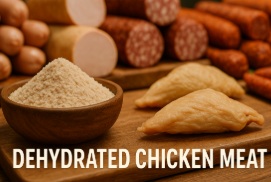
Dehydrated chicken meat (Gallus gallus domesticus)
Protein ingredient obtained from chicken meat (mainly breast and thigh, with or without skin) subjected to thermal treatment and subsequent dehydration (hot-air drying, freeze-drying, sometimes vacuum or microwave–vacuum). Available as flakes/cubes, jerky-style strips, or granules/powder (from cooked, milled meat). At equal dry portion, it concentrates proteins and flavor versus fresh meat.

Caloric value (per 100 g product)
Lean, skinless (freeze-dried/air-dried): ~320–400 kcal/100 g.
With skin or fattier cuts: ~380–480 kcal/100 g.
Depends on residual moisture (typically <4–10%) and fat content. After rehydration (≈3–4 parts water : 1 part dry), energy per 100 g of ready-to-eat food is lower.
Formats and types
Freeze-dried: highest porosity, fast rehydration, cleaner aroma.
Air-dried/oven-dried: denser structure, Maillard “brown” notes.
Jerky: salted and often spiced; higher aw (hurdles: salt, acidity).
Powders/granules: from cooked, milled meat; sometimes partially hydrolyzed for higher solubility.
Typical composition (per 100 g)
Moisture <4–10 g • Protein ~60–80 g • Fat ~5–25 g • Carbohydrates ≈0 g (except seasonings) • Salt (NaCl) variable—low in neutral products, high in jerky/seasoned items. Minerals: P, K, Se, Zn. B-vitamins partly retained; B1/B6 may decrease with prolonged air-drying.
Lipid profile (of the fat fraction; absolute g/100 g depends on cut/skin)
SFA (saturated): ~28–33% (palmitic C16:0, stearic C18:0)
MUFA (monounsaturated): ~40–45% (oleic C18:1 n-9)
PUFA (polyunsaturated): ~20–30% total
n-6 (linoleic C18:2, arachidonic C20:4) ~18–28%
n-3 (ALA C18:3; EPA/DHA trace) ~0.5–2%
Trans/CLA: negligible (non-ruminant)
Note: skinless products have few grams of fat per 100 g while showing a similar percent profile.
Production process (overview)
Trimming/selection → optional brining/marinating → cooking (oven/steam; microbiological lethality) → dehydration (freeze- or hot-air drying) to target aw (≤0.60 for ambient storage; jerky ~0.70–0.85 with hurdles) → low-RH cooling → cutting/milling → barrier packaging (vacuum/MAP, sometimes oxygen scavenger). For powders: milling/sieving; for high-solubility grades: mild enzymatic hydrolysis.
Sensory and technological properties
Aroma/taste: cooked/roasted; freeze-dried retains delicate notes, air-dried develops Maillard complexity.
Texture: crisp/vitreous when dry → fibrous after rehydration; depends on cut and pre-dry cook.
Rehydration: fast for freeze-dried (minutes); slower for dense air-dried pieces. Typical water:solid 3–4:1.
Functionality: high protein input, umami note, inclusions in dry mixes; powders act as flavor builders.
Food applications
Soups/instant noodles, instant risotti/couscous, freeze-dried ready meals.
Protein snacks and savory toppings (cubes/flakes).
Rehydrated fillings/salads, savory bakery.
Powders: bases for stocks, sauces, seasonings (indicative dose 0.2–1.0% as flavoring).
Run pilot trials: salt, pH, and fat modulate perception and rehydration.
Nutrition and health
High protein density; SFA moderate (higher with skin). Sodium varies—monitor jerky/seasoned versions. Ensure adequate hydration when sodium is restricted. (No health claims without authorization.)
Quality and specifications (typical topics)
Moisture/aw, total protein (%), fat (%), salt (%), L*a*b* color, particle size (powders), rehydration yield, lipid oxidation (PV, TBARS). Microbiology: low TVC; Salmonella absent/25 g; S. aureus/enterotoxins absent; Listeria compliant for RTE. Metals/residues within limits.
Storage and shelf life
Store dark, dry (RH <50%), at cool ambient temperature; prefer multilayer barrier packs with MAP/vacuum. With aw ≤0.60 it is shelf-stable at ambient (months). Once opened: reseal airtight and use within 2–4 weeks (or refrigerate). Apply FIFO.
Safety and suitability
Chicken meat is not among the EU major 14 allergens, though specific allergies exist. Check for gluten/soy/milk/celery/mustard from seasonings or plant cross-contact. Religious suitability (e.g., Halal) requires certification. Not suitable for vegetarians/vegans.
Sustainability and supply chain
Dehydration reduces waste and logistics impact (weight/volume). Energy use stems from drying/freeze-drying; mitigations: heat recovery, renewables, recyclable packaging, effluent management to BOD/COD targets.
Troubleshooting
Oxidized/rancid notes → exposure to O₂/light/heat → use barrier packs, approved antioxidants, lower storage T.
Slow/uneven rehydration → case-hardening from air-drying → reduce drying T, choose freeze-drying or thinner cuts.
Tough texture after rehydration → overly harsh pre-dry cook or connective-rich cuts → prefer breast or well-trimmed thigh, adjust cook.
High aw (mold risk) → inadequate process/pack → extend drying, add desiccant sachets, improve seal quality.
Conclusion
Dehydrated chicken meat is a versatile, protein-dense ingredient with long shelf life. Performance depends on cut, drying technology (freeze- vs air-dry), aw, and packaging. With proper standardization and oxidation control, it rehydrates quickly and delivers consistent sensory impact.
Mini-glossary
aw — water activity
RH/UR — relative humidity
MAP — modified atmosphere packaging
TBARS/PV — lipid oxidation indices (thiobarbituric acid/reactive substances; peroxide value)
SFA/MUFA/PUFA (n-6/n-3) — fatty-acid profile
L*a*b* — CIELAB color space
FIFO — first in, first out
BOD/COD — biochemical/chemical oxygen demand (effluents)
English DR, MacInnis RJ, Hodge AM, Hopper JL, Haydon AM, Giles GG. Red meat, chicken, and fish consumption and risk of colorectal cancer. Cancer Epidemiol Biomarkers Prev. 2004 Sep;13(9):1509-14.
Abstract. Background: Red meat and processed meat consumption have been associated with increased risk of colorectal cancer in some, but not all, relevant cohort studies. Evidence on the relationship between risk of colorectal cancer and poultry and fish consumption is inconsistent. Methods: We conducted a prospective cohort study of 37,112 residents of Melbourne, Australia recruited from 1990 to 1994. Diet was measured with a food frequency questionnaire. We categorized the frequency of fresh red meat, processed meat, chicken, and fish consumption into approximate quartiles. Adenocarcinomas of the colon or rectum were ascertained via the Victorian Cancer Registry. Results: We identified 283 colon cancers and 169 rectal cancers in an average of 9 years of follow-up. For rectal cancer, the hazard ratios [95% confidence intervals (95% CI)] in the highest quartile of consumption of fresh red meat and processed meat were 2.3 (1.2-4.2; P for trend = 0.07) and 2.0 (1.1-3.4; P for trend = 0.09), respectively. The corresponding hazard ratios (95% CIs) for colon cancer were 1.1 (0.7-1.6; P for trend = 0.9) and 1.3 (0.9-1.9; P for trend = 0.06). However, for neither type of meat was the heterogeneity between subsites significant. Chicken consumption was weakly negatively associated with colorectal cancer (hazard ratio highest quartile, 0.7; 95% CI, 0.6-1.0; P for trend = 0.03), whereas hazard ratios for fish consumption were close to unity. Conclusion: Consumption of fresh red meat and processed meat seemed to be associated with an increased risk of rectal cancer. Consumption of chicken and fish did not increase risk.
Chong EW, Simpson JA, Robman LD, Hodge AM, Aung KZ, English DR, Giles GG, Guymer RH. Red meat and chicken consumption and its association with age-related macular degeneration. Am J Epidemiol. 2009 Apr 1;169(7):867-76. doi: 10.1093/aje/kwn393.
Abstract. Age-related macular degeneration (AMD) is the leading cause of blindness among older people, and diet has been postulated to alter risk of AMD. To evaluate associations between red meat and chicken intake and AMD, the authors conducted a cohort study of 6,734 persons aged 58-69 years in 1990-1994 in Melbourne, Australia. Meat intake was estimated from a food frequency questionnaire at baseline. At follow-up (2003-2006), bilateral digital macular photographs were taken and evaluated for AMD (1,680 cases of early AMD, 77 cases of late AMD). Logistic regression was used to estimate odds ratios, adjusted for age, smoking, and other potential confounders. Higher red meat intake was positively associated with early AMD; the odds ratio for consumption of red meat > or =10 times/week versus <5 times/week was 1.47 (95% confidence interval: 1.21, 1.79; P-trend < 0.001). Similar trends toward increasing prevalence of early AMD were seen with higher intakes of fresh and processed red meat. Conversely, consumption of chicken > or =3.5 times/week versus <1.5 times/week was inversely associated with late AMD (odds ratio = 0.43, 95% confidence interval: 0.20, 0.91; P-trend = 0.007). These results suggest that different meats may differently affect AMD risk and may be a target for lifestyle modification.
Navas-Carretero S, Cuervo M, Abete I, Zulet MA, Martínez JA. Frequent consumption of selenium-enriched chicken meat by adults causes weight loss and maintains their antioxidant status. Biol Trace Elem Res. 2011 Oct;143(1):8-19. doi: 10.1007/s12011-010-8831-x.
Abstract. To assess the effects of a moderately high-protein intake on the body composition, biochemical, and antioxidant status parameters in young adults depending on either selenium- (Se) or non-enriched chicken consumption. The volunteers (n = 24) that completed the 10-week nutritional intervention were distributed in two parallel groups and randomly assigned to follow an isocaloric diet with moderately high content in protein (30% energy), either with the consumption of four 200 g portions/week of Se- or non-enriched chicken breasts. Blood samples were taken at the beginning and at the end of the study and body composition was monitored during the trial. There was a significant reduction in weight, accompanying a decrease on fat mass in both groups, while fat-free mass remained unchanged during the 10 weeks of intervention, without differences between both dietary groups. Selenium blood levels and plasma glutathione peroxidase activity, as well as lipid, glucose, and selected inflammation biomarkers remained stable during the intervention period in both dietary groups. Frequent chicken consumption, within a controlled diet with a moderately high content in protein, produced a slight but statistically significant weight reduction mainly due to the loss of fat mass. An extra Se supplementation (22 μg/day) in the Se-enriched chicken breast did not affect tachyphylactic antioxidant status of the participants neither inflammatory-related markers after weight loss.
Barbosa ACS, Mendes PS, Mattos G, Fuchs RHB, Marques LLM, Beneti SC, Heck SC, Droval AA, Cardoso FAR. Comparative analysis of the use of natural and synthetic antioxidants in chicken meat: an update review. Braz J Biol. 2023 Oct 23;83:e275539. doi: 10.1590/1519-6984.275539.
Abstract. The search for healthy foods has attracted the industry's attention to developing products that use natural ingredients, including natural antioxidants. Antioxidants act as free radicals or oxygen scavengers, inhibiting lipid oxidation and adversely affecting meat products' sensory and nutritional quality. Several synthetic antioxidants have been used in the meat industry; however, studies point to health risks related to their consumption. Such fact drives research into natural antioxidants extracted from grains, oilseeds, spices, fruits, and vegetables, which may have a health-promoting effect. This manuscript evaluates the effectiveness of several natural antioxidants in improving the quality and shelf life of chicken meat products during processing, storage, and distribution. The potential effects of natural antioxidants widely used in chicken products are also discussed. It can be concluded that these natural antioxidants are possible substitutes for synthetic ones. However, their use can affect the product's characteristics.
Connolly G, Campbell WW. Poultry Consumption and Human Cardiometabolic Health-Related Outcomes: A Narrative Review. Nutrients. 2023 Aug 11;15(16):3550. doi: 10.3390/nu15163550.
Abstract. Poultry meats, in particular chicken, have high rates of consumption globally. Poultry is the most consumed type of meat in the United States (US), with chicken being the most common type of poultry consumed. The amounts of chicken and total poultry consumed in the US have more than tripled over the last six decades. This narrative review describes nutritional profiles of commonly consumed chicken/poultry products, consumption trends, and dietary recommendations in the US. Overviews of the scientific literature pertaining to associations between, and effects of consuming chicken/poultry on, body weight and body composition, cardiovascular disease (CVD), and type II diabetes mellitus (T2DM) are provided. Limited evidence from randomized controlled trials indicates the consumption of lean unprocessed chicken as a primary dietary protein source has either beneficial or neutral effects on body weight and body composition and risk factors for CVD and T2DM. Apparently, zero randomized controlled feeding trials have specifically assessed the effects of consuming processed chicken/poultry on these health outcomes. Evidence from observational studies is less consistent, likely due to confounding factors such as a lack of a description of and distinctions among types of chicken/poultry products, amounts consumed, and cooking and preservation methods. New experimental and observational research on the impacts of consuming chicken/poultry, especially processed versions, on cardiometabolic health is sorely needed.
Toh DWK, Wong CH, Fam J, Kim JE. Daily consumption of essence of chicken improves cognitive function: a systematically searched meta-analysis of randomized controlled trials. Nutr Neurosci. 2021 Mar;24(3):236-247. doi: 10.1080/1028415X.2019.1619984.
Abstract. Essence of chicken (EC) is a dietary supplement with potential benefits on one's cognitive performance. The purpose of this meta-analysis is to evaluate the effects of consuming EC on cognitive function, applying extensively represented domains. Six databases were systematically searched to yield 1760 articles. These articles were independently screened to obtain 8 eligible articles with a pooled population of 794 subjects which is more than twice the population size considered in the previous meta-analyses. Largely, favorable effects on cognitive function were observed following daily EC intake, specifically in the working memory domain (standardized mean difference: 0.31, 95% CI: 0.16, 0.46), one of the core components in executive function which showed statistically significant results. Furthermore, the observed results were also robust to sensitivity analyses and subgroup analyses. This suggests that when consumed daily, EC may improve the mental processing aspect of cognitive function amongst the healthy population.
Ahmad S, Ahmed I, Haider S, Batool Z, Ahmed SB. Daily consumption of commercial chicken feed and meat lead to alterations in serum cholesterol and steroidal sex hormones in female rats. Pak J Pharm Sci. 2017 Jan;30(1 Suppl):257-261.
Abstract. Poultry consumption is increased worldwide owing to better taste, easy availability and low cost. The present study was designed to investigate the effects of the chicken feed, conventional chicken meat and organic chicken meat on the % growth rate, serum cholesterol, progesterone, testosterone and estrogen levels in female rats. Hundred female Albino Wistar rats were randomly assigned to four groups (n=25). Group I was control rats fed on standard chow, group II treated with commercial chicken feed, group III rats fed with conventional chicken meat and group IV with organic chicken meat for a period of 6 weeks. % Growth rate, serum cholesterol, progesterone, testosterone and estrogen levels were estimated after the treatment. The present study showed significant increase in growth rate, serum cholesterol levels and imbalance in serum steroidal hormone levels. It is therefore, suggested from the present study that the intake of commercial chicken feed and commercial chicken meat may be the potential cause of development of polycystic ovary syndrome in females due to steroid hormonal imbalance.

