

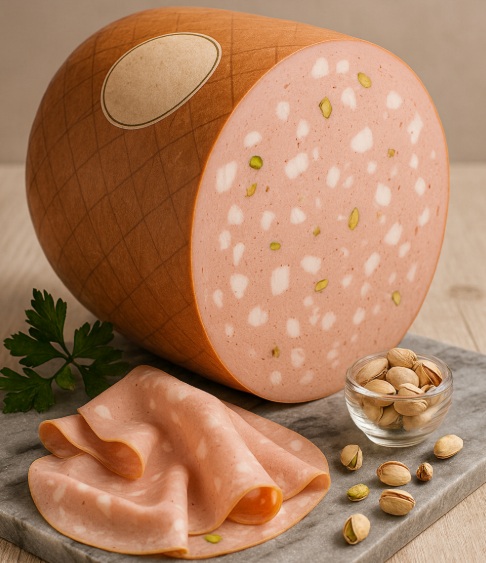
Mortadella Bologna PGI
Rating : 7
| Evaluation | N. Experts | Evaluation | N. Experts |
|---|---|---|---|
| 1 | 6 | ||
| 2 | 7 | ||
| 3 | 8 | ||
| 4 | 9 | ||
| 5 | 10 |
Cons:
Avoid excessive amounts (1)0 pts from Al222
| Sign up to vote this object, vote his reviews and to contribute to Tiiips.Evaluate | Where is this found? |
| "Descrizione" about Mortadella Bologna PGI by Al222 (23258 pt) | 2025-Oct-26 12:18 |
| Read the full Tiiip | (Send your comment) |
Mortadella Bologna PGI (emulsified cooked sausage)
Cooked cured meat made from finely emulsified pork with dispersed fat cubes (lardelli) from firm backfat, seasoned with salt and spices (black pepper; sometimes coriander, nutmeg, garlic), plus antioxidants/preservatives per regulation. In Italy, Mortadella Bologna PGI sets specific raw-material and process rules. Pistachios are optional.

Caloric value (per 100 g, ready-to-eat slices)
~260–340 kcal/100 g (depends on fat and moisture).
Typical composition (per 100 g)
Water ~50–60 g • Protein ~13–17 g • Total fat ~20–30 g • Carbohydrates (starch/technological sugars) ~0–4 g • Salt (NaCl) ~2.0–2.8 g (sodium ~800–1,100 mg) • pH ~6.0–6.4 • aw ~0.94–0.97.
Lipid profile (share of total lipids; absolute grams depend on fat level)
SFA (saturated): ~35–42% (palmitic C16:0, stearic C18:0)
MUFA (↑ oleic C18:1): ~42–50%
PUFA (total): ~8–15%
n-6 (linoleic C18:2, arachidonic C20:4): ~7–13%
n-3 (ALA C18:3; EPA/DHA traces): ~0.3–1%
Ruminant trans/CLA: negligible (non-ruminant species)
Cholesterol: typically 60–80 mg/100 g
Production process (overview)
Selection of pork muscles and firm backfat → coarse mincing → bowl-cutter emulsification with ice (tight temperature control for protein functionality) + salt, spices, antioxidants (e.g., ascorbates) and, where allowed, nitrite/nitrate → fold-in fat cubes (regular size) and optional pistachios → stuffing into natural/synthetic casings (various calibers) → slow cooking in hot air/steam to core 70–75 °C → showering/rapid chilling → cold rest → slicing and vacuum/MAP packing.
Sensory and technological properties
Appearance: uniform pink matrix with evenly distributed white fat cubes.
Aroma/taste: sweet–savory, gently spiced; no smoke; persistent umami.
Texture: elastic, cohesive; slices shiny, neither sticky nor crumbly.
Stability: heat-set protein emulsion; risk of fat separation if temperature curve/chilling are suboptimal.
Food applications
Served sliced in panini/piadine and boards; diced in pasta bakes, fillings, rice/grain salads; mousses/spreads (with ricotta/soft cheeses). Add near service to preserve aroma and juiciness.
Nutrition and health
Source of high-quality protein, B-vitamins (B1, B6, B12, niacin), zinc, and selenium. Main nutritional constraints are salt and fat: prefer moderate portions and, where available, leaner recipes. Fat quality favors MUFA over SFA, but total grams depend on formulation. (No health claims without authorization.)
Quality and specifications (typical topics)
Physicochemical: moisture, fat (total and lean/fat cube ratio), salt, pH, aw, L*a*b* color, TBARS (lipid oxidation).
Microbiology: TVC, Enterobacteriaceae; Salmonella absent/25 g; Listeria controlled (product is RTE).
Additives/residues: residual nitrite/nitrate within limits; compliant MRLs.
Sensory: no porosity or grease “sweating”; regular fat “eye”; slice not rubbery.
Storage and shelf life
Keep at 0–4 °C. Whole logs keep longer than sliced packs. After opening/slicing: use within 3–5 days (with well-managed vacuum/MAP). Protect from light/oxygen to limit photo-oxidation and color fade.
Allergens and safety
Core recipe is gluten-free; pistachios must be declared when present. Some non-PGI versions may include milk/derivatives, vegetable proteins, or polyphosphates—check labels. Main risks: post-cook recontamination and Listeria growth → strict slicing hygiene and cold chain.
Sustainability and supply chain
Key drivers: pig farming, energy for cooking/chilling, and brines/effluents. Improvements: heat recovery, renewables, effluent control to BOD/COD targets, waste reduction (trim utilization), recyclable light- and O₂-barrier packaging, and FIFO rotation.
Troubleshooting
Fat/gel separation: weak emulsion or slow cooling → increase protein binding, tighten cutter temperature, optimize cook curve; chill fast.
Porous slice: trapped air/poor stuffing → better degassing and filling parameters.
Tearing slice: fat cubes too large/soft → choose firm dorsal backfat, smaller dice, improve chilling.
Color fade/rancidity: light/O₂ exposure → upgrade barrier films, reduce exposure, rotate stock.
Excess saltiness: high NaCl or ultrathin slicing → calibrate NaCl and slice thickness.
Conclusion
Mortadella is an RTE cooked sausage with characteristic sweetness, gentle spice, and elastic bite. Sensory quality and stability hinge on emulsion control, fat-cube selection, cook/chill profile, and oxidation protection. The fat profile is MUFA-leaning, with moderate PUFA (n-6) and low n-3; salt and fat guide portion choices.
Mini-glossary
SFA/MUFA/PUFA — saturated/monounsaturated/polyunsaturated fatty acids
n-6 / n-3 — omega-6 / omega-3 families
aw — water activity
L*a*b* — CIELAB color coordinates
TBARS — thiobarbituric acid reactive substances (lipid oxidation index)
TVC — total viable count
RTE — ready to eat
MAP — modified-atmosphere packaging
MRL — maximum residue limits
BOD/COD — biochemical/chemical oxygen demand (effluent load)
FIFO — first in, first out
References__________________________________________________________________________
Wolk A. Potential health hazards of eating red meat. J Intern Med. 2017 Feb;281(2):106-122. doi: 10.1111/joim.12543.
Feingold KR,. The Effect of Diet on Cardiovascular Disease and Lipid and Lipoprotein Levels. 2024 Mar 31. In: Feingold KR, Ahmed SF, Anawalt B, Blackman MR, Boyce A, Chrousos G, Corpas E, de Herder WW, Dhatariya K, Dungan K, Hofland J, Kalra S, Kaltsas G, Kapoor N, Koch C, Kopp P, Korbonits M, Kovacs CS, Kuohung W, Laferrère B, Levy M, McGee EA, McLachlan R, Muzumdar R, Purnell J, Rey R, Sahay R, Shah AS, Singer F, Sperling MA, Stratakis CA, Trence DL, Wilson DP, editors. Endotext [Internet]. South Dartmouth (MA): MDText.com, Inc.; 2000–.
Singh B, Khan AA, Anamika F, Munjal R, Munjal J, Jain R. Red Meat Consumption and its Relationship With Cardiovascular Health: A Review of Pathophysiology and Literature. Cardiol Rev. 2025 Jan-Feb 01;33(1):49-53. doi: 10.1097/CRD.0000000000000575.
Nagao M, Iso H, Yamagishi K, Date C, Tamakoshi A. Meat consumption in relation to mortality from cardiovascular disease among Japanese men and women. Eur J Clin Nutr. 2012 Jun;66(6):687-93. doi: 10.1038/ejcn.2012.6.
Abstract. Background/objectives: Although high or low (no) meat consumption was associated with elevated or reduced mortality from cardiovascular disease, respectively, few studies have investigated the association between moderate meat consumption and cardiovascular disease. We aimed to evaluate the associations between moderate meat consumption and cardiovascular disease mortality. Subjects/methods: We conducted a prospective cohort study of 51,683 Japanese (20,466 men and 31,217 women) aged 40-79 years living in all of Japan (The Japan Collaborative Cohort Study; JACC Study). Consumptions of meat (beef, pork, poultry, liver and processed meat) were assessed via a food frequency questionnaire administrated at baseline survey. Hazard ratios (HRs) of mortality from cardiovascular disease were estimated from Cox proportional hazards regression models according to quintiles of meat consumption after adjustment for potential confounding variables. Results: During 820,076 person-years of follow-up, we documented 2685 deaths due to total cardiovascular disease including 537 ischemic heart diseases and 1209 strokes. The multivariable HRs (95% confidence interval) for the highest versus lowest quintiles of meat consumption (77.6 versus 10.4 g/day) among men were 0.66 (0.45-0.97) for ischemic heart disease, 1.10 (0.84-1.43) for stroke and 1.00 (0.84-1.20) for total cardiovascular disease. The corresponding HRs (59.9 versus 7.5 g/day) among women were 1.22 (0.81-1.83), 0.91 (0.70-1.19) and 1.07 (0.90-1.28). The associations were similar when the consumptions of red meat, poultry, processed meat and liver were examined separately. Conclusion: Moderate meat consumption, up to ~100 g/day, was not associated with increased mortality from ischemic heart disease, stroke or total cardiovascular disease among either gender.
_______________
Hill ER, Wang Y, Davis EM, Campbell WW. Healthy Dietary Patterns with and without Meat Improved Cardiometabolic Disease Risk Factors in Adults: A Randomized Crossover Controlled Feeding Trial. Nutrients. 2024 Aug 3;16(15):2542. doi: 10.3390/nu16152542. PMID
Jung AJ, Sharma A, Chung M, Wallace TC, Lee HJ. The Relationship of Pork Meat Consumption with Nutrient Intakes, Diet Quality, and Biomarkers of Health Status in Korean Older Adults. Nutrients. 2024 Dec 4;16(23):4188. doi: 10.3390/nu16234188.
Abstract. Background: Pork meat is a widely consumed protein food with the potential to differentially affect health and nutritional status across social and cultural contexts. Objectives: We evaluated the association between pork meat consumption and nutrient intake, diet quality, and biomarkers of health among older adults (age ≥ 65 years) in Korea. Methods: Our analyses utilized dietary and health examination data from the 2016-2020 Korean National Health and Nutrition Examination Survey (n = 2068). Comparisons between variables derived from the nutrition survey and health examination by pork consumption (consumers vs. non-consumers) were assessed using regression analyses for survey data. Results: Pork consumption was found to be associated with younger age, greater educational attainment, and lower likelihood of living in a rural area. Consumption was also associated with a higher intake of energy and all nutrients except vitamin B6, retinol, ⍵3, and zinc in males and vitamin B6 in females. Diet quality was modestly higher among male (67.91 ± 0.93 vs. 65.74 ± 0.74; p = 0.0308) and female (70.88 ± 0.96 vs. 67.00 ± 0.73; p < 0.0001) pork consumers. Differences in biomarkers were clinically irrelevant, with inconsistencies between genders. Handgrip strength was slightly higher among male (33.84 ± 0.52 vs. 31.91 ± 0.40; p < 0.0001) and female (20.76 ± 0.34 vs. 19.99 ± 0.22; p < 0.0001) pork consumers. Conclusions: In Korean older adults, pork consumption may contribute to a higher intake of energy and most nutrients, improved diet quality scores, higher vegetable intake, and small improvements in health biomarkers. Further well-designed studies are needed to confirm these findings.
Barone G, Storelli A, Quaglia NC, Garofalo R, Meleleo D, Busco A, Storelli MM. Trace Metals in Pork Meat Products Marketed in Italy: Occurrence and Health Risk Characterization. Biol Trace Elem Res. 2021 Aug;199(8):2826-2836. doi: 10.1007/s12011-020-02417-z.
Abstract. This study provides valuable information on the levels of various trace metals (Pb, Cd, Hg, Zn, Cu, Cr) in meat products (baked ham, raw ham, mortadella, cured sausage, würstel, salami) from South Italy and calculates potential health risk toxicity associated with their consumption for the total population and for children. In the samples studied metal concentrations are within the permissible legal limits (Cd: 0.01-0.03 μg g-1 w.w., Hg: 0.01-0.02 μg g-1 w.w., Zn: 5.71-7.32 μg g-1 w.w., Cu: 1.08-1.21 μg g-1 w.w., Cr: 0.15-0.23 μg g-1 w.w.), except for Pb (Pb: 0.22-0.38 μg g-1 w.w.). The estimated intake values are within the provisional tolerable daily intake limits for toxic metals and recommended daily intake values for essential metals in both tested groups. The noncarcinogenic risk values of the individual metals indicate that there is no health risk, but their combined effects might constitute a potential risk for children. Furthermore, the cumulative cancer risk of all samples studied exceeds the recommended threshold risk limit (> 10-4) in both total population and children, indicating a risk of potential health problems for consumers especially for children, who are more vulnerable to toxic metal exposure.
Li G, Jiang J, Li Z. The relationship between processed meat, red meat, and risk of cardiovascular disease and type 2 diabetes: A Mendelian randomization study. Eur J Prev Cardiol. 2024 Mar 25:zwae117. doi: 10.1093/eurjpc/zwae117.
Abstract. Background: Numerous observational studies have indicated a potential association between the consumption of processed and red meat and an increased risk of cardiovascular disease and type 2 diabetes mellitus (T2DM). However, the presence of a causal relationship remains uncertain. Therefore, the purpose of this study is to evaluate the impact of processed meat and red meat (pork, lamb, and beef) on the risk of cardiovascular disease, including coronary artery disease (CAD), hypertension, and stroke, and T2DM, using a Two-Sample Mendelian randomization (MR) analysis. Methods: MR analysis was conducted using the inverse-variance weighted (IVW), weighted median (WM), and MR Egger methods. To identify heterogeneity and pleiotropy, Cochrane's Q test and MR-Egger test were employed. Additionally, the stability of the MR results was assessed using the leave-one-out method. Results: IVW analyses reveal no causal association between the consumption of processed and red meat and the incidence of CAD, hypertension, stroke, and T2DM (P > 0.05). When considering processed meat intake, heterogeneity is observed in hypertension and stroke outcomes (P < 0.05). For pork intake, heterogeneity is seen in hypertension, stroke, and T2DM (P < 0.05). Lamb intake shows heterogeneity in hypertension and T2DM (P < 0.05). However, other exposures and outcomes examined show no heterogeneity (P > 0.05). No significant pleiotropy is detected for all exposures through an MR-Egger test (P > 0.05). Furthermore, the Leave-one-out test demonstrates the robustness of the results. Conclusion: The study discerned no observable impact of red and processed meat consumption on CAD, hypertension, stroke, and T2DM. The findings of this study challenge the prevailing conventional perspective in the field.
Geiker NRW, Bertram HC, Mejborn H, Dragsted LO, Kristensen L, Carrascal JR, Bügel S, Astrup A. Meat and Human Health-Current Knowledge and Research Gaps. Foods. 2021 Jul 5;10(7):1556. doi: 10.3390/foods10071556.
Abstract. Meat is highly nutritious and contributes with several essential nutrients which are difficult to obtain in the right amounts from other food sources. Industrially processed meat contains preservatives including salts, possibly exerting negative effects on health. During maturation, some processed meat products develop a specific microbiota, forming probiotic metabolites with physiological and biological effects yet unidentified, while the concentration of nutrients also increases. Meat is a source of saturated fatty acids, and current WHO nutrition recommendations advise limiting saturated fat to less than ten percent of total energy consumption. Recent meta-analyses of both observational and randomized controlled trials do not support any effect of saturated fat on cardiovascular disease or diabetes. The current evidence regarding the effect of meat consumption on health is potentially confounded, and there is a need for sufficiently powered high-quality trials assessing the health effects of meat consumption. Future studies should include biomarkers of meat intake, identify metabolic pathways and include detailed study of fermented and other processed meats and their potential of increasing nutrient availability and metabolic effects of compounds.
Celada P, Sánchez-Muniz FJ, Delgado-Pando G, Bastida S, Rodilla ME, Jiménez-Colmenero F, Olmedilla-Alonso B. Effects of improved fat meat products consumption on emergent cardiovascular disease markers of male volunteers at cardiovascular risk. J Physiol Biochem. 2016 Dec;72(4):669-678. doi: 10.1007/s13105-016-0505-5.
Abstract. High meat-product consumption has been related to cardiovascular disease (CVD). However, previous results suggest the benefits of consuming improved fat meat products on lipoprotein-cholesterol and anthropometric measurements. Present study aims to assess the effect of consuming different Pâté and Frankfurter formulations on emergent CVD biomarkers in male volunteers at increased CVD risk. Eighteen male volunteers with at least two CVD risk factors were enrolled in a sequentially controlled study where different pork-products were tested: reduced-fat (RF), omega-3-enriched-RF (n-3RF), and normal-fat (NF). Pork-products were consumed during 4-week periods separated by 4-week washout. The cardiometabolic index (CI), oxidized low density lipoproteins (oxLDL), apolipoproteins (Apo) A1 and B, homocysteine (tHcys), arylesterase (AE), C-reactive Protein (CRP), tumor necrotic factor-alpha (TNFα), and lipoprotein (a) (Lp(a)) were tested and some other related ratios calculated. AE, oxLDL and Lp(a), AE/HDLc, LDLc/Apo B, and AE/oxLDL rate of change were differently affected (P<0.01) by pork-products consumption. RF increased (P < 0.05) AE, AE/HDLc and AE/oxLDL ratios and decreased TNFα, tHcys; n-3RF increased (P < 0.001) AE, AE/HDLc and AE/oxLDL ratios and decreased (P < 0.05) Lp(a); while NF increased (P<0.05) oxLDL and Lp(a) levels. In conclusion, RF and n-3RF products affected positively the level of some emergent CVD markers. The high regular consumption of NF-products should be limited as significantly increased Lp(a) and oxLDL values. The high variability in response observed for some markers suggests the need to perform more studies to identify targets for RF- and n-3RF-products. Graphical Abstract Emergent CVD markers.
Jafari F, Damani JJ, Petersen KS. The Effect of Red Meat Consumption on Circulating, Urinary, and Fecal Trimethylamine-N-Oxide: A Systematic Review and Narrative Synthesis of Randomized Controlled Trials. Adv Nutr. 2025 Jul;16(7):100453. doi: 10.1016/j.advnut.2025.100453. Epub 2025 May 24. PMID: 40419218; PMCID: PMC12273423.
| Sign up to vote this object, vote his reviews and to contribute to Tiiips.EvaluateClose | (0 comments) |
Read other Tiiips about this object in __Italiano (1)
Kcal/100g:   260-340 Last update:   2025-10-26 12:09:52 |

