

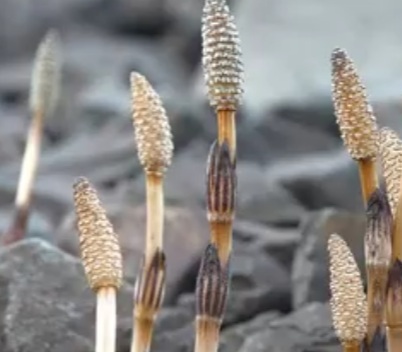
Equisetum arvense
Rating : 6
| Evaluation | N. Experts | Evaluation | N. Experts |
|---|---|---|---|
| 1 | 6 | ||
| 2 | 7 | ||
| 3 | 8 | ||
| 4 | 9 | ||
| 5 | 10 |
Pros:
Antibacterial (1) Anti-inflammatory (1)Cons:
To be taken in controlled quantity (1)0 pts from Al222
| Sign up to vote this object, vote his reviews and to contribute to Tiiips.Evaluate | Where is this found? |
| "Descrizione" about Equisetum arvense by Al222 (23249 pt) | 2025-Nov-26 19:43 |
| Read the full Tiiip | (Send your comment) |
Equisetum arvense—horsetail or scouring rush—is a perennial pteridophyte (a spore-bearing plant, not a flowering plant) in the Equisetaceae. Widespread across temperate Europe and Asia and naturalized elsewhere, it favors sandy to loamy, moist, often acidic soils along field margins and ditches. It is noted for very high silica content and long-standing use as a mild diuretic and “remineralizing” herb.

Kingdom: Plantae
Division: Equisetophyta
Class: Equisetopsida
Order: Equisetales
Family: Equisetaceae
Genus: Equisetum
Species: E. arvense
Stems: two distinct types. In spring, fertile, brownish-pink, 10–25 cm, non-chlorophyllous stems bear a terminal strobilus (cone) that releases spores. In early summer, green, photosynthetic, 20–60 cm sterile shoots appear, jointed with whorls of fine branches giving the “horsetail” look.
Roots & rhizomes: deep, tough, extensively creeping rhizome network with small tubers—makes the species hard to eradicate and potentially invasive in cultivation.
Reproduction: by spores (spring strobili) and very efficiently via vegetative rhizome spread.
Silica (SiO₂): ~5–10% of dried herb (sometimes higher), partly as soluble silicic acid → supports connective tissue, nails, hair.
Flavonoids: quercetin, kaempferol, isoquercitrin (antioxidant/vasoprotective).
Saponin: equisetonin.
Phenolic acids: caffeic, ferulic, p-coumaric.
Minerals: potassium, calcium, magnesium, manganese.
Others: trace alkaloids (including very low nicotine), polyamines; thiaminase (vitamin B₁-degrading enzyme), especially in fresh plant.
Soil: sandy or loamy, consistently moist; prefers acidic pH 5–6; tolerates imperfect drainage.
Light: full sun to partial shade.
Water: keep soil evenly moist; ideal along ponds/ditches.
Establishment: plant rhizome pieces in spring; spore raising is impractical for home growers.
Management: confine with rhizome barriers or containers; trim shoots regularly to limit spread. Avoid heavy nitrogen and excess lime (can reduce silica content).
Harvest: cut sterile green aerial parts late spring–summer; dry quickly <40 °C to preserve constituents.
Mild diuretic/drainage: increased urinary output (flavonoids, potassium salts).
Remineralizing/connective tissue support: silica may aid collagen synthesis (nails, hair, connective tissues).
Topical styptic/cicatrizing: traditional powders or poultices for minor abrasions.
Antioxidant/soothing: due to flavonoids and phenolic acids.
Herbal: teas (infusion/decoction), fluid extracts, or dry extracts standardized to silica/flavonoids; typically used intermittently.
Cosmetic: hair/nail tonics; soothing gels or lotions.
Other: natural abrasive (“scouring herb”) thanks to silica; in organic gardening, fermented macerates as plant-strengthening sprays against fungal issues.
Invasiveness: vigorous rhizomes and tolerance of poor soils make E. arvense a troublesome weed in beds and vegetable plots—container culture recommended.
Bioaccumulation: can concentrate silica and heavy metals; harvest only from clean, uncontaminated sites.
Thiaminase: prolonged or high-dose use, especially of fresh herb, may reduce vitamin B₁. Avoid in thiamine deficiency; prefer properly dried/processed material and limit duration.
Diuretics/electrolytes: may potentiate diuretic drugs → monitor for electrolyte imbalance.
Pregnancy/lactation: avoid due to limited safety data.
Allergy: rare contact reactions.
Livestock: cases of B₁ deficiency reported when horsetail contaminates hay.
Infusion/decoction: 2–4 g dried herb in 200 ml water, 1–2×/day for 2–3 weeks, then pause.
Standardized dry extract: follow manufacturer dosing (often 200–400 mg/day).
Topical: 1–3% extract gels/lotions for small areas.
References__________________________________________________________________________
Jeong SY, Yu HS, Ra MJ, Jung SM, Yu JN, Kim JC, Kim KH. Phytochemical Investigation of Equisetum arvense and Evaluation of Their Anti-Inflammatory Potential in TNFα/INFγ-Stimulated Keratinocytes. Pharmaceuticals (Basel). 2023 Oct 16;16(10):1478. doi: 10.3390/ph16101478.
Abstract. Equisetum arvense L. (Equisetaceae), widely known as 'horsetail', is a perennial plant found extensively across Asia. Extracts of E. arvense have been used in traditional medicine, particularly for the treatment of inflammatory disorders. This study aimed to determine the phytochemical compounds in E. arvense ethanolic extract and their anti-inflammatory properties. Subsequently, we isolated and identified nine secondary metabolites, including kaempferol 3,7-di-O-β-D-glucopyranoside (1), icariside B2 (2), (Z)-3-hexenyl β-D-glucopyranoside (3), luteolin 5-O-β-D-glucopyranoside (4), 4-O-β-D-glucopyranosyl caffeic acid (5), clemastanin B (6), 4-O-caffeoylshikimic acid (7), (7S,8S)-threo-7,9,9'-trihydroxy-3,3'-dimethoxy-8-O-4'-neolignan-4-O-β-D-glucopyranoside (8), and 3-O-caffeoylshikimic acid (9). The chemical structures of the isolated compounds (1-9) were elucidated using HR-ESI-MS data, NMR spectra, and ECD data. Next, the anti-inflammatory effects of the isolates were evaluated in tumor necrosis factor (TNF)α/interferon (IFN)γ-induced HaCaT, a human keratinocyte cell line. Among the isolates, compound 3 showed the highest inhibitory effect on the expression of pro-inflammatory chemokines, followed by compounds 6 and 8. Correspondingly, the preceding isolates inhibited TNFα/IFNγ-induced activation of pro-inflammatory transcription factors, signal transducer and activator of transcription 1, and nuclear factor-κB. Collectively, E. arvense could be employed for the development of prophylactic or therapeutic agents for improving dermatitis.
Shiba F, Miyauchi M, Chea C, Furusho H, Iwasaki S, Shimizu R, Ohta K, Nishihara T, Takata T. Anti-inflammatory effect of glycyrrhizin with Equisetum arvense extract. Odontology. 2021 Apr;109(2):464-473. doi: 10.1007/s10266-020-00563-3.
Abstract. Periodontal disease is the most prevalent infectious disease, and inflammatory mediators play critical roles in its progression. Therefore, controlling pro-inflammatory cytokine production, especially at initial disease stages, is essential to maintaining gingival and periodontal health. Glycyrrhizin (GL) has an anti-inflammatory effect and has been added to toothpaste and mouth rinse to prevent periodontal disease. However, there is a maximum dose for the use of GL. The aim of the present study is to screen plant extracts which can effectively enhance the effects of GL. The effects of extracts from six different plants on GL-suppressed TNF-α expression in Aggregatibacter actinomycetemcomitans (A.a.)-LPS-stimulated human oral keratinocytes (RT7) were examined. Results demonstrated that Equisetum arvense (EA) extract had the strongest additive effect on the suppression of TNF-α by GL at both mRNA and protein levels. In addition, GL downregulated the production of TNF-α by suppressing NF-κB p65 phosphorylation, but not JNK or p38 phosphorylation. In contrast, EA decreased JNK phosphorylation but not NF-κB p65 or p38 phosphorylation. The combination of GL and EA effectively attenuated A.a.-LPS-induced phosphorylation of NF-κB p65 and JNK. Furthermore, an LPS-induced periodontitis rat model showed that GL with EA supplementation significantly downregulated TNF-α mRNA in the gingival tissue. These results indicate that EA can suppress A.a.-LPS-induced pro-inflammatory cytokine production by inhibiting JNK activation and can promote the anti-inflammatory effects of GL. Our findings suggest that a combination of GL and EA may improve the development of new oral hygiene products aimed at enhancing periodontal health.
LiverTox: Clinical and Research Information on Drug-Induced Liver Injury [Internet]. Bethesda (MD): National Institute of Diabetes and Digestive and Kidney Diseases; 2012–. Horsetail. 2022 Jul 25.
Abstract. Horsetail is an extract of the plant Equisetum arvense which has been used in traditional medicine for bladder and kidney conditions and to promote wound healing. Oral forms of horsetail have been implicated in instances of serum aminotransferase elevations, but it has not been convincingly linked to instances of clinically apparent liver injury with jaundice.
Pallag A, Filip GA, Olteanu D, Clichici S, Baldea I, Jurca T, Micle O, Vicaş L, Marian E, Soriţău O, Cenariu M, Mureşan M. Equisetum arvense L. Extract Induces Antibacterial Activity and Modulates Oxidative Stress, Inflammation, and Apoptosis in Endothelial Vascular Cells Exposed to Hyperosmotic Stress. Oxid Med Cell Longev. 2018 Feb 14;2018:3060525. doi: 10.1155/2018/3060525.
Abstract. Background: The antimicrobial activity of the Equisetum arvense L. extract and the mechanisms involved in the in vitro effects on endothelial vascular cells exposed to hyperosmotic stress were evaluated. Methods: Antimicrobial activity was evaluated by disk diffusion method and minimum inhibitory concentration (MIC) determination, and oxidative stress, inflammation, and apoptosis, in pretreatment with Equisetum arvense L., caffeic acid, and cathechin, were quantified. Results: The results have shown that Equisetum arvense L. exhibited antibacterial effects only on pathogenic gram-positive cocci. The modulatory activity of Equisetum arvense L. on endothelial cells exposed to hypertonic medium was different and depended on the concentration used. Low concentrations of tested compounds exerted antioxidant effect and diminished the activity of caspase-8 and also increased IκB expression while in high doses, Equisetum arvense L. was prooxidant, induced apoptosis, and decreased IL-6 secretion. Conclusions: These experimental findings suggest that Equisetum arvense L. has antibacterial effects on gram-positive cocci and, administered in low dose, may be a new therapeutic approach for diseases associated with hypertonic conditions or oxidative stress and apoptosis.
Johnson W, Bergfeld WF, Belsito DV, Cohen DE, Klaassen CD, Liebler DC, Peterson LA, Shank RC, Slaga TJ, Snyder PW, Fiume MM, Heldreth B. Safety Assessment of Equisetum arvense-Derived Ingredients as Used in Cosmetics. Int J Toxicol. 2025 Oct 9:10915818251375449. doi: 10.1177/10915818251375449.
Abstract. The Expert Panel for Cosmetic Ingredient Safety (Panel) reviewed the safety of five Equisetum arvense-derived ingredients as used in cosmetic products; all of these ingredients are reported to function as skin-conditioning agents in cosmetics. Industry should use current good manufacturing practices to minimize impurities that could be present in these botanical ingredients. The Panel reviewed data relevant to the safety of these ingredients in cosmetic formulations, and concluded that the five Equisetum arvense-derived ingredients are safe in cosmetics in the present practices of use and concentration described in this safety assessment.
Gründemann C, Lengen K, Sauer B, Garcia-Käufer M, Zehl M, Huber R. Equisetum arvense (common horsetail) modulates the function of inflammatory immunocompetent cells. BMC Complement Altern Med. 2014 Aug 4;14:283. doi: 10.1186/1472-6882-14-283.
Abstract. Background: In Europe, extracts of Equisetum arvense (common horsetail) have a long tradition in the treatment of inflammatory disorders. To understand the molecular basis for its use, we investigated the immunomodulatory capacity of a standardized commercially available common horsetail extract on human primary lymphocyte function in vitro. Methods: The standardized extract of Equisetum arvense was phytochemically characterized. Effects on proliferation, viability and activity of mitogen-activated human lymphocytes were assessed in comparison to cyclosporine A using annexin V/propidium iodide staining assays and flow cytometry-based surface receptor characterization, respectively. Intracellular levels of effector molecules (IL-2, IFN-γ and TNF-α) were analyzed with cytokine assays. Results: T cell proliferation was inhibited dose dependently by the Equisetum extract without induction of apoptosis or necrosis. This effect was mediated through inhibition of lymphocyte activation, specifically by diminishing CD69 and IL-2 surface receptor expression and intracellular IL-2 production. Furthermore, treatment with Equisetum arvense inhibited effector functions, as indicated by reduced production of IFN-γ and TNF-α. Conclusions: The data indicate that the used extract of Equisetum arvense interferes with the polyfunctionality of immunocompetent cells thereby providing an anti-inflammatory mode-of-action.
Carneiro DM, Jardim TV, Araújo YCL, Arantes AC, de Sousa AC, Barroso WKS, Sousa ALL, Cruz AC, da Cunha LC, Jardim PCBV. Antihypertensive effect of Equisetum arvense L.: a double-blind, randomized efficacy and safety clinical trial. Phytomedicine. 2022 May;99:153955. doi: 10.1016/j.phymed.2022.153955.
| Sign up to vote this object, vote his reviews and to contribute to Tiiips.EvaluateClose | (0 comments) |
Read other Tiiips about this object in __Italiano (1)
Content:   Last update:   2025-10-23 15:52:16 | Kcal/100g:   Family:   Threat factors:   |

