

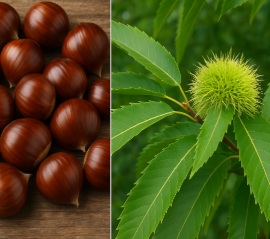
Marroni
Rating : 7
| Evaluation | N. Experts | Evaluation | N. Experts |
|---|---|---|---|
| 1 | 6 | ||
| 2 | 7 | ||
| 3 | 8 | ||
| 4 | 9 | ||
| 5 | 10 |
0 pts from Al222
| Sign up to vote this object, vote his reviews and to contribute to Tiiips.Evaluate | Where is this found? |
| "Descrizione" about Marroni by Al222 (23429 pt) | 2025-Nov-27 10:50 |
| Read the full Tiiip | (Send your comment) |
Chestnuts (Castanea sativa)
Chestnuts (marroni when large, fine-textured lots) are starchy nuts valued for their sweet, delicate flavor and diverse culinary uses. Large-caliber, easily peeled fruits with minimal internal septa are preferred for premium applications (e.g., marrons glacés), while dried kernels and flour support traditional and gluten-free preparations.

Common name: Chestnuts (marroni when large, fine-textured lots)
Parent plant: Castanea sativa Mill. — European chestnut
Kingdom: Plantae
Clade: Angiosperms
Clade: Eudicots
Order: Fagales
Family: Fagaceae
Genus: Castanea
Species: Castanea sativa Mill.
Climate:
European chestnut thrives in temperate climates with mild summers and fresh, ventilated winters. It is typical of hilly and mountainous regions.
Tolerates winter temperatures down to –15 °C during dormancy.
Suffers from excessively hot, dry summers.
Requires rainfall well distributed across the year, particularly during fruit formation.
Sun exposure:
Requires full sun or bright partial shade. Adequate light ensures:
optimal canopy development,
efficient photosynthesis,
well-formed, flavorful nuts.
Soil:
Chestnut trees prefer soils that are:
acidic to slightly acidic (pH 4.5–6.5),
deep, cool, and well drained,
rich in organic matter.
They do not tolerate calcareous soils or waterlogging, which cause root diseases and leaf chlorosis.
Irrigation:
Chestnuts need steady soil moisture, especially:
in spring during vegetative growth,
in summer during burr and nut development.
In dry summers, supplemental irrigation improves yield and nut size. Excessive moisture, however, should be avoided.
Temperature:
Germination: 10–20 °C
Optimal growth: 18–28 °C
Sensitive to late spring frost, which may damage flowers and young burrs
Fertilization:
Balanced fertilization improves productivity and nut quality:
Nitrogen: moderate amounts to prevent excessive vegetative growth.
Phosphorus: supports root activity and flowering.
Potassium: essential for nut size, flavor, and storability.
Organic amendments such as compost or well-rotted manure are beneficial.
Crop care:
Light pruning to enhance canopy ventilation and light penetration.
Removal of basal suckers.
Monitoring and control of major diseases:
chestnut blight (Cryphonectria parasitica)
ink disease (Phytophthora spp.)
Control of frequent pests such as:
chestnut gall wasp (Dryocosmus kuriphilus)
tortricid moths
stink bugs
Harvest:
Chestnuts are harvested in autumn, when burrs open naturally and nuts fall to the ground.
Large, fine-textured lots—characterized by a single internal compartment and an easy-to-remove pellicle—are classified commercially as marroni.
After harvest, nuts are cleaned, sorted, and stored in cool, ventilated conditions to avoid mold and infestation.
Propagation:
Europe chestnuts are propagated mainly via grafting onto Castanea sativa or disease-resistant hybrid rootstocks.
Propagation by seed is possible but does not preserve cultivar characteristics.
Commercial forms
Fresh in shell; steam-peeled; vacuum-cooked; roasted; boiled; dried (whole or pieces); chestnut flour; purée/cream; candied and glazed (marrons glacés).
Caloric value (100 g)
Raw: ~190–220 kcal/100 g (typical ≈ 200 kcal/100 g).
Boiled: ~110–150 kcal/100 g (water uptake lowers energy density).
Roasted: ~200–260 kcal/100 g.
Chestnut flour: ~330–370 kcal/100 g.
Key constituents
Complex carbohydrates (starch, predominantly amylopectin-rich) with simple sugars (glucose, fructose, sucrose).
Dietary fiber (soluble/insoluble), traces of pectins, native tannins and polyphenols.
Moderate protein (lysine-limited amino acid profile).
Low total lipids with a predominance of unsaturated fatty acids.
Minerals (K, Mg, Mn, Cu) and B vitamins; vitamin C in raw nuts (heat-labile).
Characteristic volatile compounds responsible for cooked-chestnut aroma.
Average composition (indicative, raw, per 100 g)
Water: ~45–50 g.
Total carbohydrate: ~40–45 g (starch + sugars).
Fiber: ~5–8 g.
Protein: ~2–4 g.
Fat: ~1–3 g.
Ash: ~1–2 g.
Pulp pH: slightly acidic (~5.6–6.3).
aw: high in fresh nuts; lowered in dried kernels and flour.
Production process
Harvest and sorting: Autumn harvest; removal of damaged/insect-infested nuts.
Post-harvest sanitation: Water-curing or cold treatments for insect control; brushing and washing.
Peeling/precook: Mechanical or steam peeling; gentle precook for peeled or ready-to-eat products.
Drying and milling: Traditional kiln (metato) or hot-air drying for long-keeping; decortication and milling into flour.
Candying/glazing (for marrons glacés): Stepwise high-°Brix sugar infusions, maturation, fondant glazing, controlled drying.
Packaging: Moisture/oxygen-barrier packs and optional MAP; traceability and controls under GMP/HACCP with defined CCPs.
Sensory and technological properties
Texture: Floury-sweet after cooking; can become fondant-like in sugared processes.
Functionality: Starch gelatinization provides body in purées and creams; chestnut flour yields gluten-free batters with natural sweetness and amber color.
Water and stability: High aw in fresh nuts drives perishability; drying reduces aw and extends shelf life.
Aroma: Honeyed, nutty, lightly toasty notes; gentle processing and barrier packs preserve volatiles.
Food applications
Roasted or boiled consumption; soups and stews; stuffings; classic desserts (castagnaccio, crêpes/necci, Mont Blanc, marrons glacés); fresh pastas and gnocchi from chestnut flour; ice creams, spreads, and pralines.
Nutrition and health
Chestnuts supply complex carbohydrates, fiber, and useful minerals with low fat and are naturally gluten-free. Glycemic impact is modulated by fiber, cooking method, and added sugars in processed products. Portion sizing matters in carbohydrate-controlled diets.
Quality and specification themes
Uniform caliber; low insect damage; pellicle that releases cleanly.
Controlled moisture in dried kernels/flour; absence of off-flavors (musty, rancid).
Mycotoxins within legal limits; compliant pesticide residues; microbiology aligned to product category.
Process/pack compliance with GMP/HACCP; declare sulfites when used for anti-browning.
Storage and shelf life
Fresh: Refrigerated storage and prompt consumption; moderate ambient RH to limit dehydration and mold.
Dried/flour: Cool, dry, dark conditions; moisture/oxygen-barrier packaging; apply FIFO rotation.
Cooked, vacuum-packed: Follow producer specs; refrigerate after opening and consume quickly.
Allergens and safety
Chestnut is not among the most common major allergens, but individual sensitivities and occasional cross-reactivity (e.g., with certain tree pollens or latex) exist. Sulfites used in some processes must be declared above thresholds. Robust hygiene and CCP control across drying, peeling, and packing mitigate microbiological risks.
Cosmetic (INCI) functions
Typical cosmetic listings include “Castanea Sativa (Chestnut) Seed Extract” or “Castanea Sativa Shell Extract.” Reported INCI functions: skin conditioning, astringent, antioxidant, and light film forming for skin/hair products.
Troubleshooting
“Wormy” nuts: Insect infestation → apply appropriate post-harvest treatments and improve sorting.
Storage molds: Elevated RH/temperature → improve ventilation, lower RH, use barrier packs.
Stale flour flavor: Oxidation or odor pickup → upgrade packaging barrier and shorten storage time.
Cooking splits: Inadequate scoring or excessive thermal gradients → score properly and stabilize heating profiles.
Sustainability and supply chain
Well-managed chestnut groves support biodiversity and rural landscapes. Valorization of husks and burs (tannins, energy, soil amendments) improves circularity. Managing washing/candying effluents against BOD/COD targets and using recyclable packaging reduce environmental impact.
Conclusion
Chestnuts provide a versatile, distinctively flavored raw material with solid technological value across sweet and savory formats. Quality hinges on varietal selection, disciplined post-harvest handling, control of aw/RH, and appropriate packaging to deliver stable, safe products with consistent sensory appeal.
Mini-glossary
pH — Measure of acidity/alkalinity; influences taste, stability, and cooking reactions.
aw — Water activity: fraction of “free” water available; lower aw improves stability.
RH — Relative humidity: ambient moisture; high RH promotes molds and caking.
°Brix — Degrees Brix: soluble-solids percentage in syrups; guides sweetness and stability during candying.
MAP — Modified atmosphere packaging: protective gas mixes extending shelf life.
GMP — Good Manufacturing Practice: hygiene and process controls ensuring consistency and traceability.
HACCP — Hazard Analysis and Critical Control Points: preventive food-safety system with defined CCPs.
CCP — Critical control point: a step where control prevents, eliminates, or reduces a hazard to acceptable levels.
FIFO — First in, first out: inventory rotation principle—use the oldest lots first.
BOD/COD — Biochemical/Chemical oxygen demand: indicators of organic load in effluents and potential environmental impact.
INCI — International Nomenclature of Cosmetic Ingredients: standardized naming/functions for cosmetic ingredients.
Sulfites — Sulfur-based preservatives/antioxidants (e.g., E220–E228) sometimes used for anti-browning; declaration required above thresholds.
Studies
Over the past 50 years, chestnut has been thoroughly studied and interesting results have emerged on the photoprotective ability of extracts of its leaves against UV rays, due to their antioxidant peculiarity (1).
Antiviral activity of chestnut wood extract against avian reovirus (2) has also been demonstrated.
The part called "burs" or hedgehog has a low protein content, but an interesting range of essential amino acids (arginine, leucina) and non-essential (asparctic acid and glutamic acid, as well as proline). The lipid extract contains tocoferols and tocotrienols (3).
References____________________________________________________
(1) Gasperini S, Greco G, Angelini S, Hrelia P, Fimognari C, Lenzi M. Antimutagenicity and Antioxidant Activity of Castanea sativa Mill. Bark Extract. Pharmaceutics. 2023 Oct 14;15(10):2465. doi: 10.3390/pharmaceutics15102465. PMID: 37896225; PMCID: PMC10610242.
Abstract. Castanea sativa Mill. (Cs), a plant traditionally employed in nutrition and to treat various respiratory and gastrointestinal infections, possesses cancer chemopreventive characteristics. In particular, Cs bark extract previously demonstrated antiproliferative and pro-apoptotic activities against a leukemic lymphoblastic cell line. Starting from this evidence, the aim of this paper was to investigate the possibility to affect also the earlier phases of the carcinogenic process by evaluating Cs bark extract's antimutagenic properties, in particular using the "In Vitro Mammalian Cell Micronucleus Test" on TK6 cells performed by flow cytometry. For this purpose, since an ideal chemopreventive agent should be virtually nontoxic, the first step was to exclude the extract's genotoxicity. Afterwards, the antimutagenic effect of the extract was evaluated against two known mutagens, the clastogen mitomycin C (MMC) and the aneugen vinblastine (VINB). Our results indicate that Cs bark extract protected cells from MMC-induced damage (micronuclei frequency fold increase reduction from 2.9 to 1.8) but not from VINB. Moreover, we demonstrated that Cs bark extract was a strong antioxidant and significantly reduced MMC-induced ROS levels by over 2 fold. Overall, our research supports the assumption that Cs bark extract can counteract MMC mutagenicity by possibly scavenging ROS production.
(2) Lupini C, Cecchinato M, Scagliarini A, Graziani R, Catelli E. In vitro antiviral activity of chestnut and quebracho woods extracts against avian reovirus and metapneumovirus. Res Vet Sci. 2009 Dec;87(3):482-7. doi: 10.1016/j.rvsc.2009.04.007.
Abstract. Field evidences have suggested that a natural extract, containing tannins, could be effective against poultry enteric viral infections. Moreover previous studies have shown that vegetable tannins can have antiviral activity against human viruses. Based on this knowledge three different Chestnut (Castanea spp.) wood extracts and one Quebracho (Schinopsis spp.) wood extract, all containing tannins and currently used in the animal feed industry, were tested for in vitro antiviral activity against avian reovirus (ARV) and avian metapneumovirus (AMPV). The MTT assay was used to evaluate the 50% cytotoxic compounds concentration (CC(50)) on Vero cells. The antiviral properties were tested before and after the adsorption of the viruses to Vero cells. Antiviral activities were expressed as IC(50) (concentration required to inhibit 50% of viral cytopathic effect). CC(50)s of tested compounds were > 200 microg/ml. All compounds had an extracellular antiviral effect against both ARV and AMPV with IC(50) values ranging from 25 to 66 microg/ml. Quebracho extract had also evident intracellular anti-ARV activity (IC(50) 24 microg/ml). These preliminary results suggest that the examined vegetable extracts might be good candidates in the control of some avian virus infections. Nevertheless further in vivo experiments are required to confirm these findings.
(3) Esposito T, Celano R, Pane C, Piccinelli AL, Sansone F, Picerno P, Zaccardelli M, Aquino RP, Mencherini T. Chestnut (Castanea sativa Miller.) Burs Extracts and Functional Compounds: UHPLC-UV-HRMS Profiling, Antioxidant Activity, and Inhibitory Effects on Phytopathogenic Fungi. Molecules. 2019 Jan 15;24(2):302. doi: 10.3390/molecules24020302.
Abstract. Chestnut (Castanea sativa Miller.) burs (CSB) represent a solid waste produced during the edible fruit harvesting. Their usual disposal in the field increases the environmental and economic impact of the agricultural process. HPLC-UV-HRMS profiling revealed that CSB organic and aqueous extracts (CSB-M, CSB-H, CSB-A) contain several hydrolyzable tannins, mainly ellagitannins, and glycoside flavonols. Ellagic acid (EA) and chestanin are predominant components (5⁻79 and 1⁻13 mg/g dry extract, respectively). NMR analysis confirmed the chemical structures of the major constituents from CSB-M. The extracts displayed a significant scavenging activity against DPPH (EC50 12.64⁻24.94 µg/mL) and ABTS⁺ radicals (TEAC value 2.71⁻3.52 mM Trolox/mg extract). They were effective in inhibiting the mycelial growth (EC50 6.04⁻15.51 mg/mL) and spore germination (EC50 2.22⁻11.17 mg/mL) of Alternaria alternata and Fusarium solani. At the highest concentration, CSB-M was also active against Botrytis cinerea both in mycelium and spore form (EC50 64.98 and 16.33 mg/mL). The EA contributed to the antifungal activity of extracts (EC50 on spore germination 13.33⁻112.64 µg/mL). Our results can support the upgrading of chestnut burs from agricultural wastes to a resource of natural fungicides for managing fruit and vegetable diseases.
| Sign up to vote this object, vote his reviews and to contribute to Tiiips.EvaluateClose | (0 comments) |
Read other Tiiips about this object in __Italiano (1)
Content:   Family:   Last update:   2025-10-21 19:16:45 | Kcal/100g:   245 Threat factors:   |

