

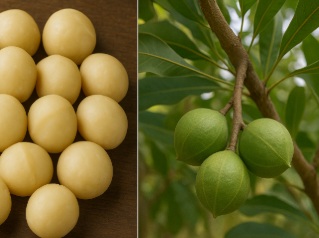
Macadamia Nuts
Rating : 7
| Evaluation | N. Experts | Evaluation | N. Experts |
|---|---|---|---|
| 1 | 6 | ||
| 2 | 7 | ||
| 3 | 8 | ||
| 4 | 9 | ||
| 5 | 10 |
Cons:
Allergen (1)0 pts from Al222
| Sign up to vote this object, vote his reviews and to contribute to Tiiips.Evaluate | Where is this found? |
| "Descrizione" about Macadamia Nuts by Al222 (23259 pt) | 2025-Nov-27 11:44 |
| Read the full Tiiip | (Send your comment) |
Macadamia Nuts
Principal species: Macadamia integrifolia, M. tetraphylla
Forms: whole kernels, pieces, roasted/salted, macadamia butter, flour/paste (incl. partially defatted), macadamia oil (virgin or refined)
Definition
High–oil tree nuts with a very high MUFA content and a sweet–buttery flavor. Consumed as snacks and in bakery/confectionery; also a source of culinary and cosmetic macadamia oil.

Common name: Macadamia nuts
Parent plants:
Macadamia integrifolia Maiden & Betche
Macadamia tetraphylla L.A.S. Johnson
(these are the main species for commercial production)
Kingdom: Plantae
Clade: Angiosperms
Clade: Eudicots
Order: Proteales
Family: Proteaceae
Genus: Macadamia
Species: M. integrifolia, M. tetraphylla
Climate:
Macadamia trees are native to Australian rainforests and require a:
warm, subtropical climate,
ideal temperatures between 18 and 28 °C,
frost-free environment (damage below about 3–5 °C),
moderate humidity with rainfall well distributed throughout the year.
They tolerate short dry periods but give their best in stable, humid environments.
Sun exposure:
They require full sun to:
maximize photosynthesis,
ensure good flowering,
achieve high nut yields.
Shade significantly reduces production.
Soil:
Macadamia trees prefer soils that are:
well drained,
deep,
rich in organic matter,
slightly acidic (pH 5.0–6.5),
medium-textured or sandy–loam.
They are sensitive to heavy clay soils and poor drainage, which favor root rot.
Irrigation:
Water requirement is moderate.
Regular water is important during flowering and nut development.
Young trees need more frequent irrigation.
Excessive watering must be avoided to prevent soil-borne diseases.
Temperature:
Germination: 18–25 °C
Ideal growth: 20–28 °C
Sensitive to cold below 5 °C
Heat stress above 32–35 °C
Strong temperature fluctuations can reduce fruit set and nut quality.
Fertilization:
Macadamia trees respond well to balanced fertilization:
Nitrogen: promotes vegetative growth, but should be used in moderation.
Phosphorus: supports healthy root systems and flowering.
Potassium: important for nut size, yield, and quality.
Essential micronutrients: zinc, boron, magnesium.
Organic amendments improve soil fertility and structure.
Crop care:
Light annual pruning to maintain an open, well-ventilated canopy.
Removal of damaged branches and water sprouts.
Weed control in early growth stages.
Protection against pests such as thrips, aphids, and beetles.
Monitoring for fungal diseases (root rots, leaf spots).
Harvest:
Macadamia nuts ripen and typically fall naturally to the ground when mature.
Key points:
Harvest usually occurs from late summer to autumn, depending on climate and cultivar.
The outer husk (fruit) splits or is removed to reveal the very hard inner shell.
The shell requires special equipment for cracking.
After harvesting, nuts are dried to reduce moisture and improve shelf life and flavor.
Propagation:
Macadamia is propagated by:
Grafting (main method in commercial orchards, ensures uniformity),
Seed (mainly for rootstock; high variability in seedling trees).
Young trees typically require 5–7 years before they start bearing significant crops.
Caloric value
~720 kcal per 100 g (typical 718–740 kcal/100 g depending on moisture and roast).
Average composition (per 100 g, dry/roasted kernels)
Fat: ~75–76 g
Protein: ~7–8 g
Carbohydrate: ~13–14 g (of which fiber ~8–9 g, sugars ~4–5 g)
Water: ~1–3 g
Minerals/Vitamins: high manganese, relevant copper, magnesium, potassium, iron; vitamins: notably thiamin (B1), with smaller amounts of B6 and niacin
Fatty-acid profile (indicative, % of total fat)
MUFA: oleic (C18:1) ~56–67%, palmitoleic (C16:1) ~12–25%
SFA: palmitic (C16:0) ~7–10%, stearic (C18:0) ~2–5%
PUFA: linoleic (C18:2) ~1–3%, α-linolenic ≤0.5%
Unsaponifiables: phytosterols (β-sitosterol), tocopherols/tocotrienols (modest), squalene (trace)
MUFA = MonoUnsaturated Fatty Acids: generally heart-friendly; help improve lipid profile (e.g., olive oil).
PUFA = PolyUnsaturated Fatty Acids: include Omega-3 and Omega-6; beneficial, but keep a reasonable Omega-6:Omega-3 balance.
SFA = Saturated Fatty Acids: limit/moderate; health impact depends on overall diet pattern and replacement nutrients.
Sensory & technological properties
Texture: very crisp raw; friable–buttery after roasting.
Flavor: buttery, dairy-like notes that intensify with roasting via Maillard/caramelization.
Oil: pale straw to yellow, mild–sweet taste; good oxidative stability owing to high MUFA/low PUFA.
Processing & roasting
Cracking/shelling → kernel drying to ~1–1.5% moisture → roasting typically 120–160 °C for 10–20 min (size dependent) → optional salting/coating.
Roasting enhances crunch and aroma; control to avoid excessive browning/bitterness and vitamin B1 loss.
Macadamia oil (brief)
Virgin/cold-pressed: delicate aroma; smoke point ~190–210 °C.
Refined (RBD): neutral, smoke point ~220–230 °C; suitable for sautéing/light frying and as a finishing oil.
Cosmetic: high palmitoleic (C16:1)—lipid affinity with skin; valued as an emollient/conditioner.
Food applications
Snacks: whole/roasted/salted or honey-/chocolate-coated.
Bakery/confectionery: cookies, shortbread, cakes, pralines; defatted flour for low-carb/gluten-free formulas (structure adjustments needed).
Culinary: toppings for salads/poke, nut butters/pestos; oil for dressings, mayonnaise, moderate-heat cooking.
Nutrition & health (highlights)
Rich in MUFA (oleic + palmitoleic) → favorable lipid profile relative to fats high in long-chain SFA.
Fiber and micronutrients (Mn, B1) add nutrient density; note high energy density—typical portions ~30 g.
Naturally low sodium unless salted; gluten-free by nature.
Allergens & safety
Classified as a tree nut allergen—risk of IgE-mediated reactions; strict labeling and cross-contact controls required.
Mycotoxins: generally lower risk than some nuts but still monitor (keep moisture low; proper storage).
Pet safety: toxic to dogs (weakness, tremors, vomiting); keep away from pets.
Quality & specifications (typical themes)
Kernel moisture ≈ 1–1.5% for crunch and shelf life.
Low peroxide/anisidine values in oil; no rancid/off notes.
Graded by size and defects (breakage, over-roast, discoloration).
Residues (pesticides/metals) within limits; aflatoxins monitored to legal thresholds.
Storage & shelf life
Store cool, dry, dark, in airtight packaging (nuts readily pick up odors).
Kernels: 6–12 months (longer if refrigerated/frozen).
Oil: 12–24 months (virgin more sensitive than RBD).
Prefer oxygen barriers (vacuum or inert gas) and moderate temperatures to limit oxidation.
Troubleshooting
Early rancidity: lower storage temperature, protect from light/oxygen, use barrier packs; rotate stock.
Loss of crunch: light re-drying/re-roast or apply sugar/salt coatings.
Over-friable bakery texture: balance with starches/flours or eggs; add hydrocolloids (xanthan/psyllium) for gluten-free matrices.
Sustainability
Produced in Australia, Hawaii, South Africa, Kenya, Latin America. Evaluate water use, biodiversity, and social conditions; favor suppliers with traceability and responsible agronomy.
Conclusion
Macadamia nuts deliver premium sensory quality and a MUFA-rich lipid profile (notably palmitoleic), making them ideal for premium snacks, bakery, and a versatile culinary/cosmetic oil. Given their high energy density and allergenic nature, practice mindful portioning, accurate labeling, and careful storage to preserve freshness and safety.
References__________________________________________________________________________
Curb JD, Wergowske G, Dobbs JC, Abbott RD, Huang B. Serum lipid effects of a high-monounsaturated fat diet based on macadamia nuts. Arch Intern Med. 2000 Apr 24;160(8):1154-8. doi: 10.1001/archinte.160.8.1154.
Abstract. Background: Recent studies have identified potential beneficial effects of eating nuts, most of which have substantial amounts of monounsaturated fats. Macadamia nuts are 75% fat by weight, 80% of which is monounsaturated. Objective: To examine variations in serum lipid levels in response to a high-monounsaturated fat diet based on macadamia nuts. Methods: A randomized crossover trial of three 30-day diets was conducted in 30 volunteers aged 18 to 53 years from a free-living population. Each was fed a "typical American" diet high in saturated fat (37% energy from fat); an American Heart Association Step 1 diet (30% energy from fat); and a macadamia nut-based monounsaturated fat diet (37% energy from fat) in random order. Serum total cholesterol, high-density lipoprotein cholesterol, and triglyceride levels were measured. Results: Mean total cholesterol level after the typical American diet was 5.20 mmol/L (201 mg/dL). After the Step 1 diet and the macadamia nut diet, total cholesterol level was 4.99 mmol/L (193 mg/dL) and 4.95 mmol/L (191 mg/dL), respectively. Low-density lipoprotein cholesterol level was 3.37 mmol/L (130 mg/dL) (typical diet), 3.21 mmol/L (124 mg/dL) (Step 1 diet), and 3.22 mmol/L (125 mg/dL) (macadamia nut diet). High-density lipoprotein cholesterol level was 1.43 mmol/L (55 mg/dL) (typical), 1.34 mmol/L (52 mg/dL) (Step 1), and 1.37 mmol/L (53 mg/dL) (macadamia nut). Lipid values after the Step 1 and macadamia nut diets were significantly different from those after the typical diet (P<.05). Conclusions: The macadamia nut-based diet high in monounsaturated fat and the moderately low-fat diet both had potentially beneficial effects on cholesterol and low-density lipoprotein cholesterol levels when compared with a typical American diet.
Garg ML, Blake RJ, Wills RB. Macadamia nut consumption lowers plasma total and LDL cholesterol levels in hypercholesterolemic men. J Nutr. 2003 Apr;133(4):1060-3. doi: 10.1093/jn/133.4.1060.
Abstract. This study was conducted to assess the cholesterol-lowering potential of macadamia nuts. Seventeen hypercholesterolemic men (mean age 54 y) were given macadamia nuts (40-90 g/d), equivalent to 15% energy intake, for 4 wk. Plasma total cholesterol, LDL cholesterol, HDL cholesterol, triglycerides and homocysteine concentrations and the fatty acid composition of plasma lipids were determined before and after treatment. Plasma MUFA 16:1(n-7), 18:1(n-7) and 20:1(n-9) were elevated after intervention with macadamia nuts. Plasma (n-6) and (n-3) PUFA concentrations were unaffected by macadamia nut consumption. Plasma total cholesterol and LDL cholesterol concentrations decreased by 3.0 and 5.3%, respectively, and HDL cholesterol levels increased by 7.9% in hypercholesterolemic men after macadamia nut consumption. Plasma triglyceride and homocysteine concentrations were not affected by treatment. Macadamia nut consumption was associated with a significant increase in the relative intake of MUFA and a reduced relative intake of saturated fatty acids and PUFA. This study demonstrates that macadamia nut consumption as part of a healthy diet favorably modifies the plasma lipid profile in hypercholesterolemic men despite their diet being high in fat.
Gutiérrez-Díaz G, Betancor D, Parrón-Ballesteros J, Gordo RG, Castromil-Benito ES, Haroun E, Vázquez de la Torre M, Turnay J, Villalba M, Cuesta-Herranz J, Pastor-Vargas C. Identification of New Allergens in Macadamia Nut and Cross-Reactivity with Other Tree Nuts in a Spanish Cohort. Nutrients. 2024 Mar 26;16(7):947. doi: 10.3390/nu16070947.
Abstract. The consumption of macadamia nuts has increased due to their cardioprotective and antioxidant properties. However, this rise is consistent with an increase in the cases of macadamia nut allergy, leading to severe reactions. Although two Macadamia integrifolia allergens (Mac i 1 and Mac i 2) have been identified in Australian and Japanese patients, the allergenic sensitization patterns in Western European populations, particularly in Spain, remain unclear. For this purpose, seven patients with macadamia nut allergy were recruited in Spain. Macadamia nut protein extracts were prepared and, together with hazelnut and walnut extracts, were used in Western blot and inhibition assays. IgE-reactive proteins were identified using MALDI-TOF/TOF mass spectrometry (MS). Immunoblotting assays revealed various IgE-binding proteins in macadamia nut extracts. Mass spectrometry identified three new allergens: an oleosin, a pectin acetylesterase, and an aspartyl protease. Cross-reactivity studies showed that hazelnut extract but not walnut extract inhibited macadamia nut oleosin-specific IgE binding. This suggests that oleosin could be used as marker for macadamia-hazelnut cross-reactivity. The results show an allergenic profile in the Spanish cohort different from that previously detected in Australian and Japanese populations. The distinct sensitization profiles observed highlight the potential influence of dietary habits and environmental factors exposure on allergenicity.
Jones JL, Sabaté J, Heskey C, Oda K, Miles F, Rajaram S. Macadamia nut effects on cardiometabolic risk factors: a randomised trial. J Nutr Sci. 2023 May 8;12:e55. doi: 10.1017/jns.2023.39.
Abstract. We sought to examine the effects of daily consumption of macadamia nuts on body weight and composition, plasma lipids and glycaemic parameters in a free-living environment in overweight and obese adults at elevated cardiometabolic risk. Utilising a randomised cross-over design, thirty-five adults with abdominal obesity consumed their usual diet plus macadamia nuts (~15 % of daily calories) for 8 weeks (intervention) and their usual diet without nuts for 8 weeks (control), with a 2-week washout. Body composition was determined by bioelectrical impedance; dietary intake was assessed with 24-h dietary recalls. Consumption of macadamia nuts led to increased total fat and MUFA intake while SFA intake was unaltered. With mixed model regression analysis, no significant changes in mean weight, BMI, waist circumference, percent body fat or glycaemic parameters, and non-significant reductions in plasma total cholesterol of 2⋅1 % (-4⋅3 mg/dl; 95 % CI -14⋅8, 6⋅1) and low-density lipoprotein (LDL-C) of 4 % (-4⋅7 mg/dl; 95 % CI -14⋅3, 4⋅8) were observed. Cholesterol-lowering effects were modified by adiposity: greater lipid lowering occurred in those with overweight v. obesity, and in those with less than the median percent body fat. Daily consumption of macadamia nuts does not lead to gains in weight or body fat under free-living conditions in overweight or obese adults; non-significant cholesterol lowering occurred without altering saturated fat intake of similar magnitude to cholesterol lowering seen with other nuts. Clinical Trial Registry Number and Website: NCT03801837 https://clinicaltrials.gov/ct2/show/NCT03801837?term = macadamia + nut&draw = 2&rank = 1. © The Author(s) 2023.
Hiraoka-Yamamoto J, Ikeda K, Negishi H, Mori M, Hirose A, Sawada S, Onobayashi Y, Kitamori K, Kitano S, Tashiro M, Miki T, Yamori Y. Serum lipid effects of a monounsaturated (palmitoleic) fatty acid-rich diet based on macadamia nuts in healthy, young Japanese women. Clin Exp Pharmacol Physiol. 2004 Dec;31 Suppl 2:S37-8. doi: 10.1111/j.1440-1681.2004.04121.x.
Abstract. 1. Recent studies have identified potential beneficial effects of eating nuts, most of which have substantial amounts of monounsaturated fatty acids (MUFA). Macadamia nuts consist of 75% fat by weight, 80% of which is MUFA (palmitoleic acid). 2. To examine variations in serum lipid levels in response to a high-MUFA diet based on macadamia nuts, 3 week interventions of macadamia nuts, coconuts and butter were determined in young, healthy Japanese female students. 3. After 3 weeks intervention, serum concentrations of total cholesterol and low-density lipoprotein-cholesterol were significantly decreased in the macadamia nut and coconut diets and bodyweight and body mass index were decreased in the group fed macadamia nuts, although there were no statistically significant changes in the group fed butter.
| Sign up to vote this object, vote his reviews and to contribute to Tiiips.EvaluateClose | (0 comments) |
Read other Tiiips about this object in __Italiano (1)
Content:   Family:   Last update:   2025-10-14 16:44:07 | Kcal/100g:   720 Threat factors:   |

