

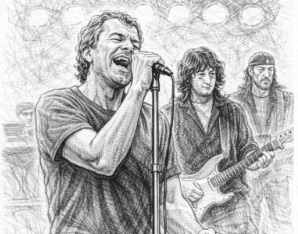
Deep Purple, complete biography, hard rock, heavy metal, international concerts, and discography
Profile
Deep Purple is a British rock band founded in 1968, universally recognized as one of the founding fathers of hard rock and heavy metal, alongside Led Zeppelin and Black Sabbath. Their history is marked by continuous lineup changes, distinct stylistic phases, and exceptional longevity in the international rock landscape.
Deep Purple played a central role in the development of high-volume electric rock, contributing decisively to the definition of 1970s hard-rock sound and exerting a profound influence on subsequent generations of musicians.

Historical context and the band’s formation (1967–1968)
The band emerged in the United Kingdom at the end of the 1960s, a period of intense musical ferment shaped by:
The initial project was conceived as a versatile band, capable of moving between rock, classical music, and experimentation. From the outset, however, a strong focus on instrumental virtuosity stands out, an element that would become a constant in their identity.
The different “Marks”: An identity in evolution
Deep Purple’s history is traditionally divided into different “Marks,” meaning distinct lineups that correspond to specific stylistic phases.
This structure makes the group a unique case: not a static band, but a musical organism in continuous transformation.
Mark I (1968–1969): Psychedelia and experimentation
The first lineup moved between:
psychedelic rock,
classical influences,
complex arrangements.
Albums such as Shades of Deep Purple and The Book of Taliesyn show a band still searching for a definitive identity, with a sound far from the hard rock that would later make them famous.
Mark II (1969–1973): The birth of hard rock
With the arrival of Ian Gillan (vocals) and Roger Glover (bass), Deep Purple found their most iconic lineup.
This phase defines:
modern hard rock,
the central role of Jon Lord’s distorted Hammond organ,
the aggressive dialogue between guitar and keyboards,
a powerful, theatrical vocal style.
Albums such as In Rock, Fireball, and Machine Head set new standards for volume, energy, and rock songwriting.
Machine Head includes Smoke on the Water, one of the most recognizable riffs in rock history.
Concerts and the live dimension in the 1970s
During the Mark II era, Deep Purple became one of the most powerful live bands in the world.
Their concerts were characterized by:
long instrumental passages,
extended improvisations,
extreme volume for the era,
strong interaction among the musicians.
The live album Made in Japan (1972) is considered one of the most important live records in rock history.
Mark III and IV (1973–1976): Funk, soul, and internal crises
After Gillan and Glover’s departure, the band entered a transitional phase.
The new lineups introduced:
funk and soul influences,
a different vocal approach,
greater rhythmic experimentation.
Albums such as Burn and Stormbringer show a band that was still creative, but internal tensions and excessive substance use led to a breakup in 1976.
Breakup and reunion (1976–1984)
After the breakup, the members pursued parallel projects. In 1984 the Mark II lineup reunited, an event received with enormous media attention.
The return marked:
The 1990s and 2000s: Continuity and renewal
In subsequent years, Deep Purple continued to release albums and perform live, despite further lineup changes.
This phase is characterized by:
respect for the hard-rock tradition,
adaptation to a multi-generational audience,
the centrality of live activity as the main pillar of their career.
The band became a rare example of active longevity, not limited to nostalgia.
Musical style (Discursive analysis)
Deep Purple’s language is built on a set of key elements:
powerful, memorable riffs,
virtuosic use of guitar and keyboards,
continuous dialogue between lead instruments,
classical-music influence applied to rock,
major emphasis on live improvisation.
Their style contributed directly to the birth of hard rock and laid the groundwork for heavy metal.
Early period – Mark I (psychedelic / progressive rock) (1968–1969)
Studio albums
| Year | Album | Main tracks |
|---|
| 1968 | Shades of Deep Purple | Hush · Mandrake Root |
| 1968 | The Book of Taliesyn | Kentucky Woman · Anthem |
| 1969 | Deep Purple | April · Chasing Shadows |
Classic period – Mark II (hard rock / heavy metal) (1970–1973)
(Classic line-up: Gillan · Blackmore · Lord · Glover · Paice)
Studio albums
| Year | Album | Main tracks |
|---|
| 1970 | In Rock | Child in Time · Speed King |
| 1971 | Fireball | Fireball · No No No |
| 1972 | Machine Head | Smoke on the Water · Highway Star |
| 1973 | Who Do We Think We Are | Woman from Tokyo · Mary Long |
Mark III period (funk / soul rock influences) (1974–1975)
(With David Coverdale and Glenn Hughes)
Studio albums
| Year | Album | Main tracks |
|---|
| 1974 | Burn | Burn · Mistreated |
| 1974 | Stormbringer | Stormbringer · Soldier of Fortune |
Mark IV period (experimentation and crisis) (1975–1976)
Studio albums
| Year | Album | Main tracks |
|---|
| 1975 | Come Taste the Band | You Keep on Moving · Gettin’ Tighter |
Break-up and reunion – reformed Mark II (1984–1987)
Studio albums
| Year | Album | Main tracks |
|---|
| 1984 | Perfect Strangers | Perfect Strangers · Knocking at Your Back Door |
| 1987 | The House of Blue Light | Bad Attitude · Call of the Wild |
Transition period and line-up changes (1990–1996)
Studio albums
| Year | Album | Main tracks |
|---|
| 1990 | Slaves and Masters | King of Dreams · Fire in the Basement |
| 1993 | The Battle Rages On… | Anya · The Battle Rages On |
| 1996 | Purpendicular | Sometimes I Feel Like Screaming · Ted the Mechanic |
Modern period – stability with Steve Morse (1998–2005)
Studio albums
| Year | Album | Main tracks |
|---|
| 1998 | Abandon | Any Fule Kno That · Watching the Sky |
| 2003 | Bananas | Haunted · Contact Lost |
| 2005 | Rapture of the Deep | Rapture of the Deep · Wrong Man |
Recent period – Don Airey era (2013–2024)
Studio albums
| Year | Album | Main tracks |
|---|
| 2013 | Now What?! | Vincent Price · All the Time in the World |
| 2017 | Infinite | Time for Bedlam · The Surprising |
| 2020 | Whoosh! | Throw My Bones · Man Alive |
| 2024 | =1 | Portable Door · Pictures of You |