

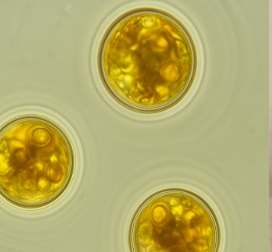
Ruttnera Lamellosa
Rating : 7
| Evaluation | N. Experts | Evaluation | N. Experts |
|---|---|---|---|
| 1 | 6 | ||
| 2 | 7 | ||
| 3 | 8 | ||
| 4 | 9 | ||
| 5 | 10 |
Pros:
Antioxidant (1)0 pts from Al222
| Sign up to vote this object, vote his reviews and to contribute to Tiiips.Evaluate | Where is this found? |
| "Descrizione" about Ruttnera Lamellosa by Al222 (23259 pt) | 2025-Dec-06 10:31 |
| Read the full Tiiip | (Send your comment) |
Ruttnera lamellosa (Ruttnera lamellosa (Anand) Andersen et al.)
Ruttnera lamellosa is a unicellular golden microalga belonging to the Haptophyta, order Isochrysidales, family Isochrysidaceae. Cells are typically spherical to subspherical and are surrounded by concentric lamellate layers of mucilage that can give rise to palmelloid aggregates or thin, pseudo-thallus–like films adhering to the substrate. Cell diameter is in the micrometre range, and light microscopy descriptions report golden-brown plastids and, in some stages, pigment droplets in the cytoplasm typical of “golden microalgae”. In culture, several morphological stages have been described, including mucilage-embedded palmelloid layers, lamellate colonies and sporangia with aplanospores embedded in a gelatinous matrix.
From an ecological perspective, Ruttnera lamellosa was first described on moist, calcareous substrates (for example chalk or gypsum cliffs and other basic rocky surfaces periodically moistened by spray or seepage), where it forms adherent algal films in well-lit, humid microhabitats. Subsequent isolations and observations indicate that it can also occur in benthic biofilms of coastal, slightly brackish or inland waters, growing on solid surfaces or sand grains under good light conditions and with sufficient nutrient availability. Within these systems it acts as a microbial primary producer, contributing to organic carbon production and nutrient cycling in epilithic and episammic microhabitats. The mucilage-rich biofilms and lamellate colonies also provide microhabitats for bacteria and other microorganisms, integrating Ruttnera into complex, multi-species microbial communities.
From a compositional and nutritional standpoint, biomass of Ruttnera lamellosa has been characterised for at least one cultivated strain. On a dry-weight basis, an indicative proximate composition includes roughly 8–9% protein, over 40% total carbohydrates, a very low fibre fraction (around 1%) and approximately 2–3% lipids, with values varying according to growth conditions. The lipid fraction contains a notable proportion of long-chain polyunsaturated fatty acids, especially docosahexaenoic acid (DHA, C22:6 n-3), which can account for a substantial share of total fatty acids. The intracellular polysaccharide fraction is reported to be rich in xylose, indicating the presence of heteropolysaccharides of potential technological interest. In addition, the biomass contains photosynthetic pigments (chlorophylls and carotenoids typical of haptophytes), antioxidant compounds with measurable radical-scavenging capacity, and a mineral component with macro- and microelements reflecting the composition of the culture medium.
In the food and nutraceutical context, Ruttnera lamellosa is considered an emerging microalgal species with potential as a source of functional ingredients. The described nutritional profile – with readily accessible carbohydrates, a moderate protein content, low fibre, and the presence of DHA and other long-chain PUFA – makes it of interest for functional foods and microalgae-based supplements. The additional antioxidant capacity of the biomass supports its possible use in formulations designed to help protect against oxidative stress. Any broad food application, however, would require thorough safety and tolerance evaluations, regulatory assessment (for example under Novel Food frameworks) and studies on the stability of fatty acids and polysaccharides during processing and storage.
From a technological and biotechnological point of view, attention focuses on the polysaccharide fraction and on the organism’s ability to produce lamellate mucilage sheaths and extracellular layers, which could be explored as biopolymer sources, rheology modifiers or bio-based coating materials. The combination of xylose-rich polysaccharides, pigments and PUFA makes Ruttnera lamellosa a candidate feedstock for microalgal biorefinery schemes, in which a single biomass stream is fractionated into multiple value-added products (lipids, polysaccharides, antioxidant extracts). The species is also of interest as a model microalga for studies on haptophyte physiology, optimisation of culture conditions, and responses to different light and nutrient regimes in benthic and planktonic stages.
For quality assessment of Ruttnera lamellosa biomass intended for processing, key parameters include strain and batch purity (absence of unwanted microbial contaminants and other microalgae), residual moisture, physiological state of the cells (integrity, pigment content), proximate composition (protein, lipids, carbohydrates, fibre), fatty acid profile (with specific attention to DHA and other PUFA), polysaccharide content and antioxidant capacity, and the presence of any metals or contaminants derived from the culture medium or process water. Harvesting conditions (e.g. centrifugation or filtration), drying regime (temperature, time, atmosphere) and storage conditions (protection from light, oxygen and humidity) are critical to preserving the physicochemical properties, technological functionality and, in particular, the stability of polyunsaturated fatty acids and antioxidant compounds in the final biomass.

Botanical / taxonomic classification (algal system, APG IV framework where applicable)
Common name: no established common English name (golden unicellular microalga)
Botanical name: Ruttnera lamellosa
Domain: Eukaryota
Phylum: Haptophyta
Class: Prymnesiophyceae
Order: Isochrysidales
Family: Isochrysidaceae
Genus: Ruttnera
Species: Ruttnera lamellosa
Ruttnera lamellosa is a unicellular golden microalga, surrounded by lamellate mucilage layers, belonging to the haptophyte group of marine microalgae.
Indicative nutritional values per 100 g (dried biomass*)
Because there are no specific nutrient tables for Ruttnera lamellosa, the values below are indicative and derived from typical compositional ranges of dried marine haptophyte microalgae.
| Component | Approx. value per 100 g |
|---|---|
| Energy | ~ 350–450 kcal |
| Total carbohydrates | ~ 20–30 g |
| — of which sugars | ~ 3–6 g |
| Structural polysaccharides / fibre | ~ 15–25 g |
| Proteins | ~ 25–35 g |
| Total fats | ~ 10–20 g |
| — of which saturated fatty acids (SFA) | ~ 2–4 g |
| — monounsaturated (MUFA) | ~ 2–4 g |
| — polyunsaturated (PUFA) | ~ 4–10 g |
| Minerals (ash) | ~ 8–12 g |
| Pigments (carotenoids, xanthophylls) | present, variable amounts |
| Vitamins (B-complex, E) | present in trace–low amounts |
* Values refer to dried biomass. Fresh microalgal biomass contains typically >80–90% water, so per-100 g values for fresh material would be much lower.
Typical features of haptophyte microalgae
Moderate to high lipid content, with a relevant share of polyunsaturated fatty acids, sometimes including EPA.
Protein fraction that can exceed 30% on a dry matter basis.
Presence of carotenoids and xanthophylls responsible for the characteristic golden coloration.
Mini-glossary of acronyms
SFA = Saturated fatty acids. When they predominate over unsaturated fats in the diet, they are generally considered less favourable for cardiovascular health.
MUFA = Monounsaturated fatty acids. Usually regarded as more favourable when replacing saturated fats.
PUFA = Polyunsaturated fatty acids. Include omega-6 and omega-3; essential in small amounts and important for cell membrane structure and inflammatory balance.
Ruttnera lamellosa exhibits the following cellular features:
The biochemical profile of Ruttnera lamellosa is less explored but likely includes:
Although Ruttnera lamellosa is not widely utilized, its characteristics offer potential in various fields:
Environmental Monitoring:
Ecological Studies:
Biotechnology:
Cultivating Ruttnera lamellosa in a controlled environment requires specific conditions:
Environmental Role:
Safety:
References__________________________________________________________________________
Assunção, M. F., Varejão, J. M., & Santos, L. M. (2017). Nutritional characterization of the microalga Ruttnera lamellosa compared to Porphyridium purpureum. Algal research, 26, 8-14.
Abstract. Sustainable food and human health are the major concerns of the society in the last decades. Functional foods and nutraceuticals from natural sources such as microalgae are regarded as a solution. In this study the nutritional composition of Ruttnera lamellosa ACOI 339 has been evaluated and compared to the widely studied Porphyridium purpureum. R. lamellosa showed a proximate composition with 8.81% of protein and 43.88% of carbohydrate and also a convenient lack of fiber (0.94%). The strain revealed a lipid content of 2.68% with substantial amount of long chain polyunsaturated fatty acids, especially docosahexaenoic fatty acid (C22:6ω3 – DHA) representing 6.36% of total fatty acids. The intracellular polysaccharide is rich in xylose, and also a promising antioxidant capacity of 12.02 mg/L equivalent to ascorbic acid was detected as an additional feature of the valuable biomass.
Andersen, R. A., Kim, J. I., Tittley, I., & Yoon, H. S. (2014). A re-investigation of Chrysotila (Prymnesiophyceae) using material collected from the type locality. Phycologia, 53(5), 463-473.
Abstract:. We isolated 17 strains of Chrysotila stipitata and 10 strains of Chrysotila lamellosa from samples collected at exposed chalk surfaces, Westgate, Kent, England, which is the type locality for C. stipitata (generitype) and C. lamellosa. The nuclear-encoded small subunit and large subunit rRNA were used in a molecular phylogenetic analysis. We also examined the cells using light microscopy. Chrysotila stipitata had two chloroplasts per cell, as originally described, and it was positioned within the Coccolithales (Prymnesiophyceae) in a RAxML tree. Chrysotila stipitata gene sequences formed a clade with Pleurochrysis, and because Chrysotila has priority, Pleurochrysis was placed in synonymy. New nomenclatural combinations were also made. Chrysotila lamellosa was located within the order Isochrysidales, and like other members of the order, C. lamellosa had one chloroplast per cell. We reinstated the generic name Ruttnera to accommodate this species (Ruttnera lamellosa comb. nov.). We also showed that several other taxa described from the chalk cliff type locality were alternate life stages for C. stipitata, and we assigned these as synonyms of C. stipitata.
Liao, S., Yin, S., & Huang, Y. (2020, December). C 38 Ethyl Alkenoates as New Group II Isochrysidales Proxy for Detecting Mixed Alkenone Productions in Ocean Sediments. In AGU Fall Meeting Abstracts (Vol. 2020, pp. B083-08).
Abstract. Alkenones are polyunsaturated long chain methyl and ethyl ketones produced by Isochrysidales, an order of haptophyte algae. Based on phylogenetic data, members of Isochrysidales have been classified into three groups, with each group showing significant differences in temperature calibrations and preferred growth environments. Alkenones have been widely used for paleo-sea surface temperature (SST) reconstructions in the past 40 years. However, such reconstructions remain challenging in coastal areas and high latitude ocean areas due to the potential mixed alkenone productions by Group II (coastal species) and Group III (marine species) Isochrysidales. Therefore, identification of mixed alkenone productions in sediments is important for assessing corresponding reconstruction results. However, there are currently no definitive biomarkers to indicate the alkenone contribution from Group II Isochrysidales for ocean sediments where the dominant alkenone producers belong to Group III Isochrysidales. Here, we systematically examine samples from cultures of Group II (Isochrysis nuda, Isochrysis litoralis, Ruttnera lamellosa, Isochrysis galbana, Tisochrysis lutea and one strain isolated from sea ice in Baffin Bay) and Group III (Emiliania huxleyi and Gephyrocapsa oceanica) Isochrysidales and environmental samples of Group I Isochrysidales. For the first time, we report the production of C37 ethyl ester (C37OEt) and C38 ethyl ester (C38OEt) (also called alkenoates) with extended chain lengths by Isochrysidales. While C37OEt alkenoates could be found in all culture samples of Group II and Group III Isochrysidales, C38OEt alkenoates are only found in Group II Isochrysidales. Our results indicate that C38OEt alkenoates are specific biomarkers for Group II Isochrysidales, and could be easily detected with gas chromatography-mass spectrometry (GC-MS) under single ion monitoring (SIM) mode after hydrogenating corresponding samples. Importantly, the Group II strain isolated from ice has the highest production of C38OEt alkenoates (percentage of C38OEt/C37Me is ~10 times higher than that of other Group II samples), allowing easier identification of its contribution to alkenone profiles of high latitude ocean sediments and subsequent study of environmental changes (e.g., temperature, sea ice).
Kaiser, J., van der Meer, M. T., & Arz, H. W. (2017). Long-chain alkenones in Baltic Sea surface sediments: new insights. Organic Geochemistry, 112, 93-104.
Abstract. C37 alkenones produced by certain haptophytes of the Isochrysidales are valuable sedimentary biomarkers used to estimate sea surface temperature (SST) in the open ocean. However, in coastal seas the role of salinity gradients on alkenone producing species and SST estimates is poorly known. Alkenones were analyzed in surface sediments from the marine Skagerrak region and the entire brackish Baltic Sea. Three types of alkenone distribution patterns were identified: type A distribution, which resembles the distribution in Emiliania huxleyi, type B distribution, which is similar to Ruttnera lamellosa, Isochrysis galbana and Pseudoisochrysis paradoxa distributions, although these haptophytes are absent from the Baltic Sea, and type C distribution, which is also found in worldwide lake sediments. These types of distribution are apparent in the percentage of C37:4 alkenone (%C37:4), which is significantly negatively correlated to sea surface salinity (SSS). The distribution of alkenones very likely results from distinct alkenone-producing haptophytes, whose spatial distribution is ultimately related to SSS, as supported by the hydrogen isotope fractionation (α) between alkenones and water .....
| Sign up to vote this object, vote his reviews and to contribute to Tiiips.EvaluateClose | (0 comments) |
Read other Tiiips about this object in __Italiano (1)
Hardiness:   Hardiness:   Natural fertilizer:   Hazards/diseases:   Last update:   2025-01-21 19:46:16 | Sun exposure:   Family:   Commercial fertilizer:   Main substances contained:  
|

