

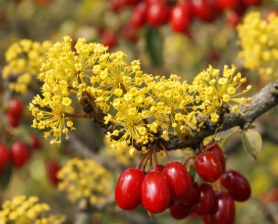
Cornus Officinalis
Rating : 7
| Evaluation | N. Experts | Evaluation | N. Experts |
|---|---|---|---|
| 1 | 6 | ||
| 2 | 7 | ||
| 3 | 8 | ||
| 4 | 9 | ||
| 5 | 10 |
0 pts from Al222
| Sign up to vote this object, vote his reviews and to contribute to Tiiips.Evaluate | Where is this found? |
| "Descrizione" about Cornus Officinalis by Al222 (24012 pt) | 2025-Dec-19 19:57 |
| Read the full Tiiip | (Send your comment) |
Cornus officinalis
Description
Cornus officinalis is a deciduous tree or large shrub belonging to the botanical family Cornaceae, traditionally cultivated and used in East Asia. It is a medium-sized plant with an upright habit and a spreading crown, typically reaching 4–8 metres in height under favourable conditions.
The leaves are opposite, ovate to elliptic, with an acuminate apex and clearly visible arcuate venation; they are deep green during the growing season. Flowering is very early, often occurring before leaf emergence: the flowers are small, yellow, and grouped in compact inflorescences that are not showy individually but abundant overall.
The fruit is an oval red drupe at full maturity, containing a hard stone. This fruit represents the main part of interest for traditional and functional uses.
![]() | ![]() |
Distribution, Ecology And Cultivation Aspects
Cornus officinalis is native to China, Korea and Japan, where it grows in hilly and montane forests, woodland margins and areas with adequate soil moisture.
From an ecological standpoint, the species prefers:
Temperate climates, with cold winters and mild to warm summers;
Deep, well-drained soils rich in organic matter;
Sunny to semi-shaded exposures;
Good tolerance to winter cold, while prolonged drought conditions are less suitable.
In cultivation, the plant is relatively undemanding. Propagation may be carried out by seed, cuttings or grafting. Fruit yield and quality depend on plant age, seasonal climatic conditions and water availability during flowering and fruit development.
Chemical Composition Of The Fruit And Functional Characteristics
The fruits of Cornus officinalis are characterised by a high content of secondary metabolites, which underpin their traditional use. The main constituents include:
Iridoids (such as morroniside and loganin), considered key chemical markers of the species;
Organic acids (including malic and citric acids);
Polyphenols and flavonoids, associated with antioxidant activity;
Tannins, responsible for the astringent taste of the fruit;
Sugars and polysaccharides in variable amounts.
Both qualitative and quantitative composition are influenced by cultivar, geographical origin, stage of ripeness and post-harvest processing methods, particularly drying.
Traditional Uses And Modern Applications
In East Asian traditional medicine, the fruits of Cornus officinalis (known as Shan Zhu Yu in the Chinese tradition) have been used for centuries as components of herbal formulations. Traditionally, they are employed to support:
General vitality and tonicity;
Functional balance of specific physiological systems;
Adaptation to stress and seasonal changes.
Dried fruits are used in decoctions, extracts and complex herbal formulas, often combined with other plant species. In modern contexts, standardised extracts of Cornus officinalis are being studied for potential nutraceutical and functional applications, always within applicable regulatory frameworks and safety evaluations.
Fruit Quality Assessment And Commercial Requirements
Quality evaluation of fruits intended for herbal or functional use is based on:
External appearance: uniform red colour, absence of mould or mechanical damage;
Degree of ripeness, which affects iridoid and polyphenol content;
Residual moisture content after drying, crucial for shelf stability;
Botanical purity, excluding closely related species or foreign plant material;
Chemical profile, particularly marker compounds;
Microbiological compliance with standards for herbal raw materials.
Careful management of harvesting, drying and storage is essential to preserve constituent stability and ensure consistent product quality.
Kingdom: Plantae
Clade: Angiosperms
Class: Eudicots
Order: Cornales
Family: Cornaceae
Genus: Cornus
Species: C. officinalis
Cornus officinalis grows to a height of 5-10 meters. The tree is noted for its peeling gray-brown bark and opposite, lance-shaped oval leaves, which turn vibrant yellow or red in the fall. In spring, before the leaves unfurl, it produces abundant yellow flowers, followed by bright red berries that mature in late summer or early fall.
The berries of Cornus officinalis are rich in vitamins, antioxidants, and bioactive compounds such as organic acids, tannins, and flavonoids. These fruits also contain cornin, a chemical compound studied for its antioxidant and anti-inflammatory properties.

The berries of Cornus officinalis are traditionally used to enhance kidney and liver function, treat vision problems, and as a general health tonic. They are noted for their use in treating erectile dysfunction, hypertension, and various inflammatory problems.
Cultivating Cornus officinalis is generally safe and does not pose significant environmental concerns. However, as with all medicinal plants, consumption of the berries should be under the guidance of a professional, as self-medication can lead to drug interactions or unwanted side effects. Sustainable cultivation practices help preserve soil health and the surrounding ecosystem.
References__________________________________________________________________________
Lee SB, Kang JH, Sim EJ, Jung YR, Kim JH, Hillman PF, Nam SJ, Kang TB. Cornus officinalis Seed Extract Inhibits AIM2-Inflammasome Activation and Attenuates Imiquimod-Induced Psoriasis-like Skin Inflammation. Int J Mol Sci. 2023 Mar 15;24(6):5653. doi: 10.3390/ijms24065653.
Abstract. The AIM2 inflammasome is an innate immune system component that defends against cytosolic bacteria and DNA viruses, but its aberrant activation can lead to the progression of various inflammatory diseases, including psoriasis. However, there have been few reports of specific inhibitors of AIM2 inflammasome activation. In this study, we aimed to investigate the inhibitory activity of ethanolic extracts of seeds of Cornus officinalis (CO), a herb and food plant used in traditional medicine, on AIM2-inflammasome activation. We found that CO inhibited the release of IL-1β induced by dsDNA in both BMDMs and HaCaT cells, but that it showed no effect on the release of IL-1β induced by NLRP3 inflammasome triggers, such as nigericin and silica, or the NLRC4 inflammasome trigger flagellin. Furthermore, we demonstrated that CO inhibited the cleavage of caspase-1, an inflammasome activation marker, and an upstream event, the translocation and speck formation of ASC. In addition, further experiments and mechanistic investigations revealed that CO can inhibit AIM2 speck formation induced by dsDNA in AIM2-overexpressing HEK293T cells. To verify the correlation in vivo, we investigated the efficacy of CO in an imiquimod (IMQ)-induced psoriasis model, which has reported associations with the AIM2 inflammasome. We found that topical application of CO alleviated psoriasis-like symptoms, such as erythema, scaling, and epidermal thickening, in a dose-dependent manner. Moreover, CO also significantly decreased IMQ-induced expression of AIM2 inflammasome components, including AIM2, ASC, and caspase-1, and led to the elevation of serum IL-17A. In conclusion, our results suggest that CO may be a valuable candidate for the discovery of AIM2 inhibitors and the regulation of AIM2-related diseases.
Czerwińska ME, Bobińska A, Cichocka K, Buchholz T, Woliński K, Melzig MF. Cornus mas and Cornus officinalis-A Comparison of Antioxidant and Immunomodulatory Activities of Standardized Fruit Extracts in Human Neutrophils and Caco-2 Models. Plants (Basel). 2021 Oct 30;10(11):2347. doi: 10.3390/plants10112347.
Abstract. Fruits of Cornus mas and Cornus officinalis are representative plant materials traditionally used in Europe and Asia, respectively, in the treatment of diabetes and diabetes-related complications, which are often mediated by pathogenic inflammatory agents. Additionally, due to the fact of mutual infiltration of Asian and European medicines, the differentiation as well as standardization of traditional prescriptions seem to be crucial for ensuring the quality of traditional products. The objective of this study was a comparison of biological activity of extracts from fruits of C. mas and C. officinalis by an assessment of their effect on reactive oxygen species (ROS) generation in human neutrophils as well as cytokines secretion both in neutrophils (tumor necrosis factor α, TNF- α; interleukin 8, IL-8; interleukin 1β, IL-1β) and in human colon adenocarcinoma cell line Caco-2 (IL-8). To evaluate the phytochemical differences between the studied extracts as well as to provide a method for standardization procedures, a quantitative analysis of iridoids, such as loganin, sweroside, and loganic acid, found in extracts of Cornus fruits was performed with HPLC-DAD. All standardized extracts significantly inhibited ROS production, whereas the aqueous-alcoholic extracts were particularly active inhibitors of IL-8 secretion by neutrophils. The aqueous-methanolic extract of C. officinalis fruit, decreased IL-8 secretion by neutrophils to 54.64 ± 7.67%, 49.68 ± 6.55%, 50.29 ± 5.87% at concentrations of 5, 50, and 100 µg/mL, respectively, compared to LPS-stimulated control (100%). The aqueous extract of C. officinalis fruit significantly inhibited TNF-α release by neutrophils at concentrations of 50 and 100 µg/mL. On the other hand, the aqueous-ethanolic extract of C. mas fruit showed the propensity to increase TNF-α and IL-1β secretion. The modulatory activity of the Cornus extracts was noted in the case of secretion of IL-8 in Caco-2 cells. The effect was comparable with dexamethasone. The content of loganin in aqueous and aqueous-methanolic extract of C. officinalis fruit was higher than in the aqueous-ethanolic extract of C. mas fruit, which was characterized by a significant quantity of loganic acid. In conclusion, the immunomodulatory effect observed in vitro may partially confirm the traditional use of Cornus fruits through alleviation of the development of diabetes-derived inflammatory complications. Loganin and loganic acid are significant markers for standardization of C. mas and C. officinalis fruit extracts, respectively.
Klymenko S, Kucharska AZ, Sokół-Łętowska A, Piórecki N, Przybylska D, Grygorieva O. Iridoids, Flavonoids, and Antioxidant Capacity of Cornus mas, C. officinalis, and C. mas × C. officinalis Fruits. Biomolecules. 2021 May 21;11(6):776. doi: 10.3390/biom11060776.
Abstract. The fruits of Cornus mas and Cornus officinalis have been known and appreciated in folk medicine for years and have a high biological value, which is mainly connected with their polyphenols and iridoids content. However, hybrids of C. mas × C. officinalis have not been investigated. The aim of this study was to evaluate the iridoids, anthocyanins, and flavonols content, and antioxidant capacity of Cornus mas, Cornus officinalis, and C. mas × C. officinalis. Iridoids and flavonoids were quantified by the High-Performance Liquid Chromatography (HPLC) method. Antioxidant capacity (AC) was measured using 2,2-diphenyl-1-picrylhydrazyl (DPPH•), 2,2'-azino-bis (3-ethyl benzothiazoline-6-sulfonic acid (ABTS•+), and ferric reducing antioxidant power (FRAP) tests. Total phenolic content (TPC) was evaluated using the Folin-Ciocalteu reagent. Among the C. mas cultivars and C. officinalis genotypes, there was considerable variation in the content of iridoids, flavonoids, and AC. Interspecific hybrids C. mas × C. officinalis contained more iridoids than C. mas and more anthocyanins than C. officinalis and additionally had higher AC and TPC than C. officinalis and most C. mas. AC, TPC, and the presence of iridoids, anthocyanins, and flavonols in hybrids C. mas × C. officinalis are reported for the first time. The Cornus species deserve special attention due to their highly biologically active substances, as well as useful medicinal properties.
Huang J, Zhang Y, Dong L, Gao Q, Yin L, Quan H, Chen R, Fu X, Lin D. Ethnopharmacology, phytochemistry, and pharmacology of Cornus officinalis Sieb. et Zucc. J Ethnopharmacol. 2018 Mar 1;213:280-301. doi: 10.1016/j.jep.2017.11.010. Epub 2017 Nov 17. PMID: 29155174.
Li M, Zhang J, Jiang L, Wang W, Feng X, Liu M, Yang D. Neuroprotective effects of morroniside from Cornus officinalis sieb. Et zucc against Parkinson's disease via inhibiting oxidative stress and ferroptosis. BMC Complement Med Ther. 2023 Jul 1;23(1):218. doi: 10.1186/s12906-023-03967-0. PMID: 37393274; PMCID: PMC10314491.
Gao X, Liu Y, An Z, Ni J. Active Components and Pharmacological Effects of Cornus officinalis: Literature Review. Front Pharmacol. 2021 Apr 12;12:633447. doi: 10.3389/fphar.2021.633447.
| Sign up to vote this object, vote his reviews and to contribute to Tiiips.EvaluateClose | (0 comments) |
Read other Tiiips about this object in __Italiano (1)
Hardiness:   Hardiness:   Natural fertilizer:   Hazards/diseases:   Last update:   2024-10-22 15:41:20 | Sun exposure:   Family:   Commercial fertilizer:   Main substances contained:   |

