

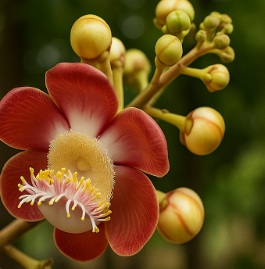
Shorea Robusta
Rating : 7
| Evaluation | N. Experts | Evaluation | N. Experts |
|---|---|---|---|
| 1 | 6 | ||
| 2 | 7 | ||
| 3 | 8 | ||
| 4 | 9 | ||
| 5 | 10 |
0 pts from admin
| Sign up to vote this object, vote his reviews and to contribute to Tiiips.Evaluate | Where is this found? |
| "Descrizione" about Shorea Robusta by admin (19545 pt) | 2025-Dec-06 18:14 |
| Read the full Tiiip | (Send your comment) |
Shorea robusta
Description
Shorea robusta is a large deciduous to semi-evergreen tree species belonging to the botanical family Dipterocarpaceae and is one of the most important forest trees of South Asia from an ecological and economic perspective. Under normal conditions it typically reaches 18–32 m in height, but in favourable sites and mature stands it can exceed 35–40 m, with a straight, cylindrical bole often free of branches for many metres, a typical feature of dominant trees in dense tropical forests.
The bark is thick, grey-brown to dark brown, with deep longitudinal fissures that become more evident with age; in older trees it may flake off in irregular plates. The leaves are simple, alternate, leathery, with an ovate to elliptic blade, pronounced venation and a distinctly pointed apex; young foliage often shows reddish or coppery tones before turning a deep, glossy green at maturity.
The flowers, small but numerous, are arranged in terminal or axillary panicles. They are creamy-white to yellowish, with a sweet fragrance that attracts insect pollinators. The fruit is a small nut provided with five wing-like lobes derived from the persistent calyx, which facilitate wind dispersal. Depending on climatic conditions, the species may behave as evergreen in wetter areas and briefly deciduous in drier zones, shedding its leaves in the pronounced dry season.
![]() | ![]() |
| Category | Data |
|---|---|
| Common name | Sal, sal tree |
| Botanical name | Shorea robusta C.F.Gaertn. |
| Kingdom | Plantae |
| Clade | Angiosperms → Eudicots → Rosids → Malvids |
| Order | Malvales |
| Family | Dipterocarpaceae |
| Genus | Shorea |
| Species | Shorea robusta C.F.Gaertn. |
| Component | Approx. value per 100 g |
|---|---|
| Energy | ~ 410–420 kcal |
| Total carbohydrates | ~ 60–65 g |
| — of which sugars | specific standardised data not widely available (part of total carbohydrates) |
| Dietary fibre | ~ 1–2 g |
| Proteins | ~ 7–9 g |
| Total fats | ~ 14–16 g |
| — of which saturated fatty acids (SFA) | ~ 8–10 g (predominantly stearic acid) |
| — monounsaturated (MUFA) | ~ 5–7 g (mainly oleic acid) |
| — polyunsaturated (PUFA) | ~ 0.5–1.5 g (mainly linoleic acid, minor share) |
| Ash (total minerals) | ~ 2–3 g |
| Specific minerals (Ca, Mg, Fe, etc.) | detailed quantitative data not uniformly reported |
| Vitamins (B-group, E) | presumed present in trace–low amounts, not standardised |
* Values refer to dried, dehulled sal seeds. Base data indicate roughly ~10–11% moisture, ~8% protein, ~63% carbohydrates, ~15% oil, ~1–1.5% fibre and ~2–2.5% ash; energy is calculated from these fractions. The well-known “sal fat” / sal butter is the isolated fat fraction from the seed and therefore has an energy value similar to other fats (~880–900 kcal/100 g). Here, however, the table refers to the whole seed.
Distribution, Ecology And Silvicultural Aspects
Shorea robusta is native to the Indian subcontinent, occurring in India, Nepal, Bhutan, Bangladesh and parts of adjacent regions. It forms extensive Sal forests, which are a key component of tropical and subtropical forest ecosystems on the southern slopes of the Himalaya and in the plains and low hills of central and eastern India.
Ecologically, the species is adapted to:
Monsoonal climates, with a clear alternation of wet and dry seasons.
Warm temperatures (roughly 18–35 °C), with very low tolerance to frost.
Deep, well-drained soils, often loamy or sandy-loam, with good moisture-holding capacity but without prolonged waterlogging.
High light availability, as it is a heliophilous and competitive species in forest succession.
The tree develops a deep and extensive root system, providing relatively good drought tolerance once established, but it is sensitive to poorly drained, compacted soils. In managed forests, S. robusta is commonly handled through selective felling, controlled natural regeneration, and shelterwood or agroforestry systems in rural landscapes. Growth is often slow in the early stages, becoming faster after the root system and main bole are well formed.
Wood And Resin: Composition And Properties
Sal wood is renowned for being very hard, heavy and naturally durable, with high resistance to decay, insects and mechanical wear. The wood has a coarse grain and relatively low permeability; its heartwood is brown to dark brown, darkening on exposure, while the sapwood is paler. It exhibits good dimensional stability and excellent mechanical strength, which makes it suitable for heavy structural uses, although it can be difficult to work and finish due to its density and resin content.
The tree exudes a resin commonly known as Sal dammar, a solid or semi-solid exudate of yellowish to brown colour. This resin has been traditionally used in varnishes, adhesives, incense and sealing or caulking mixtures, and in some regions it also has local medicinal applications.
Uses (Wood, Resin, Other Uses)
The main uses of Shorea robusta include:
Construction and heavy carpentry: beams, posts, piles, flooring, bridge components and other structures exposed to weathering.
Joinery and furniture: robust furniture, structural panels and other applications where high strength and durability are required.
Railway sleepers and heavy-duty components, thanks to the high mechanical resistance and biological durability.
Agricultural tools and handles, where toughness and impact resistance are important.
Sal resin (Sal dammar): used in varnishes, traditional adhesives, incense and local craft products.
In rural areas, the leaves are used to make leaf plates and containers, and smaller branches, offcuts and waste wood are widely used as fuelwood.
Ecological Role
Shorea robusta is a keystone species in many tropical moist and dry forests of South Asia. Sal forests support high levels of biodiversity, providing habitat and food resources for a wide range of plant and animal species. The dense canopy and abundant leaf litter play an important role in regulating the local microclimate, protecting the soil from erosion and maintaining nutrient cycles.
The species is also important in agroforestry systems, where it contributes to shade provision, soil conservation and long-term economic stability for rural communities through the combined production of timber, fuelwood, resin and non-timber forest products.
Wood Quality And Commercial Requirements
Key parameters determining the commercial quality of S. robusta wood include:
High density and hardness, essential for structural applications.
Natural durability against fungi and insects, particularly in the heartwood.
Uniform texture and heartwood colour, which are valued in joinery and visible elements.
Dimensional stability and low permeability, important for outdoor and load-bearing uses.
Low incidence of defects, such as deep cracks, severe knots, internal decay or insect damage.
Commercial wood must also comply with sanitary and phytosanitary regulations and, increasingly, with sustainable forest management standards (e.g. third-party certification schemes) to ensure traceability and responsible harvesting.
For the resin, quality assessment is based on colour, purity, softening point, viscosity and impurity content, which are critical for industrial, artisanal and potential pharmacotechnical applications.
Production process
Fruit and seed collection
Harvesting of fully ripe fruits of Shorea robusta, containing pericarp and seed.
Seeds are collected promptly after fall to limit moisture uptake and hydrolytic degradation.
Seed preparation
Removal of wings, calyx, and external tissues from the fruits.
Cracking of the seed and separation of the inner kernel, which contains the majority of the fat.
Oil/fat extraction
Mechanical pressing (expeller or screw press) of seeds/kernels to obtain crude sal fat, or
Solvent extraction, followed by careful distillation to remove residual solvent.
The crude fat is generally greenish to brown, with a typical resin-like odor.
Refining
Standard refining steps: neutralization, bleaching, deodorization.
Optional physical fractionation to adjust melting profile and hardness for specific food or cosmetic uses.
Production of sal fat / sal butter
After refining and possible fractionation, the product is a solid or semi-solid fat, cream to white in color, suitable for use in foods (where legally permitted) and widely used in cosmetics as a vegetable butter.
Physical properties
Appearance: Solid or semi-solid at room temperature; behaves like a compact vegetable butter.
Color: From white to cream in refined form; greenish–brown in crude form.
Odor: Characteristic; significantly reduced or nearly neutral in fully deodorized grades.
Melting point: Slip melting point typically around 30–35 °C, comparable to other tropical butters employed in confectionery and fat blends.
Sensory and technological properties
Flavor: Neutral or mild in refined material; more intense and characteristic in crude fat.
Texture: Firm yet workable; forms a stable crystal network that provides structure in fat blends.
Thermal behavior:
Relatively sharp melting in the region of human body temperature.
Re-solidifies into a compact structure when properly tempered and cooled.
Technological roles:
Functions as a structuring fat in vegetable fat blends, including partial cocoa butter replacers.
Can enhance snap, gloss, and fat stability in chocolate and related products when compatible blends and processing conditions are used.
In cosmetics, contributes body, a light lipid film, and a pleasant emollient feel to creams, butters, balms, and sticks.
Food applications
(Subject to local regulations.)
Where permitted by national legislation, sal fat may be used as:
A traditional cooking fat in certain local communities (mainly for cooked applications).
A component of vanaspati and other hydrogenated or non-hydrogenated vegetable fat blends.
A partial cocoa butter substitute in chocolate, compound coatings, and fillings, within carefully designed compatible fat systems.
An ingredient in baked goods, fatty fillings, and vegetable spreads.
In many importing countries, its role is primarily as a technical fat used by industry for specialized formulations rather than as a direct household fat.
Nutrition & health
Energy value: Approximately 9 kcal/g, like other fats.
Fatty acid composition:
High in stearic acid (a SFA – saturated fatty acid).
Significant content of oleic acid (MUFA – monounsaturated fatty acid).
Lower proportion of PUFA (polyunsaturated fatty acids).
Metabolic considerations:
Stearic acid, although saturated, is often regarded as more cholesterol-neutral compared with some other saturated fatty acids such as palmitic acid, especially when it replaces them in the diet.
The overall impact on health depends on the total dietary pattern and the combined balance of SFA, MUFA and PUFA from all fat sources.
Micronutrients: Contribution in vitamins and minerals is minimal; the main role is energy supply and structural fat in formulations.
Portion note
There is no fixed household “standard portion” for sal fat, as it is predominantly an industrial ingredient.
In finished products such as chocolate, bakery goods, or spreads, the amount per serving is generally limited to a few grams, in line with the typical intake of solid fats (butter, margarine, tropical fats).
Allergens and intolerances
Shorea robusta is not classified among major mandatory allergens in standard food legislation.
Rare individual sensitivity to seed lipids or residual seed proteins cannot be fully excluded.
In multi-ingredient foods (chocolate, spreads, margarines, etc.), the main allergenic risk usually comes from other ingredients (e.g., milk, soy, nuts), which must be checked on the label.
Storage and shelf-life
Store sal fat / sal butter in a cool, dry, well-ventilated area, protected from light and direct heat sources.
Use tightly closed, preferably opaque containers (drums, pails, cartons with liners) to limit contact with oxygen.
Under suitable storage conditions, refined sal fat can typically retain acceptable quality for 12–24 months, depending on refining level, peroxide value, and other stability parameters.
Elevated temperature and prolonged exposure to light accelerate oxidation, rancid off-flavors, and loss of functional and sensory quality.
Safety and regulatory aspects
The use of sal fat in foods is regulated under general legislation on vegetable fats and oils, and, where applicable, under specific rules for cocoa butter equivalents or replacers.
Production must adhere to GMP and HACCP principles, including systematic control of:
Identity and purity of the fat, avoidance of undeclared mixing with other fats.
Residual solvent content (for solvent-extracted fats), kept within legal limits.
Chemical quality parameters: free fatty acids, peroxide value, and other oxidation indices.
Contaminants: mycotoxins, heavy metals, and pesticide residues within relevant legal thresholds.
Labeling
Food and cosmetic labels may use designations such as “sal fat”, “sal butter”, or “Shorea robusta fat”, according to local regulatory frameworks.
For cosmetic products, the standard INCI name is Shorea Robusta Seed Butter (and Shorea Robusta Seed Oil where applicable).
Labels must include:
Complete list of ingredients for composite products.
Batch/lot number, best-before / expiry date.
Storage conditions and any relevant handling instructions.
Nutrition information and claims, where used, that are compliant with current legislation.
Troubleshooting
Rancidity or abnormal odor
Possible causes: Prolonged storage, high temperature, light exposure, or product exceeding its recommended shelf-life.
Corrective actions: Improve packaging (opaque, airtight), lower storage temperature, reduce stock rotation time, and verify peroxide and anisidine values.
Fat blends too hard or too soft
Possible causes: Inappropriate percentage of sal fat in the blend, or non-optimized tempering and cooling conditions.
Corrective actions: Adjust the formulation (ratios of different fats), review and fine-tune tempering curves and cooling regimes.
Crystallization defects (e.g., fat bloom in chocolate)
Possible causes: Partial incompatibility between sal fat and cocoa butter polymorphs; inadequate control of processing temperatures.
Corrective actions: Limit the level of cocoa butter replacer within compatibility ranges, optimize processing parameters, and use only fats designed to be compatible with cocoa butter.
INCI functions (cosmetics)
Typical cosmetic ingredient name: Shorea Robusta Seed Butter
Main functions:
Emollient: Softens and smooths the skin surface.
Skin conditioning: Provides a thin lipid layer that helps maintain skin softness and comfort.
Structuring agent: Adds consistency and body to creams, body butters, balms, and lip products.
May act as a partial cocoa butter alternative in lipsticks and other anhydrous color cosmetics.
Formulators should consider the oxidative stability, melting profile, and compatibility with other lipids when incorporating sal butter in cosmetic systems. CAS: 9000-16-2 91770-61-5 EC number 232-528-4 294-848-0
Conclusion
Shorea robusta seeds are an important source of sal fat, a vegetable butter with physical and functional properties that make it attractive for both food (where regulations allow) and cosmetic applications.
Its fatty acid profile, characterized by high stearic and relevant oleic acid content, and its melting behavior similar to other tropical butters, provide useful structuring and stability in fat-based systems.
Adequate control of seed quality, extraction and refining processes, and storage conditions leads to a stable, safe, and versatile ingredient suitable for specialized fat blends and cosmetic formulations as an emollient and structuring fat.
Mini-glossary
SFA – saturated fatty acids: Fatty acids without double bonds; excessive intake compared with unsaturated fats may be less favorable for blood lipid profiles.
MUFA – monounsaturated fatty acids: Fatty acids with one double bond; often considered beneficial when they replace part of dietary SFA.
PUFA – polyunsaturated fatty acids: Fatty acids with two or more double bonds, including omega-6 and omega-3 families, involved in numerous physiological functions.
GMP – Good Manufacturing Practices: Set of practices and procedures that ensure controlled and consistent production, quality, and safety of products.
HACCP – Hazard Analysis and Critical Control Points: Systematic approach to identifying, evaluating, and controlling food safety hazards along the production chain.
References__________________________________________________________________________
Datta HS, Mitra SK, Patwardhan B. Wound healing activity of topical application forms based on ayurveda. Evid Based Complement Alternat Med. 2011;2011:134378. doi: 10.1093/ecam/nep015.
Abstract. The traditional Indian medicine-Ayurveda, describes various herbs, fats, oils and minerals with anti-aging as well as wound healing properties. With aging, numerous changes occur in skin, including decrease in tissue cell regeneration, decrease in collagen content, loss of skin elasticity and mechanical strength. We prepared five topical anti-aging formulations using cow ghee, flax seed oil, Phyllanthus emblica fruits, Shorea robusta resin, Yashada bhasma as study materials. For preliminary efficacy evaluation of the anti-aging activity we chose excision and incision wound healing animal models and studied the parameters including wound contraction, collagen content and skin breaking strength which in turn is indicative of the tissue cell regeneration capacity, collagenation capacity and mechanical strength of skin. The group treated with the formulations containing Yashada bhasma along with Shorea robusta resin and flax seed oil showed significantly better wound contraction (P < .01), higher collagen content (P < .05) and better skin breaking strength (P < .01) as compared to control group; thus proposing them to be effective prospective anti-aging formulations.
Poornima B. Comparative phytochemical analysis of Shorea robusta Gaertn (oleoresin) WSR to its seasonal collection. Anc Sci Life. 2009 Jul;29(1):26-8.
Abstract. The oleoresin of the Shorea robusta Gaertn is called as Shala niryasa, Kala, Sarja rasa which has the chemical constituents such as nor-triterpene, dammarenolic acid, asiatic acid, dipterocarpol, triterpenic acid, tannic acid and phenolic content and possesses antibacterial, analgesic and wound healing effect.The medicinal property of the plant is highly influenced by the the season in which it is cultivated and collected. The classical texts of Ayurveda provide guidelines on the time of collection of raw drugs. Hence following these indications the oleoresin was collected in two seasons as per reference of Acharya Charaka and Susrutha in Hemantha rutu (Dec-Jan) and Vasantha rutu (April-May) respectively. Analytical studies revealed that the oleoresin collected in Vasantha rutu contained more tannin, resin, volatile matter, phenolic content, which are the active ingredients of the drug as compared to the oleoresin collected in Hemantha rutu .This is a preclinical work and further clinical study has to be done to prove efficacy of the seasonally collected samples.
| Sign up to vote this object, vote his reviews and to contribute to Tiiips.EvaluateClose | (0 comments) |
Read other Tiiips about this object in __Italiano (1)
Hardiness:   Hardiness:   Natural fertilizer:   Hazards/diseases:   Last update:   2025-01-17 20:07:08 | Sun exposure:   Family:   Commercial fertilizer:   Main substances contained:   |

