

Soundgarden, complete biography, grunge and alternative metal, Seattle sound, concerts, and discography
Profile
Soundgarden is an American rock band formed in Seattle in 1984, considered one of the founding cores of the Pacific Northwest scene and one of the main transition vectors between grunge, hard rock, and alternative metal. The historically most representative lineup includes Chris Cornell (vocals), Kim Thayil (guitar), Ben Shepherd (bass), and Matt Cameron (drums).
Within the Seattle landscape, Soundgarden stand out for a rare combination: metal-weight sonics, non-linear songwriting, timbral research, and an extremely recognizable vocal presence capable of carrying both aggression and introspection.

Cultural context and the Seattle scene
Mid-1980s Seattle is an ecosystem peripheral to the major centers of the US music industry. The local scene grows with distinct characteristics:
independent production and DIY circuits,
cross-pollination between punk, hardcore, and metal,
rejection of glam aesthetics and the over-produced rock of the 1980s.
In this context, Soundgarden emerge as one of the “heaviest” and structurally most ambitious projects: they do not pursue pure punk simplicity, but build songs that are often complex, with down-tuned guitars, irregular rhythmic patterns, and a marked focus on the tension between form and chaos.
Origins and formation (1984–1987)
The band originates from the meeting between Chris Cornell and Kim Thayil, with other musicians from the scene joining progressively. In the early years, the group’s identity forms along three axes:
dense, dark guitars, often played in a “monolithic” manner,
drums and rhythm with unconventional accents,
voice as the primary instrument of dynamics and emotional intensity.
The arrival and stabilization of Matt Cameron on drums consolidates a more powerful and flexible rhythmic engine, decisive for the later maturation of the sound.
Early years and underground development (1987–1989)
The first recording and live phase takes place primarily in an independent context. Soundgarden establish themselves as a club and scene band, with concerts characterized by:
With Ultramega OK (1988) and Louder Than Love (1989), the band consolidates a language still close to metal and punk, yet already recognizable for non-standard rhythmic solutions and for the central role of Cornell’s voice.
Breaking into the alternative mainstream (1990–1993)
With Badmotorfinger (1991), Soundgarden reach a more mature point of balance: the writing becomes sharper without losing density and complexity. The band enters the perimeter of mass alternative rock while maintaining a harder sonic signature than other contemporaries in the grunge scene.
In these years:
international visibility increases,
the festival and touring circuit expands,
the band becomes a reference point for audiences seeking an alternative to commercial rock without giving up metal weight.
Superunknown and the artistic-commercial peak (1994)
Superunknown (1994) represents the apex of Soundgarden’s classic trajectory: an album in which the band manages to translate complexity and darkness into a broadly communicable language.
The record’s identity is built on:
immediately recognizable riffs,
psychedelic and claustrophobic atmospheres,
alternation between aggression and near-hypnotic sections,
lyrics working through ambiguity, alienation, and inner tension.
The success of the period is not only commercial: it establishes Soundgarden as a “cornerstone” band of 1990s rock, able to unite compositional quality, sonic force, and recognizability.
Down on the Upside and the internal fracture (1996–1997)
With Down on the Upside (1996), the band shows a more experimental and less “monolithic” push: greater variety of colors, more elusive structures, tension between immediacy and research. It is an album that, while maintaining Soundgarden’s DNA, also signals an internal wear typical of bands that have experienced rapid growth and constant pressure.
In 1997 Soundgarden disband. The closure comes at a moment of high public exposure, but with the sense that the band preferred to stop rather than continue without cohesion.
Parallel activity and the construction of the myth (1998–2009)
In the years following the breakup, the members continue with distinct projects:
Chris Cornell develops a solo career and high-profile collaborations,
Matt Cameron becomes a permanent member of Pearl Jam,
Thayil and Shepherd remain active in alternative contexts and side projects.
This phase contributes to solidifying Soundgarden’s historical perception: a band with a relatively concentrated catalog but high impact, continuing to influence subsequent generations of heavy and alternative musicians.
Reunion, return to the studio, and King Animal (2010–2017)
In 2010 the band reunites and resumes live activity. The live dimension becomes central again, with tours that demonstrate:
With King Animal (2012), Soundgarden return to the studio: an album that does not aim to “modernize” the sound artificially, but to revisit and consolidate the band’s historical coordinates with more adult songwriting and production consistent with the original identity.
In 2017 Chris Cornell’s death definitively halts the band’s operations and produces a significant cultural rupture, given the symbolic weight of his figure in the history of 1990s rock.
Musical style (Discursive analysis)
Soundgarden’s language is built on a combination of technical and poetic elements that rarely coexist so organically:
guitars often tuned down, with heavy riffs and dense timbres,
frequent use of irregular meters and shifted accents, creating controlled instability,
wide dynamics, moving from sonic compression to sudden openings,
Cornell’s voice as a structural axis: range, intensity, and the ability to “cut through” the wall of sound,
lyrics oriented toward ambiguous, psychological imagery, more evocative than narrative.
In short, Soundgarden represent a meeting point between metal and alternative: heavy but not “orthodox,” melodic but not domesticated, complex yet capable of immediacy.
Concerts and live identity
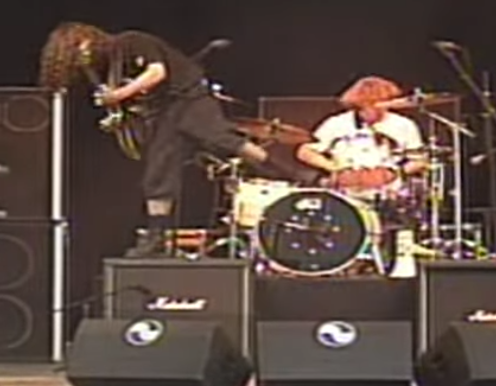
For Soundgarden, live performance is not merely reproduction of the record: it is a test of physical endurance and sound control. Historically, the band is associated with:
significant volume and frontal impact,
tense execution with strong rhythmic precision,
the ability to turn complex songs into performances that are clear and engaging.
This dimension is a structural part of their credibility, especially during periods of peak international exposure.
Formation period and Seattle underground scene (1987–1989)
Early EPs and albums
| Year | Album | Main tracks |
|---|
| 1987 | Screaming Life(EP) | Hunted Down · Swallow My Pride |
| 1988 | Fopp(EP) | Fopp · Fopp (Ohio Players cover) |
| 1988 | Ultramega OK | Flower · Beyond the Wheel |
| 1989 | Louder Than Love | Hands All Over · Loud Love |
Breakthrough and mainstream success (1991–1994)
Studio albums
| Year | Album | Main tracks |
|---|
| 1991 | Badmotorfinger | Rusty Cage · Outshined · Jesus Christ Pose |
| 1994 | Superunknown | Black Hole Sun · Spoonman · Fell on Black Days |
Artistic maturity and final experimentation (1996)
Studio albums
| Year | Album | Main tracks |
|---|
| 1996 | Down on the Upside | Pretty Noose · Burden in My Hand · Blow Up the Outside World |
Breakup and posthumous releases (1997–2010)
(The band "disbanded" in 1997; compilations and archival projects followed.)
Key releases
| Year | Album | Main content |
|---|
| 1997 | A-Sides(best of) | Black Hole Sun · Rusty Cage |
| 2010 | Telephantasm(compilation) | Remastered versions · Key tracks |
Reunion period (2012–2017)
Studio albums
| Year | Album | Main tracks |
|---|
| 2012 | King Animal | Been Away Too Long · By Crooked Steps |
Career note
Soundgarden were among the pioneers of the Seattle grunge movement, distinguished by a sound that blends heavy metal, punk, complex rhythmic structures, and the powerful vocals of Chris Cornell. Their discography shows a steady evolution, from raw underground beginnings to highly sophisticated productions with enormous cultural impact.