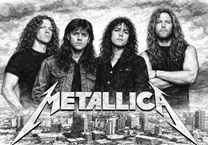
Metallica, complete biography, thrash metal, global heavy metal, international concerts, and discography
Profile
Metallica is an American heavy metal band founded in Los Angeles in 1981 and later based in the San Francisco Bay Area. They are universally recognized as the most influential and commercially successful band in the history of thrash metal, and as one of the absolute pillars of modern heavy metal.
Metallica represent a unique case: a band born in the underground that reached global scale without entirely losing its sonic identity, spanning more than four decades of stylistic evolution, internal transformation, and changes in the surrounding musical context.

Historical context and the birth of thrash metal
In the early 1980s, the metal landscape is dominated by two main poles:
the British heavy metal of the New Wave of British Heavy Metal,
the more melodic and spectacle-driven American hard rock and heavy metal.
Within this context, a new generation of musicians sought greater speed, aggression, and rhythmic rigor, combining metal impact with punk urgency. Out of that tension thrash metal was born, and Metallica rapidly became its central reference point.
Origins and formation (1981–1982)
The band formed through the meeting of James Hetfield (vocals, rhythm guitar) and Lars Ulrich (drums), united by their passion for the most extreme side of British metal. The early lineup included Dave Mustaine (lead guitar) and Ron McGovney (bass), shaping an initial incarnation strongly oriented toward speed and aggression.
Even in this embryonic phase, several core traits are already defined:
tight, repetitive riffs,
long, articulated structures,
the centrality of rhythm guitar as the engine of the sound.
Kill ’Em All and underground breakthrough (1983)
With the release of Kill ’Em All (1983), Metallica decisively broke from the dominant metal of the era.
The album introduced:
This record is often considered the official birth certificate of thrash metal and it consolidated the band’s reputation within the international underground scene.
Ride the Lightning and Master of Puppets: Maturity and complexity (1984–1986)
On the next two albums, Ride the Lightning (1984) and Master of Puppets (1986), Metallica made a decisive qualitative leap.
These works display:
greater structural complexity,
extensive use of slow/fast dynamics,
more articulated and thematically ambitious lyrics,
a vision of metal as a broad expressive language, not limited to aggression.
Master of Puppets is widely regarded as one of the absolute masterpieces of metal music, uniting technical rigor, emotional force, and compositional coherence.
Cliff Burton’s death and the rupture (1986)
In 1986, during a European tour, bassist Cliff Burton died in a road accident. His death represented a profound shock for the band, both human and artistic.
Burton had contributed decisively to:
the harmonic expansion of the sound,
the insertion of classical influences,
the musical complexity of the early catalog.
His death marks a clear watershed in Metallica’s history.
…And Justice for All and sonic radicalization (1988)
With …And Justice for All (1988), the band released an extremely rigorous and dark album.
Key characteristics:
long, intricate structures,
a cold, claustrophobic atmosphere,
a dry, uncompromising sound,
lyrics centered on justice, power, and alienation.
This work represents the peak of Metallica’s most technical and uncompromising phase.
The Black Album and the global turning point (1991)
With Metallica (1991), known as the Black Album, the band made an epochal shift.
The album introduced:
more compact songs,
fuller, more accessible production,
strong attention to groove and immediate impact.
The success was massive and global. Metallica became one of the biggest bands in the world, bringing heavy metal to an unprecedented audience.
The 1990s: Experimentation and audience division (1996–1999)
In the 1990s, the band entered an experimental phase that included:
hard rock and alternative influences,
aesthetic and image changes,
a more direct songwriting approach.
Albums such as Load and Reload deeply divided the audience, marking a fracture between early fans and a broader new listenership.
Internal crises and rebirth (2000–2008)
The early 2000s were marked by intense internal tensions, culminating in Jason Newsted’s temporary departure and a period of creative crisis.
With Death Magnetic (2008), Metallica attempted a return to harsher and more complex sounds, recovering part of the original thrash aesthetic.
The 2010s–2020s: Stability and continuity (2010–today)
In more recent years the band has maintained a central position in the global metal landscape.
Albums such as Hardwired… to Self-Destruct (2016) and 72 Seasons (2023) show:
a synthesis between historic aggression and modern production,
strong emphasis on live performance,
a commitment to preserving Metallica’s identity over the long term.
Concerts and the live dimension
Live performance has always been one of Metallica’s core pillars.
Their concerts are characterized by:
major sonic power,
wide, cross-era setlists,
large-scale stage production,
the ability to engage audiences of exceptional size.
The band is among the most active in rock history in terms of number of shows and the international scale of touring.
Musical style (Discursive analysis)
Metallica’s language is built on:
tight, recognizable rhythmic riffs,
alternation between extreme speed and heavy mid-tempos,
the centrality of rhythm guitar,
songwriting oriented toward broad, narrative structures,
lyrics addressing conflict, control, identity, and alienation.
Their style reshaped the very concept of modern metal.
Thrash metal era and underground breakthrough (1983–1986)
Studio albums
| Year | Album | Main tracks |
|---|
| 1983 | Kill ’Em All | Seek & Destroy · Whiplash · The Four Horsemen |
| 1984 | Ride the Lightning | Fade to Black · Creeping Death · For Whom the Bell Tolls |
| 1986 | Master of Puppets | Master of Puppets · Battery · Welcome Home (Sanitarium) |
Thrash maturity and global success (1988–1991)
Studio albums
| Year | Album | Main tracks |
|---|
| 1988 | …And Justice for All | One · Blackened · Harvester of Sorrow |
| 1991 | Metallica (Black Album) | Enter Sandman · Nothing Else Matters · The Unforgiven |
Stylistic shift and experimentation (1996–1999)
Studio albums
| Year | Album | Main tracks |
|---|
| 1996 | Load | Until It Sleeps · King Nothing · Hero of the Day |
| 1997 | Reload | Fuel · The Memory Remains · The Unforgiven II |
Transition period and internal crisis (2003–2004)
Studio albums
| Year | Album | Main tracks |
|---|
| 2003 | St. Anger | St. Anger · Frantic · Some Kind of Monster |
Return to metal roots and consolidation (2008–2016)
Studio albums
| Year | Album | Main tracks |
|---|
| 2008 | Death Magnetic | The Day That Never Comes · All Nightmare Long · Cyanide |
| 2016 | Hardwired… to Self-Destruct | Hardwired · Moth Into Flame · Atlas, Rise! |
Recent period and artistic continuity (2023–present)
Studio albums
| Year | Album | Main tracks |
|---|
| 2023 | 72 Seasons | Lux Æterna · Screaming Suicide · If Darkness Had a Son |
Live albums and special projects (selection)
| Year | Album | Note |
|---|
| 1993 | Live Shit: Binge & Purge | Documentation of the 1989–1993 tours |
| 1999 | S&M (with orchestra) | Metal–symphonic fusion |
| 2011 | Lulu (with Lou Reed) | Experimental project |
| 2020 | S&M2 (with orchestra) | Continuation of the symphonic project |



 Metallica