

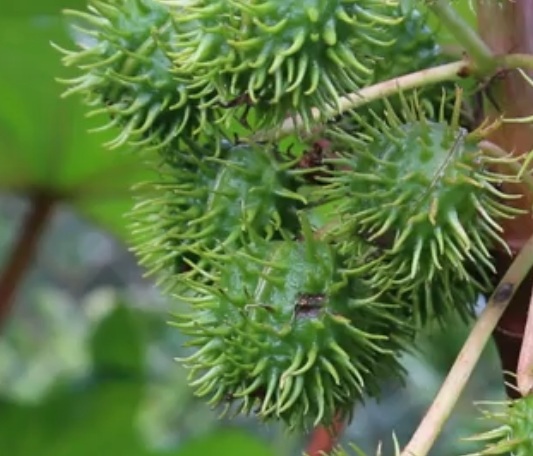
Castor oil plant
Rating : 4
| Evaluation | N. Experts | Evaluation | N. Experts |
|---|---|---|---|
| 1 | 6 | ||
| 2 | 7 | ||
| 3 | 8 | ||
| 4 | 9 | ||
| 5 | 10 |
Cons:
Take only under medical supervision (1)0 pts from admin
| Sign up to vote this object, vote his reviews and to contribute to Tiiips.Evaluate | Where is this found? |
| "Descrizione" about Castor oil plant by admin (19545 pt) | 2025-Dec-07 16:55 |
| Read the full Tiiip | (Send your comment) |
Castor oil plant, Ricinus communis (Euphorbiaceae)
Ricinus communis, commonly known as the castor oil plant or castor bean, is a perennial species belonging to the family Euphorbiaceae and represents the sole member of the genus Ricinus. Thought to originate from regions encompassing the eastern Mediterranean, northeastern Africa and India, it has become widely naturalised throughout tropical and subtropical areas worldwide. Its relevance is rooted in a dual identity: it is both an important industrial oil crop and the botanical source of ricin, one of the most studied plant toxins known to science.
The plant exhibits a vigorous growth habit, developing into a tall herbaceous–shrubby form that may reach 3 to 5 metres in favourable warm climates. The stems are thick, initially succulent and later more lignified, sometimes displaying reddish pigmentation in ornamental cultivars. The foliage is particularly distinctive: the large, glossy, palmately lobed leaves, bearing five to eleven sharply pointed lobes, give the plant a tropical appearance and contribute significantly to its widespread use as an ornamental species. The inflorescences occur as erect terminal panicles, bearing male and female flowers on the same plant. The fruit is a spiny, trilocular capsule which, upon maturation, splits open explosively to release three smooth, marbled castor seeds, commonly but inaccurately referred to as “beans.”
![]() | ![]() |
From an ecological perspective, Ricinus communis behaves as a pioneer species, capable of colonising disturbed soils, roadsides and waste areas with remarkable ease. Its high seed production, tolerance of varied environmental conditions and rapid growth rate have contributed to its spread in many regions, sometimes giving rise to invasive tendencies. The plant’s abundant light pollen can act as a potent aeroallergen, while its tissues contain a latex capable of provoking contact dermatitis in sensitive individuals.
The most critical aspect of Ricinus communis is unquestionably its toxicological profile. Within the raw seeds resides ricin, a highly potent ribosome-inactivating protein capable of irreversibly blocking protein synthesis in eukaryotic cells.
A crucial distinction must be made between the toxic seeds and commercial castor oil, which is widely used in industry, cosmetics and pharmacology. The oil is produced through pressing and subsequent heat refining, processes that denature ricin, leaving the oil entirely free of active toxin. Castor oil is chemically unusual: about ninety percent of its fatty acids consist of ricinoleic acid, a hydroxylated fatty acid that imparts the oil with high viscosity, thermal stability and distinct physicochemical behaviour. Historically, castor oil has been used as an oral laxative, acting through irritation of the intestinal mucosa and activation of specific prostaglandin receptors, but in modern practice its internal use is more restricted. It remains, however, a widely employed emollient, and serves as a base for numerous cosmetic preparations, including lipsticks, mascaras and topical formulations.
Industrially, castor oil is of significant importance due to its versatility. It is used as a high-performance lubricant, particularly under conditions of high temperature and pressure, and as a raw material for producing polymers, resins, plasticisers, paints, inks, surfactants and certain categories of biofuels. The unique chemical structure of ricinoleic acid allows the oil to act as a building block for diverse synthetic pathways, making it one of the most strategically important vegetable oils in chemical manufacturing.
Botanical classification (APG IV system)
| Category | Data |
|---|---|
| Common name | castor bean plant, castor oil plant |
| Botanical name | Ricinus communis L. |
| Kingdom | Plantae |
| Clade | Angiosperms → eudicots → rosids |
| Order | Malpighiales |
| Family | Euphorbiaceae |
| Genus | Ricinus |
| Species | Ricinus communis L. |
Fundamental note on food use
Castor seeds contain ricin and other toxic components and are not edible.
The only product of interest in food/pharmaceutical context is refined castor oil, obtained through processes that remove ricin (ricin is not present in properly refined oil). Even so, castor oil is used mainly as a pharmaceutical (traditional laxative) or technical oil, not as a common culinary fat.
Lipid profile note
Castor oil is an almost 100% fat product; its key feature is the extremely high content of ricinoleic acid, which largely determines its physical properties and functional behaviour.
The SFA fraction is relatively low compared with many animal fats, while the proportion of “classic” MUFA/PUFA (oleic/linoleic) is limited. From a dietary standpoint, castor oil is not considered a general-purpose culinary fat, but rather an oil for specific uses (pharmaceutical, cosmetic, technical).
In practical terms, its impact on the overall lipid profile of a normal diet is negligible, because castor oil is not used as a regular cooking or table oil.
Plant Characteristics
The Ricinus communis plant features large, glossy leaves that are usually deeply lobed. The plant produces clusters of flowers that are typically red or greenish in color, followed by spiny capsules containing the seeds. These seeds, or castor beans, are notable for their oil content.
Chemical Composition and Structure
The primary chemical compound in Ricinus communis is ricinoleic acid, which constitutes the major component of castor oil. Castor oil is a triglyceride with a unique chemical structure, characterized by a hydroxyl group (-OH) attached to the 12th carbon of the fatty acid chain. Additionally, the plant seeds contain ricin, a highly toxic protein, which poses significant safety risks.
Uses and Benefits
Medical: Castor oil, derived from the seeds, has been used traditionally for its laxative properties and as a remedy for various conditions including constipation and skin ailments. It is also explored for its potential in drug delivery systems.
Cosmetics: In the cosmetics industry, castor oil is valued for its moisturizing properties and is included in products like lipsticks, lotions, and shampoos.
Others: The plant’s seeds are used for industrial purposes, such as in the production of biodiesel and lubricants.
Applications
Medical: Castor oil is used in over-the-counter laxatives and in the treatment of certain dermatological conditions. Research is ongoing into its use in cancer therapies and other medical applications.
Cosmetics: Its emollient properties make it a common ingredient in skincare and haircare products, helping to improve moisture retention and enhance the texture of formulations.
Others: The oil's unique chemical properties are utilized in industrial applications, including the manufacture of plastics, textiles, and coatings.
Environmental and Safety Considerations
The ricin toxin present in the seeds poses a serious health hazard if ingested or inhaled, making careful handling and proper processing essential. The plant is also considered invasive in some areas, potentially outcompeting native flora and disrupting local ecosystems. As such, management practices are crucial to prevent environmental damage.
References__________________________________________________________________________
Sandford EC, Muntz A, Craig JP. Therapeutic potential of castor oil in managing blepharitis, meibomian gland dysfunction and dry eye. Clin Exp Optom. 2021 Apr;104(3):315-322. doi: 10.1111/cxo.13148. Epub 2021 Mar 10. PMID: 33037703.
Abstract. The multifactorial pathogenesis and interrelationship of blepharitis, meibomian gland dysfunction and dry eye disease poses challenges to any therapeutic approach. Current treatments are mostly palliative, with success limited by perceived inefficacy and poor patient compliance. Castor oil, a natural derivative of the Ricinus communis plant, is widely used as an emollient in cosmetics and personal care products, drug delivery systems and wound dressings. Castor oil is deemed safe and tolerable, with strong anti-microbial, anti-inflammatory, anti-nociceptive, analgesic, antioxidant, wound healing and vaso-constrictive properties. Its main constituent, ricinoleic acid, has a bipolar molecular structure that promotes the formation of esters, amides and polymers. These can supplement deficient physiological tear film lipids, enabling enhanced lipid spreading characteristics and reducing aqueous tear evaporation. Studies reveal that castor oil applied topically to the ocular surface has a prolonged residence time, facilitating increased tear film lipid layer thickness, stability, improved ocular surface staining and symptoms. This review summarises the properties, current uses of, and therapeutic potential of castor oil in managing ocular surface disease. The biochemical, medicinal actions of castor oil are explored from the perspective of ocular surface pathology, and include microbial and demodectic over-colonisation, inflammatory and oxidative processes, as well as clinical signs and symptoms of dryness and discomfort.
McKeon TA, Lin JT, Stafford AE. Biosynthesis of ricinoleate in castor oil. Adv Exp Med Biol. 1999;464:37-47. doi: 10.1007/978-1-4615-4729-7_4.
Abstract. Castor oil is 90% ricinoleate (12-hydroxyoleate) and has numerous industrial uses. Components of castor bean (Ricinus communis L.) pose serious problems to processors. Other researchers have cloned the gene for the oleoyl hydroxylase, but transgenic plants produce only about 20% hydroxy fatty acid. To improve such transgenic substitutes for castor, we are using HPLC analysis of castor bean microsomal suspensions to follow the hydroxylase reaction and the movement of 14C-ricinoleate through phospholipid into triacylglycerol. Most labeled ricinoleate is rapidly removed from the phospholipid fraction as free fatty acid and incorporated into triacylglycerol, with triricinolein predominating. Elucidation of the basis for high incorporation of ricinoleate and exclusion of oleate from triacylglycerols will identify genes that can be used to engineer high ricinoleate production in transgenic plants.
Final report on the safety assessment of Ricinus Communis (Castor) Seed Oil, Hydrogenated Castor Oil, Glyceryl Ricinoleate, Glyceryl Ricinoleate SE, Ricinoleic Acid, Potassium Ricinoleate, Sodium Ricinoleate, Zinc Ricinoleate, Cetyl Ricinoleate, Ethyl Ricinoleate, Glycol Ricinoleate, Isopropyl Ricinoleate, Methyl Ricinoleate, and Octyldodecyl Ricinoleate. Int J Toxicol. 2007;26 Suppl 3:31-77. doi: 10.1080/10915810701663150. PMID: 18080873.
Abstract. The oil derived from the seed of the Ricinus communis plant and its primary constituent, Ricinoleic Acid, along with certain of its salts and esters function primarily as skin-conditioning agents, emulsion stabilizers, and surfactants in cosmetics, although other functions are described. Ricinus Communis (Castor) Seed Oil is the naming convention for castor oil used in cosmetics. It is produced by cold pressing the seeds and subsequent clarification of the oil by heat. Castor oil does not contain ricin because ricin does not partition into the oil. Castor oil and Glyceryl Ricinoleate absorb ultraviolet (UV) light, with a maximum absorbance at 270 nm. Castor oil and Hydrogenated Castor Oil reportedly were used in 769 and 202 cosmetic products, respectively, in 2002; fewer uses were reported for the other ingredients in this group. The highest reported use concentration (81%) for castor oil is associated with lipstick. Castor oil is classified by Food and Drug Administration (FDA) as generally recognized as safe and effective for use as a stimulant laxative. The Joint Food and Agriculture Organization (FAO)/World Health Organization (WHO) Expert Committee on Food Additives established an acceptable daily castor oil intake (for man) of 0 to 0.7 mg/kg body weight. Castor oil is hydrolyzed in the small intestine by pancreatic enzymes, leading to the release of glycerol and Ricinoleic Acid, although 3,6-epoxyoctanedioic acid, 3,6-epoxydecanedioic acid, and 3,6-epoxydodecanedioic acid also appear to be metabolites. Castor oil and Ricinoleic Acid can enhance the transdermal penetration of other chemicals. Although chemically similar to prostaglandin E(1), Ricinoleic Acid did not have the same physiological properties. These ingredients are not acute toxicants, and a National Toxicology Program (NTP) subchronic oral toxicity study using castor oil at concentrations up to 10% in the diet of rats was not toxic. Other subchronic studies of castor oil produced similar findings. Undiluted castor oil produced minimal ocular toxicity in one study, but none in another. Undiluted castor oil was severely irritating to rabbit skin in one study, only slightly irritating in another, mildly irritating to guinea pig and rat skin, but not irritating to miniature swine skin. Ricinoleic Acid was nonirritating in mice and in one rabbit study, but produced well-defined erythema at abraded and intact skin sites in another rabbit study. Zinc Ricinoleate was not a sensitizer in guinea pigs. Neither castor oil nor Sodium Ricinoleate was genotoxic in bacterial or mammalian test systems. Ricinoleic Acid produced no neoplasms or hyperplasia in one mouse study and was not a tumor promoter in another mouse study, but did produce epidermal hyperplasia. Castor oil extract had a strong suppressive effect on S(180) body tumors and ARS ascites cancer in male Kunming mice. No dose-related reproductive toxicity was found in mice fed up to 10% castor oil for 13 weeks. Female rats injected intramuscularly with castor oil on the first day after estrus had suppressed ovarian folliculogenesis and anti-implantation and abortive effects. Castor oil used as a vehicle control in rats receiving subcutaneous injections had no effect on spermatogenesis. A methanol extract of Ricinus communis var. minor seeds (ether-soluble fraction) produced anti-implantation, anticonceptive, and estrogenic activity in rats and mice. Clinically, castor oil has been used to stimulate labor. Castor oil is not a significant skin irritant, sensitizer, or photosensitizer in human clinical tests, but patients with occupational dermatoses may have a positive reaction to castor oil or Ricinoleic Acid. The instillation of a castor oil solution into the eyes of nine patients resulted in mild and transient discomfort and minor epithelial changes. In another study involving 100 patients, the instillation of castor oil produced corneal epithelial cell death and continuity breaks in the epithelium. Because castor oil contains Ricinoleic Acid as the primary fatty acid group, the Cosmetic Ingredient Review (CIR) Expert Panel considered the safety test data on the oil broadly applicable to this entire group of cosmetic ingredients. The available data demonstrate few toxic effects. Although animal studies indicate no significant irritant or sensitization potential, positive reactions to Ricinoleic Acid in selected populations with identified dermatoses did suggest that sensitization reactions may be higher in that population. Overall, however, the clinical experience suggests that sensitization reactions are seen infrequently. In the absence of inhalation toxicity data on these ingredients, the Panel determined that these ingredients can be used safely in aerosolized cosmetic products because the particle sizes produced are not respirable. Overall, the CIR Expert Panel concluded that these cosmetic ingredients are safe in the practices of use and concentrations as described in this safety assessment.
| Sign up to vote this object, vote his reviews and to contribute to Tiiips.EvaluateClose | (0 comments) |
Read other Tiiips about this object in __Italiano (1)
Hardiness:   Hardiness:   Natural fertilizer:   Hazards/diseases:   Last update:   2025-12-07 16:26:11 | Sun exposure:   Family:   Commercial fertilizer:   Main substances contained:   |

