

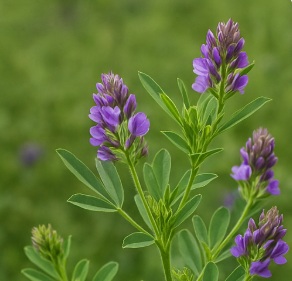
Medicago sativa
Rating : 7
| Evaluation | N. Experts | Evaluation | N. Experts |
|---|---|---|---|
| 1 | 6 | ||
| 2 | 7 | ||
| 3 | 8 | ||
| 4 | 9 | ||
| 5 | 10 |
0 pts from Al222
| Sign up to vote this object, vote his reviews and to contribute to Tiiips.Evaluate | Where is this found? |
| "Descrizione" about Medicago sativa by Al222 (23254 pt) | 2025-Nov-29 09:12 |
| Read the full Tiiip | (Send your comment) |
Medicago Sativa, commonly known as alfalfa or alfalfa, is a perennial plant belonging to the Fabaceae (Leguminosae) family. Native to western Asia and the Mediterranean, it is cultivated worldwide for its high nutritional value both as fodder for livestock and for human consumption. The plant is known for its ability to fix nitrogen in the soil, thus improving soil fertility.
Medicago Sativa is an excellent source of vitamins A, C, E and K, as well as minerals such as calcium, iron, magnesium and phosphorus. It contains high levels of flavonoids and phenolic compounds that protect cells from oxidative damage caused by free radicals, helping to prevent chronic diseases. Medicago Sativa's anti-inflammatory properties help reduce inflammation and pain associated with conditions such as arthritis and other inflammatory diseases.
Medicago Sativa extract, commonly known as alfalfa extract, is rich in vitamins, minerals, and antioxidants, making it a valuable ingredient for cosmetic formulations. This extract helps to improve skin vitality by stimulating cell regeneration and enhancing natural collagen production, which contributes to maintaining elastic and youthful skin. It is ideal for anti-aging treatments, nourishing creams, and skincare products aimed at strengthening and toning. Alfalfa extract is also used for its benefits in improving skin tone and reducing the visibility of fine lines and wrinkles.

Botanical classification
Common name: alfalfa, lucerne
Scientific name: Medicago sativa
Family: Fabaceae
Genus: Medicago
Origin: temperate regions of western Asia and the Mediterranean area, now cultivated worldwide
Growth habit: perennial herb, deep taproot, usually 40–80 cm tall, with erect or slightly prostrate stems
Cultivation and growing conditions
Climate
Prefers temperate to warm–temperate climates, with dry summers and cool winters.
Quite hardy: tolerates winter cold, especially in adult stands, but is sensitive to waterlogging on heavy soils.
Very drought-tolerant thanks to its deep root system.
Exposure
Requires full sun to express its full yield potential.
In shaded positions it becomes lanky, lodges more easily and produces lower yield and quality forage.
Soil
Prefers deep, well-drained, fertile soils with good calcium content.
Ideal pH from neutral to moderately alkaline; performs poorly on acidic soils (lime application before sowing is often needed).
Does not tolerate compact, poorly drained soils.
Thanks to symbiosis with rhizobia, it contributes to increasing soil nitrogen.
Irrigation
In many regions it is grown under rainfed conditions, relying on spring rainfall.
In drier areas or for high yields, supplementary irrigation is used, especially in spring–summer.
Best practice is to irrigate deeply, then allow the soil to dry partially, encouraging deep root development.
Temperature
Optimal germination and growth between 15 and 25 °C.
Adult plants tolerate both moderate cold and summer heat, provided water is not completely lacking.
Young seedlings are more sensitive to temperature swings and excess soil moisture.
Fertilization
As a legume, it has low nitrogen requirements (it fixes N from the air through root nodules).
Good availability of phosphorus, potassium and calcium is essential to support productivity and stand longevity.
Before sowing, apply P and K base fertilization and, if needed, correct soil pH.
In subsequent years, small maintenance dressings may be applied according to soil analysis.
Crop management
A well-prepared seedbed is essential: fine, level and free of large clods.
Appropriate seeding rate and density help form a dense sward, which suppresses weeds.
In early stages, alfalfa can be strongly affected by weed competition; false seedbeds or targeted weed control are often useful.
Avoid soil compaction (heavy machinery on wet soil), which reduces aeration and root development.
Harvest (cutting)
Used mainly as forage (hay, silage, fresh forage).
Allows several cuts per year (3–4 up to 6–7, depending on climate and management).
The ideal cutting stage to balance yield and quality is usually from bud stage to early flowering.
After each cut, the plant regrows from basal buds, starting a new vegetative cycle.
Propagation
Propagated almost exclusively by seed.
Sown as a pure stand or in mixture (e.g. with forage grasses), in spring or late summer depending on climate.
Sowing depth must be very shallow (small seeds), and good seed–soil contact is crucial for even emergence.
Energy: ~25–30 kcal
Water: ~75–80 g
Total carbohydrates: ~2–4 g
sugars: ~1–2 g
Protein: ~3–4 g
Dietary fibre: ~2–3 g
Total fat: ~0.5–0.7 g
SFA: very low
MUFA: traces
PUFA (n-6/n-3): predominant in the lipid fraction
TFA (natural trans fatty acids): negligible
Vitamins: vitamin K, vitamin C, carotenoids (provitamin A), small amounts of B-group vitamins
Minerals: calcium, magnesium, potassium, iron, manganese
(Values differ for fresh leaves, sprouts and dehydrated alfalfa meal.)
Phytonutrients and polyphenols
flavonoids (e.g. luteolin, apigenin and their glycosides)
phenolic acids (ferulic, caffeic, p-coumaric and derivatives)
Triterpenoid saponins
saponins with potential biological activity and a role in plant defence
Vitamins
vitamin K (particularly abundant)
vitamin C, carotenoids, folates and other B-group vitamins
Minerals
calcium, magnesium, potassium, zinc, iron, manganese
Protein fraction
relatively high protein content for a leafy crop, with a favourable amino-acid profile for forage
Lipid fraction
predominance of PUFA (especially linoleic and α-linolenic acids), with minor SFA and MUFA
Fibre
both soluble and insoluble fibres at significant levels in leaves and meal
Cultivation
Spring or autumn sowing on well-drained soils, often calcareous or loamy.
Deep root system ensures good drought tolerance.
Symbiosis with nitrogen-fixing bacteria (rhizobia) improves soil fertility and benefits crop rotations.
Harvesting
Multiple cuts per growing season for hay, silage or dehydrated fodder.
Young leafy material can be harvested separately for herbal or food uses (infusions, powders).
Processing
Controlled drying to produce hay or dehydrated alfalfa meal and pellets.
Fine milling to obtain powders and extracts for foods and supplements.
Sprouting of seeds under hygienic conditions to produce fresh alfalfa sprouts for direct consumption.
Storage
Hay and powders stored in cool, dry conditions, protected from moisture and light.
Sprouts stored under refrigeration with short shelf-life.
Perennial herb with slender stems and deep taproot (often >1 m).
Trifoliate leaves, tender in young growth, more fibrous in mature stages.
Flower clusters (racemes) with violet–blue corollas.
Small, yellow–ochre, smooth, glossy seeds.
Alfalfa powder: intense green colour, fine particle size, characteristic grassy odour.
Aroma: fresh, grassy, “green” hay-like note.
Taste: slightly bitter and vegetal, more pronounced in powders and concentrates.
Technological functionality:
high protein content for use in feed and in some functional food concepts,
water-soluble fractions suitable for infusions and extracts,
natural green colour for “green” blends and health-positioned products.
Sprouts: eaten fresh in salads, sandwiches, bowls and as a garnish.
Leaf powders: added to smoothies, bars, “green” mixes and functional foods for a plant-based nutrient boost.
Herbal preparations: infusions and decoctions used traditionally for nutritional or tonic purposes.
Extracts: included in some food supplements and functional beverages (within regulatory boundaries).
(Food-grade alfalfa must be clearly distinguished from feed-grade material.)
High vitamin K content contributes to normal blood coagulation (relevant for people on anticoagulant therapy, who must seek medical advice).
Provides plant-based calcium, magnesium, potassium and iron, supporting overall mineral intake.
Carotenoids and vitamin C add to the antioxidant potential of the diet.
Fibre supports intestinal regularity and may help modulate glycaemic response when consumed with meals.
Sprouts are considered nutrient-dense fresh foods, providing vitamins, minerals and phytochemicals in a low-calorie matrix.
Extracts are sometimes marketed as tonics or general wellbeing supplements, though clinical evidence is variable and not always conclusive.
Fresh sprouts: roughly 20–50 g per serving.
Leaf powder: commonly 1–5 g per serving in beverages or food preparations.
Infusions: about 1–2 g dried leaves per cup.
Medicago sativa is not among the major regulated food allergens.
Possible reactions in individuals sensitive to legumes (Fabaceae family).
As with other sprouts, microbiological safety is critical: poor hygiene during production can lead to contamination by pathogenic bacteria.
Sprouts: 3–5 days in the refrigerator under proper hygienic conditions.
Dried leaves: up to ~12 months in airtight containers, protected from light and moisture.
Powders: about 6–12 months in cool, dry, dark storage.
Hay and dehydrated meal: long shelf-life if well dried and stored away from moisture and pests.
All production stages must comply with GMP and HACCP principles, with particular attention to hygiene for sprouts and minimally processed products.
Extracts and powders sold as food supplements must follow supplement regulations (composition, labelling, claims, daily dose).
Sprouts are subject to specific microbiological criteria, given their “ready-to-eat” nature and growth in warm, humid conditions.
Due to high vitamin K content, individuals taking vitamin K–antagonist anticoagulants (e.g. warfarin) should consult a physician before significant or sustained alfalfa intake from supplements.
For foods:
sales name (e.g. “alfalfa sprouts”, “alfalfa leaf powder”),
ingredient list, country of origin where required, nutrition declaration.
For food supplements:
active ingredients and declared content, %NRV where applicable,
recommended daily dose and mandatory warnings,
clear indication of Medicago sativa as the botanical source.
For cosmetics containing alfalfa extracts:
INCI names such as “Medicago Sativa Extract” or similar, listed in descending order of concentration.
Sprout browning or off-odour
Causes: oxidation, microbial growth or temperature abuse.
Actions: improve hygiene, reduce storage time, maintain appropriate refrigeration.
Loss of green colour in powders
Causes: oxidation and excessive heat during drying or storage.
Actions: gentle drying, use of opaque, airtight packaging, cool storage.
Excessive bitterness in finished products
Causes: high inclusion levels or use of overly mature leaf material.
Actions: reduce dosage, use younger leaves, blend with other ingredients to balance flavour.
Medicago sativa enriches soil fertility through biological nitrogen fixation, reducing the need for synthetic nitrogen fertilisers.
It supports agroecosystem biodiversity and can break disease cycles when used in crop rotations.
Well-managed alfalfa systems can lower environmental impact relative to some intensive monocultures.
Processing residues (stems, fines, dust) can be used as biomass or compost, closing nutrient loops.
In processing plants, good management of process water and effluents, including monitoring BOD and COD, helps minimise environmental impact.
skin conditioning – contributes to improved appearance and feel of the skin by supplying plant-derived components.
antioxidant – vitamin C, carotenoids and polyphenols help protect both the formulation and, to some extent, the skin from oxidative stress.
soothing – used in some calming and comforting skin-care formulations.
revitalising – incorporated in toning and “anti-stress” products to support a fresher, more vibrant skin appearance.
CAS 84082-36-0
EC number 281-984-0
Cosmetic Applications
Antioxidant Properties. This compound is rich in antioxidants that protect the skin from damage by free radicals and pollution, helping to prevent premature aging (1).
Revitalizing Effects. It nourishes and revitalizes the skin, improving brightness and overall tone due to its essential nutrients such as vitamins, minerals, and proteins.
Moisturization. Enhances skin hydration, helping to keep skin supple and reducing the appearance of fine lines (2).
Purification. Helps detoxify the skin by removing impurities and toxins, which improves skin clarity and health.
Versatile Applications. It can be used in a variety of cosmetic products, such as creams, serums, lotions, and masks, for its multiple beneficial properties for the skin.
Other Applications
Dietary Supplements. It is often used in supplements to leverage its nutritional benefits, improving overall health and wellness (3).
References_____________________________________________________________________
(1) Zagórska-Dziok M, Ziemlewska A, Nizioł-Łukaszewska Z, Bujak T. Antioxidant Activity and Cytotoxicity of Medicago sativa L. Seeds and Herb Extract on Skin Cells. Biores Open Access. 2020 Oct 23;9(1):229-242. doi: 10.1089/biores.2020.0015.
(2) Rodrigues, F., Palmeira-de-Oliveira, A., das Neves, J., Sarmento, B., Amaral, M. H., & Oliveira, M. B. (2013). Medicago spp. extracts as promising ingredients for skin care products. Industrial crops and products, 49, 634-644.
Abstract. Agro-industrial by-products have the potential to be used with different purposes thus providing economical advantage to otherwise disposable residues. In particular, the field of skin care products and cosmetics may benefit from these remaining materials. Hydro-alcoholic extracts of seven species of Medicago (M. minima, M. tornata, M. truncatula, M. rigidula, M. scutelata, M. segitalis and M. sativa) were screened for antioxidant, cytotoxicity and antimicrobial activities aiming at their application as functional ingredient in skin formulations. Antioxidant activity was evaluated by standard methods such as DPPH· and FRAP. In both methods the antioxidant activity of M. segitalis displayed the highest antioxidant activity (214.49 ± 6.69 μmol Trolox equivalent per g db for DPPH; 120.84 ± 1.86 μmol/mg db for FRAP). For DPPH M. rigidula showed the lowest antioxidant activity (127.18 ± 1.96 μmol Trolox equivalent per g db) and for FRAP M. minima showed the lowest one (58.05 ± 6.09 μmol per mg db). Also, the total phenolic and total flavonoid contents (TPC and TFC, respectively) were evaluated. The TPC of the different extracts varied from 21.96 mg to 36.41 mg GAE/g db sample, being the highest TPC obtained for M. minima and the lowest for the M. scutelata. TFC varied from 5.54 to 11.67 mg CEQ/g db sample. Linear negative correlations were established between the total phenol contents and for both the antioxidant activity methods. The extracts were also screened for cytotoxicity using MTS and LDH assays in two different skin cell lines (HaCaT and HFF-1) and showed low cytotoxicity. Preliminary assays for antimicrobial potential showed that extracts from Medicago display antibacterial activity, with MIC values of 31.3 μg/mL and 125 μg/mL for some Gram-positive and Gram-negative bacteria, respectively. Taken together, the results suggested that Medicago hydro-alcoholic extracts are a potential source of natural compounds with high levels of antioxidant activity, low cytotoxicity for skin cells and the ability to potentially prevent microbial infections of the skin due to its antimicrobial effect, as well as contribute as a natural preservative in cosmetic products. All referred above justify their possible uses in skin care products.
(3) Francis H, Debs E, Koubaa M, Alrayess Z, Maroun RG, Louka N. Sprouts Use as Functional Foods. Optimization of Germination of Wheat (Triticum aestivum L.), Alfalfa (Medicago sativa L.), and Radish (Raphanus sativus L.) Seeds Based on Their Nutritional Content Evolution. Foods. 2022 May 18;11(10):1460. doi: 10.3390/foods11101460.
Abstract. Wheat, alfalfa, and radish sprouts are well-renowned for their high nutritional content. However, their optimal imbibition and germination durations are rarely considered in the literature. In this study, reduced imbibition times of 3 h, 10 h, and 4 h were demonstrated for the wheat, alfalfa, and radish seeds, respectively. The evolution of their crude fat, proteins, polyphenols, antioxidant activity, and vitamins were investigated over 7 days of germination. The crude fat and protein loads of these sprouts slightly varied during germination, whereas the phenolic compounds and antioxidant activity maxed out at day 7, 5, and 6 for the wheat, alfalfa, and radish sprouts, respectively, with significant levels of catechin. The vitamins highly increased, showing noteworthy yet different peaks of growth depending on the seed and the vitamin analyzed. Interestingly, alfalfa and radish sprouts, taken at their optimal germination day, would decidedly contribute to meet our Recommended Daily Allowances (RDAs) of vitamins E, A, and B6. Overall, for a greater nutritional content and a potential use of these sprouts as nutraceutical ingredients, our results suggested to leave the wheat, alfalfa, and radish seeds to germinate only over 7, 4, and 6 days, respectively, after which their nutritional quality tended to decrease.
| Sign up to vote this object, vote his reviews and to contribute to Tiiips.EvaluateClose | (0 comments) |
Read other Tiiips about this object in __Italiano (1)
Content:   Family:   Last update:   2024-05-20 08:48:31 | Kcal/100g:   Threat factors:   |

