

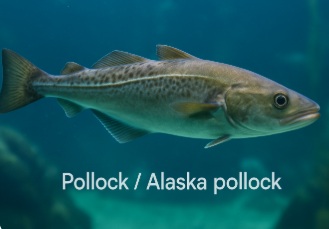
Pollock
Rating : 7
| Evaluation | N. Experts | Evaluation | N. Experts |
|---|---|---|---|
| 1 | 6 | ||
| 2 | 7 | ||
| 3 | 8 | ||
| 4 | 9 | ||
| 5 | 10 |
10 pts from Al222
| Sign up to vote this object, vote his reviews and to contribute to Tiiips.Evaluate | Where is this found? |
| "Descrizione" about Pollock Review Consensus 10 by Al222 (23420 pt) | 2025-Nov-16 12:13 |
| Read the full Tiiip | (Send your comment) |
Pollock / Alaska pollock
(Gadus chalcogrammus – historical synonym Theragra chalcogramma – fillets, portions, blocks, surimi, breaded/battered products)
Description
Alaska pollock (Gadus chalcogrammus, previously Theragra chalcogramma) is a gadid closely related to cod, fished mainly in the North Pacific (Bering Sea, Gulf of Alaska).
It is a lean white fish with very mild flavour and fine flaking texture, and is one of the most harvested fish species worldwide, especially for fillets and surimi production.
Main commercial forms:
Fresh or chilled fillets/loins (less common in some markets);
Frozen IQF fillets, loins, portions, blocks;
Block-formed fillet slabs for industrial use;
Processed products: fish fingers/sticks, breaded/battered fillets, burgers, surimi and crab-style products, ready meals.

Indicative nutritional values (per 100 g raw Alaska pollock, edible portion)
(Typical ranges for plain, unprocessed fillets.)
Energy: 70–75 kcal
Water: ≈ 80–83 g
Protein: 16–17 g
Total fat: 0.4–0.8 g
First occurrence: SFA/MUFA/PUFA = saturated/monounsaturated/polyunsaturated fatty acids. In pollock, total fat is very low, with SFA typically around 0.1–0.2 g/100 g and a small amount of MUFA and PUFA, including omega-3. Within a diet that keeps overall saturated fat moderate, this very low SFA load and modest unsaturated fraction are generally considered favourable for blood-lipid balance.
Carbohydrates: 0 g
Cholesterol: ≈ 35–60 mg
Sodium (intrinsic, no added salt): ≈ 50–70 mg
(Breaded/fried products or surimi can have much higher energy, fat and sodium due to coatings, oils, starches and added salt.)
Key constituents
Proteins
High biological value (BV) proteins with a complete essential amino acid profile.
Good levels of BCAA (leucine, isoleucine, valine), relevant for muscle metabolism and recovery.
Lipids
Flesh is very lean, with total fat contents similar to, or lower than, cod.
Contains long-chain omega-3 EPA (eicosapentaenoic acid) and DHA (docosahexaenoic acid) in moderate but non-negligible amounts for a lean fish.
Vitamins and minerals
Provides selenium, phosphorus, potassium and iodine in meaningful amounts.
Useful levels of B vitamins, especially niacin (B3) and vitamin B12.
Other components
Parvalbumin as the main fish allergen.
Histamine levels are usually low if the cold chain is maintained.
Mean mercury content is generally low, placing pollock among lower-mercury choices compared with large predatory fish.
Production process
Fishing
Harvested mainly by industrial trawl fleets and factory trawlers in the Bering Sea and subarctic North Pacific.
Often processed on board: heading, gutting, sometimes filleting and rapid freezing.
On-board or shore-based processing
Production of fillets, loins and blocks (single- or double-frozen).
Recovery of trimmings and mince for surimi and ground-fish products.
By-products (heads, frames, trimmings) rendered to fish oil and fishmeal.
Surimi production
Minced pollock is washed, refined and mixed with cryoprotectants, then formed into blocks and frozen.
These surimi blocks are later processed into imitation crab, surimi sticks and other analogue products.
Value-added products
Breaded/battered fillets and fish sticks: coating, prefrying (if applicable), freezing.
Ready meals: portioning, cooking, filling, chilling or freezing.
Physical properties
Flesh is white to pearly white, sometimes slightly pinkish; becomes opaque white after cooking.
Texture: fine, delicate flakes, generally slightly finer than cod.
Low fat content reduces susceptibility to rancidity but makes the fish more sensitive to freezer burn and dehydration if glazing and packaging are inadequate.
Sensory and technological properties
Flavour
Very mild, neutral taste with low “fishiness”; suitable for consumers who prefer gentle flavours.
Texture
Tender but cohesive; well accepted in coated products and children’s foods.
Cooking behaviour
Cooks quickly and tends to dry out if overcooked, due to very low fat.
Well suited to steaming, baking, pan-frying, light frying and stews.
The flesh is easy to mince, form and recombine into burgers, croquettes and surimi-based items.
Food applications
Home cooking / foodservice
Fillets or portions grilled, baked, steamed or pan-fried.
Stews and casseroles with vegetables, pulses or grains.
Breaded/fried or oven-baked fish portions, fish & chips, fish tacos.
Food industry
Core raw material for fish sticks/fingers, nuggets, burgers and coated fillets.
Base species for surimi and crab/shrimp-style analogue products.
Ingredient in frozen ready meals, fish soups, sauces, fillings and mixed seafood dishes.
Nutrition & health
Alaska pollock is a very lean white fish, providing:
Low energy (~70–75 kcal/100 g) and 16–17 g high-BV protein/100 g;
Minimal total fat with very low SFA and a small but useful amount of omega-3 EPA/DHA;
Micronutrients such as selenium, iodine, phosphorus and B vitamins.
It is therefore suitable for:
Low-calorie and low-fat diets;
Individuals needing to reduce saturated fat intake while maintaining adequate protein;
Species rotation strategies to keep exposure to mercury relatively low, since pollock is a low-mercury fish.
The nutritional profile of processed products depends strongly on batters, coatings, oils and salt: fried, heavily breaded items and some surimi-based products can be much higher in energy, fat and sodium than plain fish.
Portion note:
A typical adult serving of plain pollock fillet as a main course is 120–150 g cooked (≈ 150–180 g raw).
For breaded/fried products, a typical portion (e.g. 3–4 fish sticks, ≈ 90–120 g) delivers less actual fish and more coating/oil, which should be considered in energy and fat calculations.
Allergens and intolerances
Alaska pollock is a fish allergen and must be labelled as such.
Allergy to pollock fits into the broader category of white-fish allergy and may cause urticaria, gastrointestinal symptoms, bronchospasm or anaphylaxis.
Cross-reactivity with other fish species is common.
Pollock-based products (surimi, fish sticks, burgers, ready meals) may contain additional allergens:
Gluten and egg in batters and coatings;
Soy, milk, mustard, celery and others in sauces, binders or flavouring systems.
Quality and specifications (typical themes)
Composition
Protein, moisture and total fat within specification.
Salt content controlled in brined or treated products.
For blocks: yield of full fillets vs trimmings.
Physical–sensory
Uniform white–cream colour, free from dark spots and blood clots.
Fresh, non-rancid, non-ammoniac odour.
Firm, cohesive texture (not mushy or crumbly).
Minimal bones and visible defects.
Chemical
Low levels of lipid oxidation (peroxide, TBARS) in frozen products.
Environmental contaminants (metals, dioxins, PCB) within legal limits;
Mean mercury content generally low compared with large pelagic predators.
Microbiological
Controlled total counts in fresh/chilled fish.
Compliance with criteria for pathogens (e.g. Listeria) in ready-to-eat products.
Commercial sterility for canned products.
Storage and shelf-life
Fresh/chilled
Store at 0–2 °C on ice or under MAP.
Typical shelf-life: 3–7 days, depending on initial freshness, handling and packaging.
Frozen
Store at ≤ −18 °C.
Good quality for 8–12 months, with protection against temperature fluctuations and freezer burn.
IQF portions and blocks require adequate glazing and barrier packaging.
Processed products (breaded, surimi, ready meals)
Follow label instructions (usually frozen or chilled).
Avoid refreezing and prolonged holding in the 5–60 °C danger zone.
Safety and regulatory
Covered by fishery products regulations and, in many countries, by specific frameworks for the North Pacific pollock fishery.
Key points:
Full traceability of stock, FAO area and fishing method.
Strict cold-chain control from catch to processing.
Monitoring of contaminants (metals, persistent organic pollutants) and compliance with limits.
For surimi and cooked products, validated thermal processes and microbial stability.
Processing plants operate under GMP/HACCP, with CCPs on temperature, filleting and freezing times, block handling and packaging.
Labelling
Typical declarations:
Commercial name “Alaska pollock” or “pollock”;
Scientific name Gadus chalcogrammus (often with or acknowledging the historical name Theragra chalcogramma);
FAO catch area (e.g. 67, 61);
Production method (“wild-caught”);
Product state (fresh, frozen, breaded, etc.);
For processed products: ingredient list, with clear emphasis of the fish allergen and any other allergens, plus nutrition information.
Troubleshooting
Strong, “old fish” odour
Cause: loss of freshness, inadequate chilling.
Actions: improve time–temperature management, review shelf-life and display conditions.
Excessive breakage/flakiness
Cause: repeated freeze–thaw cycles, slow freezing or age of product.
Actions: ensure rapid freezing, avoid refreezing, apply FIFO rotation and monitor drip loss.
Dry surface or freezer burn
Cause: insufficient glazing, non-barrier packaging, or long storage.
Actions: improve glazing thickness, upgrade packaging, stabilise storage temperature and humidity.
Breaded products too greasy or limp after cooking
Cause: excessive oil uptake, heavy batter or poorly controlled frying conditions.
Actions: optimise batter/coating formulation, frying parameters and consumer cooking instructions (oven vs deep-fry).
Sustainability and supply chain
The Alaska pollock fishery in the North-East Pacific is one of the largest industrial fisheries globally. Many fleets operate under defined quotas, scientific monitoring and independent sustainability certifications.
Positive aspects:
Several stocks are considered well managed, with exploitation within biologically safe limits.
Full utilisation of the catch (fillets, surimi, oil, meal) reduces waste.
Ongoing work on gear selectivity and bycatch reduction.
Challenges:
Dependence on large industrial fleets and associated energy use.
Need for continuous stock assessment and long-term monitoring to maintain sustainability.
Management of processing effluents, with attention to BOD/COD, suspended solids and energy use.
Good practices:
Sourcing from fisheries with credible sustainability certifications and transparent management.
Valorising by-products (oil, meal, collagen) in a circular-economy approach.
Optimising packaging and logistics to minimise waste and climate impact.
Main INCI functions (cosmetics)
Like other white fish, Alaska pollock can be a source of cosmetic-grade:
Hydrolyzed Fish Collagen (from skin): film-forming, hydrating and conditioning for skin and hair.
Fish Protein / Hydrolyzed Fish Protein: conditioning agents in hair-care products.
Fish Oil from by-products: emollient, skin-conditioning lipid source.
Cosmetic use requires high levels of purification, oxidation control, odour reduction and contaminant monitoring.
Conclusion
Pollock / Alaska pollock is a very lean, high-protein white fish with a very mild flavour, making it suitable for a wide consumer base and especially popular in children’s and coated products. Its low fat and saturated fat, modest but useful omega-3 content and valuable micronutrients fit well into low-calorie, low-fat diets and into species rotation strategies that favour low-mercury fish. Industrially, it is a cornerstone raw material for fillets, surimi and breaded products; environmentally, sustainability hinges on robust fishery management, full traceability, efficient by-product use and good processing practices. Choosing well-managed sources, appropriate product formats and balanced cooking methods allows pollock to deliver its nutritional benefits with limited health and environmental impacts.
Mini-glossary
SFA/MUFA/PUFA – Saturated/monounsaturated/polyunsaturated fatty acids; in pollock, total fat and SFA are very low, while a small amount of MUFA and PUFA (including omega-3) contributes modestly yet positively to overall dietary fat quality.
EPA/DHA/ALA – Eicosapentaenoic acid / docosahexaenoic acid / alpha-linolenic acid; EPA and DHA are marine long-chain omega-3s associated with heart, brain and eye benefits; ALA is a plant omega-3 that the body can convert only partially into EPA/DHA.
BV (biological value) – Measure of how efficiently dietary protein can be used for body protein synthesis; pollock provides high-BV protein.
BCAA – Branched-chain amino acids (leucine, isoleucine, valine); important for muscle metabolism and recovery, abundant in fish and meat proteins.
GMP/HACCP – Good Manufacturing Practices / Hazard Analysis and Critical Control Points; core systems ensuring hygienic, controlled and traceable production of fish and fish products.
BOD/COD – Biochemical/Chemical Oxygen Demand; indicators of organic and oxidisable load in wastewater, used to design and monitor seafood-processing effluent treatment.
FIFO – First In, First Out; stock-rotation principle in which older lots are used before newer ones, reducing oxidation, quality loss and waste.
Studies
Studies in the literature have reported only the release of peptides from the low-molecular-weight Theragra chalcogramma by enzymatic hydrolysis and demonstrated their wound-healing ability (1).
This fish has potential as a new ingredient for the development of anti-photoaging foods (2).
References_____________________________________________________________________
(1) Yang, T., Zhang, K., Li, B., & Hou, H. (2018). Effects of oral administration of peptides with low molecular weight from Alaska Pollock (Theragra chalcogramma) on cutaneous wound healing. Journal of Functional Foods, 48, 682-691.
Abstract. Protein supplements play an important role in wound healing. The effect of collagen peptide (PCP) and flesh protein peptide (FPP) from Alaska Pollock on wound healing was investigated. The molecular weight distributions of PCP and FPP were in a range of 430–1000 Da and 100–1000 Da, respectively. Compared to vehicle group, the wound healing activities in PCP and FPP were significantly enhanced, which could be corroborated by the increase of wound healing rate, hydroxylproline content, and tensile strength in rat wound model (P < 0.05). H&E showed a near-normal epidermis structure of PCP and FPP on day 12, but vehicle group displayed poor re-epithelialization. PCP and FPP increased the levels of bFGF, EGF, TGF-β1 and TβRII (P < 0.05), and decreased the content of Smad7 in TGF/Smad signaling pathway. Therefore, FPP and PCP can be used as effective ingredients in the treatment of wound healing.
(2) Xu D, Zhao M, Lin H, Li C. Theragra chalcogramma Hydrolysates, Rich in Gly-Leu-Pro-Ser-Tyr-Thr, Exerts Anti-Photoaging Potential via Targeting MAPK and NF-κB Pathways in SD Rats. Mar Drugs. 2022 Apr 24;20(5):286. doi: 10.3390/md20050286. PMID: 35621937; PMCID: PMC9144478.
Abstract. Previous studies have revealed that excessive exposure to UV irradiation is the main cause of skin photoaging and the signaling pathways of MAPK and NF-κB are involved in this progression. The present study aims to investigate the anti-photoaging effects of low molecular weight hydrolysates from Theragra chalcogramma (TCH) and to clarify the underlying mechanism. The degradation of mechanical barrier functions in photoaged skin was substantially ameliorated after TCH administration; meanwhile, TCH significantly elevated the antioxidant capacity and suppressed the over-production of inflammatory cytokine IL-1β. Moreover, the histopathological deteriorations such as epidermal hyperplasia and dermal loss were significantly alleviated, along with the increase in procollagen type I content and decrease in MMP-1 activity (p < 0.05). Furthermore, TCH effectively blocked the MAPK and NF-κB signaling pathways through inhibition of the phosphorylation of p38, JNK, ERK, iκB, and p65 proteins. Collectively, these data indicate that TCH has potential as a novel ingredient for the development of anti-photoaging foods.
Xu D, Zhao M. Theragra chalcogramma Hydrolysates, Rich of Fragment Gly-Leu-Pro-Ser-Tyr-Thr, Ameliorate Alcohol-Induced Cognitive Impairment via Attenuating Neuroinflammation and Enhancing Neuronal Plasticity in Sprague-Dawley Rats. J Agric Food Chem. 2022 Oct 5;70(39):12513-12524. doi: 10.1021/acs.jafc.2c05163.
Abstract. Chronic alcohol abuse induces the cognitive deficits and is associated with low-grade inflammation and neurodegeneration. Currently, by virtue of the immunomodulatory and neuroprotective properties, nutrients represent a promising strategy to attenuate cognitive impairments. We previously prepared the hydrolysates from Theragra chalcogramma skin (TCH), and this study aims to evaluate the neuroprotection of TCH on alcohol-induced cognitive impairment (AICI) and to elucidate the associated mechanism. Behavioral results showed that TCH effectively ameliorated AICI and this amelioration was highly associated with the decrease of IL-1β and the increase of BDNF, CREB, and PSD95 in AICI rats (P < 0.05). Furthermore, TCH restored the histopathological impairment in hippocampus by reactivating extracellular signal-regulated kinase and suppressing Caspase-3 apoptosis signal pathways and modulating the abnormality of neurotransmitters acetylcholine and γ-aminobutyric acid(P < 0.05 or 0.01). Therefore, TCH exhibits potent attenuation of neuroinflammation and represents a potential ingredient for prevention of AICI.
Lee JE, Noh SK, Kim MJ. Effects of Enzymatic- and Ultrasound-Assisted Extraction on Physicochemical and Antioxidant Properties of Collagen Hydrolysate Fractions from Alaska Pollack (Theragra chalcogramma) Skin. Antioxidants (Basel). 2022 Oct 26;11(11):2112. doi: 10.3390/antiox11112112.
Abstract. Collagen hydrolysate were extracted from Alaska pollock skin using enzymatic (EAE), ultrasound (UAE), or combination of enzymatic and ultrasound (EAE+UAE) treatment. Control (C) was not treated with enzymatic or ultrasound. The extracts from C, EAE, UAE, and EAE+UAE were fractionated with ≤3, 3-10, 10-30, and ≥30 kDa. Each fraction was evaluated for biological activity and structural properties. All fractions contained high levels of glycine and proline. The ≤3 kDa fraction of control and ultrasound-assisted extracts exhibited the highest antioxidant activity as measured using Trolox equivalent antioxidant capacity, ferric ion reducing antioxidant power, oxygen radical absorbance capacity, and an assay on the inhibition of nitric oxide production by LPS-induced macrophages. The structurally digested collagen was evaluated using FTIR spectra and SDS-PAGE after Alcalase® and ultrasound treatments. The microstructure of collagen hydrolysate was assessed using SEM microscopy; the surface morphology was altered according to fraction size and extraction conditions. Overall, it was determined that enzyme treatment in combination with ultrasound is the most effective procedure for obtaining digested collagen hydrolysate, which could be used to further improve biotechnological processing for the addition of value to marine production chains in the future.
| Sign up to vote this object, vote his reviews and to contribute to Tiiips.EvaluateClose | (0 comments) |
Read other Tiiips about this object in __Italiano (1)
Last update:   2025-11-16 11:53:40 |

