

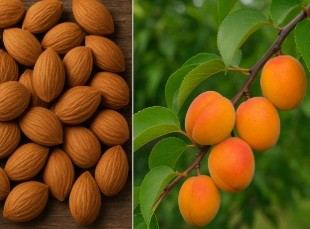
Apricot kernels
Rating : 5
| Evaluation | N. Experts | Evaluation | N. Experts |
|---|---|---|---|
| 1 | 6 | ||
| 2 | 7 | ||
| 3 | 8 | ||
| 4 | 9 | ||
| 5 | 10 |
Cons:
Allergen (1)10 pts from Whiz35
| Sign up to vote this object, vote his reviews and to contribute to Tiiips.Evaluate | Where is this found? |
| "Descrizione" about Apricot kernels Review Consensus 10 by Whiz35 (12050 pt) | 2025-Nov-27 10:58 |
| Read the full Tiiip | (Send your comment) |
Apricot kernels (Prunus armeniaca)
Apricot kernels are the seeds found inside the apricot pit, occurring in “sweet” and “bitter” types. Sweet kernels are used as food ingredients in ways similar to almonds, while bitter kernels contain higher levels of cyanogenic precursors and require strict control and limited use. Flours (full-fat or defatted) and apricot kernel oil are common derivatives.

Common name: Apricot kernels (armelline; seeds of the apricot stone)
Parent plant: Prunus armeniaca L. — apricot tree
Kingdom: Plantae
Clade: Angiosperms
Clade: Eudicots
Order: Rosales
Family: Rosaceae
Genus: Prunus
Species: Prunus armeniaca L.
Note: Apricot kernels are the seeds inside the stone of the fruit; they are not a separate species. They can be sweet (low in amygdalin) or bitter (high in amygdalin).
Climate:
The apricot tree thrives in temperate climates with cold winters (necessary for dormancy) and warm, dry summers.
It is sensitive to late spring frosts, which can damage flowers and young fruits.
It prefers sheltered, well-ventilated areas.
It requires a sufficient number of winter chill hours for uniform flowering and fruit set.
Sun exposure:
Requires full sun, which is essential for:
fruit ripening,
sugar accumulation,
proper wood maturation.
Insufficient light reduces yield and fruit quality.
Soil:
Apricot trees prefer soils that are:
well drained,
medium-textured or slightly sandy,
slightly calcareous or neutral (pH 6.5–7.5),
rich in organic matter.
They perform poorly in heavy or waterlogged soils, which favor collar rot and root diseases.
Irrigation:
They require moderate but regular irrigation, especially:
in spring (fruit set),
in summer (fruit enlargement).
Excess water causes fruit cracking and fungal issues; prolonged water deficiency reduces fruit size and yield.
Temperature:
Germination: 10–20 °C
Vegetative growth: 18–30 °C
Flowers damaged below –2 °C
Fruits damaged above 38–40 °C under prolonged heat
Fertilization:
Apricot trees benefit from balanced fertilization:
Nitrogen: necessary but should be moderate to avoid excessive vegetative growth.
Phosphorus: supports flowering and fruit set.
Potassium: improves flavor, firmness, and overall fruit quality.
Organic amendments improve soil structure and fertility.
Crop care:
Annual pruning to promote fruiting on young shoots and improve canopy ventilation.
Fruit thinning to increase size and quality.
Monitoring for common Prunus diseases:
monilia (brown rot),
shot hole disease (coryneum),
leaf curl,
gummosis.
Control of insects such as aphids, codling moth, and fruit flies.
Harvest:
Apricots are harvested between late spring and mid-summer depending on the cultivar.
Apricot kernels are obtained from stones after drying and mechanical or manual cracking.
Kernels may be:
sweet → suitable for food uses,
bitter → must be detoxified or processed due to high amygdalin content.
Propagation:
Apricot trees are multiplied mainly by grafting onto selected rootstocks (plum hybrid, peach seedling, almond).
Seed propagation is used only for rootstocks, as it does not maintain varietal characteristics.
Commercial forms
Whole, peeled, roasted or natural kernels; kibbled kernels; full-fat or defatted flours (from press cake after oil extraction); edible apricot kernel oil; pastes such as “persipan” as an alternative to almond paste, where permitted.
Caloric value (dry product, 100 g)
Whole sweet kernels (full-fat): about 560–620 kcal/100 g (typical ≈ 590 kcal/100 g).
Defatted flour: lower energy proportional to fat removal.
Average composition (indicative, per 100 g)
Full-fat kernels/flour: fat ~45–55 g; protein ~20–25 g; carbohydrate ~15–25 g; fiber ~5–10 g; moisture ≤6–7%.
Defatted flour: fat ~8–15 g; protein ~35–50 g; carbohydrate ~20–35 g; fiber ~10–15 g; moisture ≤6–7%.
Micronutrients: vitamin E (tocopherols), folates; minerals (Mg, K, P, Ca).
Fatty acid profile (apricot kernel oil, % of total fat)
MUFA (oleic) ~62–70%; PUFA (linoleic) ~20–28%; SFA (palmitic/stearic) ~6–10%. Actual values vary with cultivar and origin.
Sensory and functional properties
Sweet kernels provide a gentle almond-like aroma and contribute moistness in doughs due to their lipid content. Fine flours improve cohesion and texture in shortcrusts, fillings, and creams; defatted flours increase water binding and protein density for bars and “high-protein” bakery. The resident oil aids aroma release but should be protected from oxidation.
Manufacturing process (outline)
Lots are selected to favor sweet kernels and exclude bitter fractions. Dehulling, optional blanching, and thermal stabilization limit lipase activity and reduce enzymatic hydrolysis of cyanogenic precursors. Milling and classification deliver target fineness; defatted flour is obtained by mechanical pressing (or compliant extraction) followed by remilling of the press cake. In-line controls track moisture, color/odor, exclusion of bitter kernels, and basic oxidative markers of the oil.
Food applications
Cookies and shortcrusts; cake layers; spreads and “nut & seed” pralinés; alternative marzipans (persipan); crunchy toppings; breakfast cereals and bars; protein-enriching thickener in cold creams. In gluten-free systems, apricot kernel flour is blended with starches and other gluten-free flours.
Safety and regulatory aspects
Bitter kernels contain cyanogenic glycosides (CNG) that can release hydrogen cyanide (HCN) upon hydrolysis. Product development therefore relies on varietal selection, segregation of bitter fractions, and stabilization steps. Finished foods must comply with applicable HCN limits, and production should operate under GMP/HACCP with defined CCPs for sourcing, sorting, and lot homogeneity. Simple roasting inactivates β-glucosidases but does not remove the intrinsic CNG potential if levels are high, so formulation discipline is essential.
Quality and specification themes
Moisture ≤6–7%; verified absence of bitter kernels in “sweet” lines; clean almond-like aroma without rancid or harsh bitter notes; controlled oxidative status of the resident oil; fine and stable particle-size distribution for flours; microbiology appropriate to category. Traceable supply and structured incoming inspections under GMP/HACCP are expected.
Storage and shelf life
Store cool, protected from light, oxygen, and external odors, in barrier packaging; control ambient RH to limit caking and rancidity. Full-fat flours have shorter shelf life due to higher lipid content; defatted flours are generally more stable. Apply FIFO rotation and reseal promptly after opening. Moderate-low aw supports physical stability.
Allergens
Potential cross-reactivity with tree nuts and other stone-fruit seeds. In multiproduct facilities, prevent cross-contact with milk, soy, and other nuts through GMP/HACCP controls.
Troubleshooting
Unexpected bitterness: residual bitter kernels or CNG hydrolysis → tighten lot selection and stabilization.
Rancid notes: lipid oxidation → upgrade packaging barrier, lower storage temperature, shorten holding time.
Caking/lumps in flour: high RH → dehumidify, add secondary desiccants, adjust fineness.
Oil bleed in doughs: excess fat or shear → rebalance dry phase, reduce work, or substitute part with defatted flour.
Sustainability and supply chain
Apricot kernels valorize a by-product of apricot processing (pits), reducing waste. Managing cleaning/milling effluents against BOD/COD targets and using recyclable packaging improve environmental performance. Traceable sourcing and farmer support programs strengthen quality and resilience.
Conclusion
Apricot kernels—particularly the sweet type—offer a distinctive almond-like profile and useful functionality in bakery and fillings. Product quality depends on varietal selection, control of bitter components, target milling fineness, and proper storage; rigorous safety management ensures consistent sensory performance and reliable use.
Mini-glossary
MUFA — Monounsaturated fatty acids: Generally favorable for oxidative stability and lipid profile (e.g., oleic acid).
PUFA — Polyunsaturated fatty acids: Beneficial but more prone to oxidation (e.g., linoleic acid).
SFA — Saturated fatty acids: To moderate; health impact depends on the overall diet.
CNG — Cyanogenic glycosides: Plant compounds that can release cyanide through enzymatic hydrolysis.
HCN — Hydrogen cyanide: Toxic species liberated from CNG; must remain within regulatory limits where applicable.
aw — Water activity: Fraction of “free” water available for reactions and microbes; lower aw improves stability.
RH — Relative humidity: Percentage of water vapor in air; high RH promotes caking and quality loss.
GMP — Good Manufacturing Practice: Procedures and controls ensuring hygiene, consistency, traceability, and quality.
HACCP — Hazard Analysis and Critical Control Points: Preventive food-safety system identifying hazards and defining CCPs, limits, monitoring, corrective actions, and verification.
CCP — Critical control point: A step where control prevents, eliminates, or reduces a food-safety hazard to acceptable levels.
FIFO — First in, first out: Inventory rotation principle—use the oldest lots first to preserve quality.
BOD/COD — Biochemical oxygen demand / Chemical oxygen demand: Indicators of organic load in effluents; higher values signal greater pollution potential.
| Sign up to vote this object, vote his reviews and to contribute to Tiiips.EvaluateClose | (0 comments) |
Read other Tiiips about this object in __Italiano (1)
Content:   Family:   Last update:   2025-10-21 12:15:18 | Kcal/100g:   590 Threat factors:   |

