

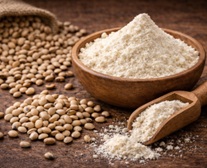
Guar seed flour
Rating : 7
| Evaluation | N. Experts | Evaluation | N. Experts |
|---|---|---|---|
| 1 | 6 | ||
| 2 | 7 | ||
| 3 | 8 | ||
| 4 | 9 | ||
| 5 | 10 |
10 pts from Harrier2
| Sign up to vote this object, vote his reviews and to contribute to Tiiips.Evaluate | Where is this found? |
| "Descrizione" about Guar seed flour Review Consensus 10 by Harrier2 (1059 pt) | 2025-Oct-25 10:42 |
| Read the full Tiiip | (Send your comment) |
Guar seed flour (Cyamopsis tetragonoloba (L.) Taub.; Fabaceae)
Ingredient obtained by milling the endosperm of guar seeds after dehulling and separating bran and germ. The main polysaccharide fraction is guar gum (galactomannan, E412), responsible for high cold-water viscosity. Used as a thickener, texture stabilizer, and water-binding agent in numerous food matrices and—natively or modified—as a rheology modifier in cosmetics.
Caloric value (per 100 g of product)
Guar endosperm flour: typically ~200 kcal/100 g (fiber energy factor ≈2 kcal/g; actual value depends on purity and moisture).
Purified guar gum (E412): ~200 kcal/100 g (predominantly soluble fiber).
At normal use levels (0.1–1.0%) the energy contribution is negligible.
It appears in form of yellowish or whitepowder


Key constituents
Galactomannan (guar gum): polysaccharide with mannose:galactose ≈ 2:1; hydrates in cold water to form high-viscosity solutions at low concentrations.
Proteins: in endosperm flour (not in highly purified gum) typically 4–7%.
Insoluble fibers and ash: traces in flour; removed in purified food grades.
Moisture: generally ≤12% (supplier spec).
Analytical markers: viscosity at 1% (e.g., Brookfield, mPa·s), particle size (D90), dispersion pH, microbiological counts, metals/pesticides within limits.
Production process
Cleaning and dehulling of seeds → separation into endosperm “splits,” bran, and germ (by-products: churi and korma for feed).
Milling of splits and sieving to obtain fine flour; optional wet/dry purification to raise gum assay.
For guar gum (E412): further refining, viscosity standardization, and microbiological control; for “instant” grades, agglomeration to improve wettability.
Sensory and technological properties
Cold hydration: rapid viscosity build (pseudoplastic); risk of “fish eyes” if dispersed without adequate shear.
pH/temperature stability: good around pH ~5–7; viscosity decreases in strong acid or alkali (hydrolysis). Tolerant of moderate heat treatments.
Salts/ions: high electrolyte levels can reduce apparent viscosity.
Synergies: marked viscosity/elasticity boost with xanthan; useful interactions with carrageenans and pectins in dairy and desserts. Boron/borate crosslinks in alkaline conditions (technical use, not food).
Food applications
Beverages and syrups: 0.05–0.30% for body and phase control (premix with sugars).
Dairy/ice cream: 0.10–0.30% for viscosity, meltdown resistance, and syneresis control.
Bakery: 0.20–0.80% for water retention, softness, and shelf life; in gluten-free systems 0.30–1.50% (often with xanthan).
Sauces and dressings: 0.15–0.50% for stability and sheen.
Restructured/plant-based meats: 0.10–0.40% for water binding and yield.
Instant preparations: agglomerated grades for quick dispersion. Optimize dosages through pilot trials.
Nutrition and health
Guar gum is a soluble, fermentable fiber: it can contribute to SCFA production in the colon. High doses may cause bloating/gas; increase intake gradually and ensure adequate hydration. In foods, health claims require prior authorization.
Quality and specifications (typical topics)
Viscosity (e.g., 1%/20 °C; product class), particle size (D90), moisture, ash, dispersion pH.
Contaminants: pesticides/metals within limits; mycotoxins and microbiology compliant; absence of Salmonella/E. coli in 25 g.
Purity: E412 content; controlled protein/mineral residues in purified grades.
Sensory: free from grassy off-notes or excessive dustiness; uniform color.
Storage and shelf life
Protect from humidity and odors; use barrier packs with desiccants.
Avoid temperature swings and prolonged compression (caking).
Apply FIFO rotation; reseal containers after use.
Allergens and safety
Not a major allergen; powder may irritate the respiratory tract and rarely cause occupational sensitization. Excess intake or ingestion without sufficient water is inadvisable (GI discomfort risk). Additive E412 is permitted in foods per regulations.
INCI functions in cosmetics
Typical entries: Cyamopsis Tetragonoloba (Guar) Gum; Hydroxypropyl Guar; Guar Hydroxypropyltrimonium Chloride (cationic).
Roles: rheology modifier/film former; cationic forms act as conditioning agents in haircare/skin feel, improving combability and wet/dry sensorials.
Troubleshooting
Lumps (“fish eyes”): poor dispersion → premix with dry solids (sugar), use high shear, add slowly; 40–60 °C water speeds hydration.
Excess viscosity: overdose/high-MW grade → reduce dose, choose low-viscosity or partially hydrolyzed grade.
Viscosity loss: strong pH extremes, high T°, or galactomannanase enzymes → correct pH, apply thermal/aseptic controls.
Phase separation: synergize with xanthan or add soluble solids; optimize shear profile.
Sustainability and supply chain
Legume crop with nitrogen fixation grown in arid/semi-arid regions (India, Pakistan): comparatively low water inputs; by-products (churi/korma) valorized as feed. In-plant: water/energy recovery, effluent management to BOD/COD targets, recyclable packaging.
Conclusion
Guar seed flour provides a highly effective, cold-hydrating rheological tool that enhances body, stability, and yield across many applications. Performance depends on grade/purity, particle size, pH/salt/temperature conditions, dispersion method, and tight viscosity standardization.
Mini-glossary
E412 — guar gum: food thickener/stabilizer.
Galactomannan — main guar polysaccharide (M:G ≈ 2:1).
Viscosity (mPa·s) — flow resistance specified at defined concentration/temperature/instrument.
SCFA — short-chain fatty acids: products of colonic fermentation.
D90 — 90th-percentile particle diameter: fineness index.
FIFO — first in, first out: stock rotation.
BOD/COD — biochemical/chemical oxygen demand: effluent organic-load indicators.
Let's look at Guar's other applications.
Food
Guar Gum has been used by the food industry as a thickener, stabilizer in emulsions due to its excellent dough properties. ‘Thickeners’ are substances which increase the viscosity of a foodstuff. It is listed as E412 on the European food additives list.
Medical
Many interesting properties, including antioxidant activity, hypocholesterolemic and prebiotic activity have been attributed by the scientific literature to this compound.
In particular, hepatoprotective activity (1) and drug release have been studied (2).
At high concentrations it can cause flatulence and swelling due to the fermentation of intestinal flora.
Cosmetics
Binder agent. A binding compound that is used in cosmetic, food and pharmaceutical products as an anti-caking agent with the function of making the product in which it is incorporated silky, compact and homogenous. The binder, either natural such as mucilage, gums and starches or chemical, may be in the form of a powder or liquid.
Emulsion stabilizer. Emulsions are thermodynamically unstable. Emulsion stabilisers improve the formation and stability of single and double emulsions. It should be noted that in the structure-function relationship, molar mass plays an important role.
Fragrance. It plays a very important role in the formulation of cosmetic products as it allows perfume to be enhanced, masked or added to the final product, improving its commercial viability. The consumer always expects to find a pleasant scent in a cosmetic product.
Viscosity Enhancing Agent - aqueous. Since viscosity is important for increasing the chemical and physical stability of the product, Viscosity Enhancing Agent acqueous is an important dosage factor in gels, suspensions, emulsions, solutions. Increasing viscosity makes formulations less sedimentary and more homogeneously thickened.
Molecular Formula: C10H14N5Na2O12P3
Molecular Weight: 535.146 g/mol
UNII: e89i1637ke
CAS: 9000-30-0
EC Number: 232-536-0 232-536-8
FEMA Number: 2537
MDL number MFCD00131250
Synonyms:
References___________________________________________________________________
(1) Wu C, Liu J, Tang Y, Li Y, Yan Q, Jiang Z. Hepatoprotective Potential of Partially Hydrolyzed Guar Gum against Acute Alcohol-Induced Liver Injury in Vitro and Vivo. Nutrients. 2019 Apr 27;11(5). pii: E963. doi: 10.3390/nu11050963.
Abstract. Natural polysaccharides, particularly galactomannans, are potential candidates for treatment of alcoholic liver diseases (ALD). However, applications are restricted due to the physicochemical properties associated with the high molecular weight. In this work, guar gum galactomannans were partially hydrolyzed by β-mannanase, and the molecular mechanisms of hepatoprotective effects were elucidated both in vitro and in vivo. Release of lactate dehydrogenase and cytochrome C were attenuated by partially hydrolyzed guar gum (PHGG) in HepG2 cells, due to protected cell and mitochondrial membrane integrity. PHGG co-administration decreased serum amino transaminases and cholinesterase levels of acute alcohol intoxicated mice, while hepatic pathologic morphology was depleted. Activity of superoxide dismutase, catalase, and glutathione peroxidase was recovered to 198.2, 34.5, 236.0 U/mg protein, respectively, while malondialdehyde level was decreased by 76.3% (PHGG, 1000 mg/kg∙day). Co-administration of PHGG induced a 4.4-fold increment of p-AMPK expression, and lipid metabolism was mediated. PHGG alleviated toll-like-receptor-4-mediated inflammation via the signaling cascade of MyD88 and IκBα, decreasing cytokine production. Moreover, mediated expression of Bcl-2 and Bax was responsible for inhibited acute alcohol-induced apoptosis with suppressed cleavage of caspase 3 and PARP. Findings gained suggest that PHGG can be used as functional food supplement for the treatment of acute alcohol-induced liver injury.
(2) Kumar B, Murali A, Bharath AB, Giri S. Guar gum modified upconversion nanocomposites for colorectal cancer treatment through enzyme-responsive drug release and NIR-triggered photodynamic therapy. Nanotechnology. 2019 Mar 20;30(31):315102. doi: 10.1088/1361-6528/ab116e.
Abstract. Multimodal therapeutic approach towards colorectal cancer (CRC) holds great promise. There is, however, no convincing strategy reported to date that employs a multimodal strategy in CRC treatment. The present study reports an intense green-emitting core-shell photoluminescent upconversion (CSGU) nanocrystal engineered to synergistically perform photodynamic and enzyme-triggered delivery of the chemotherapeutic agent for an enhanced therapeutic outcome on HT-29 colon carcinoma cells in vitro. The photodynamic activity is achieved by the energy transfer between CSGU and the chemically conjugated Rose Bengal (RB) molecules that are further protected by a mesoporous silica (MS) layer. The chemical assay demonstrates a remarkable FRET mediated generation of 1O2 under NIR (980 nm) excitation. The outermost MS layer of the nanoplatform is utilized for the loading of the 5FU anticancer drug, which is further capped with a guar gum (GG) polysaccharide polymer. The release of the 5FU is specifically triggered by the degradation of the GG cap by specific enzymes secreted from colonic microflora, which otherwise showed 'zero-release behavior' in the absence of any enzymatic trigger in various simulated gastro-intestinal (GI) conditions. Furthermore, the enhanced therapeutic efficacy of the nanoplatform (CSGUR-MSGG/5FU) was evaluated through in vitro studies using HT-29 CRC cell lines by various biochemical and microscopic assays by the simultaneous triggering effect of colonic enzyme and 980 nm laser excitation. In addition, the strong visible emission from the nanoplatform has been utilized for NIR-induced cellular bioimaging.
Paudel D, Nair DVT, Tian S, Hao F, Goand UK, Joseph G, Prodes E, Chai Z, Robert CEM, Chassaing B, Patterson AD, Singh V. Dietary fiber guar gum-induced shift in gut microbiota metabolism and intestinal immune activity enhances susceptibility to colonic inflammation. Gut Microbes. 2024 Jan-Dec;16(1):2341457. doi: 10.1080/19490976.2024.2341457.
Abstract. With an increasing interest in dietary fibers (DFs) to promote intestinal health and the growth of beneficial gut bacteria, there is a continued rise in the incorporation of refined DFs in processed foods. It is still unclear how refined fibers, such as guar gum, affect the gut microbiota activity and pathogenesis of inflammatory bowel disease (IBD). Our study elucidated the effect and underlying mechanisms of guar gum, a fermentable DF (FDF) commonly present in a wide range of processed foods, on colitis development. We report that guar gum containing diet (GuD) increased the susceptibility to colonic inflammation. Specifically, GuD-fed group exhibited severe colitis upon dextran sulfate sodium (DSS) administration, as evidenced by reduced body weight, diarrhea, rectal bleeding, and shortening of colon length compared to cellulose-fed control mice. Elevated levels of pro-inflammatory markers in both serum [serum amyloid A (SAA), lipocalin 2 (Lcn2)] and colon (Lcn2) and extensive disruption of colonic architecture further affirmed that GuD-fed group exhibited more severe colitis than control group upon DSS intervention. Amelioration of colitis in GuD-fed group pre-treated with antibiotics suggest a vital role of intestinal microbiota in GuD-mediated exacerbation of intestinal inflammation. Gut microbiota composition and metabolite analysis in fecal and cecal contents, respectively, revealed that guar gum primarily enriches Actinobacteriota, specifically Bifidobacterium. Guar gum also altered multiple genera belonging to phyla Bacteroidota and Firmicutes. Such shift in gut microbiota composition favored luminal accumulation of intermediary metabolites succinate and lactate in the GuD-fed mice. Colonic IL-18 and tight junction markers were also decreased in the GuD-fed group. Importantly, GuD-fed mice pre-treated with recombinant IL-18 displayed attenuated colitis. Collectively, unfavorable changes in gut microbiota activity leading to luminal accumulation of lactate and succinate, reduced colonic IL-18, and compromised gut barrier function following guar gum feeding contributed to increased colitis susceptibility.
Todd PA, Benfield P, Goa KL. Guar gum. A review of its pharmacological properties, and use as a dietary adjunct in hypercholesterolaemia. Drugs. 1990 Jun;39(6):917-28. doi: 10.2165/00003495-199039060-00007.
Abstract. Guar gum is a dietary fibre advocated for use in lowering serum total cholesterol levels in patients with hypercholesterolaemia. Its mechanism of action is proposed to be similar to that of the bile-sequestering resins. Although guar gum is also employed as an adjunct in non-insulin-dependent diabetic patients this review is restricted to its efficacy as a hypolipidaemic agent. Clinical trials indicate that, when used alone, guar gum may reduce serum total cholesterol by 10 to 15%, although some studies show no significant response. An attenuation of this effect during longer term treatment has been seen but evidence of this effect is equivocal. As an adjunct to established therapies (bezafibrate, lovastatin or gemfibrozil) guar gum has shown some promise: it may produce a further reduction in total cholesterol of about 10% in patients not responding adequately to these drugs alone. Gastrointestinal effects, notably flatulence, occur relatively frequently and may be considered unacceptable by some patients. Standardization of formulations and methods of administration of guar gum is required to clarify its pharmacological and clinical properties. Thus, on the basis of presently available evidence guar gum as monotherapy may be considered at most modestly effective in reducing serum cholesterol levels. Nonetheless, further investigation of guar gum is warranted, particularly its use as an adjunct to produce additional reductions in serum cholesterol in patients not responding optimally to other lipid-lowering agents.
Okamura T, Hamaguchi M, Mori J, Yamaguchi M, Mizushima K, Abe A, Ozeki M, Sasano R, Naito Y, Fukui M. Partially Hydrolyzed Guar Gum Suppresses the Development of Sarcopenic Obesity. Nutrients. 2022 Mar 9;14(6):1157. doi: 10.3390/nu14061157. PMID: 35334814;
Abstract. Partially hydrolyzed guar gum (PHGG) is a soluble dietary fiber derived through controlled enzymatic hydrolysis of guar gum, a highly viscous galactomannan derived from the seeds of Cyamopsis tetragonoloba. Here, we examined the therapeutic potential of dietary supplementation with PHGG against sarcopenic obesity using Db/Db mice. Db/Db mice fed a normal diet alone or a fiber-free diet, or supplemented with a diet containing PHGG (5%), were examined. PHGG increased grip strength and the weight of skeletal muscles. PHGG increased the short-chain fatty acids (SCFAs) concentration in feces and sera. Concerning innate immunity, PHGG decreased the ratio of inflammatory cells, while increasing the ratio of anti-inflammatory cells in the small intestine. The present study demonstrated the preventive effect of PHGG on sarcopenic obesity. Changes in nutrient absorption might be involved through the promotion of an anti-inflammatory shift of innate immunity in the intestine accompanied by an increase in SCFA production by PHGG.
| Sign up to vote this object, vote his reviews and to contribute to Tiiips.EvaluateClose | (0 comments) |
Read other Tiiips about this object in __Italiano (1)
Content:   Last update:   2025-10-25 10:28:40 | Kcal/100g:   200 |
