

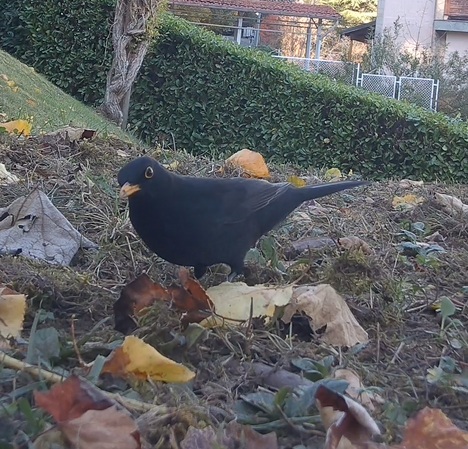
Blackbird
Rating : 8
| Evaluation | N. Experts | Evaluation | N. Experts |
|---|---|---|---|
| 1 | 6 | ||
| 2 | 7 | ||
| 3 | 8 | ||
| 4 | 9 | ||
| 5 | 10 |
0 pts from Al222
| Sign up to vote this object, vote his reviews and to contribute to Tiiips.Evaluate | Where is this found? |
| "Descrizione" about Blackbird by Al222 (23259 pt) | 2025-Oct-30 10:40 |
| Read the full Tiiip | (Send your comment) |
Turdus merula (Common Blackbird)
Description:
The common blackbird (Turdus merula) is one of the most familiar and widespread birds across Europe. The male is entirely black with a bright yellow-orange beak and a yellow eye-ring. The female is dark brown with a duller beak and faintly streaked chest. The male’s melodic, flute-like song is one of the most recognizable bird calls, often heard at dawn and dusk, especially in spring.
Scientific Classification:
Kingdom: Animalia
Phylum: Chordata
Class: Aves
Order: Passeriformes
Family: Turdidae
Genus: Turdus
Species: Turdus merula
![]() | ![]() | ![]() |
Dimensions and Weight:
The blackbird measures 23–29 cm in length, with a wingspan of 34–38 cm. It weighs between 80 and 110 grams. It has a compact body, rounded wings, and a slightly rounded long tail.
Habitat:
This species is highly adaptable and can be found in forests, hedgerows, parks, gardens, farmland, and even urban centers. It is widespread throughout Europe, North Africa, and parts of western Asia. In Italy, it is extremely common from lowlands to mountain areas, up to 1,500 meters.
Behavior and Habits:
Blackbirds are diurnal and territorial, especially in spring when males sing from elevated perches to defend their territory. They are generally monogamous, and may have multiple broods per season. The nest is cup-shaped, made of twigs, mud, and grass, hidden in shrubs or sheltered spots. The female lays 3–5 pale blue eggs and incubates them for about 13 days.
Their diet is omnivorous, consisting of earthworms, insects, larvae, berries, fruits, seeds, and small invertebrates. They are often seen hopping on lawns, flicking leaves aside with their beaks in search of food.
Dangers, Enemies, and Threats:
Natural predators include birds of prey, domestic cats, crows, jays, and mustelids. Eggs and nestlings are especially vulnerable. Other dangers include road traffic, glass windows, pesticides, and climate change, which may affect food availability. Despite this, the species is very resilient and thrives in human-altered environments.
Protected or Endangered Species:
The blackbird is not globally threatened. In Italy, it is protected during the breeding season, but may be hunted in autumn in certain regions under regulated conditions. It is listed in Annex II/2 of the EU Birds Directive, allowing regulated hunting. European populations are generally stable, although insect decline in agricultural zones could pose indirect threats.
References__________________________________________________________________________
Evans KL, Hatchwell BJ, Parnell M, Gaston KJ. A conceptual framework for the colonisation of urban areas: the blackbird Turdus merula as a case study. Biol Rev Camb Philos Soc. 2010 Aug;85(3):643-67. doi: 10.1111/j.1469-185X.2010.00121.x.
Abstract. Despite increasing interest in urban ecology the factors limiting the colonisation of towns and cities by species from rural areas are poorly understood. This is largely due to the lack of a detailed conceptual framework for this urbanisation process, and of sufficient case studies. Here, we develop such a framework. This draws upon a wide range of ecological and evolutionary theory and the increasing number of studies of how the markedly divergent conditions in urban and rural areas influence the traits of urban populations and the structure of urban assemblages. We illustrate the importance of this framework by compiling a detailed case study of spatial and temporal variation in the urbanisation of the blackbird Turdus merula. Our framework identifies three separate stages in the urbanisation process: (i) arrival, (ii) adjustment, and (iii) spread. The rate of progress through each stage is influenced by environmental factors, especially human attitudes and socio-economic factors that determine the history of urban development and the quality of urban habitats, and by species' ecological and life-history traits. Some traits can positively influence progression through one stage, but delay progression through another. Rigorous assessment of the factors influencing urbanisation should thus ideally pay attention to the different stages. Urbanisation has some similarities to invasion of exotic species, but the two clearly differ. Invasion concerns geographic range expansion that is external to the species' original geographic range, whilst urbanisation typically relates to filling gaps within a species' original range. This process is exemplified by the blackbird which is now one of the commonest urban bird species throughout its Western Palearctic range. This is in stark contrast to the situation 150 years ago when the species was principally confined to forest. Blackbird urbanisation was first recorded in Germany in 1820, yet some European cities still lack urban blackbirds. This is especially so in the east, where urbanisation has spread more slowly than in the west. The timing of blackbird urbanisation exhibits a marked spatial pattern, with latitude and longitude explaining 76% of the variation. This strong spatial pattern contrasts with the weaker spatial pattern in timing of urbanisation exhibited by the woodpigeon Columba palumbus (with location explaining 39% of the variation), and with the very weak spatial pattern in timing of black-billed magpie Pica pica urbanisation (in which location explains 12% of the variation). Strong spatial patterns in timing of urbanisation are more compatible with the leap-frog urbanisation model, in which urban adapted or imprinted birds colonise other towns and cities, than with the independent urbanisation model, in which urban colonisation events occur independently of each other. Spatial patterns in isolation do not, however, confirm one particular model. Factors relating to the arrival and adjustment stages appear particularly likely to have influenced the timing of blackbird urbanisation. Spatial variation in the occurrence of urban populations and the timing of their establishment creates opportunities to assess the factors regulating urbanisation rates, and how the composition of urban assemblages develops as a result. These are major issues for urban ecology.
Mainwaring MC, Deeming DC, Jones CI, Hartley IR. Adaptive latitudinal variation in Common Blackbird Turdus merula nest characteristics. Ecol Evol. 2014 Mar;4(6):841-51. doi: 10.1002/ece3.952.
Abstract. Nest construction is taxonomically widespread, yet our understanding of adaptive intraspecific variation in nest design remains poor. Nest characteristics are expected to vary adaptively in response to predictable variation in spring temperatures over large spatial scales, yet such variation in nest design remains largely overlooked, particularly amongst open-cup-nesting birds. Here, we systematically examined the effects of latitudinal variation in spring temperatures and precipitation on the morphology, volume, composition, and insulatory properties of open-cup-nesting Common Blackbirds' Turdus merula nests to test the hypothesis that birds living in cooler environments at more northerly latitudes would build better insulated nests than conspecifics living in warmer environments at more southerly latitudes. As spring temperatures increased with decreasing latitude, the external diameter of nests decreased. However, as nest wall thickness also decreased, there was no variation in the diameter of the internal nest cups. Only the mass of dry grasses within nests decreased with warmer temperatures at lower latitudes. The insulatory properties of nests declined with warmer temperatures at lower latitudes and nests containing greater amounts of dry grasses had higher insulatory properties. The insulatory properties of nests decreased with warmer temperatures at lower latitudes, via changes in morphology (wall thickness) and composition (dry grasses). Meanwhile, spring precipitation did not vary with latitude, and none of the nest characteristics varied with spring precipitation. This suggests that Common Blackbirds nesting at higher latitudes were building nests with thicker walls in order to counteract the cooler temperatures. We have provided evidence that the nest construction behavior of open-cup-nesting birds systematically varies in response to large-scale spatial variation in spring temperatures.
Møller AP, Jokimäki J, Skorka P, Tryjanowski P. Loss of migration and urbanization in birds: a case study of the blackbird (Turdus merula). Oecologia. 2014 Jul;175(3):1019-27. doi: 10.1007/s00442-014-2953-3.
Abstract. Many organisms have invaded urban habitats, although the underlying factors initially promoting urbanization remain poorly understood. Partial migration may facilitate urbanization because such populations benefit from surplus food in urban environments during winter, and hence enjoy reduced fitness costs of migratory deaths. We tested this hypothesis in the European blackbird Turdus merula, which has been urbanized since the 19th century, by compiling information on timing of urbanization, migratory status, and population density for 99 cities across the continent. Timing of urbanization was spatially auto-correlated at scales up to 600 km. Analyses of timing of urbanization revealed that urbanization occurred earlier in partially migratory and resident populations than in migratory populations of blackbirds. Independently, this effect was most pronounced in the range of the distribution that currently has the highest population density, suggesting that urbanization facilitated population growth. These findings are consistent with the hypothesis that timing of urbanization is facilitated by partial migration, resulting in subsequent residency and population growth.
Sitko J, Zaleśny G. The effect of urbanization on helminth communities in the Eurasian blackbird (Turdus merula L.) from the eastern part of the Czech Republic. J Helminthol. 2014 Mar;88(1):97-104. doi: 10.1017/S0022149X12000818.
Abstract. In the present study we investigated two ecologically distinct populations of T. merula for the presence of helminths. We wished to determine whether urban populations of blackbirds had reduced helminth fauna compared to birds from forest habitats. Birds were caught in two ecologically distinct sites located in the eastern part of the Czech Republic. A total of 320 birds were examined. The first site was located in Prerov where the birds were obtained from a typical urban population, and the second site was Zahlinice, which constitutes a typical forest area. As a result of parasitological examination, 30 helminth species belonging to Digenea, Cestoda, Nematoda and Acanthocephala were recorded from both sites: 29 species were found in the forested site and 15 in the urban site. The overall prevalence of infection was 93.1% and differed significantly between the sites (Zahlinice 97.2%, Prerov 85.1%). The mean species richness was almost three times higher in the forest population (3.37 ± 0.10) than in the urban one (1.78 ± 0.11). The clear qualitative and quantitative differences in the helminth community of T. merula obtained from two ecologically disparate localities show that urbanization leads to a significant reduction in the helminth fauna of a bird which is highly adapted to synanthropic habitats, while still remaining common in its original forest habitat.
| Sign up to vote this object, vote his reviews and to contribute to Tiiips.EvaluateClose | (0 comments) |
Read other Tiiips about this object in __Italiano (1)
Family:   Wingspan cm:   35 Last update:   2013-02-11 10:49:06 | Lenght cm:   25 Weight gr.:   100 |

