

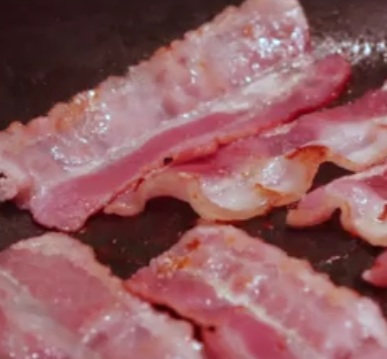
Bacon
Rating : 5.5
| Evaluation | N. Experts | Evaluation | N. Experts |
|---|---|---|---|
| 1 | 6 | ||
| 2 | 7 | ||
| 3 | 8 | ||
| 4 | 9 | ||
| 5 | 10 |
Cons:
To be taken in controlled quantity (1)10 pts from CarPas
| Sign up to vote this object, vote his reviews and to contribute to Tiiips.Evaluate | Where is this found? |
| "Bacon studies" about Bacon by CarPas (5257 pt) | 2025-Nov-01 18:53 |
| Read the full Tiiip | (Send your comment) |
Bacon studies
Overholt MF, Lowell JE, Kim GD, Boler DD, Kerr BJ, Dilger AC. Influence of feeding thermally peroxidized soybean oil to finishing barrows on processing characteristics and shelf life of commercially manufactured bacon.
J Anim Sci. 2018 Jun 29;96(7):2723-2733. doi: 10.1093/jas/sky179
Abstract. Objectives were to evaluate effects of feeding soybean oil (SO) with varying levels of peroxidation on fresh belly characteristics, processing yields, and shelf life of commercially manufactured bacon stored under food-service-style conditions. Fifty-six barrows were randomly assigned to 1 of 4 diets containing 10% fresh SO (22.5 °C) or thermally processed SO (45 °C for 288 h, 90 °C for 72 h, or 180 °C for 6 h), each infused with air at a rate of 15 L/min. Individually housed pigs were provided ad libitum access to feed for 81 d. On day 82, pigs were slaughtered, and on day 83, carcasses were fabricated and bellies collected for recording of weight, dimensions, and flop distance. Belly adipose tissue cores were collected for the analysis of iodine value (IV) by near-infrared spectroscopy (NIR-IV). Bacon was manufactured at a commercial processing facility, and sliced bacon was subsequently transferred to food-service-style packaging and subjected to 0-, 30-, 60-, or 90-d storage at -20 °C. Stored bacon was evaluated for thiobarbituric acid reactive substances (TBARS) and trained sensory evaluation of oxidized odor and flavor. Fresh belly and bacon processing traits were analyzed as a 1-way ANOVA with the fixed effect of SO, whereas shelf life traits were analyzed as a 1-way ANOVA repeated in time. There was no effect (P ≥ 0.30) of SO on belly weight, length, width, or thickness, but bellies of pigs fed 90 °C SO had greater (P ≤ 0.04) flop distance (more firm) than all other SO treatments. Belly fat NIR-IV of pigs fed 90 °C SO were 10.22 units less (P < 0.0001) than pigs fed 180 °C SO, which were 2.99 and 3.29 units less than belly adipose tissue of pigs fed 22.5 and 45 °C SO, respectively. There was no effect of SO on brine uptake or cooking yield of commercially manufactured bacon. There was a trend (P = 0.09) for bacon manufactured from bellies of pigs fed 45 and 90 °C SO to have greater slicing yields than those from pigs fed 22.5 and 180 °C SO. There were no SO × storage time interactions (P ≥ 0.27) for any shelf life trait. There was no difference in TBARS, oxidized odor, or oxidized flavor among the 4 SO treatments, although all 3 shelf life metrics increased (P < 0.0001) with storage time. Overall, feeding SO thermally processed at 90 and 180 °C reduced belly adipose tissue IV, but feeding peroxidized SO did not affect processing yields or shelf life characteristics of commercially manufactured bacon.
Little KL, Kyle JM, Bohrer BM, Schroeder AL, Fedler CA, Prusa KJ, Boler DD. A comparison of slice characteristics and sensory characteristics of bacon from immunologically castrated barrows with bacon from physically castrated barrows, boars, and gilts. J Anim Sci. 2014 Dec;92(12):5769-77. doi: 10.2527/jas.2014-8272.
Abstract. The objectives were to compare slice characteristics and sensory attributes of bacon from immunologically castrated (IC) barrows with bacon from other sexes using a trained sensory panel. Bacon was obtained for sensory evaluation from 3 experiments. In Exp. 1, trimmed and squared bellies (n=180) of IC barrows, IC barrows fed ractopamine hydrochloride (IC+RAC), physically castrated (PC) barrows, intact males (IM), and gilts were used. Data were analyzed as a general linear mixed model and pen (n=48) served as the experimental unit. Treatment (sex or diet) was a fixed effect in all 3 experiments. In Exp. 2, untrimmed, natural fall bellies (n=96) from IC and PC barrows fed 0 or 30% or a withdrawal distillers dried grains with solubles (DDGS) program when slaughtered at 5 wk after the second dose (25 wk of age) were used. In Exp. 3, untrimmed, natural fall bellies (n=96) from IC and PC barrows fed the same experimental diets as in experiment 2 but slaughtered at 7 wk after the second dose (27 wk of age) were used. Data from Exp. 2 and 3 were analyzed as a 2×3 factorial arrangement in a randomized complete block design and pen was the experimental unit. Bellies from all 3 experiments were processed using the same protocols. In Exp. 1, IM had the greatest (P<0.0001) boar aroma and flavor scores among all treatments. No differences were detected among the other treatment groups for boar aroma or flavor. Intact males had the least (P<0.0001) desirable cured bacon aroma and flavor among all treatments. No differences were detected among the other treatment groups for bacon aroma or flavor. There were no differences in bacon aroma or off-flavor between IC and PC barrows slaughtered at 5 wk after the second dose regardless of DDGS feeding program. Bacon from PC barrows was saltier (P<0.01) than bacon from IC barrows when slaughtered at 5 wk after the second dose. There were no differences in bacon aroma, off-aroma, bacon flavor, or saltiness between IC and PC barrows slaughtered at 7 wk after the second dose regardless of DDGS feeding program. Total slice area of bacon slices from IC barrows slaughtered at 5 wk after the second dose were less (P<0.01) than PC barrows, but the differences diminished (P=0.16) when slaughtered at 7 wk after the second dose. Overall, panelists successfully detected boar odor and flavor in Exp. 1. Immunological castration was as effective as physical castration at eliminating boar aroma and boar flavor in bacon even when feeding differing DDGS feeding programs or when slaughtered at 5 or 7 wk after the second dose.
Li F, Zhuang H, Qiao W, Zhang J, Wang Y. Effect of partial substitution of NaCl by KCl on physicochemical properties, biogenic amines and N-nitrosamines during ripening and storage of dry-cured bacon. J Food Sci Technol. 2016 Oct;53(10):3795-3805. doi: 10.1007/s13197-016-2366-x.
Abstract. Effects of three salting treatments (Formulation II: 80 % NaCl + 20 % KCl; Formulation III: 60 % NaCl + 40 % KCl and Formulation IV: 40 % NaCl + 60 % KCl) on physicochemical properties, residual nitrite, N-nitrosamines and biogenic amines were compared with those of control bacons (Formulation I: 100 % NaCl) during processing and storage. Results showed that there were no significant differences among treatments for moisture, pH, and total volatile basic nitrogen (TVBN) content in dry-cured bacons during processing. The replacement of 40 % or less NaCl by KCl had no negative effects on the sensory quality of bacons during processing. Formulation III significantly reduced putrescine, cadaverine and histamine contents and enhanced nitrite residues compared with the control. After 12-day ripening and during storage, the substitution of NaCl by 60 % KCl significantly increased the N-nitrosodimethylamine (NDMA) content than the control. Principal component analysis showed that there were positive correlations between TVBN, biogenic amines (putrescine, cadaverine, histamine and tyramine) and NDMA, and negative correlation between NDMA and nitrite. These findings suggested the partial substitution of NaCl by KCl could be utilized for producing reduced-sodium dry-cured bacons to improve safety of finished products.
Aaslyng MD, Koch AG. The use of smoke as a strategy for masking boar taint in sausages and bacon.
Food Res Int. 2018 Jun;108:387-395. doi: 10.1016/j.foodres.2018.03.069.
Sivendiran T, Wang LM, Huang S, Bohrer BM. The effect of bacon pump retention levels following thermal processing on bacon slice composition and sensory characteristics.
Meat Sci. 2018 Jun;140:128-133. doi: 10.1016/j.meatsci.2018.03.007.
Saldaña E, Castillo LS, Sánchez JC, Siche R, de Almeida MA, Behrens JH, Selani MM, Contreras-Castillo CJ. Descriptive analysis of bacon smoked with Brazilian woods from reforestation: methodological aspects, statistical analysis, and study of sensory characteristics.
Meat Sci. 2018 Jun;140:44-50. doi: 10.1016/j.meatsci.2018.02.014.
Lowell JE, Bohrer BM, Wilson KB, Overholt MF, Harsh BN, Stein HH, Dilger AC, Boler DD. Growth performance, carcass quality, fresh belly characteristics, and commercial bacon slicing yields of growing-finishing pigs fed a subtherapeutic dose of an antibiotic, a natural antimicrobial, or not fed an antibiotic or antimicrobial.
Meat Sci. 2018 Feb;136:93-103. doi: 10.1016/j.meatsci.2017.10.011.
McLean KG, Hanson DJ, Jervis SM, Drake MA. Consumer Perception of Retail Pork Bacon Attributes Using Adaptive Choice-based Conjoint Analysis and Maximum Differential Scaling.
J Food Sci. 2017 Nov;82(11):2659-2668. doi: 10.1111/1750-3841.13934.
Li F, Zhuang H, Qiao W, Zhang J, Wang Y. Effect of partial substitution of NaCl by KCl on physicochemical properties, biogenic amines and N-nitrosamines during ripening and storage of dry-cured bacon.
J Food Sci Technol. 2016 Oct;53(10):3795-3805. doi: 10.1007/s13197-016-2366-x.
| Sign up to vote this object, vote his reviews and to contribute to Tiiips.EvaluateClose | (0 comments) |
| "Descrizione" about Bacon Review Consensus 10 by CarPas (5257 pt) | 2025-Nov-01 18:57 |
| Read the full Tiiip | (Send your comment) |
Bacon (cured pork belly/back; smoked or unsmoked)
Description
Salt-cured pork, typically from belly (streaky bacon) or back/loin (back bacon); sold as slab or sliced (regular, thick-cut).
Cure styles: dry-cured (salt/sugar/spices rubbed on) or wet-cured (brine injected/tumbled). May be smoked (hickory, apple, beech) or unsmoked.
U.S. “uncured” labels usually mean no added synthetic nitrite—instead using celery/plant extracts (natural nitrite); functional nitrite is still present.

Caloric value (per 100 g)
Raw streaky bacon: ~350–450 kcal (fat ~30–40 g; protein ~11–15 g; salt ~2–3%).
Pan-fried, drained: ~500–600 kcal (fat ~40–50 g; protein ~35–40 g).
Values vary with cut, cure strength, and cook loss (fat rendering).
Key constituents
Proteins (myofibrillar) and collagen; triacylglycerol (pork fat) with minor phospholipids/sterols.
Salt (NaCl), nitrite/nitrate (or natural sources), sugars (sucrose, dextrose), spices/pepper, optional smoke constituents (phenolics, carbonyls).
Typical analytics: % moisture, % fat, % salt, residual nitrite, pH, water activity (aᵥ).
Production process
Trim & skin selected bellies/back loins → curing (dry rub or pumped brine with salt, nitrite/ascorbate/erythorbate, sugar, spices) → equalization (refrigerated rest).
Optional smoking (cold/hot) or smoke condensate application; some lines part-cook (par-fried/baked) for ready-to-eat uses.
Chilling → slicing (controlled temperature for clean cut) → packaging (vacuum or MAP) in oxygen- and light-barrier films.
Operate under GMP/HACCP with CCP on curing nitrite dose, time/temperature, lethality where applicable, metal detection, pack integrity.
Sensory and technological properties
Flavor/aroma: cured/savory with smoky and Maillard notes when cooked; sweetness tracks sugar level.
Texture: from crisp (low moisture/thin slices, high render) to chewy (thicker, higher moisture).
Cooking behavior: fat renders readily; curling due to fat/lean contraction; splatter from residual water—start from a cold pan or bake on a rack to reduce.
Food uses
Breakfast sides, BLT/sandwiches/burgers, salads (bits/lardons), pasta/risotti, quiche, soups/beans/greens, wraps around meats/veg, bacon fat as cooking medium.
Ingredient forms: slices, lardons, crumbles/bits, rendered fat.
Nutrition and health
Energy-dense and high in sodium; contributes heme iron and B-vitamins (notably B1/B3/B6).
Nitrite controls C. botulinum and develops cure color/flavor; excessive high-temperature charring can form nitrosamines—cook moderately, avoid burning, and drain fat.
“Reduced-sodium” and nitrate/nitrite-free (via plant extracts) products exist but still require safe handling.
Lipid profile
Typical bacon fat pattern (approx.): ~35–40% SFA (saturated fatty acids; high intakes may raise LDL), ~45–50% MUFA (monounsaturated fatty acids, mainly oleic; generally favorable/neutral for blood lipids), ~10–15% PUFA (polyunsaturated fatty acids, mainly linoleic; beneficial when balanced but more oxidation-prone).
TFA (industrial trans fatty acids) not expected unless fat is hydrogenated; MCT (medium-chain triglycerides) present only in small amounts.
Quality and specifications (typical topics)
Appearance: balanced lean/fat streaking, uniform color (no green/gray), minimal purge.
Chemistry: target salt (e.g., ~2–3%), compliant residual nitrite, pH ~5.6–6.2.
Microbiology: low aerobic counts; pathogens absent; shelf-life validated by challenge/aging studies.
Slicing metrics: slice count per 340 g (12 oz), thickness tolerance, shatter/breakage.
Smoked: PAH within limits; consistent smoke intensity.
Storage and shelf-life
Refrigerated 0–4 °C: unopened 2–8 weeks (style/pack dependent); once opened 3–7 days.
Frozen ≤−18 °C: 1–2 months for best quality.
Cooked bacon: 3–5 days refrigerated; keep sealed, minimize oxygen/light.
Allergens and safety
Pork is not a major EU/US allergen; check for added allergens in flavored cures (e.g., soy, wheat, mustard, celery).
Observe raw meat hygiene; avoid cross-contamination; cook to safe doneness without charring.
INCI functions in cosmetics
Not used as a cosmetic raw. Related historical fats: Adeps Suillus (Lard) as emollient/occlusive (subject to regulatory/oxidation controls).
Troubleshooting
Excessive saltiness: high cure pick-up or surface brine → rinse before cooking, use thick-cut and cook gently, balance with sweet/acid elements.
Curling/splatter: start in a cold pan, lower heat; bake on rack; press with a grill weight for flat rashers.
Burnt/bitter notes: heat too high or sugar-rich cure → reduce temperature, use oven at 175–200 °C, pour off rendered fat periodically.
Rapid rancidity: oxygen/light exposure → use barrier packs, keep cold, consider antioxidants (ascorbate/erythorbate) in cure.
Sustainability and supply chain
Prefer pork from suppliers with animal-welfare standards and responsible antibiotic stewardship.
Plants should treat effluents to BOD/COD targets; use recyclable/mono-material films; maintain full traceability under GMP/HACCP.
Conclusion
Bacon delivers a distinctive cured–smoky flavor and versatile texture from chewy to crisp. Managing cure chemistry, smoke, cook temperature, and packaging/oxygen exposure ensures products that are safe, stable, and consistently flavorful.
Mini-glossary
SFA — Saturated fatty acids: Excess intakes can raise LDL cholesterol; moderate and balance with unsaturated fats.
MUFA — Monounsaturated fatty acids (e.g., oleic): Generally favorable/neutral for blood lipids.
PUFA — Polyunsaturated fatty acids (e.g., linoleic/ALA): Beneficial when balanced; more oxidation-prone.
TFA — Trans fatty acids: Industrial TFAs should be avoided; small natural amounts occur mainly in ruminant fats, not typical of non-hydrogenated bacon fat.
MCT — Medium-chain triglycerides (C6–C12): Present only in small amounts in pork fat.
GMP/HACCP — Good Manufacturing Practice / Hazard Analysis and Critical Control Points: Hygiene and preventive-safety systems with defined CCP.
CCP — Critical control point: Processing step where a control prevents/reduces a hazard (e.g., nitrite dosing, temperature, sealing).
BOD/COD — Biochemical/Chemical oxygen demand: Indicators of wastewater impact from meat processing.
| Sign up to vote this object, vote his reviews and to contribute to Tiiips.EvaluateClose | (0 comments) |
Read other Tiiips about this object in __Italiano (2)
Content:   Family:   Last update:   2019-08-14 18:36:12 | Kcal/100g:   541 Threat factors:   |

