

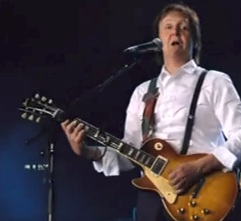
Paul McCartney, extended biography, Beatles, solo career and cultural impact
Profile
Paul McCartney (James Paul McCartney; Liverpool, June 18, 1942) is a British singer-songwriter, musician, and producer, among the most influential figures in 20th-century music and the new millennium. Co-founder of The Beatles, he played a decisive role in transforming the pop song into a complex artistic form, capable of combining melody, experimentation, and accessibility. After the band’s breakup, he built a solo career of extraordinary longevity and continuity, maintaining a central position in the global music landscape.
He sold about 25 million records.

Origins and formation (Liverpool, adolescence and early groups)
Raised in Liverpool in a musically receptive family environment, McCartney learned piano, guitar, and basic harmony at a young age. His meeting with John Lennon in 1957 marked the beginning of a collaboration destined to become one of the most important partnerships in popular music history.
In his early groups (The Quarrymen and later evolutions), McCartney developed a strong melodic instinct and remarkable instrumental versatility, leading him to cover multiple roles: bassist, pianist, guitarist, and arranger.
1957. Paul McCartney meets John Lennon and joins his band: The Quarrymen.
The Beatles and the pop revolution (1960s)
With The Beatles, McCartney took part in a phase of radical transformation of pop music. Together with Lennon, he co-wrote a repertoire that expanded the boundaries of the song form, integrating classical, folk, rock, and avant-garde influences.
His contribution stands out for:
refined melodic sense, often inspired by traditional pop and music hall;
strong harmonic writing and close attention to arrangements;
an increasingly important studio role, especially in the second half of the 1960s.
Albums such as “Sgt. Pepper’s Lonely Hearts Club Band” and “Abbey Road” reflect an artistic maturity that made the band a global cultural reference.
1960. The band, with Paul McCartney, John Lennon, George Harrison, and Pete Best, records its first disc, “My Bonnie”.
Breakup of The Beatles and transition phase (late 1960s–early 1970s)
The breakup of The Beatles represented a moment of profound personal and professional rupture. McCartney responded by temporarily withdrawing from public life and releasing his first solo album, characterized by an intimate and domestic approach.
This phase marked the beginning of a new, more autonomous and experimental artistic identity, distant from the collective dynamics of the former group.
Wings and international success (1970s)
In 1971, McCartney founded Wings, a band with which he achieved enormous commercial success during the 1970s. The project allowed him to reaffirm his position in mainstream rock, using a more direct language while remaining open to experimentation.
Wings were distinguished by solid production, highly attended tours, and a repertoire alternating energetic rock, melodic ballads, and pop-oriented tracks. This phase demonstrates McCartney’s ability to adapt to a new context without losing his identity.
1962. Ringo Starr replaces Pete Best. The first major hit is “Love Me Do”.
From 1962 to 1970, The Beatles achieve extraordinary global success.
1970. Paul McCartney leaves The Beatles.
1975. The Beatles dissolve legally and definitively.
Personal difficulties
Paul McCartney suffered from depression after leaving The Beatles. In 2014, he was forced to cancel a concert in Japan after contracting a virus.
Personal success
After leaving The Beatles, Paul McCartney consistently sought to differentiate his music and style from that of the famous group.
1970. The album “McCartney” achieves major success.
1975. The album “Venus and Mars” reaches the top of the charts.
1982. Collaboration with Stevie Wonder; the song “Ebony and Ivory” reaches number one in the charts.
Mature solo career and experimentation (1980s–2000s)
From the 1980s onward, McCartney consolidated a solo career alternating pop albums, experimental projects, and ventures into classical and orchestral music. At the same time, he strengthened his live presence with highly successful international tours.
During this period, his artistic versatility becomes particularly evident: McCartney moves effortlessly between pop songwriting, electronic music, classical composition, and cross-generational collaborations.
Civic engagement, animal rights and environment
Alongside his musical activity, McCartney is well known for his public commitment to environmental, animal rights, and humanitarian causes. A long-time vegetarian, he has supported global campaigns for animal protection and sustainability, using his fame as a tool for public awareness.
Recent phase and artistic continuity
In more recent years, McCartney has continued to release new music and perform live with a level of intensity rare for an artist of his generation. His concerts function as intergenerational events, spanning more than sixty years of repertoire while maintaining strong expressive vitality.
Style and musical contribution
Paul McCartney’s contribution can be summarized through several key elements:
centrality of melody as a primary emotional vehicle;
instrumental versatility and active involvement in arrangements;
ability to combine innovation and tradition;
creative continuity over an exceptionally long time span.
2003. He begins a U.S. tour earning about $2 million per day.
2010–2016. Concerts in New York, Mexico, England, and San Francisco.
Awards
18 Grammy Awards, along with dozens of other major international honors.
Albums
1970 McCartney
1971 Wild Life
1971 Ram
1973 Red Rose Speedway
1975 Venus and Mars
1976 Wings at the Speed of Sound
1978 London Town
1979 Back to the Egg
1980 McCartney II
1982 Tug of War
1983 Pipes of Peace
1984 Give My Regards to Broad Street
1986 Press to Play
1989 Flowers in the Dirt
1991 Paul McCartney’s Liverpool Oratorio
1993 Off the Ground
1997 Flaming Pie
1997 Standing Stone
1999 Working Classical
2001 Driving Rain
2005 Chaos and Creation in the Backyard
2006 Ecce Cor Meum
2007 Memory Almost Full
2011 Ocean’s Kingdom
2013 New
Best songs
Yesterday
Maybe I’m Amazed
My Love
House of Wax
Cultural relevance and critical interpretation
Paul McCartney represents a bridge figure between the foundational era of modern pop and its later evolutions. His work demonstrates how the song can be simultaneously popular, sophisticated, and enduring, influencing generations of musicians and listeners.
The combination of melodic talent, experimental curiosity, and artistic resilience makes McCartney one of the most significant examples of creative continuity in the history of contemporary music.