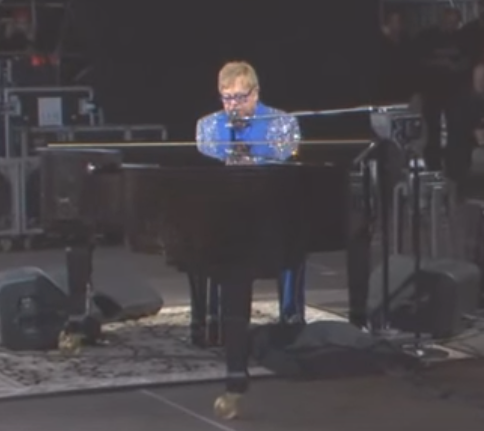
Elton John, extended biography, music career, collaborations, social commitment and cultural impact
Profile
(Reginald Kenneth Dwight; Pinner, Middlesex, March 25, 1947) is a British singer-songwriter, pianist, and performer, among the most influential and long-lived figures in international pop and rock. His career, spanning more than five decades, combines commercial success, critical recognition, and a strong capacity for stylistic renewal. He is known for the combination of instantly recognizable melodies, piano-centric songwriting, stage spectacle, and lyrics written, in most cases, by lyricist Bernie Taupin.

Musical training and early years
Gifted with precocious musical talent, Elton John studied piano from childhood and received classical training at London’s Royal Academy of Music. In parallel, he developed a growing interest in rock ’n’ roll, rhythm & blues, and American pop songwriting.
In the 1960s he worked as a session musician and songwriter for other performers, building a solid understanding of the recording industry. His meeting with Bernie Taupin in 1967 proved decisive: a collaboration emerged based on a clear division of roles (lyrics and music) that would become one of the most durable and productive partnerships in pop history.
International breakthrough (1970s)
Success arrived in the early 1970s, through a rapid succession of albums that consolidated Elton John’s signature style: piano as the lead instrument, rich arrangements, strong melodies, and lyrics that move between introspection, narrative, and symbolic imagination.
Between 1972 and 1975, Elton John reached an exceptional level of popularity, with numerous singles topping international charts. This era also established his public image: eccentric costumes, bold eyewear, and a theatrical stage presence that broke with the traditional idea of the “restrained” singer-songwriter.
Musical style and songwriting
Musically, Elton John is often associated with pop-rock, but his output also includes elements of classic rock, soft rock, glam, soul, and, in some phases, country and gospel influences. The piano is not merely an accompanying instrument, but the compositional core around which harmonic structure and emotional dynamics are built.
Taupin’s writing, combined with Elton John’s melodies, produces songs that work both as radio staples and as emotional narratives, capable of addressing solitude, desire, identity, and personal transformation.
The 1980s and 1990s: continuity, crisis and renewed momentum
The 1980s marked a transitional phase, alternating commercial successes with more complex personal periods. Despite difficulties related to health and addiction, Elton John maintained a constant presence on the charts and on the live circuit.
In the 1990s he experienced a significant renewed momentum, supported by greater control over his personal and artistic life. In this period he strengthened the collaborative dimension, working with artists across generations and styles, and broadened his audience.
Cinema, musical theatre and special projects
A major chapter in Elton John’s career concerns his relationship with film and musical theatre. His collaboration with Disney on the music for “The Lion King” represents one of his most globally visible moments, combining pop language with cinematic storytelling.
Subsequently, Elton John also devoted himself to producing stage musicals, demonstrating a notable ability to adapt his musical language to different narrative contexts without losing recognizability.
Social commitment and public identity
Beyond the artistic dimension, Elton John is known for his social commitment, especially in the fight against HIV/AIDS. Through the Elton John AIDS Foundation, he has contributed significantly to fundraising and global awareness around prevention, research, and the rights of people living with HIV.
His public visibility as an openly gay artist has played an important role in the normalization and representation of LGBTQ+ identities in mainstream pop culture.
Touring, longevity and recent phase
Over the course of his career, Elton John has built an extraordinary reputation as a live performer, with highly successful tours and a strong connection with audiences. The “Farewell Yellow Brick Road Tour,” announced as a farewell tour, became one of the most relevant live events of recent years, both in duration and in total gross.
Even in more recent phases, Elton John has continued to release new music and collaborate with contemporary artists, demonstrating an uncommon intergenerational dialogue for an artist of his generation.
Essential discography (curated selection)
“Elton John” (1970)
- "Tumbleweed Connection" (1970)
“Madman Across the Water” (1971)
“Honky Château” (1972)
“Goodbye Yellow Brick Road” (1973)
“Captain Fantastic and the Brown Dirt Cowboy” (1975)
“Songs from the West Coast” (2001)
“The Lockdown Sessions” (2021)
Cultural relevance and critical interpretation
Elton John’s significance rests on a combination of factors: the ability to fuse pop accessibility with compositional solidity, the use of the piano as an identity-defining element in mainstream rock, theatricality as an expressive language, and extraordinary artistic longevity.
His career demonstrates how an artist can move through decades of musical and social transformation while maintaining a strong identity—adapting to change without losing recognizability.