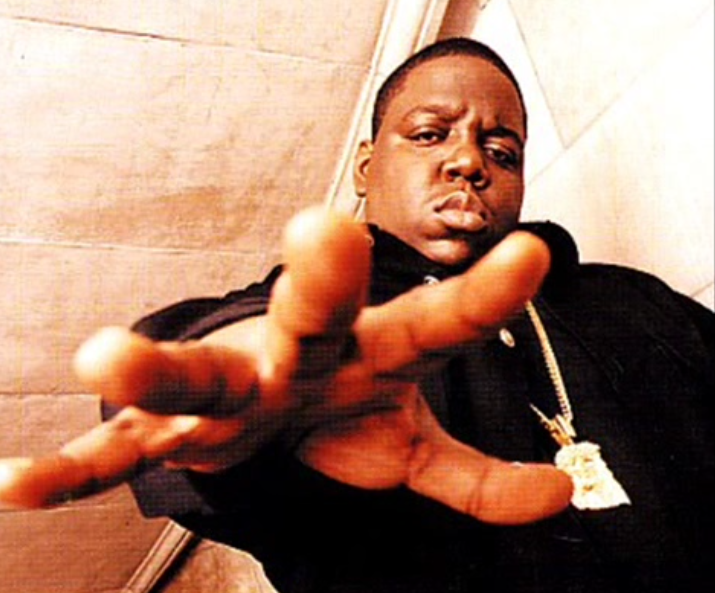
The Notorious B.I.G., Biggie Smalls complete biography, east coast rap, narrative identity and full discography
Profile
Christopher George Latore Wallace (Brooklyn, New York, May 21, 1972 – Los Angeles, California, March 9, 1997), known professionally as The Notorious B.I.G. and also as Biggie Smalls, was an American rapper widely regarded as one of the defining figures of east coast hip hop and, more broadly, of rap history. His work reshaped standards of narration, flow, and vocal presence, establishing an expressive model that remains influential today.

Origins and formation (Brooklyn, early years)
Raised in Bedford-Stuyvesant, Brooklyn, Biggie grew up in a complex urban environment shaped by economic precarity, widespread crime, and strong community identity. School and the street became two narrative poles that would constantly surface in his lyrics.
From adolescence he showed exceptional freestyle ability, standing out for impeccable diction, a natural internal sense of timing, and a deep voice that lent authority even to simple lines. First-hand experience of street life became narrative material rather than abstract exhibition.
Breaking through on the New York scene (1992–1994)
Early recognition came through underground demos that drew attention within New York’s hip hop circles. Meeting Sean “Puff Daddy” Combs was decisive: under Bad Boy Records, Biggie was positioned as the focal point of a new east coast sound able to compete with the growing influence of the west coast.
In 1994 he released “Ready to Die,” an album that immediately established him as a dominant voice in U.S. rap through writing that alternates realistic brutality, introspection, and dark humor.
Ready to Die: autobiography and urban tragedy
“Ready to Die” is built as a coherent, almost cinematic narrative in which ascent and downfall coexist without moralizing. The lyrics address crime, ambition, paranoia, death, and the desire for redemption, while maintaining extraordinary narrative clarity.
The album’s power lies in the balance between detailed storytelling and musical accessibility, with production that makes the narrative immediate without draining it of complexity.
Success, tensions and rivalry (1995–1996)
After the debut’s success, Biggie became the face of the east coast resurgence. At the same time, U.S. hip hop hardened into an increasingly rigid east coast / west coast opposition.
The media-driven rivalry with Tupac Shakur became one of the most dramatic elements of this period, contributing to a symbolic and real escalation of tensions, often amplified by interpretations and external forces beyond the music itself.
Life After Death and artistic maturity
Recorded in his final months and released posthumously in 1997, “Life After Death” represents Biggie’s broadest evolution. A double album, it displays an expanded expressive range: introspection, menace, self-mythologizing, and reflection on fate and fame.
His flow becomes even more elastic, the writing more layered, and the production supports the narrative with stylistic variety that does not compromise the work’s cohesion.
Death and the construction of the myth
The Notorious B.I.G. was killed in Los Angeles in March 1997 at just 24 years old. His death, occurring only months after Tupac Shakur’s, became a symbolic marker of the end of the most violent phase of the east coast / west coast rivalry.
The premature loss crystallized Biggie in a mythic dimension, reinforcing the perception of his work as a definitive testimony to an era and a context.
Lyrical style and artistic identity
Some defining traits of Biggie’s language include:
Narrative flow: the ability to adapt rhythm and accent to the content of the story.
Voice as an instrument: a deep, controlled timbre as an integral part of expression.
Realism without rhetoric: direct depiction of urban life, without explicit moralizing.
Irony and self-analysis: a constant alternation between hardness and critical awareness.
Primacy of story: each track as a coherent micro-narrative.
Full discography
Studio albums
1994 – Ready to Die
1997 – Life After Death
Posthumous albums
Compilations
Collaborations and collective projects
Critical reading: The Notorious B.I.G.’s contribution to rap
The Notorious B.I.G. redefined rap storytelling as a form of oral literary expression, demonstrating that urban realism can be at once raw, complex, and musically fluid. His contribution extends beyond the east coast context: he set an expressive standard in which technique, voice, and narrative operate as a single system.
More than a mere icon, Biggie stands as a structural model for rap writing and remains a reference point for generations of artists.



 The Notorious B.I.G. - Biggie Smalls