

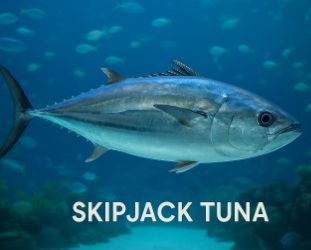
Katsuwonus pelamis, Skipjack tuna
( fresh, frozen or canned, in water, brine or oil)

Description
Skipjack tuna (Katsuwonus pelamis) is a small to medium pelagic tuna species and the main raw material for canned “light tuna” worldwide.
Flesh is pink to reddish, relatively lean, with a moderately strong but typical tuna flavour, generally less intense than bigeye and bluefin.
Main commercial forms:
fresh or frozen loins/steaks for grilling, pan-searing, stews and curries;
canned light tuna (chunks or flakes) in water, brine or vegetable oil;
ingredient in ready meals, salads, sandwich fillings, pasta and rice dishes.
Indicative nutritional values (per 100 g skipjack, raw or canned in water, drained – typical ranges)
(Average values; oil-packed and brined products have higher energy and sodium.)
Energy: 110–130 kcal
Water: ≈ 73–76 g
Protein: 23–26 g
Total fat: 0.5–2 g
First occurrence: SFA/MUFA/PUFA = saturated/monounsaturated/polyunsaturated fatty acids; skipjack is generally lean, with low saturated fat and a meaningful share of mono- and polyunsaturated fats (including marine omega-3). In a balanced diet that limits saturated fat, this lipid profile is favourable compared with many red and processed meats.
Carbohydrates: 0 g (no significant starch or sugars)
Cholesterol: 30–50 mg
Sodium (intrinsic): 35–70 mg
in brine or salted canned products this can rise to 300–600 mg/100 g or more.
Typical micronutrients (per 100 g):
Niacin (vitamin B3): ≈ 10–15 mg
Vitamin B6: ≈ 0.8–1.0 mg
Vitamin B12: ≈ 1–3 µg
Selenium: ≈ 50–80 µg
Phosphorus: ≈ 200–250 mg
Potassium: ≈ 300–400 mg
Long-chain omega-3 (EPA + DHA): typically 0.3–0.5 g/100 g, depending on fatness, season and catch area.
Key constituents
Proteins
High biological value (BV) proteins with a complete essential amino acid profile.
Rich in BCAA (leucine, isoleucine, valine), important for muscle metabolism and maintenance.
Lipids
Low to moderate total fat.
Mixture of saturated, mono- and polyunsaturated fatty acids, including marine omega-3 EPA (eicosapentaenoic acid) and DHA (docosahexaenoic acid).
No industrial trans fats; only minor natural marine trans isomers.
Minerals and vitamins
Good source of selenium, phosphorus, potassium, niacin, vitamin B6, vitamin B12 and variable amounts of vitamin D.
Other components
Naturally high in histidine; if cold chain is broken, bacteria can convert it to histamine, which is responsible for scombroid (histamine) poisoning.
Production process
(Generic scheme for fresh/frozen products and canned “light tuna”.)
Fishing and landing
Skipjack is caught with purse seines, pole-and-line, longlines and other pelagic gears.
Rapid chilling on board (ice or refrigerated seawater) is essential to limit spoilage and histamine formation.
Reception and primary processing
Sorting by size and quality;
heading, gutting and washing;
filleting and trimming into loins/steaks for fresh/frozen markets, or preparation for canning lines.
Fresh/frozen products
For fresh: packaging (often vacuum or MAP) and chilled distribution.
For frozen: rapid freezing, glazing, packing and storage at low temperature.
Canned skipjack “light tuna”
Pre-cooking (steaming or water-cooking) of whole dressed fish or loins;
removal of skin, bones and part of the dark muscle;
filling of cans with chunks or flakes;
addition of cover liquid (water, brine, oil), salt and sometimes broth/flavours;
seaming and retorting (thermal sterilisation);
cooling, storage at ambient temperature, distribution.
Physical properties
Flesh is firm and compact, flaking into pieces and chunks after cooking.
Colour: pink to reddish-purple when raw, becoming pale pink–beige and opaque after cooking or canning.
Odour: marine, moderately intense, typical tuna aroma; sour, rancid or ammoniacal notes indicate poor quality or storage abuse.
Water activity: high in fresh/frozen and drained canned flesh; long shelf-life in canned products is achieved by sterilisation, not by reduced aw.
Sensory and technological properties
Flavour: distinct “tuna” character, more pronounced than albacore but acceptable and well balanced in seasoned dishes.
Texture: meaty, somewhat coarse, suitable for high-heat and moist-heat cooking if times are controlled.
Technological behaviour:
works well in grilling, stewing, curries and ethnic dishes;
canned skipjack provides good flakes and chunks for salads, sandwiches, pasta and rice;
combines well with emulsified sauces (mayonnaise, dressings) and with cereals and vegetables, adding savouriness and protein.
Food applications
Home cooking and foodservice
fresh/frozen loins for grill, pan, oven, stews, curries and mixed seafood dishes;
canned light tuna for rice salads, pasta dishes, mixed salads, sandwiches, wraps;
pizza and baked gratins.
Food industry
main raw material for canned “light tuna”, often labelled as skipjack or simply “light tuna”;
ingredient in ready meals, tuna salads in MAP trays, high-protein snacks;
tuna pâtés, spreads and mousses.
Nutrition & health
Skipjack tuna is a high-protein, low-fat food providing:
high-quality protein (high BV) for muscle maintenance;
a favourable fat profile with useful amounts of omega-3 EPA and DHA despite low total fat.
It also provides:
selenium, which is involved in antioxidant systems and interacts with mercury metabolism;
B vitamins (B3, B6, B12) and phosphorus/potassium for energy metabolism, nervous system and muscle function.
Mercury profile – a relative advantage
Compared with larger tunas (albacore, yellowfin, bigeye), skipjack generally shows lower average mercury levels, because it is smaller and shorter-lived.
For that reason, canned light tuna based on skipjack is often considered a relatively safer option for repeated consumption than large tunas, though moderation is still recommended, especially for:
pregnant or breastfeeding individuals,
young children,
people with very high fish and canned tuna intake.
Histamine (scombroid) risk
Skipjack, like other scombroid fish, is at risk of histamine formation if the cold chain is not respected.
Elevated histamine can cause scombroid poisoning (flushing, headache, itching, gastrointestinal symptoms) shortly after ingestion.
Good time–temperature control from catch to processing and routine histamine testing are key to prevention in commercial products.
Portion note:
A typical serving as main protein is 100–150 g cooked or drained (≈ a standard can or steak), providing about 25–35 g protein and roughly 0.3–0.7 g EPA+DHA, depending on fat content and preparation.
Allergens and intolerances
Skipjack is a fish allergen and must be declared; it can elicit reactions in people with fish allergy.
Canned and prepared products may also contain:
soy (in sauces or broths),
milk or egg (in salads, mayonnaise, pâtés),
gluten, mustard or other allergens depending on recipe.
Histamine-related reactions are toxic (pseudo-allergic), not IgE-mediated allergy, but can mimic allergic symptoms and must be differentiated from true fish allergy.
Quality and specifications (typical themes)
Composition
protein, fat, moisture and salt within specification;
correct net and drained weight for canned products;
defined ratio of fish to cover medium (water/brine/oil).
Physical/sensory
characteristic colour and odour, without rancid, ammoniacal or strongly off notes;
limited bones and skin;
texture appropriate to use (not mushy, not excessively dry/fibrous).
Chemical
histamine below legal limits for scombroid fish;
mercury and other heavy metals within regulatory thresholds;
oxidation indices (e.g. peroxide value) especially in oil-packed products.
Microbiological
canned skipjack: commercial sterility after retorting;
fresh/chilled: low counts and absence of pathogens when properly refrigerated.
Storage and shelf-life
Fresh/chilled
store at 0–2 °C, ideally on ice;
shelf-life of a few days depending on initial freshness, packaging and handling.
Frozen
store at ≤ −18 °C;
typical quality shelf-life 6–12 months, with gradual loss of texture and flavour.
Canned skipjack (light tuna)
store at ambient temperature in a cool, dry, dark place;
typical shelf-life 2–5 years in unopened cans;
once opened, transfer leftovers to a non-metallic container, refrigerate and consume within 1–3 days.
Safety and regulatory
Skipjack tuna is covered by general fish and fishery products regulations:
histamine criteria and limits for scombroid species;
maximum levels for mercury and other contaminants;
hygiene and microbiological standards for fresh, frozen and canned fish;
traceability and correct commercial/scientific naming.
Processing plants must operate under GMP/HACCP, with critical control points for:
time–temperature control from catch to processing;
validation of thermal processing in canned products;
cleaning, sanitation and prevention of cross-contamination.
Labeling
Possible designations:
“skipjack tuna”, “light tuna”, “tonnetto striato” (in Italian markets);
scientific name Katsuwonus pelamis is recommended for clarity.
For canned/prepared products labels should include:
cover medium (in water, in brine, in oil);
full ingredient list with clear emphasis of the allergen fish and any other declared allergens;
net and drained weight;
nutrition declaration;
origin or catch area where required.
Transparent labelling helps distinguish skipjack from other tuna species, relevant for both mercury exposure and nutritional expectations.
Troubleshooting
Dry, fibrous cooked steaks
Cause: overcooking or high temperature applied to a very lean fish.
Actions: shorten cooking time, use moderate heat, apply marinades, cook only to the point of desired doneness.
Strong fishy or metallic odour
Cause: lipid oxidation, ageing, exposure to heat and oxygen.
Actions: reject lots with pronounced off-odours; improve cold chain, packaging (vacuum/MAP) and protection from light and oxygen.
Mushy texture in canned product
Cause: excessive thermal processing or poor raw material quality.
Actions: adjust sterilisation parameters; tighten raw-material quality specifications.
Clusters of flushing/headache/rash after consumption
Likely cause: histamine incident (scombroid) rather than classical allergy if multiple consumers are affected.
Actions: test histamine in suspect batches, review time–temperature control, reinforce HACCP measures.
Sustainability and supply chain
Skipjack is one of the most abundant and widely fished tuna species. In many regions it is considered relatively more resilient than large tunas, but sustainability still depends on:
regional stock status and fishing pressure;
gear types (pole-and-line generally has lower bycatch than some purse-seine and longline operations);
effective management by regional fisheries organisations.
Key supply-chain aspects:
proper management of effluents with controlled BOD/COD;
valorisation of by-products (heads, bones, trimmings for fishmeal and fish oil);
recyclable packaging and FIFO stock rotation to reduce oxidation, spoilage and waste.
Conclusion
Skipjack tuna (Katsuwonus pelamis) is a lean, protein-rich marine ingredient with useful amounts of omega-3, selenium and B vitamins, widely used both fresh/frozen and, above all, in light tuna canning. Compared with larger tuna species, it usually has lower mercury levels, making it a comparatively safer option for frequent use, while still calling for moderation in sensitive groups. Technologically, it is versatile and well suited to salads, sandwiches, main dishes and ready meals. Careful management of cold chain, thermal processing, histamine and heavy-metal control, together with sustainable fishing and processing practices, is essential to ensure safety, quality and environmental responsibility along the whole supply chain.
Mini-glossary
SFA/MUFA/PUFA – Saturated/monounsaturated/polyunsaturated fatty acids; in skipjack total fat is low and the share of unsaturated fats (including PUFA) helps support a more favourable lipid profile than high-SFA meats when part of a balanced diet.
EPA/DHA/ALA – Eicosapentaenoic acid / docosahexaenoic acid / alpha-linolenic acid; EPA and DHA are long-chain marine omega-3s linked to heart, brain and vision benefits, while ALA is a plant omega-3 that the body converts only partially into EPA/DHA.
BV (biological value) – Index of how efficiently dietary protein can be used for body protein synthesis; tuna proteins generally have high BV.
BCAA – Branched-chain amino acids (leucine, isoleucine, valine), important for muscle metabolism and rich in fish and meat proteins.
GMP/HACCP – Good Manufacturing Practices / Hazard Analysis and Critical Control Points; core systems ensuring hygienic, safe and traceable seafood production.
BOD/COD – Biochemical/Chemical Oxygen Demand; indicators of organic and oxidisable load in wastewater, used to design and monitor treatment plants in fish-processing and other food industries.
FIFO – First In, First Out; stock-rotation rule that uses older lots before newer ones, limiting oxidation, expiry and waste.

