

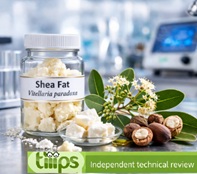
Shea fat
Rating : 7.5
| Evaluation | N. Experts | Evaluation | N. Experts |
|---|---|---|---|
| 1 | 6 | ||
| 2 | 7 | ||
| 3 | 8 | ||
| 4 | 9 | ||
| 5 | 10 |
Pros:
Anti-inflammatory (1)10 pts from Handy23
| Sign up to vote this object, vote his reviews and to contribute to Tiiips.Evaluate | Where is this found? |
| "Descrizione" about Shea fat Review Consensus 10 by Handy23 (4247 pt) | 2026-Feb-20 19:21 |
| Read the full Tiiip | (Send your comment) |
Shea fat: properties, uses, pros, cons, safety
Definition
Shea fat (often marketed as the olein fraction or “shea oil”) is the liquid fraction obtained by fractionation of shea butter derived from the seeds of Vitellaria paradoxa (family Sapotaceae). Compared with whole shea butter, it typically feels lighter, has a relatively higher share of oleic acid, a lower melting range, and is generally liquid at room temperature (with possible clouding or partial solidification at lower temperatures). It is used mainly as an emollient in cosmetics where improved slip, faster absorption and a less “buttery” sensory profile are desired.

Production process
The starting material is shea butter obtained by traditional or industrial extraction from the seeds. A fractionation step (typically dry fractionation or equivalent processes) then separates a more solid fraction (stearin) from a more liquid fraction (olein). Depending on the specification, the olein may be further refined (filtration, deodorisation) to stabilise odour/colour and improve batch consistency. Key controls include peroxide value, acidity, moisture/impurities, fatty acid profile, and cold stability (cloud point/turbidity).
Key constituents
The matrix is mainly triglycerides. In the olein fraction, triglycerides richer in oleic acid are predominant, while the relative share of stearic acid is lower than in unfractionated shea butter. Palmitic and linoleic acids are also present in variable amounts. The unsaponifiable fraction is usually present at a variable level (depending on origin and refining) and may include tocopherols and other minor constituents that contribute to stability and cosmetic performance.
Practical note: like all lipids, it is sensitive to oxidation; barrier packaging and control of light/temperature are critical to prevent rancid notes and sensory drift.
Identification data and specifications
| Parameter | Value | Note |
|---|---|---|
| Ingredient name | Shea fat (olein/oil fraction) | Often supplied as “shea olein” or “shea oil” |
| Botanical name | Vitellaria paradoxa | Family: Sapotaceae |
| Plant part | Seeds (nuts) | Seed-derived lipid ingredient |
| Nature | Oil/lipid fraction | Liquid at room temperature; may turn cloudy when cold |
| Key parameters | Fatty acid profile, peroxide value, acidity, oxidative stability, cold turbidity, odour/colour | Quality and consistency drivers |
| Allergen | Not typical | Possible individual sensitisation; purity is relevant |
| Caloric value | Typically ~880–900 kcal/100 g | Indicative for fats |
Physico-chemical properties (indicative)
| Property | Indicative value | Note |
|---|---|---|
| Physical state | Liquid (or semi-liquid) | May become cloudy/not fully clear below ~25 °C |
| Colour | Light yellow → yellow | More uniform if refined |
| Odour | Neutral → mildly characteristic | More neutral if refined/deodorised |
| Water solubility | Insoluble | Lipophilic |
| Melting range | Lower than shea butter | Consistent with higher oleic fraction |
| Stability | Good if protected | Criticalities: oxidation, odour uptake |
| Typical criticalities | Cold turbidity, sensory variability, rancidity | Driven by batch, refining and storage |
Main uses
Cosmetics
Used as an emollient in body/face oils, serums, light lotions, creams, sunscreens and hair-care products when a more slip-rich and less waxy feel than shea butter is desired. It improves spreadability and can support comfort for dry-feeling skin in synergy with other lipids, without markedly increasing oil-phase viscosity.
INCI functions. Emollient; skin conditioning.
Industrial use
May be used as a lipid base in technical blends and soaps where a more fluid and process-friendly fraction than whole butter is needed, with more predictable pumping and dosing behaviour.
Health aspect
In cosmetics, the “health” aspect mainly concerns skin tolerability and suitability for dry/dehydrated skin, considering the full formula and individual sensitivity.
Pros
The more lightweight profile compared with butter can improve sensory acceptance, making it useful in leave-on products where emollience is needed with less “heavy” feel. It is versatile as a lipid phase component in fluid formulations and can support comfort and softness.
Cons
For some individuals it may still feel occlusive or be less well tolerated, especially in very lipid-rich formulas or on blemish-prone skin. Batch variability and refining level can affect odour, colour and stability, requiring tighter specifications and controls (notably for oxidation and cold turbidity).
Serving note
Not applicable in a nutritional sense for cosmetic use.
Safety (allergens, contraindications)
It is not considered a “typical” allergen, but individual sensitisation can occur. Practical contraindications mainly concern very reactive skin or a history of reactions to specific lipids: in such cases, it is preferable to select grades with high purity and stable odour (often refined) and evaluate compatibility of the full formula. Quality management should cover contaminants control, traceability and fitness-for-use for the intended cosmetic category.
Storage and shelf-life
Store in a cool, dry place, away from light and heat, tightly closed and with an oxygen barrier. Avoid frequent opening and contamination; minimise prolonged air exposure to reduce oxidation. Shelf-life depends on initial peroxide value, packaging and warehouse conditions.
Labelling
In cosmetics, the common INCI denomination for the liquid fraction is Butyrospermum Parkii Oil (exact naming and details depend on the supplier specification). Where applicable, fragrance allergens and other regulated declarations must be handled according to finished-product rules.
Functional role and rationale for use
Its primary role is as a fluid emollient: it increases slip, facilitates application and contributes to a softer skin feel. Compared with butter, it enables lighter textures (oils and serums) while maintaining “shea” positioning and broad compatibility with many oil-phase systems.
Formulation compatibility
It is compatible with a wide range of esters, vegetable oils and (where allowed) silicones, and integrates well into light O/W emulsions. Cold turbidity can be relevant in transparent products: it is managed through low-turbidity specifications, lipid-profile control and an appropriate thermal chain. In hair care, dosage should be tuned to limit build-up while maintaining lightness and combability.
Safety, regulatory and quality
Implementation of GMP/HACCP (good practices and supply-chain quality control) supports traceability, contaminants control and batch consistency. For cosmetic use, compliance depends on supplier specifications and the safety assessment of the finished product, with particular attention to oxidation parameters and sensory stability.
Conclusion
Shea fat (the olein fraction of Vitellaria paradoxa) is a lipid raw material designed to deliver emollience with a more lightweight sensory profile than shea butter. The main technical drivers are fatty acid profile, oxidation control, cold stability (turbidity) and specification consistency. In cosmetics, it is especially useful in oils and lotions where high slip and spreadability are required while maintaining a “shea” identity.
Studies
Shea fat is mainly made up of fatty acids (1).
The trees that provide a higher content of these fatty acids are those from West Africa rather than from East Africa.
It is used in traditional medicine for the treatment of various diseases, including inflammation and fever. This is an ethyl acetate capable of exerting an anti-inflammatory and anti-rheumatoid action (2).
Two derivatives, glucosylcucurbic acid and methyl glucosylcucurbate, were recently isolated from the shea kernel. These and their derivatives of cucurbic acid and cucurbate methyl, were evaluated for their melanogenesis-inhibiting cancer properties (3).
For more information:
References___________________________________________
(1) Akihisa T, Kojima N, Katoh N, Ichimura Y, Suzuki H, Fukatsu M, Maranz S, Masters ET. Triterpene alcohol and fatty acid composition of shea nuts from seven African countries. J Oleo Sci. 2010;59(7):351-60. doi: 10.5650/jos.59.351.
(2) Eyong KO, Foyet HS, Baïrys G, Ngosong Folefoc G, Acha Asongalem E, Lagojda A, Lamshöft M. A new ursane triterpenoic acid and other potential anti-inflammatory and anti-arthritic constituents from EtOAc extracts of Vitellaria paradoxa stem bark. J Ethnopharmacol. 2015 Nov 4;174:277-86. doi: 10.1016/j.jep.2015.08.014.
(3) Zhang J, Kurita M, Ebina K, Ukiya M, Tokuda H, Yasukawa K, Masters ET, Shimizu N, Akihisa M, Feng F, Akihisa T. Melanogenesis-inhibitory activity and cancer chemopreventive effect of glucosylcucurbic acid from shea (Vitellaria paradoxa) kernels. Chem Biodivers. 2015 Apr;12(4):547-58. doi: 10.1002/cbdv.201400424.
______________________
Zhang J, Kurita M, Shinozaki T, Ukiya M, Yasukawa K, Shimizu N, Tokuda H, Masters ET, Akihisa M, Akihisa T. Triterpene glycosides and other polar constituents of shea (Vitellaria paradoxa) kernels and their bioactivities. Phytochemistry. 2014 Dec;108:157-70. doi: 10.1016/j.phytochem.2014.09.017.
| Sign up to vote this object, vote his reviews and to contribute to Tiiips.EvaluateClose | (0 comments) |
| " Shea butter studies" about Shea fat Review Consensus 10 by Handy23 (4247 pt) | 2022-Oct-22 11:47 |
| Read the full Tiiip | (Send your comment) |
Compendium of the most significant studies with reference to properties, intake, effects.
Li D, Xiao JQ, Liu WY, Zhang CF, Akihisa T, Abe M, Masters ET, Zhai WW, Feng F, Zhang J. Vitellaria paradoxa nutshells from seven sub-Saharan countries as potential herbal medicines for treating diabetes based on chemical compositions, HPLC fingerprints and bioactivity evaluation. Chin J Nat Med. 2019 Jun;17(6):446-460. doi: 10.1016/S1875-5364(19)30052-4.
Abstract. The aim of the study was to determine the feasibility of the Vitellaria paradoxa nutshell as a new medicinal resource for treating diabetes. Copyright © 2019 China Pharmaceutical University.
Honfo FG1, Akissoe N, Linnemann AR, Soumanou M, Van Boekel MA. Nutritional composition of shea products and chemical properties of shea butter: a review. Crit Rev Food Sci Nutr. 2014;54(5):673-86. doi: 10.1080/10408398.2011.604142.
Abstract. Increasing demand of shea products (kernels and butter) has led to the assessment of the state-of-the-art of these products. In this review, attention has been focused on macronutrients and micronutrients of pulp, kernels, and butter of shea tree and also the physicochemical properties of shea butter. Surveying the literature revealed that the pulp is rich in vitamin C (196.1 mg/100 g); consumption of 50 g covers 332% and 98% of the recommended daily intake (RDI) of children (4-8 years old) and pregnant women, respectively. The kernels contain a high level of fat (17.4-59.1 g/100 g dry weight). Fat extraction is mainly done by traditional methods that involve roasting and pressing of the kernels, churning the obtained liquid with water, boiling, sieving, and cooling. The fat (butter) is used in food preparation and medicinal and cosmetics industries. Its biochemical properties indicate some antioxidant and anti-inflammatory activities. Large variations are observed in the reported values for the composition of shea products. Recommendations for future research are presented to improve the quality and the shelf-life of the butter. In addition, more attention should be given to the accuracy and precision in experimental analyses to obtain more reliable information about biological variation.
Lin TK, Zhong L, Santiago JL. Anti-Inflammatory and Skin Barrier Repair Effects of Topical Application of Some Plant Oils. Int J Mol Sci. 2017 Dec 27;19(1). pii: E70. doi: 10.3390/ijms19010070.
Abstract. Plant oils have been utilized for a variety of purposes throughout history, with their integration into foods, cosmetics, and pharmaceutical products. They are now being increasingly recognized for their effects on both skin diseases and the restoration of cutaneous homeostasis. This article briefly reviews the available data on biological influences of topical skin applications of some plant oils (olive oil, olive pomace oil, sunflower seed oil, coconut oil, safflower seed oil, argan oil, soybean oil, peanut oil, sesame oil, avocado oil, borage oil, jojoba oil, oat oil, pomegranate seed oil, almond oil, bitter apricot oil, rose hip oil, German chamomile oil, and shea butter). Thus, it focuses on the therapeutic benefits of these plant oils according to their anti-inflammatory and antioxidant effects on the skin, promotion of wound healing and repair of skin barrier.
Thioune O, Khouma B, Diarra M, Diop AB, Lô I. The excipient properties of shea butter compared with vaseline and lanolin. J Pharm Belg. 2003;58(3):81-4.
Abstract. A shea butter ointment containing 3% aureomycin (clortetracyclin hydrocloride) was prepared and some of its macroscopic and microscopic characteristics were evaluated. Then, the release of the active ingredient was compared by UV spectrophotometry with those obtained when excipients such as petroleum jelly and lanoline were used. Results had shown that the shea butter ointment had satisfactory characteristics. In the other hand, it was found that shea butter released the aureomycin easily and at a faster rate than the other excipients.
Sloffer EM, Gaur S, Engeseth NJ, Andrade JE. Development and Physico-Chemical Characterization of a Shea Butter-Containing Lipid Nutrition Supplement for Sub-Saharan Africa. Foods. 2017 Nov 8;6(11). pii: E97. doi: 10.3390/foods6110097.
Abstract. Lipid-based nutrient supplements (LNS) are used to prevent and treat moderate and severe acute malnutrition, a leading cause of mortality in children-under-five. The physical and chemical changes of two new LNS products were evaluated before and after accelerated shelf life testing (ASLT) according to protocols suggested by the U.S. Agency for International Development (USAID) and Doctors without Borders and compared against USAID's A-20 paste as a control. LNS formulas containing Shea butter from the Shea nut tree (Vitellaria paradoxa), a common fat source in parts of Sub-Saharan Africa, with and without flax-seed oil, as a source of omega-3 fatty acids, were developed. LNS formulas were batched (0.8 kg) in a wet grinder, sealed under nitrogen in three-layer mini-pouches (20 g), and underwent ASLT at 40 ± 2 °C for six months with sampling every eight weeks. At each time point, water activity, moisture, peroxide value, oil separation, vitamin C content, and hardness were evaluated. Results showed comparable stability among all formulas with an increase in Aw (p < 0.05) but no change in vitamin C, oil separation, or peroxide value. Addition of Shea butter improved the LNS's hardness, which remained stable over time. Modifying fat profile in LNS can improve its texture and essential fatty acid content without affecting its storage stability
Hon KL, Tsang YC, Pong NH, Lee VW, Luk NM, Chow CM, Leung TF. Patient acceptability, efficacy, and skin biophysiology of a cream and cleanser containing lipid complex with shea butter extract versus a ceramide product for eczema. Hong Kong Med J. 2015 Oct;21(5):417-25. doi: 10.12809/hkmj144472.
Abstract. Objectives: To investigate patient acceptability, efficacy, and skin biophysiological effects of a cream/cleanser combination for childhood atopic dermatitis.....Conclusions: The trial cream was acceptable in three quarters of patients with atopic dermatitis. Patients who accepted the cream had less pruritus and improved quality of life than the non-accepting patients following its usage. The cream containing shea butter extract did not differ in acceptability or efficacy from a ceramide-precursor product. Patient acceptability is an important factor for treatment efficacy. There is a general lack of published clinical trials to document the efficacy and skin biophysiological effects of many of the proprietary moisturisers.
Verma N, Chakrabarti R, Das RH, Gautam HK. Anti-inflammatory effects of shea butter through inhibition of iNOS, COX-2, and cytokines via the Nf-κB pathway in LPS-activated J774 macrophage cells. J Complement Integr Med. 2012 Jan 12;9:Article 4. doi: 10.1515/1553-3840.1574.
Abstract. Shea butter is traditionally used in Africa for its anti-inflammatory and analgesic effects. In this study we explored the anti-inflammatory activities of the methanolic extract of shea butter (SBE) using lipopolysaccharide (LPS)-induced murine macrophage cell line J774. It was observed that SBE significantly reduced the levels of LPS-induced nitric oxide, Tumor necrosis factor-α (TNF-α), interleukins, 1β (IL-1β), and -12 (IL-12) in the culture supernatants in a dose dependent manner. Expression of pro-inflammatory enzymes, inducible nitric oxide synthase (iNOS), and cyclooxygenase-2 (COX-2) were also inhibited by SBE. These anti-inflammatory effects were due to an inhibitory action of SBE on LPS-induced iNOS, COX-2, TNF-α, IL-1β, and IL-12 mRNA expressions. Moreover, SBE efficiently suppressed IκB phosphorylation and NF-κB nuclear translocation induced by LPS. These findings explain the molecular bases of shea butter's bioactivity against various inflammatory conditions and substantiate it as a latent source of novel therapeutic agents.
| Sign up to vote this object, vote his reviews and to contribute to Tiiips.EvaluateClose | (0 comments) |
Read other Tiiips about this object in __Italiano (2)
Content:   Last update:   2026-02-20 18:54:29 | Kcal/100g:   Family:   Threat factors:   |

