

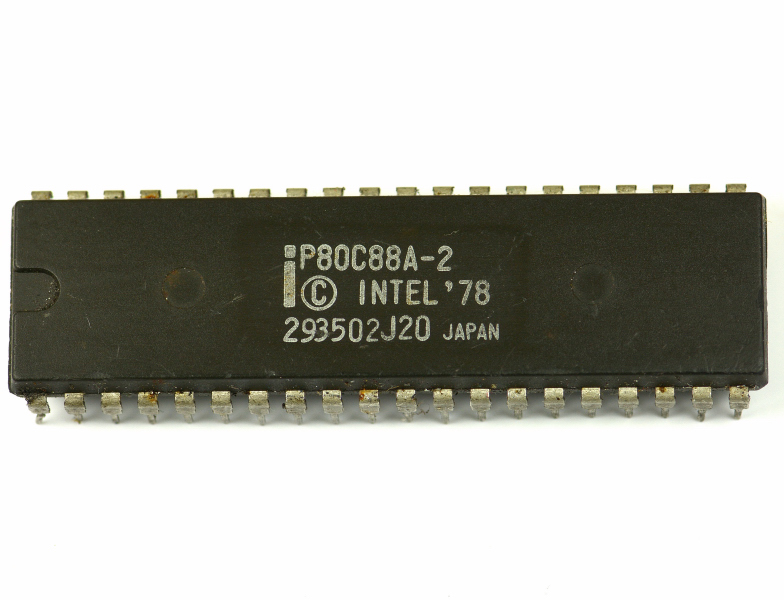
L'Intel 80C88 succede all'8088 e viene immesso sul mercato nel 1978, implementato in N-channel con tecnologia CMOS SAJI IV in versione ceramica e plastica in DIP 40 CERDIP, lavorava a 16 bit ed era compatibile con l'8080 e l'8085 sia per quanto riguardava l'hardware che per il software.
Caratteristiche della serie 8088 :
8-Bit Data Bus Interface
16-Bit Internal Architecture
Direct Addressing Capability to 1 Mbyte of Memory
Direct Software Compatibility with 8086 CPU
14-Word by 16-Bit Register Set with Symmetrical Operations
24 Operand Addressing Modes
Byte, Word, and Block Operations
8-Bit and 16-Bit Signed and Unsigned Arithmetic in Binary or Decimal, Including Multiply and Divide
Two Clock Rates: 5 MHz for 80C88 and 8 MHz for 80C88-2
Available in EXPRESS
Standard Temperature Range
Extended Temperature Range