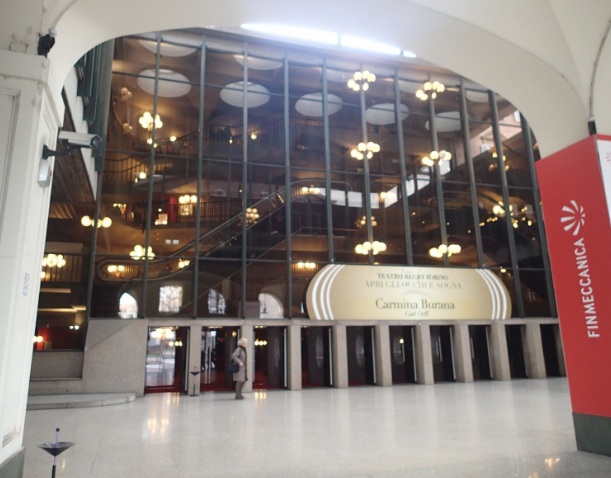
Teatro Regio, Turin
The Teatro Regio is Turin’s principal opera house and one of Italy’s most important musical institutions. Located in Piazza Castello, in the historic heart of the city, it presents seasons of opera, ballet and symphonic concerts, together with educational activities and performances for families.
Its history began in the eighteenth century, but the present building, designed mainly by Carlo Mollino after the destruction of the previous theatre, is one of the most original examples of twentieth-century Italian theatre architecture.

History
The first Teatro Regio was designed by architect Benedetto Alfieri at the request of Charles Emmanuel III of Savoy. It was built in only two years and inaugurated on 26 December 1740 with Francesco Feo’s opera Arsace.
The eighteenth-century auditorium could accommodate approximately 2,500 spectators, distributed among the stalls, five tiers of boxes and an upper gallery. The theatre was directly connected to the Royal Palace and included rooms reserved for the Savoy court.
During the nineteenth century, the Regio became one of Italy’s principal musical centres. One of the most important events in its history was the world premiere of Giacomo Puccini’s La bohème, conducted by Arturo Toscanini on 1 February 1896.
Between 1901 and 1905 the theatre was closed for major renovation work. The top two tiers of boxes were replaced by three galleries, increasing its capacity to approximately 3,000 and making the auditorium accessible to a broader public.
During the night of 8–9 February 1936, a violent fire that started beneath the stage almost completely destroyed the building. The façade facing Piazza Castello and a small number of historic areas were among the few surviving parts of the old theatre.
Reconstruction was delayed by the Second World War and by a lengthy debate over the different projects. The final commission was entrusted to Carlo Mollino and Marcello Zavelani Rossi, with the collaboration of Carlo Graffi and Adolfo Zavelani Rossi.
The new Teatro Regio was inaugurated on 10 April 1973 with Giuseppe Verdi’s I vespri siciliani, conducted by Gianandrea Gavazzeni and staged by Maria Callas and Giuseppe Di Stefano.
Exterior architecture
Facing Piazza Castello, the theatre retains its historic eighteenth-century façade, incorporated into the group of buildings surrounding the Royal Palace. This creates a striking contrast with Mollino’s modern structure, which is particularly visible from Piazzetta Carlo Mollino and Via Verdi.
The modern exterior is characterised by curved surfaces, exposed brickwork, large glazed areas and structures deliberately different from the straight lines of the surrounding historic buildings.
The new theatre therefore does not attempt to imitate its eighteenth-century predecessor. Instead, it creates a dialogue between historic Turin and twentieth-century architecture.
Auditorium and interior spaces
The main auditorium has a total capacity of 1,582 seats. Most are located in the large sloping stalls area, which contains 1,392 seats, while the remaining places are distributed among a ring of 31 boxes.
The plan of the auditorium recalls the shape of a shell or oyster. Its curved surfaces, wooden finishes and distinctive lighting create an enveloping environment, very different from the vertical arrangement of traditional Italian-style theatres.
The foyer extends across four levels and covers approximately 3,700 square metres. Its most recognisable spaces include:
- the Foyer del Toro, featuring a large marble mosaic with the symbol of Turin;
- the Sala del Caminetto, which preserves a small fireplace from the old theatre;
- the broad curved staircases and walkways designed to guide the audience gradually towards the auditorium;
- the Piccolo Regio Puccini, used for performances, meetings, concerts and educational activities.
The interiors are among the most personal expressions of Carlo Mollino’s style, in which architecture, furniture, lighting and audience circulation were conceived as parts of a single experience.
Stage and technical characteristics
The Teatro Regio has a large and technologically complex stage suitable for operas, ballets and productions involving substantial scenery.
Its technical systems permit scene changes, vertical and lateral movement and the simultaneous management of different sets. These features allow the theatre to alternate productions even within a relatively short period.
The Regio also has workshops devoted to constructing and maintaining scenery, costumes and stage properties. A significant proportion of its productions can therefore be created directly by the theatre’s own technical departments and craftspeople.
Cultural importance
The Teatro Regio has hosted world premieres and internationally distinguished conductors, singers and directors. Its association with Arturo Toscanini and the world premiere of La bohème occupies a particularly important place in its history.
Today the theatre maintains its own orchestra and chorus, as well as numerous artistic and technical departments. It also works with singers, conductors, directors, designers and ballet companies from many countries.
Its activities are not limited to evening performances. They include educational initiatives, guided tours, introductory talks, school projects and programmes for young people and families.
Programme
The programme mainly includes:
- Italian and international operas;
- new productions and revivals;
- classical and contemporary ballets;
- symphonic and choral concerts;
- recitals and chamber-music events;
- performances for children and families;
- educational activities for schools and students;
- guided tours and backstage itineraries.
Operas are normally presented with surtitles. Productions in foreign languages generally include Italian and original-language surtitles, while Italian operas may be accompanied by Italian and English surtitles.
Audience experience
Entering the Teatro Regio provides an opportunity not only to attend a performance, but also to experience one of Carlo Mollino’s most significant architectural works. The route through the foyers, curved staircases and auditorium is an important part of the visit.
The sloping stalls generally provide a good view of the stage. Some lateral seats in the stalls or boxes may, however, offer only a partial view and are normally identified as restricted-view seats.
For operas with large sets, a central position makes it easier to appreciate the overall visual composition. Seats closer to the stage provide a better view of the singers, costumes and acting details.
Visitors should arrive in good time. Once a performance has begun, admission to the auditorium may only be permitted during the intervals.
Accessibility
The theatre provides a step-free route and priority entrance for visitors with reduced mobility. The main auditorium has six wheelchair spaces, while the Piccolo Regio Puccini has two.
Ticket concessions are available for visitors with reduced mobility and, in certain circumstances, their companions. Contacting the box office in advance is advisable to confirm availability, seat location and access arrangements.
The theatre staff can provide assistance at the entrance and when moving through the accessible areas.
Location and transport
Address: Piazza Castello 215, 10124 Turin, Italy.
The theatre is located in the city centre, next to the Royal Palace and within walking distance of Via Roma, Via Po and the Mole Antonelliana.
The nearest public-transport stops include:
- Castello: lines 13, 15, 55 and 56;
- Garibaldi: lines 4, 11, 27, 51, 57 and Star 2.
From Porta Nuova and Porta Susa railway stations, the theatre can be reached by taxi in approximately ten minutes or on foot in around twenty minutes.
Several paid underground car parks are available nearby, including those at Piazza Castello, Santo Stefano, Piazza Vittorio Veneto and Valdo Fusi. Drivers should take account of the restrictions applying to Turin’s central limited-traffic zone.
Tickets and useful information
Tickets can be purchased from the theatre’s box office or online through its official sales channels. Vivaticket is identified by the Teatro Regio as its authorised ticket retailer.
Box office: Piazza Castello 215, Turin
Telephone: +39 011 8815 241 / 242
Official website: www.teatroregio.torino.it
Opening hours, prices, concessions and sales conditions may change from season to season. Visitors should therefore check the latest information on the official website.
Online purchases may be subject to additional booking fees. Programmes may also be modified for artistic, technical or organisational reasons.
Pros and cons
Pros
- Major historical and musical importance: it is one of Italy’s leading opera houses.
- Unique architecture: Carlo Mollino’s interiors are an attraction in their own right.
- Central location: the theatre stands in the historic heart of Turin.
- High-quality programme: it presents operas, ballets and concerts featuring international artists and productions.
- Permanent orchestra and chorus: they provide artistic continuity and a strong musical identity.
- Good views from most of the stalls: the sloping arrangement helps improve sightlines.
- Surtitles: these make foreign-language operas and complex librettos easier to understand.
- Activities for young people, schools and families: these introduce new audiences to opera.
- Guided tours: visitors can discover the building, its architecture and the operation of the theatre.
- Accessible route: step-free access and designated wheelchair spaces are available.
Cons
- Variable and sometimes high prices: the best seats and most important productions can be expensive.
- Online booking fees: these may increase the overall ticket price.
- Restricted views from certain seats: lateral stalls positions and some boxes may provide a partial view.
- Parking is not always easy: the central location and limited-traffic zone can create difficulties for drivers.
- Restricted late admission: latecomers may have to wait until the interval.
- Length of performances: some operas can last more than three hours, including intervals.
- Limited availability for popular productions: the best sectors can sell out quickly.
Overall assessment
The Teatro Regio is one of Turin’s most important cultural landmarks and one of Italy’s principal opera institutions. Its identity brings together two different periods: the tradition of Benedetto Alfieri’s eighteenth-century theatre and the visionary modernity of Carlo Mollino’s building.
The quality of its programme, its permanent orchestra and chorus, its technically sophisticated stage and its original interiors make the Regio highly recommended both for opera enthusiasts and for visitors interested in major twentieth-century architecture.
Seat selection requires some attention, particularly in the lateral sectors, and reaching the theatre by car can be less convenient than using public transport. Overall, however, attending a performance at the Regio is one of the most distinctive and prestigious cultural experiences offered by Turin.
Mini-glossary
Stalls: the main seating area located in front of the stage.
Box: a separate, usually elevated seating compartment positioned around the auditorium.
Upper gallery: the highest seating area in a traditional theatre, generally offering less expensive tickets.
Surtitles: a translation or transcription of the sung text projected above or close to the stage.
World premiere: the first public performance of a work anywhere in the world.
Foyer: an interior area where the audience gathers before the performance and during intervals.
Orchestra pit: the lowered area between the stalls and the stage where the orchestra performs.
Production: the combined direction, scenery, costumes, lighting and technical solutions used to present a performance.



 Teatro Regio