



Butter: properties, uses, pros, cons, safety
Definition
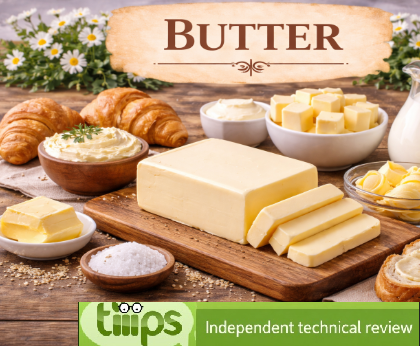
Butter is a dairy product obtained from the fat phase of cow’s milk (Bos taurus, family Bovidae) via cream separation followed by churning. It is a predominantly lipid matrix (milk fat) with a smaller proportion of water and non-fat solids. Commercially, the main distinction is between sweet cream butter (from non-fermented or minimally ripened cream) and butter from ripened/fermented cream, with differences in flavour profile. It is a key ingredient for plasticity, flavour and performance in cooking and bakery.
Production process
The typical process includes: separation of cream from milk, optional pasteurisation, then ripening (optional controlled fermentation to develop flavour, if required). The cream is then churned to separate butter granules from buttermilk. This is followed by washing, working (to distribute water uniformly), forming and packaging in light- and oxygen-barrier materials. Key controls include fat content, moisture, microbiological quality, acidity and oxidative stability.
Key constituents
The matrix is mainly milk triglycerides with a complex fatty acid profile. It contains a relevant share of SFA (saturated fatty acids), together with MUFA (monounsaturated fatty acids) and smaller amounts of PUFA (polyunsaturated fatty acids). Small amounts of phospholipids and unsaponifiable components are present (including fat-soluble vitamins: vitamin A and, to a variable extent, vitamins D and E). The aqueous phase contains trace amounts of proteins and lactose, generally low in butter but not zero.
Identification data and specifications
| Parameter | Value | Note |
|---|---|---|
| Ingredient name | Butter | Sweet cream or ripened-cream butter |
| Origin | Cow’s milk (Bos taurus) | Dairy product |
| Source/derivation | Cream → butter | Churning and working |
| Nature | Water-in-oil emulsion (W/O) | Continuous fat phase |
| Key parameters | % fat, moisture, acidity, peroxide value, sensory profile, microbiological load | Quality and shelf-life drivers |
| Allergen | Yes: milk | Contains milk-derived components |
| Caloric value | Typically ~700–760 kcal/100 g | Depends on water and composition |
Physico-chemical properties (indicative)
| Property | Indicative value | Note |
|---|---|---|
| Physical state | Solid/semi-solid | Plasticity depends on temperature |
| Colour | White → yellow | Depends on diet/seasonality |
| Odour | Dairy, buttery | Rancid notes indicate oxidation |
| Water solubility | Insoluble | W/O emulsion |
| Melting range | Indicatively ~28–35 °C | Gradual melt, depends on fat profile |
| Stability | Good if refrigerated and protected | Key risks: rancidity, odour uptake |
| Typical criticalities | Oxidation, water separation, sensory defects | Driven by light, oxygen and cold chain |
Main uses
Food
Used as a spread, for sautéing and cooking, in sauces and emulsions (clarified butter / finishing with butter), for finishing risotto and pasta, and in pastry and bakery (shortcrust, cakes, brioche, laminated doughs). In lamination, butter plasticity and melting behaviour influence layering and friability.
Industrial use
Used in bakery, creams, fillings, ready meals and sauces. Industrial drivers include consistent plasticity, sensory quality and oxidation control.
Nutrition and health
Butter is energy-dense and composed mainly of fat. The share of SFA is significant; MUFA and small amounts of PUFA are also present. In a balanced diet, portion size and consumption frequency are key, together with the overall saturated-fat balance in the diet.
Pros
It has high palatability and provides a characteristic flavour profile. It offers baking performance that can be difficult to replicate with other fats and provides fat-soluble vitamins at variable levels.
Cons
It is calorie-rich and high in SFA; uncontrolled use can rapidly increase energy and saturated-fat intake. It is an allergen (milk).
Serving note
Practical portions are often small (spread amounts or recipe inclusion), but energy density is high. For impact assessment, consider actual grams used and total daily saturated fat intake.
Safety (allergens, contraindications)
Allergen: milk. For those with cow’s milk protein allergy, or severe lactose intolerance (even though lactose is generally low in butter), individual tolerance and product specification should be considered. Food safety depends on maintaining the cold chain, appropriate packaging and process hygiene. Typical defects include oxidative rancidity and odour uptake.
Storage and shelf-life
Store refrigerated, tightly closed and protected from light and odours. Butter readily absorbs external aromas. Freezing is possible to extend shelf-life, with attention to oxidation protection and freezer burn.
Labelling
On-pack, declare “butter” and highlight the allergen milk. In composite products, butter affects saturated fat content and energy value in the nutrition declaration.
Functional role and rationale for use
Butter acts as a fat phase with the characteristic plasticity, crystalline structure and flavour of milk fat. In bakery, fat crystal structure influences lamination and friability; in sauces and emulsions it contributes gloss and sensory roundness.
Formulation compatibility
In fine pastry, temperature and handling must be controlled to maintain plasticity (especially for laminated doughs). In emulsions and sauces, aqueous-phase and emulsion management influence stability; in sweet products, choosing sweet cream vs ripened-cream butter changes the flavour profile.
Safety, regulatory and quality
Application of GMP/HACCP across the milk-to-butter chain supports hygiene, traceability and microbiological control. Quality control focuses on acidity, peroxide value (oxidation) and sensory profile, as well as compliance with composition specifications.
Conclusion
Butter is a core dairy fat valued for flavour and technological performance in cooking and bakery. Key drivers are raw material quality, oxidation control, cold-chain management and plasticity consistency. From a nutrition perspective, the critical point is high energy density and the share of SFA, best managed through appropriate portions.
Mini-glossary
SFA: saturated fatty acids; excessive intake may be less favourable than unsaturated fats in the context of an overall diet.
MUFA: monounsaturated fatty acids; often considered more favourable when replacing part of SFA.
PUFA: polyunsaturated fatty acids; include omega-6 and omega-3 families with potential benefits when balanced.
W/O emulsion: water-in-oil emulsion with a continuous fat phase (typical of butter).
Peroxide value: indicator of primary lipid oxidation, used to monitor freshness and stability.
GMP/HACCP: good manufacturing practices (GMP) and the hazard analysis and critical control points (HACCP) system for safety and contamination prevention.
In the scientific field it is now established that the consumption of butter can bring serious risks in the cardiovascular system. This study summarizing the general lines was carried out on 23,000 subjects for 8 years (1) and another in-depth study of 33,000 subjects found a positive association between butter and the risk of myocardial infarction (2) and obesity.
Butter is also a potential factor of arterial stiffness that preludes to cardiovascular diseases while the consumption of dairy products has not been harmful for arterial stiffness (3).
These data also apply to salted butter on which the content of sodium chloride weighs, which already creates cardiovascular problems alone.
Basically, therefore, with butter we have to be careful and, if we really like it, taste it from time to time, but don't make it a constant and regular consumption. Of course this rule applies to all foods at risk.
It is also considered a risk element related to prostate cancer (4).
A correlation between butter consumption and Alzheimer's disease has also been established (5).

