



Hydrolyzed Sweet Almond Protein: properties, uses, pros, cons, and safety
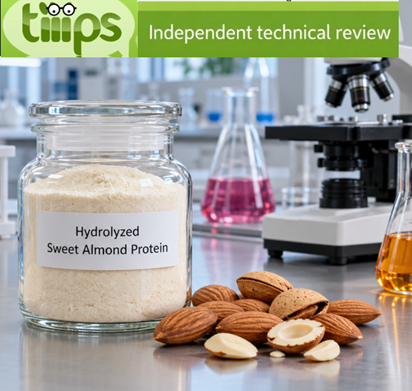
Hydrolyzed Sweet Almond Protein is a hydrolysate of sweet almond proteins, obtained from the protein fraction of Prunus dulcis through enzymatic, acid, or other controlled hydrolysis processes.
The treatment breaks down the original proteins into smaller peptides and amino acids, making the material more readily dispersible in water and more suitable for use in cosmetic formulations.
It is mainly used in hair and skin products, where it contributes to conditioning, reduction of static electricity, and improvement of the sensory characteristics of the treated surface.
No specific Cosmetics Regulation provisions have been identified in Annexes II–VI of the European Cosmetics Regulation.
Description
Hydrolyzed Sweet Almond Protein belongs to the family of hydrolyzed plant proteins.
The starting material consists of the protein fraction of sweet almond. Hydrolysis breaks some of the peptide bonds of the original proteins, producing a mixture consisting mainly of:
peptides;
oligopeptides;
amino acids;
possible minor components originating from the raw material or production process.
The degree of hydrolysis determines the size of the resulting peptides and can influence:
solubility;
deposition on skin and hair;
film-forming behaviour;
formulation compatibility;
sensory properties;
residual allergenic potential.
It is therefore not a single chemically defined molecule but a complex mixture of peptide fractions.
It should not be confused with:
Prunus Amygdalus Dulcis Oil, which consists mainly of the lipid fraction of almond;
Hydrolyzed Sweet Almond Seedcake, obtained instead by hydrolysis of the press cake remaining after seed processing;
non-hydrolyzed almond extracts;
hydrolyzed plant proteins derived from wheat, soy, rice, pea, or other botanical sources.
The term “hydrolyzed” indicates that the original protein has undergone a process that reduces its molecular size, but does not necessarily mean that every allergenic peptide has been completely eliminated.
Production process
Production may start from sweet almonds or from a protein fraction obtained during processing of the raw material.
A typical process may include:
selection and preparation of the raw material;
grinding or processing of the seeds;
partial separation of the lipid fraction;
extraction or concentration of the protein component;
dispersion of the protein in water;
controlled hydrolysis;
enzyme inactivation or neutralisation, when necessary;
filtration;
concentration;
standardisation;
preservation as an aqueous solution or possible drying.
Hydrolysis may be:
enzymatic, using proteases;
acidic;
alkaline;
carried out through other processes capable of controlled protein cleavage.
Enzymatic hydrolysis is particularly useful because it allows better control over the degree of protein fragmentation while limiting the need for highly aggressive processing conditions.
Temperature, pH, enzyme type, and duration of hydrolysis determine the final distribution of peptide sizes.
After hydrolysis, the material may be filtered and concentrated to obtain a liquid cosmetic ingredient containing a defined percentage of active material.
Some commercial grades are supplied as aqueous solutions and may contain preservatives.
Typical composition
Hydrolyzed Sweet Almond Protein consists mainly of fractions derived from almond proteins that have undergone hydrolysis.
The mixture may contain:
peptides of different sizes;
oligopeptides;
free amino acids;
water;
mineral salts;
traces of carbohydrates;
possible residual lipids;
preservatives in aqueous commercial products.
There is no universal percentage composition applicable to all commercial products.
The actual content of hydrolyzed protein may vary considerably among suppliers, since some raw materials are marketed already diluted in water.
The distribution of peptide sizes also depends on the manufacturing process.
Identification data and specifications
| Characteristic | Value | Note |
|---|---|---|
| INCI name | Hydrolyzed Sweet Almond Protein | cosmetic nomenclature |
| Definition | hydrolysate of sweet almond proteins | mixture of peptides and amino acids |
| Origin | plant-derived | Prunus dulcis / sweet almond |
| Chemical category | hydrolyzed plant protein | peptide mixture |
| Molecular formula | not applicable | mixture of different peptides |
| Molecular weight | variable | one material evaluated by the CIR had an average molecular weight of approximately 3,000 Da; some commercial grades are around 2,500 Da |
| CAS associated with the cosmetic entry | 235433-31-5 | identifier reported in CosIng-related data |
| Other CAS used in literature and by some suppliers | 100209-19-6 | also associated with “Almond, ext., hydrolyzed” |
| EC | not uniquely assigned to the cosmetic entry | 309-327-6 is associated with CAS 100209-19-6 |
| CosIng reference | 76678 | cosmetic reference |
| Cosmetic functions | Antistatic; Hair Conditioning; Skin Conditioning | documented functions |
| Current EU glossary | entry 13112 | HYDROLYZED SWEET ALMOND PROTEIN |
| Cosmetics Regulation provisions | no specific provisions identified | no specific entry in Annexes II–VI |
Different identifiers may be encountered because hydrolyzed proteins are complex materials and different classification systems or commercial grades may have been associated with different identifiers.
For this reason, when assessing a specific raw material, the identifiers stated in the manufacturer's SDS and Certificate of Analysis should always be considered.
Indicative physicochemical properties
| Characteristic | Indicative value | Note |
|---|---|---|
| Commercial form | aqueous solution or concentrated material | depends on grade |
| Appearance | clear or slightly cloudy liquid | varies according to concentration |
| Colour | yellow-amber to light brown | depends on processing |
| Odour | characteristic, generally mild | raw-material dependent |
| Affinity with water | high | promoted by hydrolysis |
| Main component | water-soluble peptides | variable distribution |
| Commercial pH | grade-dependent | some products are mildly acidic |
| Thermal stability | formulation-dependent | high temperatures may alter proteins |
| Compatibility | generally good in aqueous systems | compatibility with electrolytes, surfactants, and preservatives should be verified |
| Dry matter | highly variable | depends on commercial dilution |
One commercial example of hydrolyzed sweet almond protein has a pH of approximately 4–5 and is supplied as an aqueous solution.
Some suppliers recommend adding the ingredient to the aqueous phase at moderate temperature and avoiding prolonged exposure to high temperatures.
These values should not be regarded as universal specifications for the INCI ingredient.
Cosmetics
Hydrolyzed Sweet Almond Protein may be used in:
shampoos;
conditioners;
hair masks;
leave-in products;
detangling sprays;
anti-frizz treatments;
products for dry or damaged hair;
volumising products;
mild cleansers;
creams;
emulsions;
lotions;
moisturising products;
after-sun products;
hand and body products.
Peptide fractions have affinity for keratin-rich surfaces and may temporarily deposit on the hair fibre.
On hair, this can contribute to:
improved combability;
reduced static electricity;
increased perception of softness;
improved slip;
temporary reduction in the sensation of roughness;
improved surface appearance of the fibre.
On skin, peptides can contribute to surface conditioning and a softer feel.
The effect is primarily cosmetic and superficial and should not be interpreted as permanent reconstruction of the protein structures of the skin or hair.
Action on the hair fibre
The surface of damaged hair often shows:
irregular cuticles;
increased porosity;
increased friction;
greater tendency to develop electrostatic charge.
Hydrolyzed peptides may interact with the hair surface through different physicochemical interactions.
Smaller fractions may more readily reach irregular areas of the surface, while larger fractions tend to remain deposited mainly on the exterior.
This may temporarily reduce friction and improve tactile properties.
However, this does not mean that hydrolyzed proteins can biologically “rebuild” damaged hair.
The external hair shaft consists of non-living keratinised tissue, and the cosmetic effect therefore consists mainly of surface conditioning.
Degree of hydrolysis and peptide size
The degree of hydrolysis is an important parameter.
More extensive hydrolysis generally produces smaller peptides.
This can modify:
water solubility;
viscosity;
deposition capacity;
formulation compatibility;
substantivity on hair;
interaction with skin;
sensory properties;
residual allergenicity.
Hydrolyzed proteins do not normally have a single molecular size but rather a distribution of peptide sizes.
For this reason, two raw materials carrying the same INCI name may behave differently when produced using different hydrolysis processes.
Hydrolyzed Sweet Almond Protein and sweet almond oil
The two ingredients originate from the same botanical source but are chemically very different.
Hydrolyzed Sweet Almond Protein derives from the protein fraction.
Prunus Amygdalus Dulcis Oil, by contrast, derives from the lipid fraction and consists mainly of triglycerides and fatty acids.
They therefore differ in:
composition;
solubility;
formulation behaviour;
cosmetic function;
interaction with skin and hair.
The presence of sweet almond oil in a formulation is therefore not equivalent to the presence of hydrolyzed almond proteins.
This distinction is particularly important when assessing potential allergenic risk.
Pros
Plant-derived origin.
Improves hair conditioning.
Reduces static electricity.
May improve combability and softness.
Easily incorporated into many aqueous systems.
Can be used in both rinse-off and leave-on products.
Peptide size can be modulated through the hydrolysis process.
Available studies have not indicated mutagenic activity.
Available skin-tolerance tests have generally shown a favourable profile.
The CIR considers it safe in the practices of use and concentrations evaluated.
No specific restrictions have been identified in Annexes II–VI of the European Cosmetics Regulation.
Cons
It derives from almond, a protein source capable of causing IgE-mediated allergic reactions in sensitised individuals.
Hydrolysis does not necessarily guarantee complete removal of allergenic epitopes.
The CIR advises individuals with known allergy to tree-nut proteins to avoid personal-care products containing these ingredients.
In one animal study, a solution containing 2.3–3.3% of the ingredient was classified as a very mild sensitiser.
Mild ocular irritation was observed within the same concentration range in a rabbit study.
Characteristics may vary considerably between suppliers.
The INCI name does not specify the degree of hydrolysis or peptide-size distribution.
Commercial products may contain water, preservatives, and other components that require separate assessment.
Plant origin does not automatically mean absence of allergenicity or complete harmlessness.
Commercial claims relating to “repair” of the hair should be interpreted as superficial cosmetic effects rather than biological regeneration of the fibre.
Safety and tolerability
Hydrolyzed Sweet Almond Protein has been evaluated within the Cosmetic Ingredient Review assessment of plant-derived proteins and peptides.
The main aspects of interest include:
skin irritation;
eye irritation;
sensitisation;
allergy to almond proteins;
raw-material purity;
peptide-size distribution.
In a rabbit dermal-tolerance test using a raw material containing 2.3–3.3% Hydrolyzed Sweet Almond Protein, no significant skin irritation was observed.
An animal sensitisation study performed within the same concentration range indicated very mild sensitising potential.
Studies involving individuals exposed to different hydrolyzed proteins used in hair-care products did not report adverse reactions specifically attributed to Hydrolyzed Sweet Almond Protein.
These results do not, however, eliminate the possibility of immediate allergic reactions in individuals already sensitised to almond proteins.
In rabbit ocular tests, a preparation containing 2.3–3.3% of the ingredient was found to be very mildly irritating.
The irritation potential of the finished product nevertheless depends on:
concentration;
pH;
vehicle;
other ingredients;
conditions of use;
duration of contact.
Genotoxicity
Hydrolyzed Sweet Almond Protein has been evaluated using the Ames test.
A preparation containing 2.3–3.3% of the ingredient showed no:
mutagenic activity;
pro-mutagenic activity.
The available data therefore do not indicate a particular genotoxic concern for the ingredient under the conditions tested.
However, extensive toxicological programmes covering every possible endpoint are not available for this specific ingredient.
The CIR safety assessment considers the overall available data on hydrolyzed plant proteins, cosmetic exposure, and the chemical characteristics of the ingredients.
Almond allergy and type I hypersensitivity
This is the aspect requiring the greatest attention.
Almonds are among the foods capable of causing immediate IgE-mediated allergic reactions in sensitised individuals.
Hydrolysis reduces protein size, but its effect on allergenicity depends on the degree of fragmentation.
Some peptide fragments may retain structures that are recognised by IgE antibodies.
It is therefore not scientifically correct to assume that a hydrolyzed protein is automatically free from allergenic potential.
The CIR has specifically noted that immediate hypersensitivity reactions may occur with protein-derived ingredients in sensitised individuals and recommends that people with known allergy to tree-nut proteins avoid personal-care products containing these ingredients.
Particular caution is appropriate in:
leave-on products;
facial products;
products applied to compromised skin;
aerosol or spray products;
products that may result in accidental inhalation exposure.
The absence of regulated fragrance allergens should not be confused with the absence of allergenic almond proteins: these are entirely different phenomena.
CIR assessment
The Expert Panel for Cosmetic Ingredient Safety evaluated Hydrolyzed Sweet Almond Protein together with other plant-derived proteins and peptides.
The Panel concluded that Hydrolyzed Sweet Almond Protein is:
safe in the present practices of use and concentration described in the safety assessment.
In the use data considered by the CIR, the ingredient was reported in numerous cosmetic products, including both leave-on and rinse-off preparations.
Reported concentrations in finished cosmetic products were generally low, with maximum values in the region of 0.063% in the data considered in the assessment.
This value is not a regulatory limit and should not be interpreted as a mandatory maximum concentration.
Commercial raw materials may be used at higher percentages when they consist of diluted solutions containing only a fraction of active hydrolyzed protein.
The assessment should therefore distinguish between:
percentage of commercial raw material added to the formulation;
actual percentage of Hydrolyzed Sweet Almond Protein;
dry-matter content;
peptide distribution.
EU cosmetic restrictions
No specific:
Cosmetics Regulation provisions
have been identified for Hydrolyzed Sweet Almond Protein in Annexes II–VI of Regulation (EC) No 1223/2009.
The ingredient is included in the current EU glossary under:
13112 – HYDROLYZED SWEET ALMOND PROTEIN
The currently applicable glossary is established by Commission Implementing Decision (EU) 2025/1175, applicable from 30 July 2026.
The absence of a specific restriction does not remove the requirement to assess the safety of the finished formulation.
Particular consideration should be given to:
actual concentration;
exposure;
conditions of use;
purity;
stability;
sensitisation;
possible exposure of individuals allergic to almonds.
Raw-material control
For a professional assessment, it is advisable to request:
updated SDS;
Certificate of Analysis (COA);
technical data sheet;
complete INCI designation;
CAS identifier used by the manufacturer;
botanical origin;
part of the plant used;
process used to obtain the protein fraction;
hydrolysis method;
degree of hydrolysis;
molecular-weight distribution of the peptides;
protein or peptide content;
total nitrogen;
dry matter;
water;
pH;
ash;
free amino acids, when available;
preservatives present;
residual processing reagents;
heavy metals;
pesticide residues;
aflatoxins, where relevant;
microbiological specifications;
colour;
odour;
solubility;
stability;
skin and eye irritation data;
sensitisation data;
specific information on the allergenic potential of residual proteins.
When comparing two suppliers, the INCI designation alone is not sufficient.
Particularly important parameters are:
actual hydrolyzed-protein content, degree of hydrolysis, peptide distribution, dry-matter content, preservative system, and control of residual allergenicity.
Environment
Hydrolyzed Sweet Almond Protein is derived from a plant-based raw material, and its principal components are peptides and amino acids.
These characteristics may favour biodegradation compared with particularly persistent synthetic materials, but specific environmental data are not sufficient to consider the ingredient automatically free from environmental impact.
Environmental assessment should consider:
origin of the almonds;
water consumption associated with cultivation;
land use;
energy used during processing;
extraction of the protein fraction;
hydrolysis process;
treatment of process water;
preservatives;
transport;
concentration of the raw material;
biodegradability of the complete commercial product.
The possibility of using protein fractions originating from by-products of almond-oil production may represent an opportunity for valorisation of residual biomass.
Plant origin, however, does not automatically imply environmental sustainability: the outcome depends on the specific supply chain and production process.
Conclusion
Hydrolyzed Sweet Almond Protein is a hydrolyzed plant protein obtained from sweet almond and composed of a mixture of peptides and amino acids.
It is used mainly in hair- and skin-care products to improve conditioning, combability, softness, and electrostatic behaviour.
Protein fragmentation facilitates its use in aqueous formulations, but composition and performance may vary considerably depending on the degree of hydrolysis and the commercial grade used.
The CIR considers the ingredient safe in the practices of use and concentrations evaluated, and no specific Cosmetics Regulation provisions have been identified in the European Union.
The most important aspect not to overlook is the potential allergenicity in individuals sensitised to almond and tree-nut proteins. Hydrolysis may reduce protein size but does not necessarily guarantee complete elimination of allergenic epitopes.
Hydrolyzed Sweet Almond Protein can therefore be considered a conditioning ingredient with a favourable safety profile in appropriately formulated cosmetic products, with particular attention to degree of hydrolysis, peptide distribution, actual concentration, purity, ocular irritation, sensitisation, and risk for individuals with known almond allergy.

