



Creatine: properties, uses, pros, cons, safety
Creatine is a nitrogen-containing organic compound naturally present in the human body and in foods of animal origin, particularly meat and fish. In the body, it participates in the creatine–phosphocreatine system, which contributes to the rapid regeneration of ATP in tissues with high energy demands.
In cosmetics, its documented function is Skin Conditioning. Its dermatological interest is mainly related to its role in cellular energy metabolism and to experimental and clinical studies evaluating its topical application to the skin.
No specific Cosmetics Regulation provisions are identified under Annexes II–VI of the EU Cosmetics Regulation.
Description
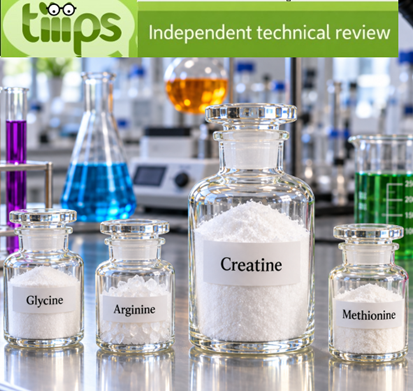
Creatine is a glycine derivative containing a guanidino group. In the human body, it is synthesized mainly from:
glycine;
arginine;
methionine.
Once inside cells, it can be phosphorylated by creatine kinase to form phosphocreatine. The creatine/phosphocreatine system functions as a rapidly available energy reserve for ATP regeneration.
This system is particularly important in muscle, but creatine kinases and creatine transporters are also present in human skin.
Cosmetic Creatine should be distinguished from:
Creatine Monohydrate, the hydrated form widely used in dietary supplements;
Creatinine, a cyclic metabolic and degradation product;
Creatine Phosphate;
other creatine salts and derivatives.
Manufacturing process
Industrial creatine is generally produced by chemical synthesis rather than extraction from animal tissues.
One of the principal manufacturing routes involves reaction between:
sodium or potassium sarcosinate;
cyanamide.
The reaction is carried out under controlled pH and temperature conditions and is followed by:
crystallization;
separation;
washing;
recrystallization;
filtration;
drying;
purity control.
Depending on the production process, possible impurities may include:
creatinine;
dicyandiamide;
dihydrotriazine derivatives;
residual starting materials.
Alternative production routes may produce different impurity profiles.
Synthetic origin does not make the substance biologically different from naturally occurring creatine when the final material is chemically identical and adequately purified.
Identification data and specifications
| Characteristic | Value | Note |
|---|---|---|
| INCI name | Creatine | cosmetic ingredient name |
| Common name | Creatine | naturally occurring nitrogen-containing compound |
| Chemical name | N-(Aminoiminomethyl)-N-methylglycine | glycine derivative |
| Synonyms | N-Amidinosarcosine; Methylguanidoacetic Acid | chemical names |
| Chemical category | guanidino derivative of glycine | small polar molecule |
| Molecular formula | C₄H₉N₃O₂ | anhydrous creatine |
| Molecular weight | 131.13 g/mol | anhydrous form |
| CAS | 57-00-1 | anhydrous creatine |
| EC | 200-306-6 | European identifier |
| PubChem CID | 586 | chemical identifier |
| CosIng reference | 55520 | cosmetic ingredient reference |
| Cosmetic function | Skin Conditioning | documented function |
| Cosmetics Regulation provisions | no specific provision identified | no specific Annex II–VI provision |
CAS 6020-87-7 refers to Creatine Monohydrate and should not automatically be used for the anhydrous form.
Indicative physicochemical properties
| Characteristic | Indicative value | Note |
|---|---|---|
| Physical state | crystalline solid | at room temperature |
| Appearance | white powder/crystals | purified grade |
| Odor | practically odorless | characteristic |
| Water solubility | approximately 13.3 g/L at 18 °C | moderate |
| Solubility in ethanol | very low | highly polar substance |
| Density | approximately 1.33 g/cm³ | indicative value |
| Ionic behavior | predominantly zwitterionic | under physiological conditions |
| Volatility | negligible | practically non-volatile |
| Stability in dry form | high | when properly stored |
| Stability in solution | lower | affected by pH, temperature, and time |
| Thermal behavior | decomposes at elevated temperature | does not undergo ordinary boiling |
Cosmetics
Creatine may be used in:
facial creams;
serums;
anti-aging products;
firming products;
eye-area creams;
after-sun products;
body-care formulations;
shampoos;
scalp lotions;
hair-care products.
Its cosmetic interest is supported by the presence of the creatine kinase system in skin cells and by evidence that topically applied creatine can become available to cutaneous cells.
Cellular energy metabolism and oxidative stress
Studies on keratinocytes and epidermal systems have indicated that creatine can:
support the creatine kinase system;
contribute to mitochondrial function;
help maintain cellular energy availability;
reduce some consequences of oxidative stress;
increase cellular resistance to experimentally induced UV-related damage.
These findings provide a plausible rationale for its use in cosmetics designed for skin exposed to environmental stress.
Creatine is not a UV filter and cannot replace an authorized sunscreen ingredient.
Collagen, wrinkles and firmness
Topical research has also investigated effects related to skin structure and aging.
In dermal fibroblast models, creatine has been associated with increased collagen-related activity and procollagen synthesis.
In a study involving 43 men, a formulation containing creatine, guarana, and glycerol, applied for six weeks, produced improvements in parameters including:
cheek sagging;
crow's feet;
under-eye wrinkles.
Other studies using formulations containing creatine and folic acid have reported improvements in skin firmness and parameters related to collagen metabolism.
These results are encouraging, but many of the formulations were multicomponent systems, so the entire clinical effect cannot be quantitatively attributed to creatine alone.
Overall, however, the topical evidence is more substantial than for many cosmetic ingredients whose anti-aging positioning relies exclusively on in vitro results.
Hair
Creatine is also used in hair and scalp products.
Multicomponent formulations containing creatine have been investigated in relation to hair loss, but such studies generally do not allow the specific contribution of creatine to be isolated.
A long-standing hypothesis suggested that oral creatine supplementation might increase DHT and thereby promote hair loss.
A randomized controlled study published in 2025 using 5 g/day of creatine monohydrate for 12 weeks found no significant differences from placebo in:
DHT;
DHT/testosterone ratio;
hair density;
follicular unit count;
overall hair thickness.
Current evidence therefore does not support the claim that creatine itself causes hair loss.
Food and dietary supplements
Creatine occurs naturally mainly in:
meat;
fish;
other animal tissues.
In dietary supplements, the most widely studied form is Creatine Monohydrate.
In the European Union, specific health claims are authorized.
For adults performing high-intensity exercise, the authorized claim states:
“Creatine increases physical performance in successive bursts of short-term, high-intensity exercise.”
The beneficial effect is obtained with a daily intake of 3 g of creatine.
For adults over 55 years of age who regularly perform resistance exercise, an authorized claim also relates to improvement of the effect of resistance training on muscle strength, under defined exercise conditions and with 3 g/day.
By contrast, a 2024 EFSA assessment concluded that a sufficient cause-and-effect relationship had not been established between creatine supplementation and a general improvement in cognitive function. Creatine should therefore not be presented in the EU as having a broadly authorized cognitive benefit.
Pros
It is a physiological substance naturally present in the human body.
The creatine/phosphocreatine mechanism is well characterized.
Specific topical skin data are available.
Cellular studies support effects on energy metabolism and oxidative stress.
Clinical studies exist on cosmetic formulations containing creatine.
It is compatible with aqueous formulations within its solubility limits.
It has low volatility and low bioaccumulation potential.
Synthetic manufacture allows a high degree of standardization and purity.
Cons
Stability in solution is lower than in the dry state.
Unfavorable pH, temperature, and storage conditions can promote formation of creatinine.
Water solubility is limited compared with some other small hydrophilic ingredients.
Many cosmetic studies use creatine together with other active ingredients.
Anti-aging and collagen claims should remain proportional to the available evidence.
It is not a sunscreen filter.
Raw-material quality depends strongly on control of synthesis-related impurities.
Safety and regulation
The general safety profile of creatine is well characterized because of its physiological presence and extensive nutritional use.
No specific SCCS or CIR assessment dedicated exclusively to cosmetic Creatine has been identified that establishes a universal maximum concentration.
Nevertheless, there are no major indications that properly purified and correctly formulated creatine presents a particular cosmetic safety concern at normal use levels.
Stability and creatinine formation
One of the principal technical issues is spontaneous conversion of creatine into creatinine through intramolecular cyclization.
Degradation is promoted especially by:
prolonged storage in solution;
certain acidic conditions;
elevated temperatures.
For liquid cosmetic formulations, long-term stability should therefore be tested rather than relying only on the initial creatine assay.
EU Cosmetics Regulation provisions
No specific:
Cosmetics Regulation provisions
are identified for Creatine under Annexes II–VI of Regulation (EC) No 1223/2009.
The usual safety assessment of the finished cosmetic product remains necessary.
Raw-material control
For professional evaluation, it is advisable to obtain:
updated SDS;
Certificate of Analysis (COA);
technical data sheet;
creatine assay;
confirmation of anhydrous or monohydrate form;
water content;
creatinine;
dicyandiamide;
dihydrotriazines;
thiourea where relevant to the manufacturing route;
residual sarcosine;
residual cyanamide;
metals;
pH;
microbiological specifications where relevant;
stability data;
storage conditions.
For liquid cosmetic products, it is also useful to measure the remaining creatine content after stability testing, because initially pure material may gradually degrade during the commercial life of the product.
Environment
Creatine is a small polar molecule naturally present in living organisms.
Its environmental characteristics include:
very low volatility;
low tendency to bioaccumulate;
high mobility in water;
potential biodegradation in biological systems and wastewater treatment.
The environmental profile of the commercial ingredient therefore depends mainly on the industrial synthesis and purification process, including:
energy consumption;
production of precursors;
reagent management;
treatment of process water;
control of by-products.
Conclusion
Creatine is a physiological compound involved in the cellular creatine–phosphocreatine energy system and is used in cosmetics as a Skin Conditioning ingredient.
Compared with many cosmetic ingredients marketed as cellular “energy boosters,” it has a well-defined biological rationale and topical studies showing interesting effects on cellular energy metabolism, oxidative stress and, in specific formulations, skin firmness and wrinkles.
No specific Cosmetics Regulation provisions are identified for the ingredient.
Creatine can be considered a generally favorable cosmetic ingredient with an interesting level of supporting evidence, with particular attention to purity, chemical form, creatinine and other synthesis impurities, solubility, pH, processing temperature, and stability in the finished product.

