



Glycerol esters of wood rosins: properties, uses, advantages, disadvantages, safety
Glycerol esters of wood rosins, also commonly referred to as glycerol esters of wood rosin (GEWR), are a food additive identified as E 445 in the European Union and Great Britain.
They consist of a complex mixture of glycerol esters of resin acids obtained from wood rosin. Their principal food-technological use is as an emulsion stabiliser and weighting agent, particularly in cloudy beverages containing citrus or other oil-soluble flavourings.
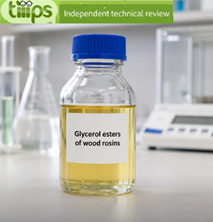
The additive increases the density of the oil phase so that very small flavour-oil droplets remain more evenly suspended in the aqueous beverage instead of rising to the surface and separating.
The UK Food Standards Agency currently lists “Glycerol esters of wood rosins – E 445” as an authorised food additive in England, Scotland and Wales.
Description
E 445 is not a single chemical molecule. It is a complex mixture formed primarily by esterifying glycerol with the resin acids present in wood rosin.
Wood rosin is obtained by solvent extraction of ground, aged pine stumps, followed by refining. This distinguishes it from:
gum rosin, obtained from oleoresin tapped from living pine trees;
tall oil rosin, obtained as a by-product of kraft pulp manufacture.
These materials are chemically related but are not identical, and the EU specification for E 445 specifically excludes products derived from gum rosin and tall oil rosin.
The refined wood rosin used as the starting material consists predominantly of resin acids, together with a smaller fraction of neutral, non-acidic substances.
The resin-acid fraction is composed mainly of isomeric diterpenoid monocarboxylic acids, with the typical empirical molecular formula:
C₂₀H₃₀O₂
One of the characteristic resin acids is abietic acid.
After reaction with glycerol, the resulting food additive contains primarily glycerol diesters and triesters of resin acids, together with smaller quantities of monoesters, residual free resin acids and neutral substances.
Botanical origin
The wood rosin used in the toxicological material assessed by EFSA was obtained from:
Pinus palustris – longleaf pine;
Pinus elliottii – slash pine.
Both belong to the Pinaceae family.
These species are particularly important from a safety-assessment perspective because EFSA's current ADI was established using GEWR manufactured from these two pine species.
EFSA concluded that the toxicological data were sufficient to establish an ADI for material derived from P. palustris and P. elliottii, but did not automatically extend that ADI to GEWR from other Pinus species because sufficiently detailed compositional equivalence data were unavailable.
Production process
Production begins with aged pine stumps containing residual resin.
The process generally includes:
recovery and preparation of resin-rich pine stump material;
grinding of the wood;
solvent extraction of wood rosin;
liquid-liquid solvent refining;
purification of the resin fraction;
reaction with glycerol;
esterification at elevated temperature;
formation mainly of glycerol diesters and triesters;
removal of volatile materials;
purification by steam stripping or countercurrent steam distillation;
cooling and solidification;
analytical verification of the final food-grade material.
The European specification explicitly states that the final additive is purified by steam stripping or countercurrent steam distillation.
The esterification step substantially changes the properties of the original resin acids. The resulting larger ester molecules have the physical characteristics needed to function as weighting agents in flavour-oil emulsions.
Main substances contained
Glycerol esters of wood rosins are a complex mixture, so there is no universal single molecular formula or molecular weight for E 445.
EFSA reviewed analytical data from five commercial production samples derived from P. palustris and P. elliottii. The average composition was approximately:
total glycerol esters: 84.3%;
glycerol diesters + triesters: 82.0%;
glycerol monoesters: 2.2%;
neutral substances: 13.2%;
free resin acids: 2.6%.
These values describe analysed commercial samples and should not be interpreted as an obligatory formulation for every production batch.
Glycerol esters
The predominant fraction consists of glycerol esterified with resin acids.
The mixture contains:
monoesters;
diesters;
triesters.
The diester and triester fractions predominate.
Resin acids
The resin acids originate naturally from pine wood rosin and include diterpenoid carboxylic acids such as abietic acid and structurally related compounds.
Neutral fraction
The neutral fraction can contain several types of non-acidic resin-derived substances, including diterpene alcohols, aldehydes, methyl esters and other saponifiable or unsaponifiable compounds.
EFSA therefore considers GEWR to contain three principal analytical fractions:
glycerol esters of resin acids;
free resin acids;
neutral substances.
Identification data and specifications
| Characteristic | Value | Note |
|---|---|---|
| Name | Glycerol esters of wood rosins | UK regulatory name |
| Alternative name | Glycerol esters of wood rosin | common EU/technical wording |
| Abbreviation | GEWR | widely used technical abbreviation |
| Synonym | Ester gum | technical name |
| EU/GB number | E 445 | food additive |
| Codex designation | INS 445(iii) | international identifier |
| CAS | 8050-30-4 | FDA substance inventory |
| Chemical nature | Complex mixture of glycerol esters of wood-roisin resin acids | not a single compound |
| Raw material | Wood rosin from aged pine stumps | solvent-extracted and refined |
| Typical resin-acid empirical formula | C₂₀H₃₀O₂ | characteristic resin-acid fraction |
| Molecular formula of E 445 | Not unique | complex mixture |
| Molecular weight | Not unique | depends on individual ester |
| Appearance | Hard yellow to pale-amber solid | EU specification |
| Water solubility | Insoluble | EU specification |
| Acetone solubility | Soluble | EU specification |
| Softening range | 82–90 °C | current EU specification |
| Acid value | 3–9 | current EU specification |
| Hydroxyl value | 15–45 | current EU specification |
| Gluten | Intrinsically absent | pure additive |
| Major regulated allergens | None intrinsic | supplier documentation still required |
The EU specification defines E 445 as a hard yellow to pale-amber solid, insoluble in water and soluble in acetone, with an acid value of 3–9 and hydroxyl value of 15–45.
The US FDA substance inventory identifies wood rosin, glycerol ester with CAS 8050-30-4 and recognises “glycerol ester of wood rosin” among its alternative names.
Technological properties
The most important use of GEWR is the stabilisation of oil-in-water flavour emulsions.
Flavour oils such as:
orange oil;
lemon oil;
lime oil;
grapefruit oil;
other citrus oils;
have a lower density than water.
If these oils are dispersed into a beverage without adequate stabilisation, the droplets tend to rise toward the surface.
This can result in:
separation of the flavour oil;
formation of an oily ring;
uneven cloudiness;
non-uniform flavour distribution;
reduced physical stability during shelf life.
E 445 is incorporated into the oil phase to increase its density.
By bringing the density of the flavour-oil droplets closer to that of the surrounding aqueous phase, their upward movement is reduced and the emulsion remains more stable.
For this reason the additive is commonly described as a weighting agent.
Stabiliser or emulsifier?
The terms are related but not identical.
An emulsifier primarily helps create and maintain an interface between two immiscible phases such as oil and water.
A weighting agent principally modifies the density of the dispersed oil phase so that gravitational separation occurs more slowly.
Glycerol esters of wood rosins therefore function particularly as an emulsion stabiliser through density adjustment.
In commercial flavour emulsions they may be used together with other ingredients such as:
gum arabic;
modified starches;
other emulsifiers;
hydrocolloid stabilisers.
E 445 does not necessarily form the entire emulsion system by itself.
Food use and safety evaluation
| Aspect | Evaluation |
|---|---|
| Principal technological function | Weighting agent / emulsion stabiliser |
| Cloudy flavoured beverages | Helps keep flavour oils uniformly suspended |
| Citrus oils | Increases oil-phase density |
| EU cloudy flavoured drinks | Maximum 100 mg/L |
| EU cloudy spirit drinks | Maximum 100 mg/L |
| EU flavoured cloudy alcoholic drinks below 15% alcohol | Maximum 100 mg/L |
| EU citrus-fruit surface treatment | Maximum 50 mg/kg |
| EU personalised/promotional hard-coated confectionery printing | Maximum 320 mg/kg |
| Great Britain | E 445 authorised in England, Scotland and Wales |
| USA beverage use | Up to 100 ppm in the finished beverage for density adjustment of citrus oils |
| EFSA ADI | 10 mg/kg body weight/day |
| EFSA ADI scope | GEWR from P. palustris and P. elliottii corresponding to tested material |
| Nutritional purpose | None |
| Gluten | Intrinsically absent |
| Major regulated allergen | None intrinsic |
In the EU, authorised uses include cloudy flavoured drinks at 100 mg/L, citrus-fruit surface treatment at 50 mg/kg, cloudy alcoholic beverage categories at 100 mg/L, and a specific confectionery-printing application at 320 mg/kg.
The UK Food Standards Agency currently lists E 445 Glycerol esters of wood rosins as authorised in England, Scotland and Wales, with conditions of use linked to the assimilated food-additives framework.
In the United States, 21 CFR §172.735 permits glycerol ester of wood rosin, gum rosin or tall oil rosin to adjust the density of citrus oils used in beverages, provided the additive does not exceed 100 ppm in the finished beverage.
The US definition is therefore broader than the EU E 445 identity because the US provision also covers glycerol esters of gum rosin and tall oil rosin under specified conditions.
Use in soft drinks and energy drinks
In cloudy soft drinks and some energy drinks, the ingredient may appear as:
stabiliser: glycerol esters of wood rosins
Its role is not directly related to:
caffeine;
taurine;
vitamins;
sweetness;
nutritional value;
stimulant activity.
It is primarily present to stabilise the oil-soluble flavour system.
For example, when a beverage contains citrus flavour oils, very small oil droplets need to remain uniformly dispersed throughout the water phase.
Without adequate stabilisation, the beverage may develop:
an oily surface ring;
separation;
uneven turbidity;
flavour variation between portions of the package.
E 445 helps prevent these physical defects.
At the EU maximum of 100 mg/L, the additive represents only 0.01% of the beverage by weight/volume approximation.
A 500 mL beverage containing the maximum 100 mg/L would therefore contain approximately 50 mg of E 445.
This illustrates that the material is used in very small technological quantities.
Nutritional properties
E 445 is not added for nutritional purposes.
At authorised use levels it does not make a meaningful contribution to:
protein;
carbohydrates;
sugars;
dietary fibre;
vitamins;
minerals.
Although the molecule contains glycerol-derived and resin-derived organic structures, it should not be treated nutritionally like dietary fat or carbohydrate.
Its role in the finished food is fundamentally technological rather than nutritional.
Advantages
Effective at very low concentrations.
Improves physical stability of flavour-oil emulsions.
Helps maintain consistent cloudiness.
Reduces upward migration of citrus and other flavour oils.
Helps prevent formation of an oily surface ring.
Promotes more uniform flavour distribution.
Particularly useful in citrus-flavoured beverages.
Provides predictable physical performance when the flavour emulsion is correctly formulated.
Does not contribute meaningful sugar or sodium at normal technological use levels.
Is intrinsically gluten-free.
Is not itself a major regulated food allergen.
Has defined regulatory specifications.
Is authorised for specific food applications in the EU and Great Britain.
EFSA concluded in 2023 that there was no safety concern at the maximum permitted levels or at reported use levels for the GEWR material covered by its assessment.
Disadvantages
It provides no nutritional benefit.
It is a chemically complex mixture rather than one precisely defined molecule.
Composition can vary according to the wood-roisin feedstock and manufacturing process.
The current EFSA ADI is specifically supported for material manufactured from Pinus palustris and Pinus elliottii and corresponding chemically to the toxicologically tested GEWR.
It must not be confused with glycerol esters of gum rosin or tall oil rosin under the EU E 445 specification.
It is insoluble in water and must be correctly incorporated into the flavour-oil phase.
Incorrect formulation can reduce rather than improve emulsion stability.
It cannot be used without restriction in every type of food.
Authorised food categories and maximum levels must be respected.
Its plant origin does not mean that the commercial additive is an unprocessed natural resin.
Safety
EFSA completed a follow-up safety assessment of E 445 in 2023.
The Panel established an Acceptable Daily Intake (ADI) of 10 mg/kg body weight per day.
This value was derived from a NOAEL of 976 mg/kg body weight per day in a dietary reproduction/developmental toxicity screening study in rats, applying an uncertainty factor of 100.
For illustration, this ADI corresponds to:
60 kg adult → 600 mg/day;
70 kg adult → 700 mg/day;
80 kg adult → 800 mg/day.
The ADI is not a recommended intake. It is a toxicological reference value representing an amount that can be consumed daily over a lifetime without appreciable health risk on the basis of the available evidence.
EFSA concluded that exposure estimates did not exceed the new ADI in the population groups assessed and that there was no safety concern for E 445 at either maximum permitted levels or reported use levels.
Scope of the EFSA ADI
An important qualification is that EFSA restricted the ADI to GEWR manufactured from:
Pinus palustris;
Pinus elliottii.
These were the botanical sources represented in the toxicological database used to establish the ADI.
For GEWR derived from other Pinus species, EFSA did not consider the available detailed compositional information sufficient to permit automatic read-across to the tested material.
This does not mean that material from other pine species has been shown to be unsafe. It means that the available data were insufficient to extend the same toxicological conclusion automatically.
United Kingdom
The UK Food Standards Agency's authorised-products register lists:
E 445 – Glycerol esters of wood rosins
with status Authorised for:
England;
Scotland;
Wales.
The register refers to the assimilated versions of the food-additive authorisation and specification legislation for conditions of use and identity requirements.
The official UK wording therefore supports the plural form “Glycerol esters of wood rosins” used in the title of this report.
United States
In the United States, FDA regulates the beverage use of glycerol ester of rosin under 21 CFR §172.735.
The regulation permits glycerol ester of:
wood rosin;
gum rosin;
tall oil rosin;
subject to specified conditions.
For this use, the material must have:
acid number 3–9;
drop-softening point 88–96 °C;
specified colour requirements;
purification by countercurrent steam distillation or steam stripping.
It may be used to adjust the density of citrus oils in beverages at up to 100 ppm in the finished beverage.
The FDA food-substances inventory also identifies wood rosin, glycerol ester, CAS 8050-30-4.
The US and EU specifications should therefore not be treated as completely interchangeable: they have different regulatory definitions and conditions.
Absorption and metabolism
GEWR contains a substantial proportion of relatively high-molecular-weight glycerol diesters and triesters.
These larger resin esters are subject to limited gastrointestinal hydrolysis and absorption compared with many small, water-soluble food constituents.
However, the additive should not be described as completely non-absorbable.
The mixture also contains smaller fractions such as:
monoesters;
free resin acids;
neutral resin-derived substances.
These fractions can differ in their potential for hydrolysis and absorption.
EFSA therefore considered the proportions of monoesters, free resin acids and neutral substances particularly relevant when comparing different GEWR preparations.
Allergens and gluten
Pure food-grade glycerol esters of wood rosins are:
intrinsically gluten-free;
not derived from wheat;
not a milk ingredient;
not an egg ingredient;
not a soy protein;
not themselves among the major regulated food allergens in EU, UK or US food-allergen frameworks.
Although the starting material is obtained from pine, E 445 is a highly processed and purified resin-derived additive, not a pine-protein preparation.
Occupational contact allergy associated with rosin or colophony should therefore not automatically be equated with food allergy to properly manufactured E 445 at authorised use levels.
For a commercial raw material, manufacturers should nevertheless obtain:
certificate of analysis;
allergen statement;
specification of botanical source;
purity data;
manufacturing-process information;
residual-solvent data where relevant;
confirmation of food-grade regulatory compliance.
Storage
E 445 is normally supplied as a hard yellow to pale-amber resinous solid.
The raw material should be stored:
in tightly closed containers;
in dry conditions;
protected from contamination;
away from excessive heat;
under the conditions specified by the supplier.
The current EU specification gives a ring-and-ball softening range of 82–90 °C, meaning that the material remains a resinous solid under ordinary storage conditions.
Actual shelf life depends on the commercial grade, packaging, oxidation control and storage temperature.
Environment
The starting raw material is obtained from resin-rich aged pine stumps rather than from fresh food crops.
The production chain includes:
recovery of stump wood;
grinding;
solvent extraction;
resin refining;
glycerol production;
esterification;
steam purification;
energy consumption;
solvent recovery;
transport and packaging.
Using resin from aged pine stumps can represent a form of utilisation of a forestry material that might otherwise have limited value.
However, the fact that the starting material is plant-derived does not mean that the finished additive has no environmental impact.
Solvent extraction, refining, esterification and purification all require energy and industrial process controls.
Conclusion
Glycerol esters of wood rosins, identified as E 445, are a complex mixture of glycerol esters of resin acids derived from solvent-extracted and refined wood rosin.
The starting wood rosin is obtained from aged pine stumps, which clearly distinguishes it from gum rosin obtained by tapping living pine trees and tall oil rosin obtained from kraft pulp processing. The EU specification excludes these latter two rosin sources from the identity of E 445.
The additive has no single molecular formula or molecular weight. Commercial material analysed by EFSA contained on average approximately 84.3% total glycerol esters, 13.2% neutral substances and 2.6% free resin acids, with diesters and triesters making up the predominant ester fraction.
Its principal food-technological role is as a weighting agent and stabiliser for flavour emulsions, particularly in cloudy citrus-flavoured beverages. By increasing the density of the oil phase, E 445 reduces the tendency of flavour oils to rise and separate from the water phase.
In the European Union, authorised uses include cloudy flavoured drinks up to 100 mg/L, citrus-fruit surface treatment up to 50 mg/kg, specified cloudy alcoholic beverages up to 100 mg/L, and a particular hard-confectionery printing use up to 320 mg/kg.
Great Britain currently lists Glycerol esters of wood rosins – E 445 as an authorised additive in England, Scotland and Wales.
In the United States, glycerol ester of rosin may be used under 21 CFR §172.735 to adjust the density of citrus oils in beverages at no more than 100 ppm in the finished beverage, subject to the prescribed identity and purity conditions.
From a safety perspective, EFSA established in 2023 an ADI of 10 mg/kg body weight per day for GEWR manufactured from Pinus palustris and Pinus elliottii corresponding to the material represented in the toxicological database. EFSA concluded that there was no safety concern at the current maximum permitted levels or reported use levels.
Overall, glycerol esters of wood rosins are a highly processed, resin-derived technological food additive used at very low concentrations, primarily to stabilise oil-based flavour systems. Their presence in a soft drink or energy drink should therefore be interpreted as serving an emulsion-stabilising and weighting function, rather than a nutritional or stimulant role.

