



Vit. B12: properties, uses, advantages, disadvantages, safety
Vit. B12, or vitamin B12, is an essential water-soluble vitamin belonging to the B-vitamin group. The term “Vit. B12” does not identify one single molecule, but a family of cobalt-containing compounds collectively known as cobalamins.
When “Vit. B12” appears in the ingredient list of a beverage, fortified cereal or other processed food, it normally indicates that a source of vitamin B12 has been deliberately added during manufacturing.
Added vitamin B12 should therefore be distinguished from vitamin B12 naturally present in animal-derived foods. However, vitamin B12 has an important characteristic compared with many other industrially produced vitamins: because of its extremely complex molecular structure, commercial B12 is produced primarily by microbial fermentation rather than conventional total chemical synthesis, followed by extraction, purification and conversion into the desired commercial form. Modern industrial production is based particularly on selected bacterial strains capable of biosynthesising cobalamins.
In the European Union, the forms specifically authorised for the addition of vitamin B12 to foods are cyanocobalamin and hydroxocobalamin. Therefore, if an ingredient list states only “Vit. B12”, the exact chemical form cannot be determined without the manufacturer's technical specification.
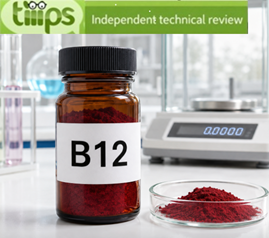
Description
Vitamin B12 is one of the most structurally complex vitamins.
Its distinctive characteristic is a cobalt atom located within a corrin-ring structure. The term cobalamin derives from this cobalt-containing molecular structure.
The principal forms of vitamin B12 include:
methylcobalamin;
adenosylcobalamin or 5′-deoxyadenosylcobalamin;
hydroxocobalamin;
cyanocobalamin.
Methylcobalamin and adenosylcobalamin are the two main metabolically active coenzyme forms in humans. Other forms, including cyanocobalamin and hydroxocobalamin, can be converted into metabolically active forms after absorption.
Vitamin B12 naturally present in foods is normally associated with the food's protein matrix. During digestion it must first be released before undergoing the specialised absorption process involving intrinsic factor.
Vitamin B12 added to fortified foods, by contrast, is already present in free form rather than being bound to food proteins.
Natural or industrially produced?
This distinction is particularly important when Vit. B12 appears in an ingredient list.
Naturally occurring vitamin B12
Vitamin B12 occurs naturally mainly in:
liver and other organ meats;
meat;
fish;
shellfish;
milk and dairy products;
eggs;
other animal-derived foods.
NIH identifies foods of animal origin, including fish, meat, poultry, eggs and dairy products, as the main natural dietary sources of vitamin B12.
Conventional plant foods are generally not reliable natural sources of vitamin B12 unless the vitamin has been added through fortification or the food contains B12-producing microorganisms under particular conditions.
Added Vit. B12
When Vit. B12 is listed separately as an ingredient, it normally represents an industrially produced and purified vitamin preparation added for nutritional fortification.
In the case of B12, “industrially produced” should not simply be interpreted as chemically synthesised.
Vitamin B12 biosynthesis occurs naturally in certain bacteria and archaea, and industrial manufacture relies predominantly on microbial fermentation because total chemical synthesis is extraordinarily complex and commercially impractical. Important industrial production organisms include strains related to Propionibacterium freudenreichii and Pseudomonas denitrificans.
A technically appropriate description is therefore:
“industrially produced vitamin B12 obtained through microbial fermentation, purification and standardisation.”
It should not automatically be described as natural vitamin B12 merely because microbial organisms are involved in its manufacture.
Production process
Commercial vitamin B12 production is principally a biotechnological fermentation process.
A typical industrial process can include:
selection of a high-producing microorganism;
preparation of the fermentation medium;
controlled microbial fermentation;
biosynthesis of cobalamins;
separation of microbial biomass;
recovery of the vitamin-containing fraction;
purification;
conversion into the required commercial cobalamin form;
concentration;
crystallisation or drying;
standardisation;
incorporation into a vitamin premix where required;
analytical determination of vitamin activity and purity.
Microbial fermentation is the core industrial production method because the B12 molecule requires a highly complex biosynthetic pathway involving numerous enzymatic steps. Current industrial biotechnology continues to optimise microbial strains and fermentation conditions to improve production efficiency.
In food manufacturing, B12 is often incorporated as part of a vitamin premix, because the amount required in a finished food is extremely small, typically measured in micrograms.
The premix allows a minute quantity of vitamin to be distributed uniformly throughout a large volume or mass of food.
Main substances contained
The designation Vit. B12 does not describe a complex food ingredient with one universal composition.
It indicates vitamin B12 activity, which can be provided by different cobalamins.
For ordinary food fortification in the European Union, the authorised forms are:
Cyanocobalamin
Cyanocobalamin is one of the most widely used industrial forms of vitamin B12.
It contains a cyano group coordinated to the central cobalt atom and is particularly useful industrially because of its chemical stability. Recent reviews of B12 biomanufacturing identify cyanocobalamin as the principal industrial product form.
Hydroxocobalamin
Hydroxocobalamin is another recognised form of vitamin B12 in which a hydroxy ligand is associated with the cobalt centre.
Both cyanocobalamin and hydroxocobalamin are listed by current EU legislation as permitted vitamin B12 formulations for addition to foods.
Methylcobalamin and adenosylcobalamin
These are biologically important forms of B12 and are present in human metabolism.
They may also be found in certain supplements and specialised products, depending on the applicable market and product category, but they should not automatically be assumed to be the form used when an ordinary food ingredient list simply states “Vit. B12.”
It is therefore technically incorrect to assign one molecular formula, molecular weight or CAS number to Vit. B12 as a generic ingredient name.
Identification data and specifications
| Characteristic | Value | Note |
|---|---|---|
| Ingredient name | Vit. B12 | nutritional designation |
| Full name | Vitamin B12 | family of cobalamins |
| Category | Water-soluble vitamin | B-complex vitamin |
| Characteristic element | Cobalt | central element of the cobalamin structure |
| Single chemical substance | No | several cobalamins exist |
| Main metabolically active forms | Methylcobalamin, adenosylcobalamin | coenzyme forms |
| EU-authorised forms for addition to foods | Cyanocobalamin, hydroxocobalamin | Regulation (EC) No 1925/2006 |
| Common industrial form | Cyanocobalamin | particularly stable |
| Main industrial production method | Microbial fermentation + purification | commercial production |
| Molecular formula of “Vit. B12” | Not unique | depends on the form used |
| EU/UK nutrition-labelling reference value | 2.5 µg/day | adult reference value |
| EFSA Adequate Intake for adults | 4 µg/day | scientific dietary reference value |
| US RDA for adults | 2.4 µg/day | NIH/FNB |
| Energy contribution | Negligible | used at microgram levels |
| E-number | None | nutrient, not an E-number additive |
| Major regulated food allergen | No | not a major food allergen |
| Gluten | Intrinsically absent | commercial premix should still be checked |
The EU authorises vitamin B12 for food fortification and specifically lists cyanocobalamin and hydroxocobalamin as permitted formulations.
For nutrition-labelling purposes, the European and UK reference value is 2.5 µg, whereas EFSA established an Adequate Intake of 4 µg/day for adults. These are different types of reference values and should not be confused.
The US Recommended Dietary Allowance for adults is 2.4 µg/day, rising to 2.6 µg during pregnancy and 2.8 µg during lactation.
Nutritional and biological properties
Vitamin B12 is essential for several important physiological processes.
It is involved in:
normal red blood cell formation;
nervous-system function;
DNA synthesis and metabolism;
homocysteine metabolism;
cellular division;
one-carbon metabolism;
normal neurological function.
Vitamin B12 acts as a cofactor for key enzymes involved in methylation and intermediary metabolism.
Its deficiency can therefore cause both haematological and neurological effects.
Food use and evaluation
| Aspect | Evaluation |
|---|---|
| Main purpose in foods | Nutritional fortification |
| Energy drinks | Frequently added with other B vitamins |
| Functional beverages | Used to increase declared vitamin B12 content |
| Breakfast cereals | Common fortification nutrient |
| Fortified plant-based foods | Important source when the underlying food naturally contains little or no reliable B12 |
| Food supplements | Widely used |
| Technological function | Not primarily a preservative, colour or emulsifier |
| Required quantity | Very small, usually measured in micrograms |
| EU/UK labelling reference value | 2.5 µg |
| EFSA Adequate Intake for adults | 4 µg/day |
| US adult RDA | 2.4 µg/day |
| Upper intake level | No numerical UL established in the US because of the low observed toxicity |
| Industrial production | Mainly microbial fermentation |
| Gluten | Intrinsically absent in the pure vitamin |
| Major food allergens | None intrinsic |
Vit. B12 in foods
Natural vitamin B12 is primarily associated with foods of animal origin.
Important sources include:
liver;
shellfish;
fish;
meat;
milk;
yogurt;
cheese;
eggs.
Fortification is particularly important for foods that otherwise contain little or no B12, including certain:
breakfast cereals;
plant-based drinks;
fortified nutritional yeast;
meat-alternative products;
specialised nutrition products.
NIH specifically distinguishes naturally occurring B12 in animal-derived foods from vitamin B12 added to fortified foods.
Vit. B12 in energy drinks
Vitamin B12 is frequently added to energy drinks together with nutrients such as vitamin B6, niacin and riboflavin.
Its role should not be confused with that of caffeine.
Vitamin B12 is not an acute central-nervous-system stimulant comparable with caffeine. Its purpose in these beverages is primarily nutritional fortification and contribution to normal vitamin-dependent metabolic pathways.
Therefore, in a formulation containing:
caffeine + taurine + niacin + Vit. B6 + Vit. B12
the ingredients perform very different roles.
The presence of B12 does not demonstrate that the beverage provides an additional immediate stimulant effect in a person whose vitamin B12 status is already adequate.
Absorption
Vitamin B12 has a particularly complex absorption mechanism.
B12 naturally bound to food proteins must first be released from the food matrix during digestion.
After a sequence of binding and transfer reactions, the vitamin associates with intrinsic factor, a protein required for efficient receptor-mediated absorption in the ileum.
The process can be summarised as:
release of naturally bound B12 from food proteins;
association with carrier proteins;
transfer to intrinsic factor;
transport to the terminal ileum;
receptor-mediated absorption.
Vitamin B12 added to fortified foods is already present in a free form and therefore does not require the initial step of being released from food proteins.
Absorption is also saturable. As the ingested dose becomes very large, the percentage of the dose absorbed falls substantially. This is one reason why high-dose supplements can contain hundreds or thousands of micrograms without the entire quantity being absorbed.
Advantages
Vitamin B12 is an essential micronutrient.
It supports normal red blood cell formation.
It is essential for normal neurological function.
It participates in DNA metabolism.
It contributes to normal homocysteine metabolism.
It participates in cell division.
It is required only in extremely small quantities.
It can be accurately incorporated into foods using standardised premixes.
Fortification allows B12 to be supplied through foods that naturally contain little or no reliable vitamin B12.
This can be particularly useful in plant-based products.
Industrial fermentation allows B12 to be manufactured without extracting the vitamin from animal tissues.
Cyanocobalamin provides good stability for many food and supplement applications.
Pure vitamin B12 is intrinsically gluten-free.
It is not a major regulated food allergen.
Commercial production is highly standardised.
Disadvantages
The simple designation “Vit. B12” is chemically imprecise.
The ingredient declaration alone does not reveal which cobalamin has been added.
A single molecular formula or CAS number cannot correctly be assigned to generic Vit. B12.
Added B12 should not automatically be described as naturally occurring B12.
The presence of B12 does not make a food intrinsically healthy if the overall product is high in sugar, caffeine or other components that need separate evaluation.
A very high declared B12 content does not mean that the same proportion of the dose will be absorbed.
Vitamin B12 does not act as an immediate stimulant in individuals with adequate nutritional status.
Commercial vitamin premixes may contain carriers or other technological components that cannot be identified from the term “Vit. B12” alone.
Stability can be influenced by light, pH, temperature and interactions with other ingredients.
Safety
Vitamin B12 has a low potential for toxicity.
In the United States, the Food and Nutrition Board has not established a Tolerable Upper Intake Level (UL) for vitamin B12 because available evidence indicates a low potential for adverse effects at high intakes.
This does not mean that progressively larger amounts provide progressively greater benefits.
The percentage absorbed decreases markedly at high oral doses, and additional B12 does not automatically improve energy, physical performance or other functions when an individual's B12 status is already adequate.
It is therefore important to distinguish between:
no established numerical UL
and
a nutritional need for very high doses.
They are not equivalent concepts.
Cobalt sensitivity
Because cobalamins contain cobalt, individuals with a known cobalt allergy can, in rare circumstances, experience sensitivity reactions to medicinal forms of cyanocobalamin or hydroxocobalamin. UK safety authorities specifically advise vigilance in people with known cobalt allergy. This issue is primarily documented in the context of therapeutic B12 products and should not be interpreted as meaning that vitamin B12 is one of the standard regulated food allergens.
Deficiency
Vitamin B12 deficiency can have important consequences because of the vitamin's roles in blood formation and neurological function.
Possible manifestations include:
megaloblastic anaemia;
fatigue;
weakness;
neurological abnormalities;
tingling or numbness;
impaired sensation;
cognitive changes in severe cases;
elevated methylmalonic acid;
elevated homocysteine.
Some groups have a greater risk of inadequate vitamin B12 status because of low dietary intake or impaired absorption.
Relevant situations can include:
vegan diets without adequate fortified foods or supplementation;
impaired gastrointestinal absorption;
pernicious anaemia or inadequate intrinsic factor;
gastrointestinal surgery;
older age associated with reduced gastric function;
prolonged use of certain medications.
Reference values
Different B12 reference values serve different purposes.
EU and UK nutrition-labelling reference value
For nutrition labelling:
Vitamin B12 = 2.5 µg
This value is used to calculate the percentage of the nutrient reference value on food labels. The same 2.5 µg reference is reflected in current UK nutrition information.
EFSA Adequate Intake
EFSA established an:
Adequate Intake = 4 µg/day for adults
based on biomarkers of cobalamin status.
United States
The US adult RDA is:
2.4 µg/day
with higher values during pregnancy and lactation.
These values should not be interpreted as contradictory because NRV, AI and RDA are different types of nutritional reference values developed for different purposes.
European Union
Vitamin B12 is included among the vitamins that may be added to foods under Regulation (EC) No 1925/2006.
The authorised forms listed for food fortification are:
cyanocobalamin;
hydroxocobalamin.
Therefore, when a conventional EU food declares only “Vit. B12”, the generic designation does not establish which of these forms was actually used.
United Kingdom
In the UK, foods fortified with vitamins and minerals remain subject to specific nutrition and fortification requirements, and the addition of vitamins can trigger nutrition-labelling obligations.
Current UK government guidance confirms that when vitamins or minerals are added to a prepacked food, nutrition information must be provided, while the reference amount used for vitamin B12 is 2.5 µg.
Food supplements are separately recognised as concentrated sources of vitamins, minerals or other substances with nutritional or physiological effects.
United States
In the United States, vitamin B12 is treated as a nutrient rather than an E-number technological additive.
The US adult RDA is 2.4 µg/day, and vitamin B12 is commonly supplied in fortified foods and dietary supplements. Natural dietary sources are predominantly animal-derived foods, while fortified foods can provide substantial amounts independently of the original food matrix.
Cyanocobalamin is widely used in commercial vitamin preparations because of its stability.
Allergens and gluten
Pure vitamin B12 compounds are intrinsically gluten-free.
Vitamin B12 itself is not one of the major food allergens requiring routine declaration under EU, UK or US major-allergen frameworks.
However, a commercial vitamin premix can contain additional materials such as:
carriers;
maltodextrins;
stabilisers;
encapsulating agents;
anticaking agents;
other formulation aids.
Consequently, the allergen and gluten status of a commercial Vit. B12 ingredient should ultimately be established from the supplier specification for the actual premix or preparation used.
The declaration “Vit. B12” alone does not reveal the complete composition of such a premix.
Stability
Vitamin B12 stability depends on the chemical form and the surrounding food matrix.
Relevant factors include:
light;
temperature;
pH;
oxygen;
reducing or oxidising substances;
interactions with other vitamins;
storage duration;
processing conditions.
Cyanocobalamin is particularly useful industrially because it is one of the more chemically stable forms of vitamin B12 and remains a major form used in commercial production.
For liquid products such as fortified beverages and energy drinks, the manufacturer must evaluate vitamin retention throughout the intended shelf life.
Storage of the vitamin preparation
Vitamin B12 preparations are generally stored:
in tightly closed containers;
protected from light;
protected from moisture;
away from excessive heat;
according to the supplier's technical specification.
Because the amounts incorporated into foods are extremely small, accurate dosing and homogeneous distribution are particularly important.
Standardised vitamin premixes are therefore commonly used instead of attempting to dose extremely small quantities of pure vitamin directly into large manufacturing batches.
Environment
The environmental profile of added Vit. B12 is linked mainly to its biotechnological manufacturing process.
Relevant stages include:
production of fermentation substrates;
microbial cultivation;
energy consumption for fermentation;
aeration and agitation;
recovery of microbial biomass;
extraction;
purification;
conversion to the required commercial form;
drying;
manufacture of vitamin premixes;
packaging and transport.
Commercial B12 production is therefore a clear example of microbial biotechnology applied to food and nutritional ingredients.
Modern industrial development continues to focus on improving microbial strains and fermentation efficiency because fermentation remains the core method of commercial vitamin B12 production.
Conclusion
Vit. B12 is the nutritional designation for vitamin B12, a family of cobalt-containing compounds known as cobalamins.
When B12 occurs naturally in meat, fish, milk, eggs or other animal-derived foods, it forms part of the natural food matrix. When “Vit. B12” appears separately in the ingredient list of a beverage or fortified food, it normally represents an industrially produced and purified vitamin preparation deliberately added for nutritional fortification.
In the European Union, the authorised forms for addition of vitamin B12 to foods are cyanocobalamin and hydroxocobalamin. Consequently, the simple declaration “Vit. B12” does not provide enough information to determine which chemical form is actually present.
Commercial vitamin B12 should not simply be described as chemically synthetic. Because of the molecule's exceptional structural complexity, modern commercial manufacture relies predominantly on microbial fermentation followed by extraction, purification and standardisation. Cyanocobalamin is particularly important industrially because of its stability.
From a nutritional perspective, B12 is essential for red blood cell formation, neurological function, DNA-related metabolism and several fundamental cellular reactions.
For nutrition labelling, the EU/UK reference value is 2.5 µg, while EFSA has established an adult Adequate Intake of 4 µg/day. The US adult RDA is 2.4 µg/day. These values serve different regulatory and scientific purposes.
No numerical UL has been established in the United States because vitamin B12 has a low observed toxicity, but this should not be interpreted as evidence that very high doses necessarily provide additional benefits.

