



Levocarnitine tartrate: properties, uses, advantages, disadvantages, safety
Levocarnitine tartrate, also known as L-carnitine L-tartrate or L-carnitine tartrate, is a crystalline salt formed from L-carnitine (levocarnitine) and L-tartaric acid.
It is not the form in which L-carnitine normally occurs naturally in foods. Levocarnitine tartrate is an industrially produced ingredient, manufactured by combining purified food-grade L-carnitine with purified L-tartaric acid. The resulting salt provides a stable and easily handled source of L-carnitine for food and supplement formulations. The Food Chemicals Codex describes L-carnitine L-tartrate as a white crystalline powder synthesised from food-grade L-carnitine and L-tartaric acid.
Chemically, two molecules of L-carnitine are associated with one molecule of L-tartaric acid. Based on this stoichiometry, the pure compound consists theoretically of approximately 68.2% L-carnitine and 31.8% L-tartaric acid/tartrate.
Description
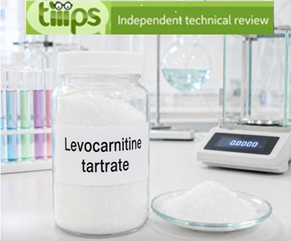
Levocarnitine tartrate is the L-tartrate salt of levocarnitine. It is generally supplied as a white crystalline powder with physical characteristics particularly suitable for dry formulations, powders, tablets, capsules and premixes.
The United States Pharmacopeia identifies Levocarnitine Tartrate as a defined 2:1 compound with molecular formula C₁₈H₃₆N₂O₁₂, molecular weight 472.49 g/mol and CAS 36687-82-8.
The L-carnitine component is physiologically relevant. L-carnitine participates in the carnitine shuttle, which transports long-chain fatty acids across the inner mitochondrial membrane so that they can undergo β-oxidation.
This well-established biochemical function should not, however, be interpreted as evidence that simply consuming additional L-carnitine automatically increases fat burning in healthy people. In its assessment of a proposed claim that L-carnitine contributes to normal lipid metabolism, EFSA concluded that a cause-and-effect relationship had not been established between dietary L-carnitine consumption and contribution to normal lipid metabolism in the target population.
Production process
Levocarnitine tartrate is produced industrially by combining food-grade L-carnitine and L-tartaric acid in the appropriate stoichiometric ratio.
A typical manufacturing process can include:
preparation of purified L-carnitine;
preparation of food-grade L-tartaric acid;
dissolution of the components;
adjustment to the required 2:1 molar ratio of L-carnitine to L-tartaric acid;
formation of the salt;
concentration of the solution;
crystallisation;
separation of the crystals;
drying;
particle-size adjustment;
purity and identity testing;
packaging under controlled conditions.
The FCC specifically describes the substance as being synthesised from food-grade L-carnitine and L-tartaric acid, confirming that the commercial salt is an industrially manufactured ingredient rather than a naturally occurring food constituent.
The manufacturing route for the L-carnitine component itself may vary between suppliers. The final assessment of a commercial ingredient should therefore rely on the manufacturer's specification, certificate of analysis and process documentation rather than assuming a universal production route.
Main substances contained
Levocarnitine tartrate is a highly purified defined ingredient, not a complex food matrix.
Its two structural components are:
L-carnitine (levocarnitine): approximately 68.2% theoretically;
L-tartaric acid/tartrate: approximately 31.8% theoretically.
These percentages follow directly from the molecular composition of the 2:1 salt:
2 molecules of L-carnitine;
1 molecule of L-tartaric acid.
This distinction is important when interpreting the amount shown in a food formulation.
1 g of levocarnitine tartrate does not provide 1 g of L-carnitine.
The theoretical equivalents are approximately:
100 mg levocarnitine tartrate → 68 mg L-carnitine;
250 mg → 171 mg L-carnitine;
500 mg → 341 mg L-carnitine;
1,000 mg → 682 mg L-carnitine.
The remaining mass consists principally of the tartrate component.
A commercial grade may additionally contain very small amounts of moisture and process-related impurities within the applicable specification, but these are not characteristic functional components of the ingredient.
Identification data and specifications
| Characteristic | Value | Note |
|---|---|---|
| Name | Levocarnitine tartrate | food/nutritional ingredient |
| Synonyms | L-carnitine L-tartrate; L-carnitine tartrate | common alternative names |
| Chemical nature | Salt of L-carnitine and L-tartaric acid | defined 2:1 compound |
| Molecular formula | C₁₈H₃₆N₂O₁₂ | complete salt |
| Molecular weight | 472.49 g/mol | USP/FCC |
| CAS | 36687-82-8 | substance identifier |
| Molar ratio | 2 L-carnitine : 1 L-tartaric acid | characteristic structure |
| Theoretical L-carnitine content | about 68.2% | calculated from molecular composition |
| Theoretical tartrate component | about 31.8% | calculated from molecular composition |
| Appearance | White crystalline powder | FCC description |
| Origin of the salt | Industrially manufactured | produced from food-grade components |
| Main purpose | Source of L-carnitine | nutritional/physiological ingredient |
| E-number | None | not an E-number technological additive |
| Gluten | Intrinsically absent | pure compound |
| Major regulated allergens | None intrinsic | commercial specification should still be checked |
USP and FCC identify the compound with formula C₁₈H₃₆N₂O₁₂, molecular weight 472.49 and CAS 36687-82-8.
Nutritional and physiological properties
The nutritional relevance of levocarnitine tartrate derives mainly from the L-carnitine released from the salt.
L-carnitine is involved in mitochondrial fatty-acid metabolism by facilitating the transport of long-chain fatty acyl groups into mitochondria.
The human body can also synthesise L-carnitine, and the compound occurs naturally in food, particularly in animal-derived foods.
Natural dietary sources include especially:
red meat;
other meats;
dairy products;
fish;
other animal-derived foods.
Plant foods generally contain substantially lower amounts.
It is therefore important to distinguish between:
Naturally occurring L-carnitine
→ naturally present in foods and human tissues.
Levocarnitine tartrate added to food
→ an industrially manufactured salt used as a supplemental source of L-carnitine.
Food use and evaluation
| Aspect | Evaluation |
|---|---|
| Main function | Source of L-carnitine / ingredient with nutritional or physiological purpose |
| Energy drinks | May be added together with caffeine, taurine, vitamins and other functional ingredients |
| Functional beverages | Used as a source of L-carnitine |
| Food supplements | Commonly used in powders, capsules and tablets |
| Sports products | Used in powders, drinks and bars |
| EU foods for specific groups | L-carnitine L-tartrate is specifically listed as an authorised source of carnitine in certain regulated food categories |
| Actual L-carnitine contribution | About 68% of ingredient weight theoretically |
| Naturally occurring salt | No |
| E-number | None |
| Protein, fat and fibre contribution | Nutritionally negligible at normal use levels |
| Gluten | Intrinsically absent |
| Major food allergens | None intrinsic |
| Main high-dose tolerability issues | Gastrointestinal effects and characteristic body odour may occur |
| EU claim for normal lipid metabolism | Not substantiated for supplemental dietary L-carnitine in the general population |
| US status | FDA GRN 993 received a “no questions” response for a specific infant-formula use and level |
In the European Union, L-carnitine-L-tartrate is specifically listed among permitted sources of carnitine for certain categories of foods for specific groups, alongside L-carnitine and L-carnitine hydrochloride.
In the United States, FDA GRAS Notice GRN 993 concerns L-carnitine-L-tartrate for a specific use in cow- or goat-milk-based infant formula at a maximum level of 0.88 mg/100 kcal, providing 0.6 mg L-carnitine/100 kcal. FDA issued a “no questions” response to that notifier's GRAS conclusion. This finding applies to that defined use and should not be interpreted as an unrestricted FDA approval for every food category or dose.
Food applications
Levocarnitine tartrate is particularly useful where manufacturers want a stable, accurately dosable solid source of L-carnitine.
Typical applications can include:
energy drinks;
functional beverages;
dietary supplements;
sports powders;
capsules;
tablets;
nutrition bars;
powdered drink preparations;
certain specialised nutritional products.
Its physical properties can make it preferable to free L-carnitine in dry formulations, particularly when powder handling, stability and accurate dosing are important.
In the gastrointestinal tract, the salt provides L-carnitine and tartrate components that can subsequently enter their respective physiological pathways.
Levocarnitine tartrate in energy drinks
Levocarnitine tartrate is sometimes present in energy drinks together with caffeine, taurine, B vitamins, sugars or sweeteners.
These substances perform very different functions.
Caffeine has a direct pharmacological stimulant effect on the central nervous system.
L-carnitine, by contrast, has a physiological role in mitochondrial fatty-acid transport, but supplemental L-carnitine should not automatically be described as a stimulant or fat-burning substance.
EFSA evaluated a proposed health claim relating L-carnitine consumption to normal lipid metabolism and concluded that the available evidence did not establish the required cause-and-effect relationship in the general population.
Therefore, the presence of levocarnitine tartrate in an energy drink does not demonstrate that the beverage increases fat oxidation, causes weight loss or enhances energy expenditure.
L-carnitine and “fat burning”
The biochemical role of L-carnitine is well established: carnitine is required for mitochondrial transport of long-chain fatty acids.
However, this should not be simplified into:
more ingested L-carnitine = more fat burned.
For the proposed claim “L-carnitine contributes to normal lipid metabolism”, EFSA concluded that the evidence did not establish that dietary L-carnitine is required to maintain normal lipid metabolism in the intended general population, and consequently no cause-and-effect relationship was established.
This distinction is particularly important in advertising and product descriptions.
The ingredient may legitimately be described as a source of L-carnitine, but physiological or weight-management claims require separate scientific and regulatory substantiation.
Advantages
Provides a concentrated and standardised source of L-carnitine.
Contains theoretically about 68% L-carnitine.
Is chemically well characterised.
Has a defined 2:1 composition.
Is available as a stable crystalline powder.
Can be accurately dosed in industrial formulations.
Is suitable for powders, capsules, tablets, drinks and nutrition bars.
The L-carnitine released from the salt participates in normal physiological carnitine pathways.
Is intrinsically gluten-free.
Has no intrinsic major regulated food allergen.
Does not characteristically contribute sodium.
Is recognised in EU legislation as a source of carnitine for specified categories of foods for particular groups.
EFSA specifically assessed L-carnitine-L-tartrate as a source of L-carnitine for particular nutritional uses.
Disadvantages
It is an industrially manufactured salt, not a form naturally occurring in ordinary foods.
Only approximately 68% of its weight corresponds to L-carnitine.
Approximately 32% corresponds to the tartrate component.
It has no E-number because its primary role is not that of a conventional technological food additive.
Its presence in a food does not automatically demonstrate a nutritional benefit for the consumer.
It should not be described automatically as a fat burner.
Supplemental dietary L-carnitine has not been demonstrated by EFSA to contribute to normal lipid metabolism in the general population for the assessed health claim.
The physiological effects obtained in studies using gram-level supplemental doses should not be extrapolated to very small amounts present in some beverages.
At higher supplemental intakes, gastrointestinal intolerance can occur.
High intakes of L-carnitine can be associated with a characteristic fish-like odour of breath, sweat or urine in some individuals.
The contribution from the tartrate component must also be considered when exposure is high.
Safety
EFSA specifically evaluated L-carnitine-L-tartrate for use as a source of L-carnitine in foods for particular nutritional purposes.
The evaluation concluded that the compound could be regarded as an acceptable source of L-carnitine for the uses assessed, while also considering exposure to the tartaric-acid component.
The safety assessment of levocarnitine tartrate therefore involves two components:
exposure to L-carnitine;
exposure to L-tartrate/tartaric acid.
This is relevant because 1 g of the compound provides approximately:
682 mg L-carnitine;
318 mg tartrate component.
The safety of a finished food consequently depends on the actual quantity used, the serving size, frequency of consumption and total exposure from other dietary or supplemental sources.
European Union
Regulation (EU) No 609/2013 lists L-carnitine-L-tartrate among sources of carnitine that may be used in specified categories of foods for particular groups.
The regulation distinguishes between the permitted sources according to food category. L-carnitine-L-tartrate is listed for certain infant formula applications, foods for special medical purposes and total diet replacement products, subject to the detailed rules applicable to those categories.
This specific listing should not be confused with a universal authorisation for every possible conventional food use at any concentration.
For ordinary foods and food supplements, regulatory treatment of substances other than harmonised vitamins and minerals can depend on the product category and the applicable EU and national framework.
United Kingdom
UK food-supplement guidance defines a food supplement as a concentrated source of vitamins, minerals or other substances with a nutritional or physiological effect, alone or in combination, supplied in dose form. L-carnitine ingredients can fall within this broader “other substances” category when used in supplements.
For a commercial product placed on the UK market, compliance therefore requires assessment of the specific ingredient, dose, claims, intended population and applicable retained/UK food law rather than assuming that all L-carnitine products have one universal authorised level.
United States
In the United States, L-carnitine-L-tartrate has been the subject of FDA GRAS notifications.
For GRN 993, the intended use was specifically in cow- or goat-milk-based non-exempt infant formula for term infants at a maximum of 0.88 mg L-carnitine-L-tartrate per 100 kcal, corresponding to 0.6 mg L-carnitine per 100 kcal. FDA responded that it had no questions regarding the notifier's GRAS conclusion for that use.
This is a use-specific GRAS conclusion, not a general statement that any quantity of levocarnitine tartrate may be added to any food.
The United States Pharmacopeia also maintains a dedicated Levocarnitine Tartrate dietary-ingredient monograph, reflecting its use and standardisation in supplement applications.
Natural or industrially produced?
This distinction is essential.
L-carnitine
L-carnitine itself occurs naturally:
in the human body;
in animal tissues;
particularly in meat;
in dairy foods;
in smaller amounts in other foods.
Levocarnitine tartrate
Levocarnitine tartrate is not normally a natural constituent of ordinary foods.
It is an industrially manufactured crystalline salt produced from purified L-carnitine and purified L-tartaric acid. FCC explicitly describes L-carnitine L-tartrate as being synthesised from these two food-grade components.
The technically appropriate description is therefore:
“industrially manufactured L-carnitine salt with L-tartaric acid, used as a source of L-carnitine.”
It should not be described simply as naturally occurring carnitine.
Allergens and gluten
Pure levocarnitine tartrate:
is intrinsically gluten-free;
does not contain wheat as part of its chemical structure;
does not contain milk, egg, soy, nuts or other major food allergens as structural components;
is not itself a major regulated allergen under EU, UK or US allergen frameworks.
For a specific commercial raw material, however, manufacturers should still obtain:
allergen declaration;
certificate of analysis;
gluten statement where required;
manufacturing-process information;
cross-contact information;
microbiological specification;
residual-solvent information where relevant.
The intrinsic chemical composition of the substance does not replace supplier-specific quality documentation.
Stability and storage
Levocarnitine tartrate is supplied as a white crystalline powder, and its salt form is useful partly because it provides convenient handling characteristics for industrial formulations.
The raw material should normally be stored:
in tightly closed containers;
in a cool environment;
in dry conditions;
protected from excessive humidity;
protected from contamination;
according to the manufacturer's technical specification.
The stability of L-carnitine in a finished food may additionally depend on:
pH;
temperature;
water activity;
heat treatment;
storage time;
interaction with other ingredients.
The stability of the finished formulation should therefore be assessed separately from the stability of the dry raw material.
Environment
The environmental profile of levocarnitine tartrate depends on the industrial production of both L-carnitine and L-tartaric acid, followed by salt formation, purification, crystallisation, drying, packaging and transport.
Relevant factors include:
origin and production route of L-carnitine;
source of L-tartaric acid;
water use;
energy consumption;
purification processes;
crystallisation;
use and recovery of processing solvents where applicable;
drying requirements;
wastewater treatment;
packaging and transport.
The fact that L-carnitine and tartaric acid are related to naturally occurring biological compounds does not mean that commercial levocarnitine tartrate is an unprocessed natural ingredient.
Conclusion
Levocarnitine tartrate is a defined crystalline salt formed from two molecules of L-carnitine and one molecule of L-tartaric acid.
Its molecular formula is C₁₈H₃₆N₂O₁₂, its molecular weight is 472.49 g/mol and its CAS number is 36687-82-8. USP and FCC recognise it as a specifically defined dietary/food ingredient.
From its molecular composition, the pure compound contains theoretically about 68.2% L-carnitine and 31.8% tartrate component. Consequently, 1 g of levocarnitine tartrate provides approximately 682 mg of L-carnitine, rather than 1 g.
L-carnitine itself is naturally present in the human body and in foods, particularly animal-derived foods. Levocarnitine tartrate, however, is an industrially produced form, manufactured by combining purified food-grade L-carnitine with L-tartaric acid.
Its main purpose in foods, supplements and functional products is to provide a stable, standardised source of L-carnitine. In the EU it is specifically recognised as a carnitine source in certain regulated categories of foods for particular groups, while in the United States it has been the subject of use-specific GRAS notifications.
Although L-carnitine has a genuine biochemical role in transporting long-chain fatty acids into mitochondria, this should not be translated into an automatic fat-burning or weight-loss claim. EFSA concluded that a cause-and-effect relationship had not been established between supplemental dietary L-carnitine and contribution to normal lipid metabolism in the general population.
Overall, levocarnitine tartrate is a well-characterised, industrially produced and concentrated source of L-carnitine. Its proper evaluation in a finished food should consider the actual amount of levocarnitine tartrate present, the corresponding L-carnitine dose, the tartrate contribution, intended population, serving size, total dietary exposure and the regulatory status of the specific product category.

