



Potassium citrate monohydrate: properties, uses, advantages, disadvantages, safety
Potassium citrate monohydrate is the monohydrated form of tripotassium citrate, the fully neutralised potassium salt of citric acid. In food applications it is used mainly to regulate acidity, buffer pH, sequester metal ions and stabilise formulations.
In the European Union it corresponds specifically to E 332(ii) – Tripotassium citrate, for which the official food-additive specification identifies the substance as the monohydrated tripotassium salt of citric acid. Codex/JECFA identifies the same additive as INS 332(ii).
It should not be confused with monopotassium citrate E 332(i). Potassium citrate monohydrate contains three potassium ions per citrate ion and therefore has a substantially higher potassium content and a more alkaline behaviour in aqueous solution.
Description
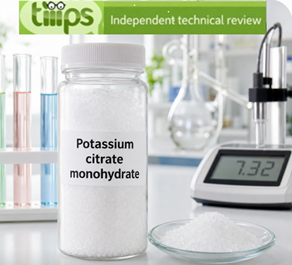
Potassium citrate monohydrate is a white hygroscopic granular powder or transparent crystalline material. It is highly soluble in water and contains one molecule of water of crystallisation for each molecule of tripotassium citrate.
The monohydrate is a true crystalline hydrate: its water molecule is incorporated into the crystal structure and should not be interpreted simply as free water added to the ingredient.
The substance is the fully neutralised potassium salt of citric acid. Because all three acidic hydrogen atoms of citric acid have been replaced by potassium, an aqueous solution has a moderately alkaline reaction compared with citric acid itself.
EU food-additive specifications establish a pH of 7.5–9.0 for a 5% aqueous solution. This characteristic explains its usefulness in acidic beverages and foods, particularly when it is necessary to moderate excessive sourness while maintaining controlled pH conditions.
Potassium citrate monohydrate is also described by the current US regulation as an odourless, deliquescent material occurring as transparent crystals or a white granular powder and containing one mole of water per mole of potassium citrate.
Production process
Potassium citrate monohydrate is generally produced by neutralising citric acid with a potassium-containing base.
Typical potassium sources include:
potassium hydroxide;
potassium carbonate.
The industrial process normally involves:
preparation of a purified citric acid solution;
controlled addition of the potassium compound;
complete neutralisation of the three acidic groups;
filtration and purification where necessary;
concentration of the solution;
controlled crystallisation;
formation of the monohydrate crystal;
separation of the crystals;
drying under controlled conditions;
particle-size adjustment;
packaging in moisture-resistant containers.
US 21 CFR §184.1625 specifically describes potassium citrate as being prepared by neutralising citric acid with potassium hydroxide or potassium carbonate.
The citric acid used as the starting material is commonly manufactured industrially by fermentation of carbohydrate-containing substrates followed by extensive purification. The purified citric acid is then converted into the potassium salt.
Main substances contained
Food-grade potassium citrate monohydrate is a highly purified chemical ingredient, rather than a complex food matrix.
Its principal component is tripotassium citrate associated with one molecule of water of crystallisation.
EU specifications require an assay of not less than 99% calculated on the anhydrous basis.
The material may therefore contain:
tripotassium citrate as the principal substance;
one molecule of water of crystallisation;
very small amounts of moisture;
trace process-related impurities;
oxalates and elemental impurities only within the limits established for food-grade material.
The ingredient contains no nutritionally meaningful protein, fat or dietary fibre.
Its most important nutritional constituent is potassium. Based on its molecular composition, potassium citrate monohydrate contains theoretically about 36.2% potassium by weight.
This means, for example, that:
100 mg provide theoretically about 36 mg potassium;
1 g provides about 362 mg potassium;
10 g would provide about 3.62 g potassium.
These are theoretical compositional calculations and should not replace the supplier's certificate of analysis when precise formulation calculations are required.
Unlike sodium citrate, potassium citrate monohydrate does not inherently add sodium to a formulation.
Identification data and specifications
| Characteristic | Value | Note |
|---|---|---|
| Name | Potassium citrate monohydrate | food-grade potassium citrate |
| Chemical name | Tripotassium citrate monohydrate | fully neutralised potassium salt of citric acid |
| EU designation | E 332(ii) | tripotassium citrate |
| Codex designation | INS 332(ii) | international food-additive identifier |
| Chemical class | Potassium salt of citric acid | citrate salt |
| Formula | C₆H₅K₃O₇·H₂O | monohydrate |
| Molecular weight | 324.42 g/mol | EU specification |
| CAS | 6100-05-6 | monohydrate |
| EINECS | 212-755-5 | EU identifier associated with tripotassium citrate |
| Appearance | White hygroscopic granular powder or transparent crystals | EU specification |
| Assay | ≥99% on the anhydrous basis | food-additive specification |
| pH | 7.5–9.0 | 5% aqueous solution |
| Loss on drying | ≤6.0% | 180 °C, 4 hours |
| Oxalates | ≤100 mg/kg as oxalic acid | after drying |
| Arsenic | ≤1 mg/kg | EU purity criterion |
| Lead | ≤1 mg/kg | EU purity criterion |
| Mercury | ≤1 mg/kg | EU purity criterion |
| Water solubility | high / freely soluble | suitable for liquid formulations |
| Theoretical potassium content | about 36.2% | calculated from molecular composition |
| Gluten | intrinsically absent | pure additive |
| Major regulated allergens | none intrinsic | pure food-grade material |
The EU specification explicitly identifies E 332(ii) as tripotassium citrate, monohydrated tripotassium salt of citric acid, with the formula and quality criteria shown above.
The US FDA substance inventory likewise recognises the names Potassium citrate monohydrate and Tripotassium citrate monohydrate and identifies CAS 6100-05-6.
Technological properties
The main technological value of potassium citrate monohydrate comes from the citric acid/citrate buffering system.
When a food or beverage contains citric acid, malic acid or another acidifying ingredient, adding potassium citrate can moderate changes in pH and make the acidity easier to control.
This is particularly important because pH and perceived sourness are related but not identical.
A beverage may require a particular pH for flavour stability, preservation or processing reasons while becoming sensorially too sour if only additional acid is used. Potassium citrate allows the formulation to be adjusted by providing the conjugate citrate component of the buffer system.
The citrate ion also has the ability to bind or complex certain metal ions, including calcium. This gives the ingredient useful sequestrant properties and can influence mineral and protein equilibria.
Its high solubility makes it particularly suitable for beverages and other aqueous foods.
Food use and safety evaluation
| Aspect | Evaluation |
|---|---|
| Main technological functions | Acidity regulator, sequestrant and stabiliser |
| Buffering | Effective component of citric acid/citrate buffer systems |
| Soft drinks | Helps control pH and moderate excessive acidic taste |
| Energy drinks | Can be used alongside citric or malic acid to balance acidity |
| Sports drinks | Provides pH control while also contributing potassium |
| Flavoured waters | Useful for acidity adjustment and mineral formulation |
| Dairy/protein systems | Can influence calcium equilibria and protein stability |
| Other foods | Used in authorised processed foods, sauces, confectionery and other formulations |
| Nutritional contribution | Significant potassium contribution depending on dosage |
| Sodium contribution | Essentially none from the pure salt |
| Gluten | Intrinsically absent |
| Major allergens | None intrinsic |
| JECFA assessment | ADI not limited |
| EU | E 332(ii), authorised according to applicable food-category conditions |
| Great Britain | E 332 Potassium citrates listed as authorised by the Food Standards Agency |
| USA | Potassium citrate permitted under 21 CFR §184.1625 subject to current good manufacturing practice |
JECFA classifies tripotassium citrate as an acidity regulator, sequestrant and stabiliser and established an ADI “not limited”.
In Great Britain, the Food Standards Agency lists E 332 Potassium citrates as authorised for England, Scotland and Wales.
In the United States, current 21 CFR §184.1625 permits potassium citrate in food with no limitation other than current good manufacturing practice.
Food applications
Potassium citrate monohydrate is particularly useful in beverages.
Typical applications include:
carbonated soft drinks;
energy drinks;
sports drinks;
electrolyte beverages;
flavoured waters;
fruit beverages;
powdered drink mixes;
confectionery;
sauces;
dairy products;
protein beverages;
desserts;
processed foods requiring pH control.
In a beverage containing citric acid and/or malic acid, potassium citrate can reduce excessive sharpness while maintaining a controlled acid-base system.
For this reason, formulations frequently use an acid and its citrate salt together rather than trying to achieve the required sensory profile with acid alone.
The ingredient can also provide potassium to electrolyte formulations, although whether it may be presented to consumers as a nutritional source of potassium depends on the amount present and the applicable nutrition-claim legislation.
Potassium contribution
Potassium citrate monohydrate differs significantly from sodium citrate because the associated cation is potassium rather than sodium.
Its theoretical potassium content of approximately 36.2% means that even relatively modest ingredient levels can contribute measurable quantities of potassium.
For example:
0.10 g potassium citrate monohydrate → about 36 mg potassium;
0.25 g → about 90 mg potassium;
0.50 g → about 181 mg potassium;
1.00 g → about 362 mg potassium.
This can be advantageous in sports or electrolyte beverages but must be included in the total mineral calculation of the finished formulation.
Potassium is an essential mineral involved in maintenance of intracellular fluid balance, nerve transmission and muscle function.
Sodium and salt declaration
Potassium citrate monohydrate does not itself contain sodium.
This is technologically important when comparing it with trisodium citrate, particularly in products where reducing sodium is desirable.
Under EU nutrition-labelling rules, declared salt is calculated from sodium according to:
salt = sodium × 2.5
Therefore potassium citrate itself does not directly increase the calculated salt value in the way that sodium citrate does.
This does not mean that potassium citrate is nutritionally neutral: instead of sodium, it contributes a potentially significant amount of potassium.
Advantages
Potassium citrate monohydrate offers several useful properties in food formulation:
excellent water solubility;
effective pH control;
useful buffering capacity;
ability to moderate excessive sourness;
sequestration of certain metal ions;
compatibility with citric acid-based systems;
contribution to mineral balance in beverages;
contribution of potassium without adding sodium;
predictable composition;
high food-grade purity;
no intrinsic gluten;
no intrinsic major regulated food allergens;
no fat or cholesterol;
no meaningful protein or dietary fibre.
It can be particularly useful when a manufacturer wants the technological advantages of citrate buffering while avoiding the additional sodium associated with sodium citrate.
Disadvantages
The principal nutritional consideration is its high potassium concentration.
At approximately 36% potassium by weight, relatively large amounts of potassium citrate monohydrate can substantially increase the potassium content of a food or beverage.
Excessive use may also adversely affect the formulation by:
raising pH too far;
reducing desired sourness;
producing a mineral or saline taste;
changing ionic strength;
altering calcium availability;
influencing protein behaviour;
affecting texture or stability.
It is therefore not necessarily interchangeable 1:1 by weight with trisodium citrate, monopotassium citrate or anhydrous tripotassium citrate.
Differences in:
molecular weight;
hydration;
potassium concentration;
sodium concentration;
flavour;
buffer capacity;
must be considered when reformulating.
Safety
Potassium citrate has a long history of food use and a favourable international toxicological assessment.
JECFA established an ADI “not limited” for tripotassium citrate. This designation reflects the low toxicological concern associated with citrate at normal food-use levels and its integration into normal physiological metabolic pathways.
Citrate is a normal intermediate in cellular metabolism and participates in the citric acid cycle.
After ingestion, potassium citrate dissociates into potassium and citrate ions. Citrate enters normal metabolic pathways, while potassium becomes part of the body's potassium pool.
For healthy individuals with normal kidney function, excess dietary potassium is normally eliminated through the kidneys. NIH notes that high dietary potassium intakes have not been shown to cause harm in healthy people with normal renal function.
Potassium-sensitive individuals
A different situation applies to people whose ability to eliminate potassium is impaired.
Individuals with conditions such as chronic kidney disease, or those using certain medicines that reduce urinary potassium excretion, can develop elevated blood potassium concentrations.
Examples of relevant medicines include:
ACE inhibitors;
angiotensin receptor blockers;
potassium-sparing diuretics.
NIH notes that hyperkalaemia can occur in susceptible individuals even at potassium intakes that would normally be well tolerated by healthy people.
This does not mean that potassium citrate monohydrate at normal food-additive levels is unsafe for the general population. It means that the total dietary potassium load can be relevant for individuals with impaired potassium handling.
Therapeutic potassium citrate products used medically should also not be confused with the much smaller quantities normally present in foods as technological additives.
Regulatory status
European Union
Potassium citrate monohydrate is covered by E 332(ii) Tripotassium citrate.
Regulation (EU) No 231/2012 defines its identity and purity specifications, including:
monohydrate form;
minimum 99% assay on an anhydrous basis;
pH 7.5–9.0;
maximum 6% loss on drying;
specified limits for oxalates and elemental impurities.
Its permitted amount in a finished food depends on the relevant food category and conditions established under the EU food-additive framework. It should therefore not be assumed that one universal numerical limit applies to every food.
United Kingdom
The Food Standards Agency records E 332 Potassium citrates as an authorised food additive for Great Britain, subject to the applicable conditions of authorisation.
United States
Current US regulation 21 CFR §184.1625 defines potassium citrate specifically as the monohydrate, states that it contains one mole of water per mole of potassium citrate and permits its food use according to current good manufacturing practice.
The FDA food-substance inventory recognises technical effects including pH control, sequestration, nutrient supplementation, flavour enhancement and emulsifier/emulsifier-salt functions.
Allergens and gluten
Pure food-grade potassium citrate monohydrate is intrinsically gluten-free.
It is also not itself one of the major regulated food allergens under EU, UK or US allergen frameworks.
This does not eliminate the normal requirement for manufacturers to assess:
supplier allergen declarations;
cross-contact controls;
manufacturing environment;
specifications of the commercial grade.
The fact that citric acid may be produced by fermentation of carbohydrate-containing substrates does not mean that the purified potassium citrate automatically contains the proteins or allergens associated with those substrates.
The final additive should be assessed according to its actual purity, manufacturing process and analytical specification.
Storage
Potassium citrate monohydrate is hygroscopic and can become deliquescent when exposed to moist air. Both EU descriptions and US regulatory specifications recognise this moisture-sensitive behaviour.
It should therefore be stored:
in tightly closed containers;
in a dry environment;
protected from atmospheric humidity;
away from contamination;
according to the temperature and humidity conditions specified by the supplier.
Excessive moisture exposure can cause:
caking;
clumping;
reduced powder flow;
difficulties in accurate dosing;
changes in apparent concentration by weight.
The package should therefore be resealed promptly after use.
Environment
The environmental impact of potassium citrate monohydrate arises primarily from the upstream production of citric acid and potassium compounds, together with crystallisation, drying and transport.
Important factors include:
production of carbohydrate feedstocks used for citric acid fermentation;
fermentation efficiency;
purification of citric acid;
manufacture of potassium hydroxide or potassium carbonate;
water consumption;
energy required for concentration and crystallisation;
drying;
wastewater management;
packaging and transport.
Citrate itself is compatible with normal biological metabolic pathways, but this should not be interpreted as meaning that the complete industrial production chain has no environmental footprint.
Conclusion
Potassium citrate monohydrate is specifically tripotassium citrate monohydrate, corresponding to E 332(ii) / INS 332(ii).
It is the fully neutralised potassium salt of citric acid containing one molecule of water of crystallisation. Its food-grade formula is C₆H₅K₃O₇·H₂O, and EU specifications establish a molecular weight of 324.42 g/mol, minimum assay of 99% on the anhydrous basis and a pH of 7.5–9.0 for a 5% aqueous solution.
Its main food-technological importance lies in acid-base control, buffering, sequestration and formulation stability. It is especially useful in beverages containing citric or malic acid because it allows manufacturers to control pH while moderating excessive sourness.
A particularly important characteristic is its high potassium content, theoretically about 36.2% by weight. This makes it useful when potassium contribution is desirable and allows citrate functionality without introducing sodium.
From a safety perspective, JECFA established an ADI “not limited” for tripotassium citrate. In the United States it is permitted under 21 CFR §184.1625 according to current good manufacturing practice, while in the EU and Great Britain it is authorised subject to the applicable food-category conditions.
The main nutritional consideration is therefore not citrate toxicity but the total potassium contribution. For healthy people with normal kidney function, dietary potassium is efficiently regulated, whereas individuals with impaired renal potassium excretion or certain medication regimens may need to control total potassium intake.
Overall, potassium citrate monohydrate is a well-characterised, highly soluble and technologically versatile food additive, particularly valuable for acidity regulation and buffering in beverages and other aqueous foods, with the additional advantage of providing citrate functionality without increasing sodium content.

