



Trisodium citrate: properties, uses, advantages, disadvantages, safety
Trisodium citrate is the fully neutralised sodium salt of citric acid and is widely used as a food additive to control acidity and improve the technological stability of foods and beverages.
In the European Union it is identified specifically as E 331(iii), while Codex Alimentarius uses INS 331(iii). It is also commonly referred to as sodium citrate or tribasic sodium citrate. JECFA classifies it as a food additive and has assigned it an ADI “not limited/not specified”, based in part on the well-established metabolic pathways of citrate.
Description
Trisodium citrate is produced by complete neutralisation of the three acidic groups of citric acid with sodium.
It normally appears as colourless crystals or a white crystalline powder and is readily soluble in water. Food-grade material can occur in anhydrous, dihydrate or pentahydrate form. These forms contain the same citrate salt but differ in the amount of water incorporated into their crystal structure.
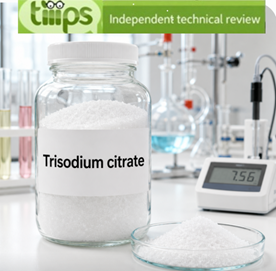
In aqueous solution it is mildly alkaline. EU specifications establish a pH between 7.5 and 9.0 for a 5% aqueous solution, which explains why it is particularly useful in formulations containing acids such as citric acid or malic acid.
Unlike citric acid itself, trisodium citrate does not primarily contribute a strongly sour taste. Instead, it can moderate acidity and help maintain a more stable pH.
Production process
Industrial trisodium citrate is generally manufactured by neutralising citric acid with a sodium source, most commonly sodium hydroxide or sodium carbonate.
The process typically involves:
preparation of an aqueous citric acid solution;
controlled addition of the sodium compound;
complete neutralisation;
purification or filtration where required;
concentration of the solution;
crystallisation;
separation of the crystals;
drying;
milling or particle-size classification;
packaging under controlled conditions.
The US regulation for sodium citrate specifically describes preparation by neutralising citric acid with sodium hydroxide or sodium carbonate and recognises both anhydrous and hydrated forms.
The degree of drying and crystallisation determines whether the commercial material is supplied as anhydrous trisodium citrate or as one of its hydrated forms.
Main substances contained
Food-grade trisodium citrate is a highly purified chemical ingredient, not a complex food matrix.
Its predominant component is trisodium citrate itself. EU specifications require an assay of not less than 99% on the anhydrous basis.
Depending on the commercial form, the material may also contain:
water of crystallisation, in the hydrated forms;
very small quantities of permitted residual impurities;
trace amounts of oxalates and regulated elemental impurities within the applicable specifications.
Water of crystallisation is structurally associated with the crystalline salt and should not be interpreted as ordinary free water added to the formulation.
Trisodium citrate is not a meaningful source of protein, fat, fibre or vitamins. Its nutritionally relevant inorganic component is sodium.
The approximate theoretical sodium content is:
26.7% in anhydrous trisodium citrate;
23.5% in the dihydrate;
19.8% in the pentahydrate.
These percentages are derived from molecular composition and are useful when estimating the sodium contribution of the ingredient to a finished food.
Identification data and specifications
| Characteristic | Value | Note |
|---|---|---|
| Name | Trisodium citrate | food additive |
| Synonyms | Sodium citrate; tribasic sodium citrate | common alternative names |
| EU number | E 331(iii) | specific form of sodium citrates |
| Codex number | INS 331(iii) | international identifier |
| Chemical class | Sodium salt of citric acid | fully neutralised citrate |
| CAS | 68-04-2 | substance identifier |
| EINECS | 200-675-3 | European identifier |
| Anhydrous formula | C₆H₅Na₃O₇ | anhydrous form |
| Hydrated formula | C₆H₅Na₃O₇·nH₂O, n = 2 or 5 | dihydrate or pentahydrate |
| Molecular weight | 258.07 g/mol anhydrous; 294.10 g/mol dihydrate; 348.16 g/mol pentahydrate | EU specification |
| Appearance | White crystalline powder or colourless crystals | food-grade material |
| Assay | ≥ 99% on anhydrous basis | EU and JECFA specification |
| pH | 7.5–9.0 | 5% aqueous solution, EU specification |
| Solubility | Freely soluble in water | JECFA specification |
| Loss on drying | ≤1.0% anhydrous; 10.0–13.0% dihydrate; ≤30.3% pentahydrate | EU specification |
| Oxalates | ≤100 mg/kg as oxalic acid after drying | EU specification |
| Arsenic | ≤1 mg/kg | EU specification |
| Lead | ≤2 mg/kg | EU specification |
| Mercury | ≤1 mg/kg | EU specification |
The identity and purity criteria are defined in current EU food-additive specifications and are broadly consistent with the JECFA monograph for trisodium citrate.
Technological behaviour
Trisodium citrate is particularly valuable because it forms part of the citric acid/citrate buffering system.
When used together with citric acid, the relative proportions of acid and citrate can be adjusted to obtain a desired pH while avoiding excessive sensory sourness.
It can also interact with calcium and other metal ions. This property is particularly important in dairy systems, processed cheese and other protein-containing foods because modification of ionic equilibria can substantially influence protein hydration, dispersion and stability.
Its high water solubility makes it especially convenient for beverages and liquid formulations.
Food use and safety evaluation
| Aspect | Evaluation |
|---|---|
| Main food functions | Acidity regulator, buffer, sequestrant and stabiliser; also used as an emulsion stabiliser/emulsifying salt in appropriate applications |
| Beverages | Helps control pH and moderate the sharpness of acidified formulations |
| Energy drinks and soft drinks | Often used alongside citric or malic acid to establish the required acid–buffer balance |
| Dairy applications | Can modify calcium equilibria and improve protein-system stability |
| Processed cheese | Can assist dispersion and emulsification of the protein/fat system |
| Other foods | Used in authorised applications including processed foods, sauces, confectionery and other formulations requiring pH or mineral-ion control |
| Nutritional contribution | Not used as a nutrient; can contribute a significant amount of sodium |
| Gluten | Intrinsically absent |
| Major regulated allergens | None intrinsic |
| JECFA safety assessment | ADI not limited / not specified |
| EU status | E 331 sodium citrates authorised under the conditions of Regulation (EC) No 1333/2008; permitted levels depend on the food category |
| UK status | E 331 Sodium citrates authorised in England, Scotland and Wales |
| USA status | Sodium citrate permitted under 21 CFR §184.1751, subject to current good manufacturing practice |
JECFA lists trisodium citrate as an acidity regulator, sequestrant and stabiliser, and its specification also identifies buffering and emulsion-stabilising uses.
In the EU, sodium citrates are authorised in numerous food categories. Many uses are at quantum satis, while other categories have specific maximum levels; therefore E 331 should not be described as universally unlimited in every food. The current Union list, for example, includes both quantum-satis uses and category-specific limits.
The UK Food Standards Agency lists E 331 Sodium citrates as authorised for food use in England, Scotland and Wales.
In the United States, 21 CFR §184.1751 permits sodium citrate in food with no limitation other than current good manufacturing practice.
Food applications
Trisodium citrate is widely used in beverages because it allows formulators to adjust the relationship between pH and perceived acidity.
For example, a beverage containing citric acid or malic acid may taste excessively sharp if only additional acid is used to establish the required pH. Addition of trisodium citrate can create a buffer system that moderates this effect and improves pH stability.
Typical applications include:
carbonated soft drinks;
energy drinks;
sports drinks;
flavoured waters;
fruit-based beverages;
confectionery;
sauces;
processed cheese;
dairy preparations;
protein beverages;
desserts;
prepared foods.
Its exact effect depends strongly on the rest of the formulation, especially the type and amount of acid, calcium content and other salts present.
Nutritional aspects
Trisodium citrate contributes essentially no nutritionally meaningful protein, fat or fibre and is not used as a source of energy.
The main nutritional consideration is its sodium content.
This is important because the sodium content declared for a finished food does not come only from sodium chloride. It can also originate from:
trisodium citrate;
sodium bicarbonate;
sodium phosphates;
sodium benzoate;
sodium lactate;
other sodium-containing ingredients.
Consequently, even a product with relatively little added table salt may contain measurable sodium from technological ingredients.
For formulation calculations, the hydration state of trisodium citrate is relevant because anhydrous, dihydrate and pentahydrate materials contain different percentages of sodium by weight.
Advantages
Trisodium citrate is highly versatile, readily soluble and effective at relatively modest concentrations.
Its principal advantages include the ability to:
provide precise control of acid–base balance;
reduce excessive sourness in strongly acidified products;
improve pH stability;
support stability in mineral- and protein-containing formulations;
improve technological performance of certain dairy and emulsified systems;
function effectively in both liquid and solid formulations;
provide predictable performance because food-grade material is highly standardised.
It is also a long-established food additive with extensive international use and a favourable toxicological assessment by JECFA.
Disadvantages
The most important nutritional limitation is the additional sodium supplied by the ingredient.
This can become relevant when substantial quantities are used or when a formulation contains several sodium salts simultaneously.
Excessive technological use can also:
raise the pH beyond the desired range;
reduce desired tartness;
produce a slightly salty, mineral or alkaline taste;
alter calcium availability in the formulation;
change protein behaviour;
modify texture or emulsion characteristics.
The statement “ADI not specified” must not be interpreted as permission to use unlimited quantities. The additive must still comply with the permitted food categories, applicable maximum levels and good manufacturing practice.
Safety
JECFA established an ADI not limited/not specified for trisodium citrate and concluded that citric acid and its calcium, potassium and sodium salts did not constitute a significant toxicological hazard under their intended food uses. The assessment particularly considered the well-established metabolic pathways of citrate.
Citrate is a normal intermediate of human metabolism and is involved in the citric acid cycle.
After ingestion, trisodium citrate dissociates into sodium and citrate ions. Citrate can enter normal physiological pathways, while sodium contributes to the body's total sodium load.
Therefore, from a nutritional standpoint, the sodium contribution may be more relevant than the citrate itself, particularly in foods consumed frequently or in formulations containing several sodium salts.
Allergens and gluten
Pure food-grade trisodium citrate is intrinsically gluten-free and is not itself one of the major food allergens requiring specific declaration under EU, UK or US allergen legislation.
This does not eliminate the need for manufacturers to control cross-contact and obtain appropriate allergen documentation from the supplier when required by their quality-management system.
The raw material used to manufacture citric acid does not automatically determine the allergen status of purified trisodium citrate. The final additive is a purified chemical salt and should be assessed on the basis of its actual specification and manufacturing controls.
Storage
Trisodium citrate should be stored:
in a dry environment;
in tightly closed containers;
protected from moisture;
away from contamination;
under the temperature and humidity conditions specified by the manufacturer.
Because it is highly water-soluble, exposure to excessive humidity can cause caking or changes in powder flow.
Correctly stored food-grade trisodium citrate is chemically stable and normally has a long shelf life.
Environment
The environmental profile of trisodium citrate depends largely on the upstream production of citric acid, the sodium compound used for neutralisation, energy consumption, water use, purification and drying.
Modern citric acid is commonly produced industrially by fermentation of carbohydrate-containing substrates, followed by purification. Conversion into trisodium citrate then requires neutralisation and crystallisation.
The actual environmental footprint therefore depends on:
feedstock origin;
fermentation efficiency;
energy source;
sodium hydroxide or sodium carbonate production;
water consumption;
drying requirements;
waste and effluent management;
transport and packaging.
Conclusion
Trisodium citrate is the fully neutralised sodium salt of citric acid and is specifically identified as E 331(iii) / INS 331(iii).
It is a highly purified, water-soluble food additive available in anhydrous and hydrated forms. EU specifications require an assay of at least 99% on the anhydrous basis, together with defined requirements for pH, water content and impurities.
Its principal value in food technology is its ability to control acid–base balance and improve formulation stability, particularly in beverages, dairy systems and processed foods. JECFA has assigned it an ADI not limited/not specified, reflecting the established metabolism and low toxicological concern of citrate at authorised food-use levels.
In Europe, the permitted amount depends on the specific food category: many uses of sodium citrates are authorised at quantum satis, while some categories have explicit maximum levels. In Great Britain, E 331 remains an authorised food additive, and in the United States sodium citrate is permitted under 21 CFR §184.1751 subject to current good manufacturing practice.
The main nutritional consideration is the sodium contribution. Anhydrous trisodium citrate contains approximately 26.7% sodium by weight, while hydrated forms contain proportionally less. Consequently, when assessing a finished food or beverage, trisodium citrate should be considered together with all other sodium-containing ingredients when evaluating the product's total sodium content.

