



Hydrolyzed Elastin: properties, uses, pros, cons, safety
Hydrolyzed Elastin is a protein-derived cosmetic ingredient obtained by hydrolysis of elastin using acids, enzymes, or other hydrolysis methods. Elastin is a structural fibrous protein found in animal connective tissues; hydrolysis breaks the insoluble macromolecule into smaller peptide fragments that are more suitable for incorporation into cosmetic formulations.
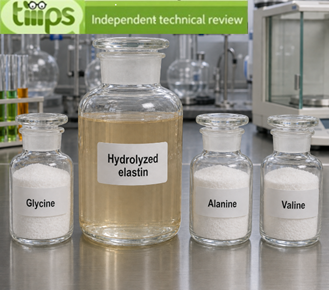
Its documented cosmetic functions are Hair Conditioning, Skin Conditioning, and Skin Conditioning – Emollient.
Description
Native elastin is a highly cross-linked, hydrophobic, and substantially insoluble protein, particularly rich in non-polar amino acid residues. In animal tissues, it is the principal structural component of elastic fibers and contributes to the ability of tissues to deform and return to their original shape.
For cosmetic use, elastin is subjected to hydrolysis, producing a mixture of peptides that are smaller than the original protein. This treatment improves its processability and compatibility with cosmetic formulations, particularly aqueous systems, compared with native elastin, which is too insoluble for practical cosmetic use.
Raw materials may originate from different animal tissues. Sources documented for hydrolyzed elastin include bovine skin and tendons, fish skin, and other animal connective tissues or ligaments.
The characteristics of the final ingredient depend significantly on the biological source, extraction process, hydrolysis method, and resulting peptide-size distribution.
Manufacturing process
Production generally begins with the isolation of elastin from the selected animal tissue. The material is washed and purified to remove unwanted components and may then be dried before hydrolysis.
Hydrolysis can be carried out using:
acids;
proteolytic enzymes;
combinations of thermal and enzymatic treatment;
other controlled methods capable of cleaving peptide bonds.
Enzymes that have been used in elastin hydrolysis include:
pancreatic elastase;
ficin;
pepsin;
trypsin.
Acid hydrolysis processes at elevated temperatures have also been described.
After hydrolysis, manufacturing may include:
pH adjustment;
filtration;
purification;
concentration;
microbiological control;
standardization of active material content;
peptide-distribution analysis;
color and odor control;
addition of a preservative system when supplied as an aqueous commercial grade.
The production process and degree of hydrolysis can significantly affect both the molecular size and the characteristics of the resulting peptides.
Main compounds present
Hydrolyzed Elastin is not a single molecule but a mixture of peptides and protein fragments derived from elastin.
Its composition depends on the animal species, source tissue, and hydrolysis process. Native elastin is particularly rich in amino acids such as:
glycine;
alanine;
valine;
proline;
leucine;
isoleucine;
phenylalanine.
The amino acid profile of elastin is characterized by a high proportion of non-polar amino acids, which distinguishes it from other structural proteins such as collagen.
A commercial grade may also contain:
water;
salts resulting from pH adjustment;
small amounts of incompletely hydrolyzed protein material;
residues from the extraction or hydrolysis process;
preservatives when the ingredient is supplied as a solution.
The actual composition should always be verified using the documentation provided for the specific commercial raw material.
Identification data and specifications
| Characteristic | Value | Note |
|---|---|---|
| INCI name | Hydrolyzed Elastin | cosmetic ingredient name |
| Definition | hydrolysate of elastin derived by acid, enzyme, or other method of hydrolysis | CosIng definition |
| Chemical category | protein hydrolysate / peptide mixture | elastin-derived ingredient |
| Origin | animal, including possible bovine or marine grades | depends on supplier |
| Molecular formula | not applicable | mixture of peptides rather than a single molecular substance |
| Molecular weight | variable; approximately 1,000–4,000 Da for several investigated grades | depends on degree of hydrolysis |
| CAS | 100085-10-7; 73049-73-7; 91080-18-1 | identifiers reported for the ingredient |
| EC | 309-148-3 (I); —; 293-509-4 | corresponding reported identifiers |
| Cosmetic functions | Hair Conditioning; Skin Conditioning; Skin Conditioning – Emollient | documented cosmetic functions |
| Cosmetics Regulation provisions | no specific provision indicated | the relevant CosIng field is blank |
Indicative physicochemical properties
| Characteristic | Indicative value | Note |
|---|---|---|
| Commercial form | aqueous solution or other supplier-prepared grade | depends on concentration and process |
| Appearance | variable | verify TDS and COA |
| Solubility/dispersibility | substantially improved compared with native elastin | consequence of hydrolysis |
| Formulation affinity | mainly aqueous systems | depends on peptide distribution |
| Behavior on skin | conditioning and emollient | cosmetic surface effect |
| Behavior on hair | conditioning | documented cosmetic use |
| Stability | dependent on pH, temperature, microbiological control, and degree of hydrolysis | verify for the commercial grade |
| Microbiological sensitivity | relevant in aqueous grades | appropriate preservation and quality control are required |
| Variability between grades | significant | biological source and processing strongly affect composition |
Cosmetics
In cosmetics, Hydrolyzed Elastin is used mainly as a skin- and hair-conditioning ingredient.
It may be incorporated into:
face and body creams;
serums;
anti-aging formulations;
lotions;
moisturizing products;
facial and body masks;
shampoos;
conditioners;
hair masks;
leave-on hair treatments;
products intended to improve softness and sensory characteristics.
On the skin, its effect is mainly cosmetic and superficial. It can contribute to conditioning, softness, and the sensory properties of the formulation.
It should not automatically be claimed that topical Hydrolyzed Elastin rebuilds, replaces, or restores the elastic fibers of the dermis. The presence of elastin-derived peptides in a cosmetic formulation does not demonstrate reconstruction of the skin's native elastin network.
On hair, the protein-derived peptides can contribute to surface conditioning and improve the sensory characteristics of the hair shaft.
Pros
It has a documented skin-conditioning function.
It has a documented emollient function.
It has a documented hair-conditioning function.
Hydrolysis makes elastin considerably easier to formulate than insoluble native elastin.
It can be used in both skin-care and hair-care products.
Available irritation studies on several hydrolyzed elastin grades have generally shown no or minimal irritation.
A human repeated-insult patch test using a preparation containing Hydrolyzed Elastin did not show irritation or sensitization under the tested conditions.
Available cosmetic safety evaluations support its use under the assessed conditions.
Cons
It is generally an ingredient of animal origin, unless the supplier specifies otherwise.
The INCI name alone does not indicate whether the material is derived from cattle, fish, or another animal source.
Composition can vary significantly according to species, tissue source, and hydrolysis method.
It does not have a single defined molecular structure because it is a mixture of peptides.
Its cosmetic effect should not be interpreted as biological reconstruction of dermal elastin.
Animal-derived raw materials require careful control of traceability, microbiological quality, and source safety.
Fish-derived grades may require additional consideration for people sensitized to fish proteins.
The effectiveness and sensory behavior can differ substantially between commercial grades.
Safety, regulation and environment
The Expert Panel for Cosmetic Ingredient Safety evaluated Hydrolyzed Elastin as part of its assessment of proteins and peptides derived from skin and connective tissue. Hydrolyzed Elastin was considered safe in cosmetics under the practices of use and concentrations evaluated.
Available data are generally favorable regarding skin and eye irritation. Several bovine- and marine-derived grades evaluated in safety studies were reported as non-irritating or minimally irritating.
A human repeated-insult patch test conducted in 52 subjects with a preparation containing Hydrolyzed Elastin at 25% w/v in corn oil did not produce skin irritation or sensitization. This is a safety-study concentration and should not be interpreted as a regulatory maximum use level.
EU Cosmetics Regulation provisions
In the CosIng information provided for Hydrolyzed Elastin, the field “Cosmetics Regulation provisions” is blank.
Therefore, no specific provision under the Annexes of the EU Cosmetics Regulation is indicated for this ingredient, unlike ingredients for which CosIng explicitly reports provisions such as III/62 or IV/119.
This does not mean that every commercial grade is automatically suitable for cosmetic use. Safety must still be established for the actual raw material, its biological origin, its impurity profile, and the finished cosmetic product.
Animal origin and allergy considerations
The biological origin of the raw material is an important point.
Protein ingredients derived from fish may be relevant to individuals sensitized to fish proteins. A case of sensitization involving elastin derived from cod has been reported in a cosmetic context, in a subject with IgE antibodies against several fish proteins.
This does not mean that Hydrolyzed Elastin should generally be considered a strong allergen. Specific sensitization studies on evaluated hydrolyzed elastin preparations have generally been negative. Nevertheless, the protein source and degree of hydrolysis should be known, particularly for consumers with established fish allergy.
Bovine-derived raw materials
For bovine-derived grades, a controlled and traceable supply chain is important. Animal-derived materials require appropriate controls to reduce microbiological and biological contamination risks.
For relevant bovine grades, documentation such as BSE/TSE declarations or certificates should be obtained where appropriate.
For professional evaluation of the raw material, it is advisable to request:
an updated SDS;
a Certificate of Analysis (COA);
technical data sheet;
animal species and tissue of origin;
declaration of bovine, marine, or other origin;
BSE/TSE certification, where applicable;
peptide-size distribution;
active matter content;
amino acid profile, where available;
purity data;
hydrolysis-process residues;
relevant metals and other impurities;
microbiological specifications;
preservative system, if present;
pH;
stability data;
available irritation and sensitization data.
From an environmental perspective, the profile depends on the biological source, extraction and hydrolysis process, other components of the commercial grade, and the quantities actually released.
A meaningful environmental assessment should consider:
origin and traceability of the animal material;
use of biological resources;
processing requirements;
biodegradation of peptides;
wastewater treatment;
sustainability of the supply chain;
environmental impact of associated preservatives or processing residues.
A favorable environmental judgment should not be assigned solely because the ingredient is protein-derived or naturally sourced.
Conclusion
Hydrolyzed Elastin is an elastin-derived protein hydrolysate used primarily for skin conditioning, emollience, and hair conditioning. Hydrolysis converts highly insoluble native elastin into smaller peptide fragments that are much easier to incorporate into cosmetic formulations.
The available cosmetic safety profile is generally favorable, and the evaluated hydrolyzed elastin preparations have not shown significant irritation or sensitization under the tested conditions.
No specific “Cosmetics Regulation provisions” are indicated in the CosIng information provided.
Important quality and safety considerations nevertheless remain, particularly animal origin, possible marine origin, allergy considerations in sensitized individuals, microbiological quality, traceability, peptide distribution, and BSE/TSE documentation for relevant bovine grades.
For Tiiips, Hydrolyzed Elastin can therefore be regarded as a generally favorable cosmetic ingredient when the raw material is appropriately documented and controlled, while avoiding unsupported claims that topical use can directly rebuild or replace the skin's native dermal elastin.

