



Vitis vinifera seed oil: properties, uses, pros, cons, safety
Vitis Vinifera Seed Oil, commonly known as grape seed oil, is the fixed oil obtained from the seeds of Vitis vinifera (Vitaceae). In cosmetics it is used mainly as an emollient and skin conditioning ingredient, as also reported in the attached CosIng screenshot. It is a light vegetable oil, rich in fatty acid triglycerides, particularly appreciated in skin care, hair care, massage oils, body products, emulsions, facial oils, balms, and formulas where a not-too-heavy skin feel is desired.
Description
Grape seed oil is a plant-derived raw material obtained from grape seeds, often as a valorization of by-products from the wine industry. From a chemical standpoint, it is not a single molecule, but a natural mixture of triglycerides, with a very high proportion of unsaturated fatty acids, especially linoleic acid, and smaller amounts of oleic, palmitic, stearic, and other minor components.
In cosmetics, its main role is emollient: it helps make the skin softer, reduces the feeling of superficial dryness, and improves formula spreadability. Compared with heavier oils or oils very rich in saturated fatty acids, it tends to be perceived as lighter and less greasy, although the real sensory profile depends on refining grade, quality, oil blend, and percentage of use.
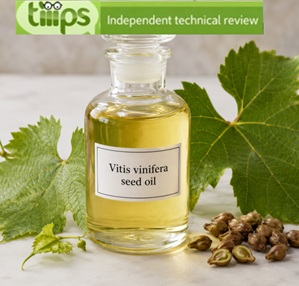
It is important to distinguish grape seed oil from grape seed extract. The oil is mainly lipidic; the extract may instead be richer in polyphenols, procyanidins, and water-soluble or hydroalcohol-soluble compounds. Many strong antioxidant claims referring to “grape seed extract” cannot be automatically transferred to the simple oil.
Production process
Production starts from grape seeds. After separation from grape pomace, the seeds are cleaned, dried, and subjected to mechanical pressing or solvent extraction, possibly followed by refining. Some technical sheets describe refined grape seed oil as a fatty oil obtained from the seeds of Vitis vinifera by extraction or expression and subsequent refining.
Cold pressing is more valued commercially because it limits solvent use and may better preserve some minor fractions, but it often provides lower yields. Solvent extraction can increase yield, but requires strict control of residues. Refining can improve color, odor, stability, and purity, but may reduce some naturally occurring minor compounds.
After extraction, the usual steps include filtration, possible neutralization, bleaching, deodorization, and control of acidity, peroxide value, iodine value, fatty acid profile, solvent residues, pesticides, heavy metals, and oxidative stability.
Main compounds present
Vitis Vinifera Seed Oil consists mainly of triglycerides containing fatty acids:
linoleic acid, normally the main one;
oleic acid;
palmitic acid;
stearic acid;
small amounts of linolenic acid and other minor fatty acids;
unsaponifiable fraction with tocopherols, phytosterols, and minor compounds in variable amounts.
The literature reports that grape seed oil is rich in unsaturated fatty acids and that its content may vary depending on grape variety and growing conditions. A 2022 paper indicates, as approximate ranges, about 61-73% linoleic acid, 14-25% oleic acid, and a very low proportion of linolenic acid, with about 85-90% total unsaturated fatty acids.
Identification data and specifications
| Characteristic | Value | Note |
|---|---|---|
| INCI name | Vitis Vinifera Seed Oil | cosmetic designation |
| Common name | grape seed oil | common designation |
| Botanical name | Vitis vinifera | European grapevine |
| Botanical family | Vitaceae | botanical family |
| Part used | seeds | grape seeds |
| Chemical category | vegetable oil / fatty acid triglycerides | natural mixture, not a single molecule |
| CAS | 85594-37-2 / 84929-27-1 / 8024-22-4 | from the attached CosIng screenshot and technical sheets |
| EC | 287-896-9 / 284-511-6 / - | from the attached CosIng screenshot and technical sheets |
| CosIng Ref. | 80653 | reported by INCI databases |
| CosIng functions | skin conditioning - emollient; skin conditioning | from the attached CosIng screenshot |
| INCI description | fixed oil consisting mainly of fatty acid glycerides, obtained by pressing grape seeds | description reported in INCI databases |
| Food use | edible oil, if food grade | nutritional/culinary use, distinct from cosmetic grade |
| Visible specific cosmetic restrictions | none in the attached screenshot | finished product assessment remains necessary |
Indicative physicochemical and compositional properties
| Characteristic | Indicative value | Note |
|---|---|---|
| Appearance | clear oily liquid | typical of vegetable oils |
| Color | pale yellow to green-yellow or light yellow | depends on refining and batch |
| Odor | mild, characteristic, oily | more neutral in refined grades |
| Water solubility | insoluble | requires emulsion or oil phase |
| Oil solubility | miscible with vegetable oils and lipophilic esters | useful in fatty phases |
| Density | about 0.91-0.93 g/mL | typical indicative value for vegetable oils |
| Acidity | variable | check acid value/FFA |
| Peroxide value | critical parameter | indicates oil oxidation |
| Main profile | rich in linoleic acid | variable by origin and grade |
| Oxidative stability | moderate, to be controlled | high proportion of polyunsaturated fatty acids |
| Cosmetic skin feel | light, emollient, spreadable | depends on formula and refining |
| Main technical risk | rancidity/oxidation | protect from air, light, and heat |
Food
In the food sector, grape seed oil may be used as an edible oil, if produced and marketed as food grade. It is rich in unsaturated fatty acids, especially linoleic acid, and may be used in dressings, cold preparations, and some culinary applications. However, food grade must be distinguished from cosmetic grade: the same botanical designation is not enough to guarantee suitability for consumption.
From a nutritional standpoint, the favorable profile is mainly linked to the presence of unsaturated fatty acids. However, like all oils, it remains a very calorie-dense food and should be used in reasonable amounts. The high proportion of polyunsaturated fatty acids also requires attention to storage, because oxidation can worsen sensory and nutritional quality.
The benefits of grape seed extracts should not be automatically attributed to grape seed oil. The extract may be much richer in procyanidins and polyphenols, whereas the oil is mainly a lipid fraction. Some reviews indicate interest in grape seed oil in food and cosmetic contexts, but many biological activities are observed mainly in in vitro or experimental studies and should not automatically become health claims for the finished product.
Cosmetics
In cosmetics, Vitis Vinifera Seed Oil is used as an emollient and skin conditioning agent. It may appear in face creams, body lotions, massage oils, oil serums, lip balms, hair products, masks, cleansing oils, body butters, make-up, and products for skin requiring a relatively light oil.
The emollient function consists of improving softness, spreadability, and superficial comfort. It can also help reduce the feeling of dryness and improve the distribution of other lipophilic ingredients. In hair products it can help make the fiber softer and shinier, especially in leave-on products or nourishing masks.
Vitis Vinifera Seed Oil is not a fragrance and is not among fragrance allergens. The main issue is therefore not allergen labeling, but oxidative quality: an old, oxidized, or poorly stored oil may have an unpleasant odor and a higher irritant potential.
Pros
It is a light and versatile vegetable oil.
It works well as an emollient and skin conditioning ingredient.
It has a good linoleic acid content, useful for the cosmetic profile of light oils.
It can improve skin softness, spreadability, and comfort.
It can be used in skin care, body care, hair care, make-up, and massage oils.
It derives from grape seeds, often as a valorization of by-products from the wine industry.
It is not a fragrance allergen and has no perfuming function.
CIR indicated that Vitis Vinifera Seed Oil and Hydrogenated Grapeseed Oil had been assessed and concluded safe as used in cosmetics.
Cons
It is not a strong dermatological active: its function is mainly emollient and formulation-related.
Its high proportion of unsaturated fatty acids makes it more sensitive to oxidation than more saturated oils.
It may become rancid if exposed to light, air, heat, or prolonged storage.
Quality varies greatly between refined, virgin, cold-pressed, or solvent-extracted oil.
Antioxidant claims should not be overstated: the oil is not equivalent to grape seed extract.
On very sensitive or acne-prone skin, as with any oil, tolerability must be verified in the finished product.
If intended for food use, food grade is required; cosmetic grade must not be consumed.
Plant origin does not automatically guarantee sustainability, absence of pesticides, or high quality.
Safety, regulatory aspects, and environment
From a cosmetic standpoint, Vitis Vinifera Seed Oil is generally considered a low-concern ingredient when fresh, well stored, compliant with cosmetic grade, and used in properly assessed formulas. CIR reports that the safety of Vitis Vinifera Seed Oil and Hydrogenated Grapeseed Oil had already been assessed in 2011, with a conclusion of safety as used in cosmetics. A later CIR publication on Vitis vinifera derivatives also reports that the evaluated grape-derived ingredients function mainly as skin-conditioning agents and were considered safe under the assessed cosmetic practices of use and concentration.
The most important practical risk is oxidation. An oxidized oil can worsen odor, color, formula stability, and skin tolerability. For this reason, peroxide value, acid value, storage in tightly closed containers, protection from light and heat, use within shelf life, and, where appropriate, formulation antioxidants such as tocopherol are important.
No specific cosmetic provisions are shown in the “Cosmetics Regulation provisions” section of the attached CosIng screenshot. This does not remove the obligation to perform a safety assessment of the finished cosmetic product: concentration, oil quality, possible impurities, product category, application area, stability, and compatibility with the rest of the formula must always be considered.
From an environmental standpoint, grape seed oil is interesting because it may valorize seeds obtained as a by-product of grape and wine processing. However, the real profile depends on grape cultivation, pesticide use, drying/extraction energy, extraction method, refining, transport, packaging, and waste management. Origin as a by-product is favorable, but not sufficient on its own to demonstrate overall sustainability.
For correct cosmetic use, it is advisable to request from the supplier:
updated SDS;
certificate of analysis;
fatty acid profile;
acid value / free fatty acids;
peroxide value;
iodine value;
color and odor;
possible solvent residues;
pesticides and heavy metals, when relevant;
geographical origin and extraction method;
cosmetic-grade declaration;
possible organic, COSMOS, vegan, or palm-free certification, if claimed;
shelf life and storage conditions.
Conclusion
Vitis Vinifera Seed Oil is a very useful cosmetic vegetable oil as an emollient and skin conditioning agent. Its main value is formulation-related and sensory: it makes the skin softer, improves spreadability, and allows the creation of oil-based or emulsified formulas with a relatively light touch.
Professional assessment must avoid two simplifications: not all benefits of grape seed extracts automatically apply to the oil, and not all grape seed oils have the same quality. The decisive points are extraction method, refining, fatty acid profile, peroxide value, acidity, freshness, storage, origin, and supplier documentation.
In a well-designed formula, with fresh and controlled oil, Vitis Vinifera Seed Oil is generally a favorable and versatile ingredient. The points to control are oxidation, purity, stability, SDS, COA, formulation compatibility, concentration in the finished product, and consistency between cosmetic or food grade and intended use.

