



MIPA-laureth sulfate: properties, uses, pros, cons, safety
MIPA-Laureth Sulfate is an ethoxylated anionic surfactant used mainly in cosmetics as a cleansing and surfactant-cleansing ingredient. The standard INCI spelling is usually sulfate, while sulphate is the British variant. It is used mainly in rinse-off products such as shampoos, shower gels, shower oils, body cleansers, and cleansing formulas where detergency, foam, solubilization, and good compatibility with oily or mixed surfactant systems are needed.
The most important regulatory point is that the ingredient is linked to Annex III/61 of the European Cosmetics Regulation, concerning monoalkylamines, monoalkanolamines and their salts. The restriction mainly concerns the control of secondary amines and nitrosamines: it must not be used with nitrosating systems, and purity, nitrosamine limits, and storage in nitrite-free containers must be controlled.
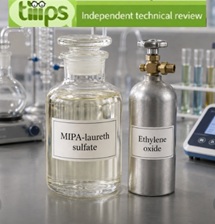
Description
MIPA-Laureth Sulfate is the monoisopropanolamine salt of a lauryl ether sulfate, meaning a sulfated and ethoxylated lauryl alcohol. COSMILE clarifies that “MIPA” indicates an alkylamine group or a salt of monoisopropanolamine, while “laureth sulfate” indicates lauryl ether sulfates or dodecylpoly(oxyethylene) sulfates.
Its structure is typical of a surfactant: a lipophilic portion derived from the lauryl chain and an anionic sulfate head, associated with the MIPA counterion. This allows the ingredient to reduce surface tension, help disperse sebum and dirt, improve rinsing, and contribute to foam formation.
Compared with Sodium Lauryl Sulfate, laureth sulfates are generally perceived as easier to manage and more suitable for modern cosmetic systems, but they should not automatically be described as “mild” in an absolute sense. Like all anionic cleansing surfactants, tolerability depends on concentration, pH, co-surfactants, presence of emollients, contact time, and skin type.
Production process
The industrial process normally starts from a lauryl fatty alcohol or a C12-C14 fraction, which is ethoxylated with ethylene oxide, then sulfated, and finally neutralized with monoisopropanolamine to obtain the MIPA salt. The final substance is not a perfectly single molecule, but a technical mixture with a variable average degree of ethoxylation. The Australian public report describes the substance as 2-Propanol, 1-amino-, compound with α-sulfo-ω-(dodecyloxy)poly(oxy-1,2-ethanediyl) (1:1), with n generally ranging from 1 to 4.
After synthesis, the usual steps include neutralization, purification, control of active matter, pH, color, odor, solvents, residual salts, secondary amines, nitrosamines, 1,4-dioxane where relevant to the ethoxylated supply chain, and formulation compatibility. In commercial grades, MIPA-Laureth Sulfate may be supplied as a concentrated liquid, solution, blend with propylene glycol, blend with other surfactants, or component of systems for shower oils and anhydrous cleansers.
Main compounds present
In the commercial grade, the main component is MIPA-Laureth Sulfate, namely the MIPA salt of lauryl ether sulfate. Depending on the commercial grade, the following may also be present:
water or technical solvents;
propylene glycol, in some concentrated grades;
lauryl/laureth sulfates with different degrees of ethoxylation;
inorganic salts, such as residual chlorides and sulfates;
free monoisopropanolamine;
traces of secondary amines;
possible residues related to the ethoxylation or sulfation process.
This variability makes it essential to distinguish between INCI name, commercial grade, active matter content, solvent, pH, impurities, and regulatory compliance declaration. One commercial grade, Hydriosul LMP.90, for example, is described as an anhydrous anionic surfactant with CAS 9062-04-8 / 83016-76-6, clear to cloudy pale-yellow/yellow appearance, about 90% concentration, about 8% 1,2-propylene glycol, and pH 6.0-8.0 in a 10% solution.
Identification data and specifications
| Characteristic | Value | Note |
|---|---|---|
| INCI name | MIPA-Laureth Sulfate | official cosmetic designation |
| Spelling variant | MIPA-laureth sulphate | British/non-INCI spelling |
| Descriptive chemical name | Lauryl alcohol, polymer with oxirane, sulfuric acid ester, 2-hydroxy-1-aminopropane salt | technical description |
| Chemical category | anionic surfactant / alkyl ether sulfate | MIPA salt of lauryl ether sulfate |
| Molecular formula | C3H9NO.(C2H4O)nC12H26O4S | n variable, technical mixture |
| Molecular weight | variable; about 384 g/mol in the NICNAS report for n = 1 | depends on degree of ethoxylation |
| CAS | 83016-76-6 / 9062-04-8 | references reported by INCI and technical sources |
| EC | not clearly unique in the public sources consulted | verify on supplier SDS |
| CosIng Ref. | 76978 | reference reported by INCI databases |
| Cosmetic functions | cleansing; surfactant-cleansing | according to COSMILE/CosIng-derived data |
| EU restriction | Annex III/61 | monoalkylamines, monoalkanolamines and their salts |
| Key regulatory point | control of secondary amines and nitrosamines | do not use with nitrosating systems |
Indicative physicochemical properties
| Characteristic | Indicative value | Note |
|---|---|---|
| Appearance | clear to slightly cloudy liquid; sometimes paste or blend | depends on commercial grade |
| Color | colorless, pale yellow, or yellow | varies with concentration and supplier |
| Odor | characteristic surfactant odor | depends on purity and solvent |
| Ionic nature | anionic | sulfate head |
| Water solubility | good | typical of laureth sulfates |
| Compatibility | good with many anionic, amphoteric, and non-ionic surfactants | to be verified in the formula |
| Indicative pH | about 5.5-8.0 depending on commercial grade | check technical sheet |
| Viscosity | moderate to high | depends on active matter, solvents, and salts |
| Foam | good / high | useful in shampoos and cleansers |
| Formulation sensitivity | salts, pH, co-surfactants, oils, solvents | requires stability testing |
| Main technical risk | skin/eye irritation as concentrated raw material | depends on concentration and formula |
Food
MIPA-Laureth Sulfate has no relevant food role. It is not a nutrient, not a flavouring, and not a common food additive. Its function is linked to cosmetics and cleansing, not food consumption.
For food assessment, therefore, the food focus is not relevant. Any systemic toxicological data are useful for the safety assessment of the substance and finished product, but they do not make the ingredient a food raw material.
Cosmetics
In cosmetics, MIPA-Laureth Sulfate is used mainly as a cleansing surfactant. COSMILE reports the functions cleansing and surfactant-cleansing, meaning cleaning of skin, hair, or teeth and surfactant washing activity.
It may appear in shampoos, shower gels, shower oils, facial cleansers, body cleansers, hair products, hand cleansers for heavy dirt, cleansing scrubs, and cleansing systems where good dispersion of oils and dirt is needed. It is particularly interesting in oil-based cleansing products or systems where an oily phase must be combined with cleansing capacity.
In a well-balanced finished product, it can contribute to foam, cleansing performance, and sensory quality. However, because it is an anionic surfactant, it may be irritating or degreasing if used at high concentrations, if the system is poorly balanced, or if it is applied to sensitive or compromised skin, eyes, or mucous membranes.
Pros
It is an effective anionic surfactant for cleansing and removal of sebum, oils, and impurities.
It offers good foaming capacity and can improve the sensory profile of shampoos and cleansers.
It is useful in rinse-off systems and formulas requiring compatibility with oily components.
It can be formulated with amphoteric surfactants, non-ionics, and emollients to mitigate cleansing harshness.
It is more versatile in technical systems than many simple surfactants.
Concentrated commercial grades can be useful in anhydrous formulas, shower oils, or soluble-film systems.
It is well framed from a regulatory standpoint, with specific reference to Annex III/61.
Cons
It is not a food ingredient and has no nutritional value.
It is an anionic surfactant: it may irritate skin and eyes if the formula is not well designed.
It is not automatically “mild” simply because it is a laureth sulfate.
Quality depends greatly on active matter, pH, residual salts, solvents, secondary amines, nitrosamines, and impurities.
Being ethoxylated, it requires attention to process residues typical of this supply chain.
The MIPA counterion requires regulatory attention regarding amines and nitrosamines.
It is more suitable for rinse-off products than for leave-on formulas.
It should not be used or assessed without checking SDS, COA, and Annex III/61 compliance.
Safety, regulatory aspects, and environment
From a cosmetic standpoint, MIPA-Laureth Sulfate must be assessed mainly as an anionic cleansing surfactant and as a salt of a monoalkanolamine. The European restriction linked to Annex III/61 should not be read as a simple detergency limit, but as a quality and safety control concerning secondary amines and nitrosamines: maximum secondary amine content, no use with nitrosating systems, minimum purity, nitrosamines within the permitted limit, and nitrite-free containers.
The NICNAS/Australian Industrial Chemicals public report on MIPA-Laureth sulfate indicates that direct data were limited and that the assessment also relied on analogues. It concludes that the substance is likely to have low acute oral and dermal toxicity, is not likely to be a sensitizer, and is not likely to be genotoxic, but is likely to be irritating to skin and eyes, with a mild-to-moderate irritant profile by analogy with Sodium Laureth Sulfate.
The same report classifies the substance as irritating to eyes and skin according to the criteria cited, but also indicates that, in the assessed rinse-off product scenario, there was no significant concern for public health when used as described.
CIR, in its assessment of Sodium Laureth Sulfate and related salts of sulfated ethoxylated alcohols, reports that irritancy potential exists, but that these ingredients are not normally irritating in practice when properly formulated; the conclusion is favorable when they are formulated to be non-irritating. This reference concerns related ingredients and does not replace the specific MIPA-Laureth Sulfate dossier, but it is useful for framing the laureth sulfate family.
From a formulation standpoint, greater caution is needed in:
products with high surfactant concentration;
products for eyes or periocular areas;
products for mucous membranes;
products for children;
sensitive, dry, atopic, or compromised skin;
leave-on formulas;
systems with nitrites or potential nitrosating agents;
formulas with amines, amides, or other ingredients susceptible to nitrosamine formation.
For correct cosmetic use, it is advisable to request from the supplier:
updated SDS;
certificate of analysis;
active matter content;
pH;
secondary amine content;
nitrosamine content;
declaration “not to be used with nitrosating systems”;
nitrite-free container declaration;
possible 1,4-dioxane control if relevant to the ethoxylated supply chain;
residual salts, chlorides, and sulfates;
origin of the fatty fraction;
declaration of compliance with the EU Cosmetics Regulation;
skin/eye irritation or tolerability testing on the finished product;
challenge test if the formula is aqueous.
From an environmental standpoint, the NICNAS report indicates that alkyl ether sulfates are expected to be readily biodegradable under aerobic and anaerobic conditions and are not considered bioaccumulative in aquatic organisms; in the assessed use scenario, risk to the aquatic environment was not considered unacceptable. This does not remove the need to assess the finished product, especially for rinse-off products discharged into wastewater.
Conclusion
MIPA-Laureth Sulfate is a technical cosmetic ingredient, useful mainly as an anionic cleansing surfactant in shampoos, shower gels, shower oils, and cleansing systems. Its main value is formulation-related: cleansing, foam, dispersion of oils and impurities, compatibility with complex surfactant systems, and good performance in rinse-off products.
Professional assessment must, however, be cautious. It is not a food ingredient, not a dermatological active, and should not be automatically defined as mild. The critical points are skin/eye irritation, concentration, pH, surfactant system, presence of emollients, process impurities, secondary amines, nitrosamines, and compliance with Annex III/61.
In a well-designed formula, intended mainly for rinsing and supported by complete supplier documentation, it can be a functional and acceptable ingredient. The points to control are SDS, COA, active matter, pH, secondary amines, nitrosamines, residual salts, possible ethoxylation contaminants, skin/eye tolerability, and behavior of the finished product.

