



Levulinic acid: properties, uses, pros, cons, safety
Levulinic Acid is a ketonic organic acid of natural, synthetic, or bio-based origin. In cosmetics it is used mainly as a skin conditioning and perfuming ingredient, as also shown in the CosIng sheet you attached. From a formulation standpoint, it is interesting because it combines a simple structure, good water solubility, and a profile compatible with acidic or moderately acidic cosmetic products. However, its assessment should be distinguished from that of its salt, Sodium Levulinate, which is often used in combination and behaves similarly in aqueous solution. CIR evaluates Levulinic Acid and Sodium Levulinate together, indicating that both function as skin conditioning agents, while Levulinic Acid is also reported as a fragrance ingredient.
Description
Levulinic Acid, also known as 4-oxopentanoic acid, γ-ketovaleric acid, or 3-acetylpropionic acid, is a small organic molecule containing both a carboxylic group and a ketone group. This dual functionality makes it useful both as a cosmetic ingredient and as a chemical intermediate for the synthesis of derivatives, solvents, esters, plasticizers, and bio-based molecules.
In cosmetics its main role is not that of a strong dermatological “active”, but rather that of a technical-functional ingredient: it can contribute to skin feel, fragrance, or masking of base formulation odors. In many formulas it is also associated with Sodium Levulinate or other organic ingredients to support formulation stability, although it should not automatically be confused with a preservative authorized under Annex V.
It is also naturally present in some natural or processed foods, but in this context its role is not nutritional: it can mainly be considered an aromatic compound or flavouring substance in regulated applications. CIR reports its natural presence in foods such as papaya, rice, sake, and wheat bread.
Production process
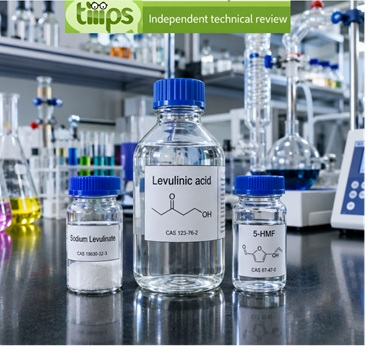
Levulinic Acid can be obtained through different supply chains. One of the most relevant industrial routes is the conversion of carbohydrate-rich biomass, such as cellulose, wood, starch crops, sugars, organic waste, or algae. In general, polysaccharides are hydrolyzed into sugars, then converted through intermediates such as 5-hydroxymethylfurfural (5-HMF) and subsequently rehydrated to obtain Levulinic Acid.
This potentially bio-based origin is one of the most interesting aspects of the ingredient, because Levulinic Acid is also considered a chemical platform for derivatives useful in solvents, biofuels, polymers, plasticizers, and other industrial intermediates. However, “bio-based” does not automatically mean safer or more sustainable: actual quality depends on the process, purity, acid residues, by-products, energy used, and supplier specification.
After synthesis, the usual steps include purification, decolorization, acidity control, assay, moisture control, metals, process residues, and stability checks. For cosmetic use, it is important to have an SDS, certificate of analysis, purity specification, and declaration of compliance with cosmetic regulations.
Main compounds present
In the pure grade, the main compound is Levulinic Acid. Commercial grades may contain small amounts of water, organic impurities, acid residues, by-products from carbohydrate conversion, or traces of intermediates related to the production process.
The most important related compound in cosmetics is Sodium Levulinate, the sodium salt of Levulinic Acid. In aqueous solution, Levulinic Acid and Sodium Levulinate are closely connected from a chemical standpoint, because they depend on pH and on the equilibrium between the acidic form and the dissociated form. CIR evaluates them together precisely because, in water, the acid form and the salt are functionally and chemically related.
Identification data and specifications
| Characteristic | Value | Note |
|---|---|---|
| Common name | Levulinic acid | common designation |
| INCI name | Levulinic Acid | cosmetic designation |
| Chemical name | 4-oxopentanoic acid | IUPAC/common designation |
| Synonyms | γ-ketovaleric acid; 3-acetylpropionic acid; 4-oxovaleric acid | technical synonyms |
| Chemical category | keto-carboxylic acid | organic acid with ketone function |
| Molecular formula | C5H8O3 | compound formula |
| Molecular weight | about 116.11 g/mol | theoretical value |
| CAS | 123-76-2 | reported in the attached CosIng sheet |
| EC | 204-649-2 | reported in the attached CosIng sheet |
| CosIng functions | skin conditioning; perfuming | from the attached CosIng sheet |
| Related substance | Sodium Levulinate | sodium salt of Levulinic Acid |
| Sodium Levulinate CAS | 19856-23-6 | sodium salt |
| Food use | flavouring agent | aromatic use, not nutritional |
| Specific EU cosmetic restrictions | not shown in the attached CosIng screenshot | always verify the updated sheet and supplier dossier |
Indicative physicochemical properties
| Characteristic | Indicative value | Note |
|---|---|---|
| Appearance | solid or low-melting material | may also appear as a liquid/solidified material depending on temperature |
| Color | white, pale yellow, or yellow-brown depending on grade | depends on purity and process |
| Odor | mild, acidic, sometimes caramel-like | relevant for fragrance/flavour use |
| Water solubility | high | useful in aqueous formulas |
| Alcohol solubility | good | useful in fragrances and flavours |
| Density | about 1.14 g/cm³ | indicative value |
| Melting/solidification point | about 27-35 °C depending on source and grade | may solidify at room temperature |
| Boiling point | about 245 °C | indicative value |
| Log Kow | about -0.5 estimated | hydrophilic compound |
| pH in solution | acidic | depends on concentration and neutralization |
CIR reports that Levulinic Acid and Sodium Levulinate are highly soluble in water; Levulinic Acid is described as a solid with a low melting point and limited granularity, while Sodium Levulinate is a white or off-white solid. JECFA specifications for flavouring use report a yellow to brown appearance, possible solidification, a slight caramel-like odor, solubility in water/alcohol/oil, a boiling point around 245 °C, and minimum purity of 97%.
Food
In the food sector, Levulinic Acid may be used as a flavouring agent, not as a nutrient. The JECFA database identifies it as a flavouring substance with FEMA No. 2627 and JECFA No. 606, with the assessment “no safety concern at current levels of intake when used as a flavouring agent”.
Its food contribution is therefore sensory, linked to acidic, caramel-like, or aromatic notes, not health-related. Assessment must refer to food grade, purity, dosage, flavouring compliance, and overall exposure.
In the United States, the FDA lists it among substances added to food as a flavor enhancer and flavoring agent or adjuvant, with reference FEMA 2627 and 21 CFR 172.515.
Cosmetics
In cosmetics, Levulinic Acid is used as skin conditioning and perfuming, according to the attached CosIng sheet. CIR consistently reports that Levulinic Acid and Sodium Levulinate are skin conditioning agents, while Levulinic Acid is also a fragrance ingredient.
It may appear in creams, lotions, cleansers, shampoos, hair products, body products, deodorants, natural/bio-oriented formulations, and cosmetic systems where acidic support, a sensory function, or better compatibility with alternative preservation systems is desired. In many cases it is used together with Sodium Levulinate, because the salt is easier to manage in aqueous formulas and can contribute to system stability.
An important point is not to overinterpret its function. Levulinic Acid may be mentioned in contexts related to microbiological control, but it should not automatically be presented as a regulatory preservative unless it is classified and authorized as such under the applicable regulation. It is more prudent to describe it as an ingredient that can support the formulation system, while preservative efficacy of the finished product must be demonstrated by challenge testing.
Pros
It has a simple and well-known structure.
It can derive from biomass, sugars, cellulose, wood, or other renewable sources.
It is highly water-soluble and therefore useful in many aqueous cosmetic formulas.
In cosmetics it performs skin conditioning and perfuming functions.
It can be used in combination with Sodium Levulinate in acidic or moderately acidic cosmetic systems.
It is also of interest as a food flavouring, with regulated sensory use.
CIR considers it safe, together with Sodium Levulinate, in the practices of use and concentration assessed, when formulated to be non-irritating.
Cons
It is not a nutritional food ingredient: in food it has an aromatic function.
It may be irritating, especially as a concentrated raw material or in formulas that are too acidic.
Its cosmetic function should not be confused with a deep dermatological action.
It should not automatically be presented as a complete preservative without verification in the finished product.
It may modify the pH of the formula and requires formulation control.
CIR notes attention for its possible ability to increase skin penetration of other ingredients under specific experimental conditions.
Quality depends on purity, origin, production process, residues, and supplier documentation.
Safety, regulatory aspects, and environment
From a cosmetic standpoint, the most solid available assessment is that of the Cosmetic Ingredient Review, which concludes that Levulinic Acid and Sodium Levulinate are safe in cosmetics under the described practices of use and concentration, when formulated to be non-irritating. This clarification is important: safety does not depend only on the INCI name, but on concentration, pH, product type, application area, frequency of use, and the entire formula.
The most realistic risk is irritation, especially for eyes, mucous membranes, or sensitive skin if pH or concentration is not well controlled. CIR also reports that Levulinic Acid showed potential ocular irritation in vitro, up to results compatible with serious eye damage in a BCOP assay; this datum concerns the substance or test conditions and does not automatically imply the same risk in the finished cosmetic product, but it requires formulation caution.
In the CIR sources consulted, Levulinic Acid and Sodium Levulinate were not reported as subject to specific restrictions in the European Union; in the attached CosIng screenshot, the “Cosmetics Regulation provisions” section also appears empty. This does not remove the obligation to assess safety, purity, and tolerability of the finished product.
From an environmental standpoint, Levulinic Acid is interesting because it can be produced from biomass and belongs to the group of bio-based chemical platforms. However, real sustainability depends on biomass source, conversion process, use of acids/catalysts, purification, energy consumption, and by-product management. It is not correct to automatically infer a favorable environmental profile only because it can be produced from renewable raw materials.
For correct cosmetic use, it is advisable to request from the supplier:
updated SDS;
certificate of analysis;
purity and assay;
pH or acidity;
impurities and process residues;
declaration of EU cosmetic compliance;
irritation/tolerability data, if available;
clarification of the function declared in the formula;
challenge test of the finished product if the ingredient is used to support preservation.
Conclusion
Levulinic Acid is a versatile and technically interesting ingredient, useful mainly as a skin conditioning, perfuming, acidifying/formulation ingredient, and bio-based building block. In cosmetics it can be favorable when used in a controlled way, often in combination with Sodium Levulinate or other compatible components.
Professional assessment must avoid two errors: presenting it as a strong dermatological active or automatically considering it a complete preservative. The decisive point is the finished product: pH, concentration, preservative system, skin/eye tolerability, and supplier documentation determine real safety.
In a well-designed formula, with controlled pH and documented raw material, Levulinic Acid is generally a favorable ingredient. The points to control are purity, acidity, concentration, irritation potential, formulation compatibility, SDS, COA, and experimental verification of stability and tolerability of the finished cosmetic product.

