



Mentha piperita oil: properties, uses, pros, cons, safety
Mentha piperita oil, commonly known as peppermint essential oil or peppermint oil, is the volatile oil obtained from Mentha piperita, an aromatic plant of the Lamiaceae family. It is a raw material used in cosmetics, perfumery, oral care, detergency and, in specific contexts, also as a food flavouring. Its olfactory profile is typically fresh, mentholated, herbaceous, balsamic and pungent.
From a cosmetic standpoint, the most important point is regulatory: Mentha piperita oil is included in Annex III, entry 361, of the European Cosmetics Regulation as a substance to be declared on the label when it exceeds 0.001% in leave-on products and 0.01% in rinse-off products. This obligation is in addition to the assessment of individual components present in the oil, such as Menthol, Limonene, Linalool or other potentially relevant allergens.
Description
Mentha piperita oil is an essential oil, not a single molecule. Its composition varies according to botanical origin, climate, harvest, plant condition, distillation, storage and supplier standards. The most representative components are menthol, menthone, isomenthone, menthyl acetate, menthofuran, 1,8-cineole, limonene and small amounts of pulegone.
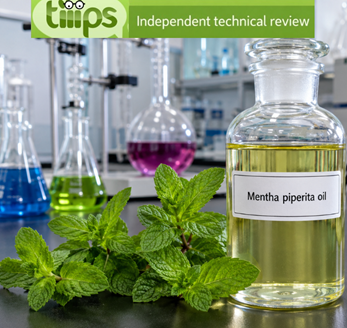
Its main sensory feature is the cooling sensation perceived on the skin and mucous membranes, mainly due to menthol and its interaction with cold sensory receptors. In cosmetics this effect can be useful in oral hygiene products, shampoos, scalp products, cleansers, foot products, refreshing gels and sports formulas. However, the sensation of freshness should not be confused with a therapeutic effect.
Compared with a simple mint extract, the essential oil is more concentrated in volatile compounds and requires more cautious assessment regarding irritation, sensitization, use on sensitive areas, children’s products, lip products and products intended for mucous membranes or the eye contour.
Production process
Mentha piperita oil is mainly obtained by steam distillation of the aerial parts of the plant, often leaves and flowering tops. Steam passes through the plant material, carries the volatile fraction and, after condensation, allows the essential oil to be separated from the aqueous phase.
After distillation, rectification, filtration, standardization and analytical control may follow. Some commercial grades may be rectified to modify the olfactory profile or the content of specific components. Quality is assessed mainly through GC-MS, menthol/menthone profile, pulegone and menthofuran content, odor, color, peroxides, residues, adulteration and compliance with the supplier’s standard.
A good-quality oil should not be assessed only by fragrance: purity, botanical traceability, absence of adulteration, controlled content of problematic components and adequate cosmetic documentation are also essential.
Main compounds present
The main components of peppermint essential oil are:
menthol, responsible for the fresh and mentholated effect;
menthone, important for the typical aromatic note;
isomenthone;
menthyl acetate, sweeter and rounder;
menthofuran, to be controlled for its toxicological profile;
1,8-cineole, with a fresh and balsamic note;
limonene, an odorant terpene and allergen to be declared above threshold;
pulegone, a critical component to monitor;
β-caryophyllene and other minor terpenes.
According to the CIR review, the main constituents of the oil may include menthol within a broad range, menthone, isomenthone, menthyl acetate, menthofuran and 1,8-cineole; pulegone content may vary and must be carefully controlled. For this reason, the quality of the actual batch is more important than a generic description of the oil.
Identification data and specifications
| Characteristic | Value | Note |
|---|---|---|
| INCI name | Mentha Piperita Oil | cosmetic designation |
| Common name | peppermint essential oil / peppermint oil | common designation |
| Botanical name | Mentha piperita / Mentha × piperita | natural hybrid between Mentha aquatica and Mentha spicata |
| Botanical family | Lamiaceae | aromatic family |
| Part used | aerial parts, leaves and/or flowering tops | depends on the entry and supplier |
| Production method | steam distillation | most common method |
| CAS | 8006-90-4 / 84082-70-2 | references reported in Annex III and INCI databases |
| EC | 282-015-4 | reference reported for one of the entries |
| CosIng Ref. | 40077 / related entries for flower/leaf oil | according to INCI/CosIng database |
| Cosmetic functions | fragrance, skin conditioning, flavouring; also masking, refreshing, tonic depending on database | depends on the entry consulted |
| EU restriction | Annex III, entry 361 | label declaration above threshold |
| Leave-on threshold | 0.001% | mandatory indication above threshold |
| Rinse-off threshold | 0.01% | mandatory indication above threshold |
| Food use | flavouring in specific contexts | non-nutritional |
Indicative physicochemical and compositional properties
| Characteristic | Indicative value | Note |
|---|---|---|
| Appearance | mobile liquid | typical of essential oils |
| Color | colorless to pale yellow | may vary with batch and oxidation |
| Odor | mentholated, fresh, herbaceous, balsamic | characteristic of peppermint |
| Water solubility | very low / insoluble | requires solubilizers or a suitable phase |
| Solubility in alcohol | good | useful in perfumery and flavourings |
| Volatility | high | volatile odorant component |
| Menthol | about 30-55% according to CIR data; other standards may require specific values | characteristic component |
| Menthone | about 14-32% according to CIR data | important aromatic component |
| Menthyl acetate | about 2.8-10% according to CIR data | sweeter note |
| Menthofuran | about 1-9% according to CIR data | component to control |
| 1,8-cineole | about 3.5-14% according to CIR data | balsamic note |
| Pulegone | from traces to variable percentages | critical component to monitor |
| Main technical risk | irritation, sensitization, oxidation, pulegone/menthofuran | depends on grade and formula |
Food
In the food sector, Mentha piperita oil may be used as a flavouring, especially in candies, chewing gums, sweets, beverages, baked goods, mentholated preparations and oral hygiene flavourings. Its role is sensory, not nutritional.
It should be distinguished from the use of peppermint leaf in infusions or herbal preparations. The essential oil is much more concentrated and requires food-grade quality, controlled dosages, regulatory compliance and verification of components such as pulegone and menthofuran.
From a nutritional standpoint, the judgment is straightforward: it does not provide nutrients and should not be presented as a health-promoting ingredient. Its value in food is aromatic and technological-sensory.
Cosmetics
In cosmetics, Mentha piperita oil is used mainly as a perfuming ingredient, oral care flavouring, masking agent, refreshing ingredient and skin conditioning component. It may appear in toothpastes, mouthwashes, lip balms, shampoos, scrubs, refreshing gels, foot products, cleansers, body creams, sports products and scalp formulas.
Its main appeal is the sensation of immediate freshness. In hair products it can contribute to the feeling of a fresher and cleaner scalp; in body products it can give a sensory toning effect; in oral hygiene products it is used for aroma, freshness and masking of the base odor.
The central regulatory point is labeling. Regulation (EU) 2023/1545 included Mentha piperita oil in Annex III, entry 361: its presence must be indicated in the ingredient list when it exceeds:
0.001% in leave-on products;
0.01% in rinse-off products.
As of July 19, 2026, the sector is still within the transitional period linked to Regulation (EU) 2023/1545: products not compliant with the new restrictions may be placed on the market until July 31, 2026 and made available on the market until July 31, 2028, under the transitional conditions provided.
Pros
It has a fresh, mentholated and highly recognizable olfactory profile.
It is useful as a perfuming ingredient and flavouring in cosmetics and oral care products.
It can perform a masking function by covering technical odors in the formula.
It gives a sensation of freshness appreciated in shampoos, gels, foot products and sports products.
It is a well-known and well-studied plant raw material.
In hair products it can improve the perception of scalp cleanliness and freshness.
European regulation now provides a clear threshold for mandatory label indication.
Cons
It is not a nutritional food ingredient: its value in food is only aromatic.
In cosmetics it is subject to declaration above threshold as Mentha Piperita Oil.
It can be irritating on sensitive skin, mucous membranes, eye contour or damaged skin.
The cooling sensation may mask irritation or skin discomfort.
It contains components to control, particularly menthol, menthofuran and pulegone.
Composition varies greatly according to botanical origin, harvest, distillation and storage.
It is not automatically suitable for products for small children, the eye contour or mucous membranes without specific assessment.
Like many essential oils, it may oxidize and increase its irritant or sensitizing potential.
Safety, regulatory aspects and environment
From a cosmetic standpoint, Mentha piperita oil should be considered a useful ingredient but one to be handled with caution. The CIR review concludes that Mentha Piperita Oil, extract, leaf and some leaf derivatives are safe in the practices of use and concentration assessed, when formulated to be non-sensitizing. The same review also notes that data were insufficient to conclude safety for some flower/leaf/stem derivatives and meristem cell culture derivatives under cosmetic conditions of use.
The main risk profile concerns irritation, sensitization, cumulative exposure to terpenes/terpenoids and specific components such as pulegone and menthofuran. In the past, CIR had indicated that pulegone should not exceed 1% in the finished product; in the later review, the Panel discussed that this limit was no longer justified in the same way, but still reiterated the need to consider common components shared among multiple botanicals in the same formula.
In Europe, the most practical labeling point is Annex III, entry 361: Mentha Piperita Oil must be declared if it exceeds 0.001% in leave-on products or 0.01% in rinse-off products. In addition, individual allergens present in the oil, such as Limonene and any other regulated components, must be assessed and declared if they exceed their respective thresholds.
From a formulation standpoint, particular caution is needed in:
high-frequency leave-on products;
lip products;
toothpastes and mouthwashes;
products intended for children;
products for sensitive or compromised skin;
eye contour products;
sprays or potentially inhalable products;
formulas with several essential oils sharing terpenes or terpenoids.
For correct use, it is advisable to request from the supplier:
updated SDS;
certificate of analysis;
GC-MS;
data on menthol, menthone, menthofuran, pulegone, limonene and other terpenes;
allergen declaration;
IFRA certificate, if used as a fragrance;
oxidation/peroxide data;
declaration of compliance with the EU Cosmetics Regulation;
indication of botanical origin, plant part, extraction method and commercial grade.
From an environmental standpoint, the oil is of plant origin, but real sustainability depends on cultivation, distillation yield, energy consumption, transport, purity, waste management and product fate. In rinse-off products, release of terpenes and odorant components into wastewater should be considered; in leave-on products, the main issue remains skin exposure and correct labeling.
Conclusion
Mentha piperita oil is a highly recognizable and functional essential oil, useful mainly as a perfuming ingredient, flavouring, masking agent and refreshing ingredient in cosmetics, oral care, hair care and body products. Its main value is sensory: it provides freshness, a mentholated note and a perception of cleanliness.
Professional assessment must avoid two errors: considering it automatically safe because it is natural, or attributing therapeutic effects not demonstrated in the finished product. The critical points are menthol, pulegone, menthofuran, allergens, oxidation, use on sensitive areas and mandatory declaration as Mentha Piperita Oil above the Annex III thresholds.
In a well-designed formula and with complete supplier documentation, it can be a favorable and very useful ingredient. The points to control are GC-MS, purity, oxidation, pulegone/menthofuran content, allergen declaration, IFRA certificate, concentration in the finished product, product category and compliance with the European Cosmetics Regulation.

